
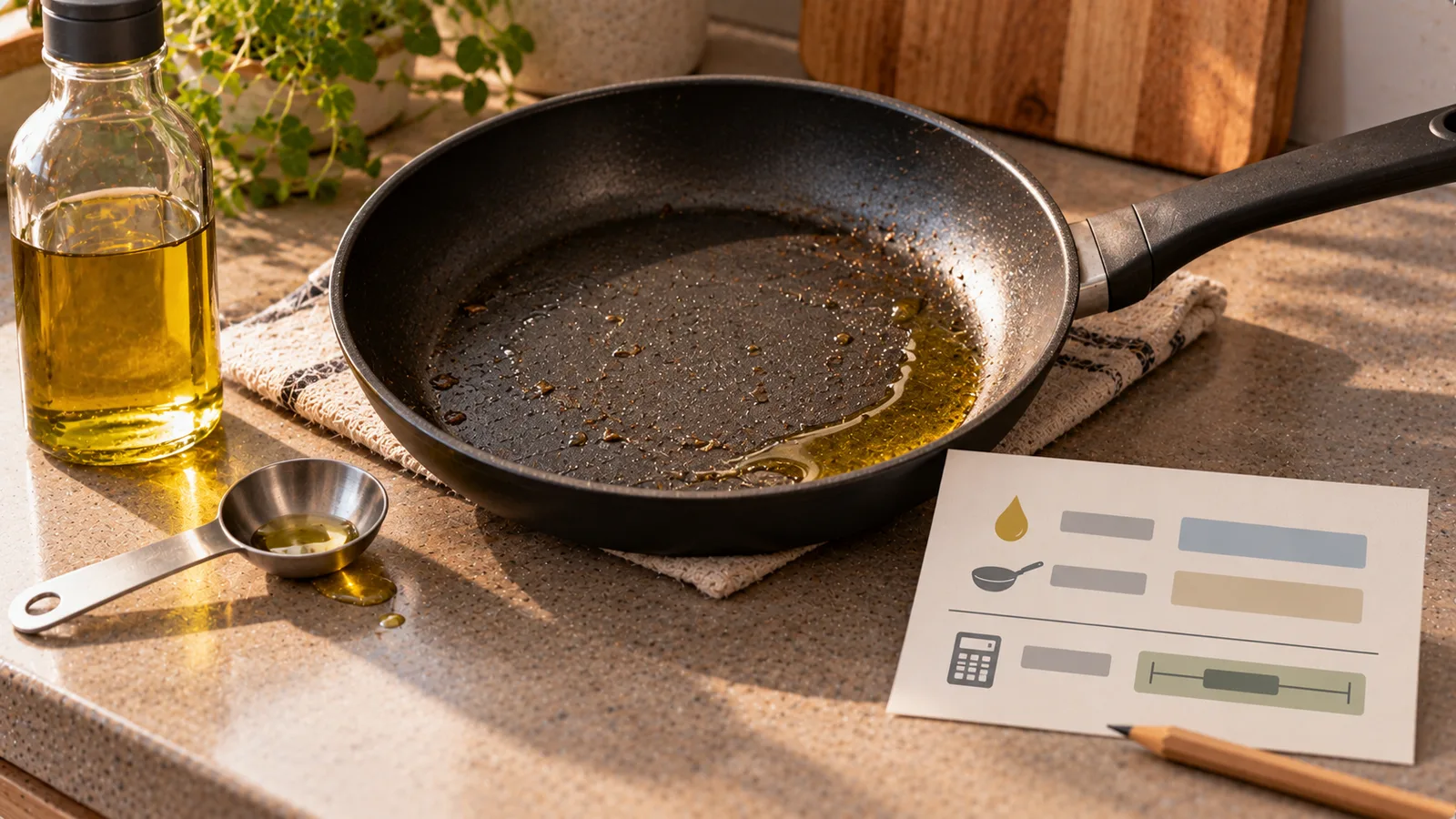
You add 20 g of olive oil to a frying pan, cook your food and then notice that some oil is still sitting in the pan.
Should you log all 20 g?
Or should you subtract the oil that was left behind?
For everyday food tracking, the simplest reliable starting point is to log the oil you intentionally added. If a clearly measurable amount remains in the pan and was not eaten, you can subtract it.
The difficult part is that cooking oil does not behave like a perfectly measurable ingredient. Some remains in the pan, some coats the food, some may be absorbed, and some can be lost with cooking juices or residue.
The goal is therefore not to create an artificially exact number. It is to make a reasonable, repeatable estimate.
The simplest method: log the oil you added
Suppose you add:
15 g olive oil
to the pan.
If you do not measure what remains afterward, log the full 15 g.
This is usually more consistent than guessing that an arbitrary percentage stayed behind.
If your oil contains approximately 9 kcal per gram, 15 g represents roughly:
15 × 9 = 135 kcal
The exact labeled energy may differ slightly, so use the nutrition information for the oil you actually use when available.
When should you subtract leftover oil?
Subtracting oil makes the most sense when a clearly measurable amount remains in the cookware and you know it was not consumed.
For example:
Oil added: 20 g
Oil clearly recovered or measured after cooking: 5 g
Estimated oil consumed with the food:
20 − 5 = 15 g
You would then log approximately 15 g of oil.
The key word is measured.
Simply looking at a shiny pan and deciding that “about half the oil is still there” can introduce more error than logging the original amount.
Best practical method: weigh the oil
If you want a more accurate estimate, weigh the oil as you add it.
Method 1: weigh the bottle
Place the oil bottle on a kitchen scale before pouring.
Suppose it weighs:
742 g
After pouring, it weighs:
724 g
Oil added:
742 − 724 = 18 g
You now know that approximately 18 g entered the pan.
This is usually easier than trying to weigh a hot pan.
Measuring oil left after cooking
If a meaningful pool of oil remains after the food is removed, you can measure it separately.
For example:
Oil added: 18 g
Recoverable oil left in pan: 4 g
Estimated oil associated with the cooked food:
18 − 4 = 14 g
If the meal is eaten by one person, log approximately 14 g.
If it is shared, divide the estimated oil across portions along with the rest of the recipe.
Do not subtract every greasy mark
A thin film of oil left on a pan is difficult to measure accurately.
Trying to calculate every trace can create false precision.
If only a small coating remains, logging the full amount added is often the simpler and more reproducible method.
The difference may be small compared with the uncertainty involved in estimating the residue.
Oil can mix with cooking juices
After cooking meat or vegetables, the liquid left in the pan may contain:
- cooking oil;
- water released from food;
- rendered fat;
- sauces;
- dissolved food solids.
The liquid you see is therefore not necessarily pure added oil.
If 10 g of liquid remains in the pan, that does not mean 10 g of your cooking oil remained.
Subtracting the entire leftover liquid as oil would be incorrect.
Rendered fat makes the calculation harder
Consider cooking meat in 10 g of oil.
During cooking, the meat releases some of its own fat.
At the end, 12 g of oily liquid remains in the pan.
You cannot conclude that none of the added oil was consumed.
The remaining fat may be a mixture of:
- the oil you added;
- fat rendered from the meat;
- water and juices.
In this situation, attempting to isolate the exact amount of added oil can be impractical.
For ordinary tracking, logging the added oil consistently is often the better approach.
What if you pour the pan juices over the food?
If you use the remaining oil or pan juices as part of the meal, there is little reason to subtract them.
For example, if you:
- spoon the oil over the vegetables;
- make a pan sauce;
- pour the juices over rice;
- mop the oil up with bread;
then much more of the added oil may ultimately be consumed.
In that situation, logging the full amount added is usually appropriate.
What if you discard the oil?
If a substantial amount is clearly discarded, subtracting a measured amount can improve the estimate.
Example:
Added oil: 30 g
After cooking, you carefully pour off and weigh 11 g of leftover oily material.
If that material is mostly the original cooking oil, a reasonable estimate is:
30 − 11 = 19 g
But if the leftover liquid contains substantial water or rendered animal fat, the calculation becomes less certain.
Record the result as an estimate rather than an exact measurement.
A practical accuracy hierarchy
For everyday tracking, you can think of oil logging in four levels.
Level 1: easiest
Log all oil added.
This is consistent and requires no extra measurement.
Level 2: better portion measurement
Weigh the amount of oil added, rather than estimating teaspoons or tablespoons.
Level 3: subtract clearly measurable leftover oil
If a meaningful amount of oil remains and can reasonably be measured, subtract it.
Level 4: recipe-level measurement
For recipes where oil matters substantially, calculate the total oil used for the entire dish and divide it among the portions actually eaten.
You usually do not need laboratory-level precision beyond this.
Why tablespoons can be inaccurate
A tablespoon sounds precise, but the amount poured can vary.
Differences can come from:
- spoon size;
- whether the spoon is level;
- oil left on the spoon;
- pouring directly from the bottle;
- estimating by eye.
If cooking oil is important to your calorie estimate, weighing it in grams is generally easier to reproduce.
Example: oil for sautéed vegetables
You cook vegetables with:
12 g olive oil
After cooking, only a thin coating remains in the pan.
You do not measure the residue.
Practical entry:
12 g olive oil
Trying to subtract an estimated 1–2 g based on appearance is unlikely to meaningfully improve accuracy.
Example: visible pool of oil
You fry food using:
25 g oil
After removing the food, a clear pool remains.
You collect and weigh approximately:
8 g
Estimated amount no longer left behind:
25 − 8 = 17 g
Logging about 17 g can be more representative than logging all 25 g.
But this assumes the recovered material is reasonably comparable to the oil you added.
Example: shared dinner
You prepare four servings using:
24 g oil
You decide to log all the oil because the remaining amount is too small to measure reliably.
Oil per serving:
24 ÷ 4 = 6 g
If you eat one serving, log approximately 6 g of oil.
If you eat 1.5 servings:
6 × 1.5 = 9 g
This is usually more useful than trying to estimate oil separately from every individual piece of food.
Unequal portions complicate things
Oil is not always distributed evenly.
One serving may contain more sauce or oil than another.
If portions are visibly different, dividing the oil equally may not be perfect.
But unless you have a practical way to measure the difference, equal division is often a reasonable estimate.
Food tracking does not require pretending that every molecule was distributed equally.
What about frying?
Deep-frying and shallow-frying are more complicated than sautéing.
If you begin with a large amount of frying oil, you should not automatically log the entire amount placed in the pan or fryer.
Much of it remains afterward.
At the same time, weighing the fryer before and after does not perfectly reveal how much oil the food absorbed because:
- food loses water;
- crumbs enter the oil;
- oil can be carried away on utensils;
- some oil remains on surfaces.
For fried foods, a reliable nutrition database entry for the prepared fried food may be more practical than treating all frying oil as a separate ingredient.
What about an oil spray?
Cooking sprays can be difficult to estimate from a stated serving such as a fraction of a second.
If you want better accuracy, weigh the container before and after spraying.
Example:
Can before: 312 g
Can after: 309 g
Difference:
3 g
This gives a more useful estimate than trying to count extremely short sprays.
Check the product label because sprays can contain ingredients other than pure oil.
What if you brush oil onto food?
If you measure 10 g of oil into a bowl and brush it onto vegetables, some may remain:
- in the bowl;
- on the brush;
- on the tray.
You can log all 10 g for simplicity.
If a substantial measurable amount remains, you can subtract it.
Again, consistency matters more than trying to estimate microscopic residue.
Roasting trays and baking sheets
Oil used for roasting can remain on:
- parchment;
- foil;
- baking trays;
- roasting dishes.
If you add 20 g and only a thin coating remains afterward, logging the full amount is a practical approach.
If several grams form a clearly measurable pool that you discard, subtracting that amount can be reasonable.
Does oil evaporate?
Cooking oils do not simply evaporate like water under ordinary cooking conditions.
High heat can cause chemical changes, smoke and some loss, but you should not assume that a large percentage of oil disappeared into the air.
If oil is no longer visibly in the pan, much of it may be on or in the food, mixed with other cooking residues, or transferred elsewhere.
Do not use an arbitrary “evaporation percentage” to reduce your oil entry.
Avoid fixed absorption percentages
You may see rules such as:
> Food absorbs 50% of the oil.
or:
> Always log 75% of the oil used.
These rules are too broad for general use.
Oil retention depends on:
- food type;
- cooking method;
- surface area;
- temperature;
- cooking duration;
- breading;
- amount of oil;
- whether food is drained afterward.
A fixed percentage may create the appearance of accuracy without reflecting the actual meal.
Use a range when uncertainty matters
Sometimes you can establish reasonable upper and lower bounds.
Suppose:
Oil added: 20 g
You can clearly see that at least 3 g remained, but measuring the exact residue is difficult.
A reasonable estimate might place consumed oil somewhere below 20 g and around or above 17 g.
For practical logging, you might choose a consistent estimate within that narrow range rather than pretending to know the exact value.
The purpose of the range is to acknowledge uncertainty, not to create another complicated calculation.
How much difference can oil make?
Oil is energy-dense.
At approximately 9 kcal per gram:
5 g ≈ 45 kcal
10 g ≈ 90 kcal
20 g ≈ 180 kcal
That means large unlogged amounts can meaningfully affect a calorie estimate.
But it does not follow that every tiny film left on cookware must be measured.
Focus on the differences large enough to matter.
When tracking for weight loss
If you are tracking calories for weight management, cooking oils are worth including because they can contribute substantial energy without adding much food volume.
A useful approach is:
- measure the amount added;
- log it consistently;
- subtract only clearly measurable oil that was not consumed;
- avoid changing the method from meal to meal based on guesswork.
Consistency helps you interpret your longer-term intake more reliably.
When tracking macros
Cooking oil is primarily fat.
If you subtract 5 g of oil from the amount consumed, that also changes the estimated fat intake.
Approximately:
5 g oil ≈ 5 g fat
depending on the product.
Do not reduce calories without also keeping the fat entry consistent with the amount of oil you decide to log.
Use the product label when available
Different oils are nutritionally similar in energy density, but your tracker should ideally use the actual product information.
Check:
- serving size;
- grams per serving;
- calories;
- total fat.
If the label gives values per tablespoon but you weigh the oil in grams, use a database entry or label information that supports a gram-based quantity when possible.
Homemade recipes: log the total first
For a recipe, calculate all oil used for the entire batch before dividing portions.
Example:
Vegetables: various ingredients
Oil added: 30 g
You decide that approximately 5 g was clearly left behind and discarded.
Estimated oil in the finished dish:
30 − 5 = 25 g
The recipe produces five portions.
Estimated oil per portion:
25 ÷ 5 = 5 g
This is much easier than attempting to assign oil separately to every vegetable.
If you eat a different fraction of the recipe
Suppose the finished dish contains an estimated 25 g of oil.
You eat 40% of the dish.
Estimated oil consumed:
25 × 0.40 = 10 g
Use the same fraction for the rest of the recipe's nutrition.
Restaurant meals are different
At a restaurant, you usually do not know:
- how much oil was added;
- how much remained in the cookware;
- whether butter was also used;
- whether oil was added after cooking.
Trying to reconstruct exact cooking-oil absorption is rarely possible.
Use a suitable restaurant or prepared-dish estimate rather than pretending you know the kitchen's exact oil quantity.
What if someone else cooked the meal?
If you can ask how much oil was used, that can improve the estimate.
If not, use a reasonable prepared-food entry or estimate based on the dish.
Avoid assigning an exact number of grams of oil when you have no measurement basis.
Repeated meals can be calibrated
If you cook the same dish frequently, you can standardize your method.
For example:
- always use 15 g oil;
- cook in the same pan;
- make four similar portions;
- log the same recipe.
This reduces day-to-day tracking noise.
If you later change the recipe substantially, update the entry.
Do not let oil tracking dominate the meal
The goal of food tracking is useful information, not perfect reconstruction.
Spending several minutes trying to determine whether 0.8 g or 1.4 g of oil remained on a pan is unlikely to improve your dietary decisions.
Measure the major quantities accurately and handle small residual amounts consistently.
A simple decision tree
Did you measure how much oil you added?
If no, estimate it as reasonably as possible and consider weighing it next time.
If yes, use that amount as your starting point.
Is a substantial amount clearly left behind?
If no, log the full amount added.
If yes, continue.
Can the leftover oil reasonably be measured?
If yes, subtract the measured amount.
If no, either log the full amount or use a conservative, repeatable estimate.
Is the remaining liquid mixed with water or rendered fat?
If yes, do not assume the entire leftover liquid equals unused cooking oil.
The practical takeaway
For most home-cooked meals:
Start by logging the cooking oil you actually added.
If a substantial, clearly measurable amount remains in the pan and is discarded, subtracting it can improve your estimate.
If only a thin film remains, or the leftover liquid is mixed with food juices and rendered fat, trying to calculate the exact unused oil often creates false precision.
A good tracking method is:
- weigh oil in grams when practical;
- use the amount added as your baseline;
- subtract only clearly measurable leftovers;
- divide recipe oil across portions;
- keep calories and fat consistent;
- avoid arbitrary absorption percentages;
- use ranges when uncertainty is meaningful;
- apply the same method consistently.
You do not need to know exactly how many molecules of oil reached your plate. You need an estimate that is reasonable enough to make your food diary useful.