
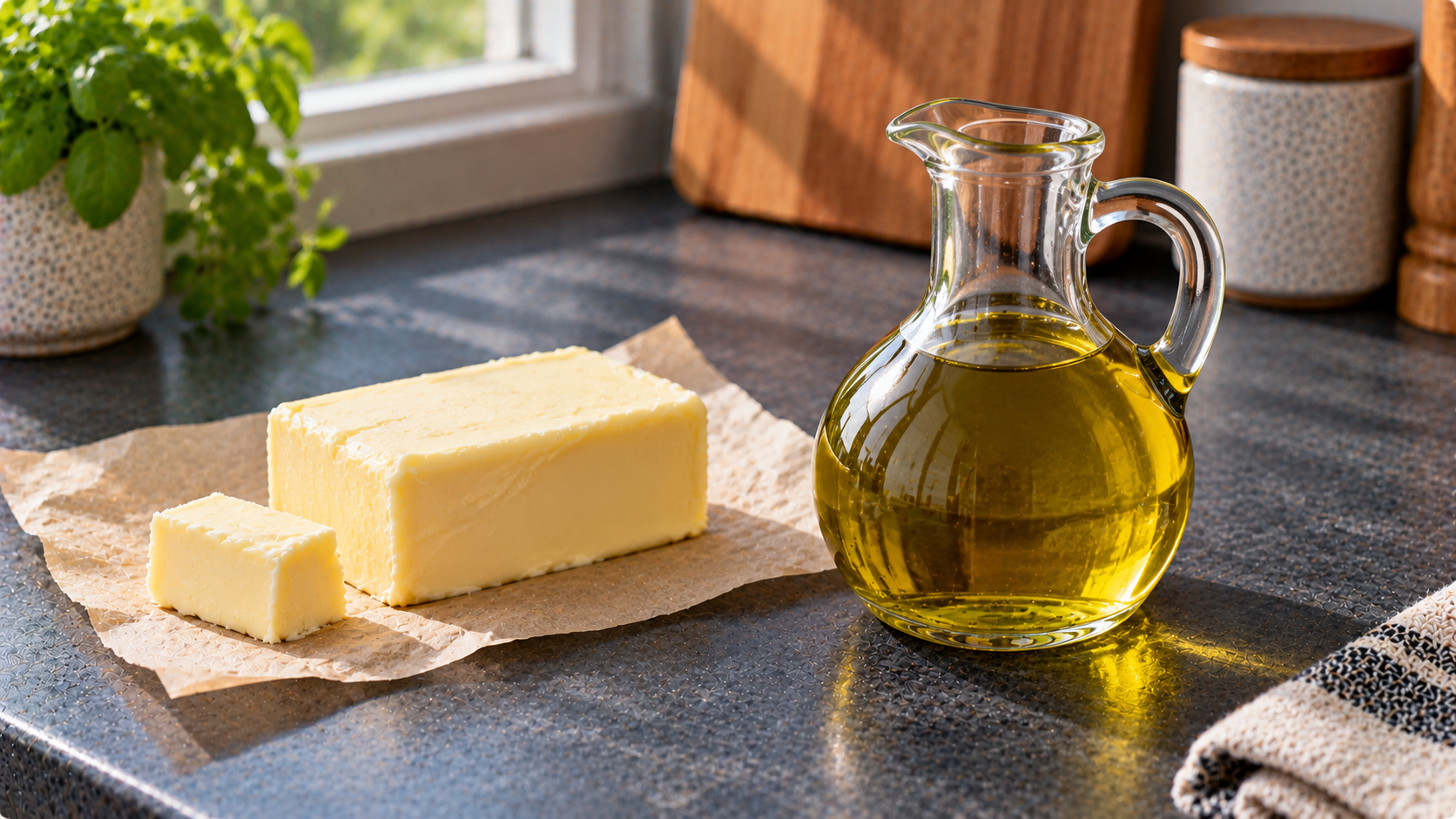
Butter and olive oil can both improve the taste and texture of a meal, yet their nutrition profiles and practical uses differ considerably. The meaningful choice is not simply which one has fewer calories. Compare equal edible weights, the type of fat, how each ingredient behaves in a recipe, and how often it features in the overall diet. Butter contains water and milk solids in addition to fat; olive oil is almost entirely fat. As a result, olive oil generally supplies more calories per 100 g while butter delivers considerably more saturated fat. Neither result means a teaspoon of either food decides whether an entire meal is healthy.
Butter and olive oil: a fair comparison
The table uses typical rounded reference figures per 100 g, not a promise that every brand has exactly the same composition. Butter means conventional dairy butter, rather than light butter, ghee or a mixed spread. Olive oil means pure olive oil, not an oil-based dressing. Salt and moisture content, cultivar and analytical datasets can cause small differences. Check the actual product label for precise numbers.
| Approximate measure | Dairy butter | Olive oil |
|---|---|---|
| Calories per 100 g | 717 kcal | 884 kcal |
| Total fat per 100 g | 81 g | 100 g |
| Saturated fat per 100 g | 51 g | 14 g |
| Monounsaturated fat per 100 g | 21 g | 73 g |
| Polyunsaturated fat per 100 g | 3 g | 11 g |
| Water | Present | Virtually none |
| Cholesterol | Present | None |
| Naturally occurring dairy proteins | Traces | None |
The fatty-acid figures have been rounded independently, so they do not have to sum exactly to the total fat. Some food databases list butter around 717 kcal and olive oil around 884 kcal; different labels may round differently. See USDA FoodData Central. It would be misleading to compare one tablespoon of butter with one tablespoon of oil without stating the corresponding grams.
What happens in a normal serving?
A weighed serving makes the arithmetic straightforward. Ten grams of butter contributes about 72 kcal, whereas 10 g olive oil contributes about 88 kcal. The 16-kcal difference at equal weight is smaller than the energy contributed by an unmeasured extra spoonful. The larger nutritional difference is in saturated fatty acids: approximately 5.1 g in 10 g butter versus 1.4 g in 10 g olive oil.
| Edible amount | Butter, approximate kcal | Olive oil, approximate kcal |
|---|---|---|
| 5 g | 36 | 44 |
| 10 g | 72 | 88 |
| 15 g | 108 | 133 |
| 20 g | 143 | 177 |
| 30 g | 215 | 265 |
The table is based on 717 and 884 kcal per 100 g, rounded to whole calories. A spoon is not a unit of mass: a level spoon of solid butter and a spoon of liquid oil can have different weights. A kitchen scale is particularly useful when the fat is a large part of a recipe. If 20 g oil is poured into a pan but some remains behind, the amount consumed may be less; in a homemade recipe, estimating the retained quantity is better than pretending to know it exactly.
Saturated and unsaturated fats: the key nutritional distinction
Butter has a much larger share of saturated fatty acids. Olive oil is richer in monounsaturated fatty acids, especially oleic acid. The American Heart Association's 2026 dietary guidance recommends choosing sources of unsaturated fats in place of sources of saturated fats within a complete dietary pattern. The German Nutrition Society similarly recommends choosing vegetable oils more often, while limiting saturated-fat-rich foods.
The distinction between these fatty-acid types matters beyond butter and olive oil; see the explanation of saturated and unsaturated fats.
What is replaced matters. Swapping some butter for olive oil changes the fatty-acid composition in a favorable direction. Removing butter while adding refined starch or sweets does not reproduce the same nutritional substitution. The evidence concerns dietary patterns and changes in fat quality over time, not an immediate therapeutic effect from a single meal. Olive oil is also energy dense; using it freely without considering portions can increase energy intake.
Are butter and olive oil equally suitable for high heat?
The answer depends on the product, temperature and duration, not a single universal smoke-point number. Whole butter includes milk solids that can brown and eventually burn. This browning can be desirable for flavor at controlled heat, but a very hot empty pan makes butter scorch quickly. Clarified butter or ghee has had much of its water and milk solids removed, so it behaves differently from regular butter; it is not interchangeable with regular butter in the nutrition table above.
Olive oil can be used for many ordinary stovetop preparations. Its performance depends on whether the oil is extra virgin or refined, oil quality, heat exposure and other conditions. Smoke point alone does not capture every dimension of oxidation and stability. The DGE recommends appropriate heat-stable oils for very high-temperature frying and advises against allowing oil to smoke. In practice, choose a moderate pan temperature, avoid prolonged overheating and follow a specific oil's label when one is supplied.
| Cooking situation | Practical choice | Why |
|---|---|---|
| Salad or cold dressing | Extra-virgin olive oil | Flavor and unsaturated-fat profile |
| Moderate sautéing | Olive oil, with temperature controlled | Convenient cooking fat without milk solids |
| Lightly browning mushrooms | Small measured butter portion, or mixed method | Characteristic taste; avoid scorching |
| Very hot frying | Suitable heat-stable cooking oil | Check refinement and temperature recommendations |
| Pastry depending on solid fat | Butter, if recipe requires it | Solid structure and water content affect texture |
This is not a medical hierarchy of cooking techniques. Keeping cooking fat from smoking and avoiding repeated abusive heating are sensible precautions regardless of the fat chosen.
What extra-virgin, refined, salted and clarified actually mean
Extra-virgin olive oil is obtained through mechanical processes and retains characteristic flavor compounds. Refined olive oil is processed differently, is usually milder, and may perform differently in cooking. Both remain predominately unsaturated-fat foods, although minor components vary. Neither is calorie-free. When a label says “olive oil blend,” inspect the ingredient list to see what it actually contains.
Salted and unsalted butter differ chiefly in sodium and salt content, although products vary in water and fat. Ghee or clarified butter contains a higher concentration of fat than ordinary butter, which generally alters calories per 100 g. A reduced-fat dairy spread is not ordinary butter, and some spreads contain plant oils or other ingredients. Products marketed as “spreadable butter” may be mixtures. Use the brand's declared values and ingredients rather than automatically assigning the standard butter entry.
Is olive oil always the better choice for cholesterol?
If the practical choice is regular butter versus olive oil as a routinely used fat, replacing some butter with olive oil generally improves the saturated-versus-unsaturated fat profile. That matches mainstream cardiovascular dietary advice. But a person’s LDL cholesterol and long-term cardiovascular risk are affected by the full diet, genetics, activity and medical circumstances. An individual serving of oil cannot diagnose, prevent or treat a condition. Avoid claims that olive oil “cleans arteries” or that butter is poisonous. The relevant evidence supports choosing a healthier overall pattern, not dramatic effects from an isolated product.
A useful home adjustment is to cook vegetables and legumes with a modest measured amount of olive oil, while retaining a little butter for recipes in which its flavor or structure is important. If lowering saturated fat is a clinical goal, individualized advice can help account for other sources such as cheese, pastry, meat and coconut-fat products. AHA healthy cooking oils provides the broader replacement principle.
Calories are not the same as nutritional quality
Olive oil's higher calories per 100 g arise because it contains essentially no water, whereas butter does. This does not make butter the automatically preferred food during weight loss. A 10 g butter portion has fewer calories, but its saturated fat is much higher. The balance depends on how much is eaten, the rest of the menu and the person's goals. Conversely, choosing olive oil does not mean the calories disappear because the fat is unsaturated. Both should be measured when accurate energy tracking is important.
If some oil stays in the pan, the amount poured need not equal the amount eaten; the guide to logging leftover cooking oil explains practical estimates.
A common mistake is logging a 250 g tray of vegetables with 20 g olive oil as plain vegetables. If the vegetables contain 100 kcal and 20 g oil is fully consumed, the oil adds roughly 177 kcal; the complete dish has about 277 kcal before further ingredients. Replacing the 20 g oil with 20 g butter gives about 243 kcal but changes the fat composition. These are ingredient arithmetic examples, not matched sensory or clinical trials.
Three realistic cooking decisions
Breakfast toast. A measured 8–10 g butter layer can provide the familiar dairy taste. If this is an occasional choice, consider the diet as a whole. If a plant-oil-based spread is considered instead, compare the actual saturated-fat and ingredient information; not every spread is identical.
Roasted vegetables. For a tray of vegetables, 15 g olive oil contributes about 133 kcal. If shared evenly among three people and all consumed, that is about 44 kcal of oil per person. The vegetables, nuts, cheese and sauces are separate components. An oil spray is not necessarily negligible: total grams still count.
Creamy sauce. Butter can provide flavor and thickening behavior but may supply appreciable saturated fat. Olive oil can work in some sauces, though it will not reproduce the same structure in all emulsions or baked preparations. Using less of either fat and adjusting other ingredients can be more useful than a gram-for-gram exchange where texture matters.
Cost and labels: compare the edible quantity
Butter is commonly sold by weight, while olive oil is frequently sold by volume. Comparing the shelf price of a 250 g butter pack with a 750 ml oil bottle does not tell you the cost of the amount you actually use. For a rough conversion, olive oil density is approximately 0.91 g/ml, though actual values vary with temperature and product. Consequently, 10 g oil corresponds to about 11 ml, not 10 ml. For serious cost comparison, use a common unit, such as price per 100 g or per measured cooking portion, and check the package.
| Example price, explicitly hypothetical | Pack | Approximate cost of 10 g |
|---|---|---|
| Butter at €2.50 | 250 g | €0.10 |
| Olive oil at €8.00 | 750 ml (about 683 g) | €0.12 |
These prices are illustrative arithmetic, not verified current supermarket prices. Fat quality and culinary function are still more consequential than a small difference per portion. In the EU, consult the nutrition declaration and ingredient list rather than relying on broad front-of-pack claims. See Regulation 1169/2011.
A practical decision guide
Choose olive oil more often when you want a liquid cooking fat or dressing and aim to replace saturated fat with unsaturated fat. Choose a small amount of butter when its flavor or physical role is important, rather than treating it as the default for every pan. Use an appropriately heat-stable product for very high-temperature cooking. Weigh the amount actually consumed, and keep the whole diet in view. There is no universal rule that one of these ingredients must be excluded from every balanced eating pattern.
Sources and interpretation
- USDA FoodData Central — food composition database
- American Heart Association — 2026 dietary guidance
- American Heart Association — healthy cooking oils
- German Nutrition Society (DGE) — choose vegetable oils
- European Union — Regulation 1169/2011 on food information
Nutrition figures are typical rounded reference values. Cooking conditions and branded foods may differ; this is general nutrition information, not individualized medical advice.