
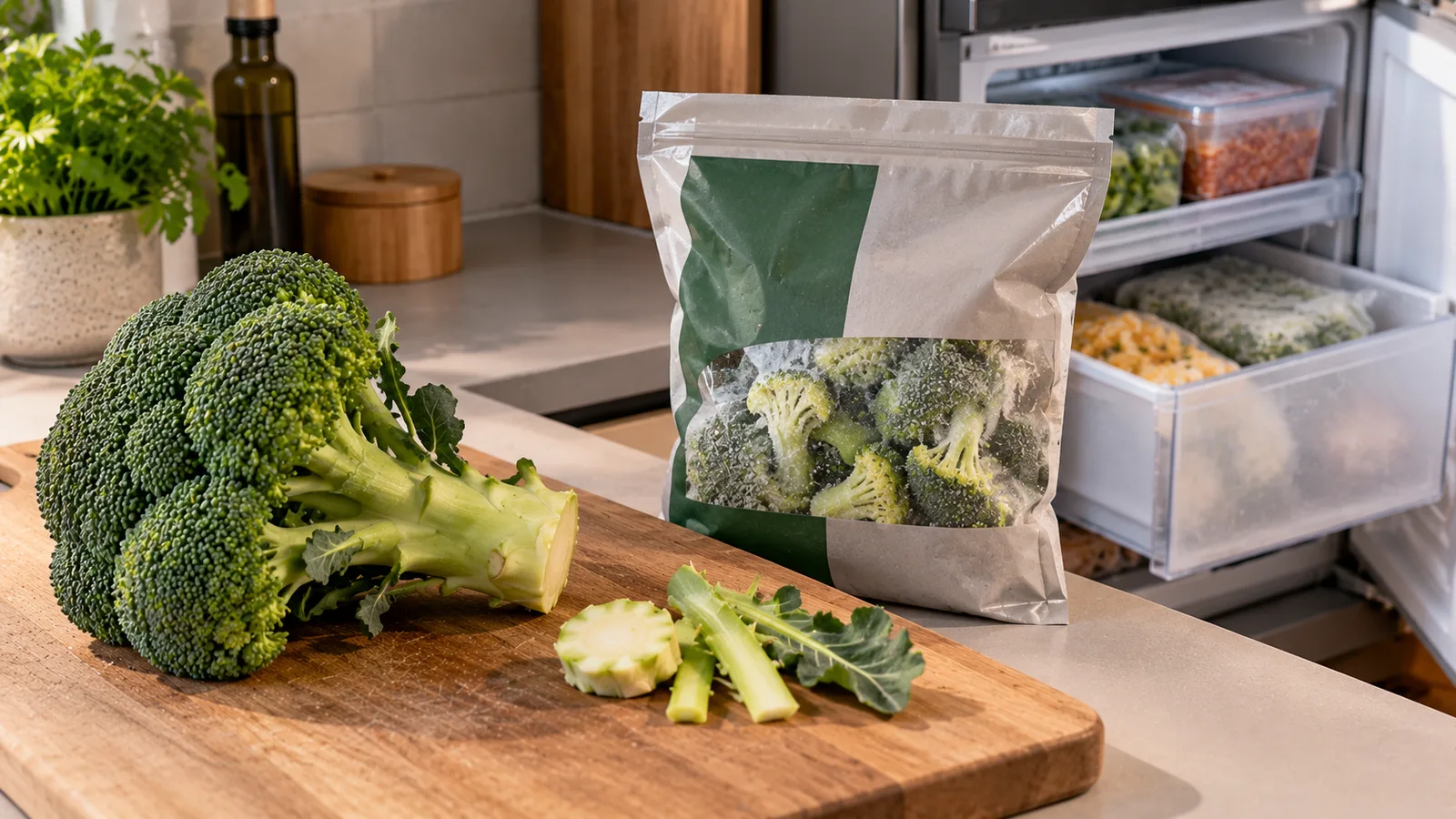
Frozen food is not automatically cheaper than fresh food, and fresh food is not automatically better value.
The price printed on the shelf tells you what the package costs. It does not always tell you what the food you actually eat costs.
A useful comparison considers:
- purchase price;
- package weight;
- edible or usable weight;
- trimming and preparation losses;
- food that may spoil before you use it;
- the amount you actually need;
- freezer space.
The central calculation is simple:
edible cost = purchase price ÷ edible quantity
This lets you compare products on the amount that can realistically become meals.
Shelf price and edible cost are different
Suppose fresh broccoli costs:
€2.40 for 500 g
At first glance:
€2.40 ÷ 0.5 kg = €4.80/kg
But imagine that after trimming, you use 400 g.
The edible cost becomes:
€2.40 ÷ 0.4 kg = €6.00/kg edible food
Now compare a 750 g bag of frozen broccoli for €3.90.
If the entire 750 g is usable:
€3.90 ÷ 0.75 kg = €5.20/kg usable food
The fresh broccoli had the lower shelf price per kilogram, but the frozen broccoli has the lower cost per usable kilogram in this example.
That does not mean frozen broccoli will always be cheaper. It shows why the comparison depends on usable yield.
Calculate edible yield
Edible yield is the proportion of the purchased weight that you actually use.
Formula:
edible yield = edible weight ÷ purchased weight
If you buy 1 kg of a food and use 800 g:
800 g ÷ 1,000 g = 0.80
The edible yield is:
80%
You can then calculate edible cost directly:
purchase price ÷ edible weight
or adjust the price per kilogram:
purchase price per kg ÷ edible yield
For example:
- price: €4.00/kg;
- edible yield: 80%.
Then:
€4.00 ÷ 0.80 = €5.00/kg edible food
Do not assume every trimmed part is waste
Edible yield depends on how you cook.
Broccoli stems can be eaten.
Carrot skins do not necessarily need to be removed.
Some vegetable leaves, stems and other parts may be usable depending on the food and recipe.
If you normally use them, they belong in your edible quantity.
Your calculation should reflect your kitchen rather than an arbitrary trimming percentage.
Spoilage changes the effective cost
Fresh food may have a high edible yield immediately after purchase but a lower effective yield if some of it spoils.
Suppose you buy:
1 kg of fresh berries for €8
You eventually eat 750 g and discard 250 g because they spoil.
Effective cost:
€8 ÷ 0.75 kg = €10.67/kg actually eaten
Now suppose a 1 kg frozen bag costs €9 and you eventually use the whole bag.
Effective cost:
€9 ÷ 1 kg = €9/kg eaten
The frozen product is more expensive at checkout but cheaper per kilogram actually consumed in this example.
If you normally finish the fresh berries without waste, the result changes.
Your own waste rate matters more than a theoretical one
Avoid assuming that fresh food always creates waste.
A household that plans meals carefully may use almost everything it buys.
For that household, fresh food may be excellent value.
Another household may frequently discard:
- wilted vegetables;
- overripe fruit;
- unused herbs;
- food left after schedule changes.
Frozen food can have a financial advantage when it prevents those recurring losses.
Compare the same usable product
A fair comparison requires comparable products.
For example:
- fresh plain spinach vs frozen plain spinach;
- fresh berries vs unsweetened frozen berries;
- fresh fish fillets vs plain frozen fish fillets.
Be careful when one product includes:
- sauce;
- breading;
- seasoning;
- added water or glaze;
- other ingredients.
A 1 kg package is not necessarily 1 kg of the food you intended to compare.
Read the package description and label.
Example: spinach
Imagine fresh spinach costs:
€2.20 for 300 g
You use 250 g before the remainder becomes unusable.
Effective edible cost:
€2.20 ÷ 0.25 kg = €8.80/kg
Frozen spinach costs:
€2.80 for 600 g
If all 600 g is eventually used:
€2.80 ÷ 0.6 kg = €4.67/kg
For this household, frozen spinach is substantially cheaper per amount actually used.
But if the fresh spinach is completely consumed:
€2.20 ÷ 0.3 kg = €7.33/kg
Frozen still costs less in this particular example, but the difference becomes smaller.
The numbers are illustrative. Actual prices vary by retailer, package and date.
Example: fresh versus frozen berries
Fresh berries:
- package: 400 g;
- price: €4.00;
- eaten: 350 g.
Effective cost:
€4.00 ÷ 0.35 kg = €11.43/kg
Frozen berries:
- package: 750 g;
- price: €6.75;
- eventually used: 750 g.
Effective cost:
€6.75 ÷ 0.75 kg = €9.00/kg
Again, the important number is not simply the package price.
It is the cost of the quantity that becomes food rather than waste.
Example where fresh can win
Frozen is not always the budget choice.
Suppose fresh carrots cost:
€1.20/kg
You use almost the entire kilogram.
Even at a 95% usable yield:
€1.20 ÷ 0.95 = €1.26/kg edible
A 750 g frozen bag might cost €1.80:
€1.80 ÷ 0.75 kg = €2.40/kg
In this example, fresh carrots are clearly cheaper.
The correct answer depends on the food and your actual use.
Cost per portion can be easier to understand
Instead of comparing kilograms, calculate the amount used in a typical meal.
Suppose you normally use 150 g of frozen vegetables.
At an edible cost of €4/kg:
0.15 kg × €4 = €0.60 per portion
If the comparable fresh vegetable costs €5.50/kg after accounting for waste:
0.15 kg × €5.50 = €0.83 per portion
Difference:
€0.23 per portion
If you eat it twice a week, that difference can be evaluated against other factors such as preference, convenience and freezer capacity.
Large frozen bags are not automatically a bargain
A low price per kilogram matters only if you can store and use the product.
Suppose:
- 500 g bag: €2.20;
- 1.5 kg bag: €5.40.
Prices:
500 g: €4.40/kg
1.5 kg: €3.60/kg
The larger bag is cheaper per kilogram.
But buying it may be a poor decision if:
- your freezer is already full;
- the bag prevents you from storing more useful foods;
- you do not eat the product often;
- you need the cash for other groceries.
Unit price is one part of the decision, not the entire decision.
Freezer space has economic value
Freezer capacity is limited.
Using half a freezer drawer for a low-value bulky product can prevent you from storing:
- discounted protein foods;
- batch-cooked meals;
- bread;
- leftovers;
- ingredients bought in useful larger quantities.
This does not require assigning an exact euro value to every litre of freezer space.
Instead, ask:
Is this product worth the space it occupies compared with what I usually freeze?
Think in portions, not only package size
A freezer inventory becomes easier to manage when food is translated into usable portions.
For example:
- frozen vegetables: 6 meal portions;
- fish: 4 fillets;
- berries: 5 breakfast portions;
- cooked soup: 3 meals.
This tells you more than knowing that the freezer contains 3.4 kg of food.
When shopping, ask whether the package adds useful future meals or merely adds volume.
Packaging can reduce usable freezer capacity
A product may fit poorly even when its food weight is reasonable.
Bulky cardboard boxes, irregular packages and large bags can occupy more freezer volume than necessary.
Where safe and appropriate, some foods can be stored more efficiently after purchase according to package instructions and food-safety guidance.
Do not remove packaging if doing so would lose necessary preparation, storage, traceability or expiry information unless that information is retained another way.
Avoid buying frozen food that duplicates existing stock
The cheapest frozen product is still an unnecessary expense if you already have enough.
Before shopping, check:
- which frozen vegetables are open;
- how many portions of protein remain;
- whether prepared meals are waiting to be eaten;
- which products should be used first.
A quick freezer inventory can prevent duplicate purchases.
Use price per kilogram carefully
Price per kilogram is useful when products have similar usable yields.
If two bags of plain frozen peas are comparable, unit price is a strong shortcut.
If comparing:
- whole fresh fish with bones;
- frozen boneless fillets,
the raw price per kilogram can be misleading because the edible yields differ.
The same issue occurs with:
- fruit with large pits or peels;
- meat with bones;
- vegetables with substantial trimming;
- shell-on seafood.
A fish example
Suppose whole fresh fish costs:
€8/kg
After removing inedible parts, imagine your usable yield is 55%.
Effective edible cost:
€8 ÷ 0.55 = €14.55/kg edible fish
Frozen boneless fillets cost:
€12/kg
If almost the whole purchased weight is usable, the fillets may be cheaper per edible kilogram despite the higher shelf price.
This is an illustrative calculation. Actual yield depends on the species, cut and preparation.
Check whether frozen seafood has glaze
Some frozen seafood products may have a protective ice glaze.
When comparing prices, check the package information and applicable net-weight information rather than assuming every gram of gross package weight represents edible seafood.
Use the declared product quantity and follow the labeling information for the specific product.
Convenience can affect total food spending
Frozen ingredients can sometimes reduce spending indirectly because they are available when plans change.
For example, having:
- frozen vegetables;
- frozen fish;
- frozen bread;
- prepared portions of homemade food
may make it easier to assemble a meal without an extra shop or takeaway order.
This does not make every frozen purchase economical.
The value comes from buying foods you actually use.
Fresh food can offer the same flexibility when planned well
Fresh food can also be budget-friendly when:
- it is used quickly;
- it is incorporated into several planned meals;
- leftovers are managed well;
- appropriate items are frozen before they spoil.
The comparison should not become a rule that one format is always superior.
Calculate the break-even waste rate
You can estimate how much fresh food could be lost before frozen becomes cheaper.
Suppose:
- fresh food costs €4/kg;
- frozen food costs €5/kg;
- frozen food is fully usable.
Let the usable proportion of fresh food be Y.
The fresh edible cost is:
€4 ÷ Y
Set that equal to the frozen cost:
€4 ÷ Y = €5
Therefore:
Y = 0.80
So fresh food remains cheaper while at least 80% is used.
If more than 20% is lost, frozen becomes cheaper under these simplified assumptions.
This calculation is particularly useful for foods you regularly fail to finish.
A simple comparison table
| Factor | Fresh | Frozen |
|---|---|---|
| Shelf price | Check actual price | Check actual price |
| Edible yield | May require trimming | Often high for prepared plain products |
| Spoilage risk | Can be significant | Usually lower while properly frozen |
| Portion flexibility | Depends on product | Often easy to remove only what is needed |
| Storage | Refrigerator/counter | Requires freezer capacity |
| Large-pack value | Depends on use rate | Can be good if space and demand exist |
| Waste | Depends heavily on household | Often easier to control |
This is a purchasing framework, not a claim that one format is universally better.
A five-step calculation
When fresh and frozen versions are both available:
1. Record the actual price
Use the current shelf price.
2. Record the usable quantity
For fresh food, account for parts you do not use.
For frozen food, check what the declared package weight represents.
3. Estimate realistic household waste
Do not add an imaginary waste percentage if you normally finish the product.
4. Calculate cost per edible kilogram or portion
price ÷ amount actually usable
5. Check storage capacity
Ask whether the package fits your freezer without displacing something more useful.
When frozen food is especially useful for a budget
Frozen options can be financially practical when:
- fresh versions frequently spoil in your household;
- you need small amounts at irregular intervals;
- the frozen product has little preparation waste;
- a larger package will genuinely be used;
- freezer space is available;
- the product helps prevent unplanned convenience purchases.
When fresh may be the better buy
Fresh food may offer better value when:
- its unit price is substantially lower;
- nearly all of it is edible;
- you know you will use it promptly;
- you lack freezer space;
- frozen packages are larger than you need;
- local or seasonal pricing makes fresh food inexpensive.
Do not compare nutrition through price alone
This calculation answers a budget question:
How much does the usable food cost?
It does not determine whether fresh or frozen food is nutritionally superior.
Nutrient content varies by food, processing, storage and preparation. If your decision is specifically about nutritional differences between fresh and frozen vegetables, that is a separate comparison from edible cost.
Build a personal reference list
After several shopping trips, you may notice recurring patterns.
For example:
| Food | Usually better value for you | Reason |
|---|---|---|
| Spinach | Frozen | Fresh often remains unused |
| Carrots | Fresh | Cheap and usually fully eaten |
| Berries | Frozen | Used slowly in small portions |
| Bread | Either | Fresh loaf can be frozen in portions |
| Fish | Compare | Promotions and edible yield vary |
This personal list can be more useful than generic advice because it reflects your prices, storage and waste.
The practical rule
Do not ask only:
Which package is cheaper?
Ask:
How much will the food I actually use cost?
Then consider:
- current purchase price;
- edible quantity;
- realistic spoilage or trimming;
- cost per edible kilogram or portion;
- freezer space;
- likelihood that the entire purchase will eventually be used.
Frozen food can save money when it reduces waste or provides a lower edible cost. Fresh food can be cheaper when its price is low and you use it efficiently.
The better budget choice is the option that gives your household the lower cost for food that actually becomes meals.
Sources
- USDA Economic Research Service, food loss and food availability methodology.
- USDA FoodData Central, food descriptions and preparation-state reference data.
- European Commission, consumer food information and food labeling requirements.
- Verbraucherzentrale, consumer guidance on food storage, shopping and avoiding food waste.