
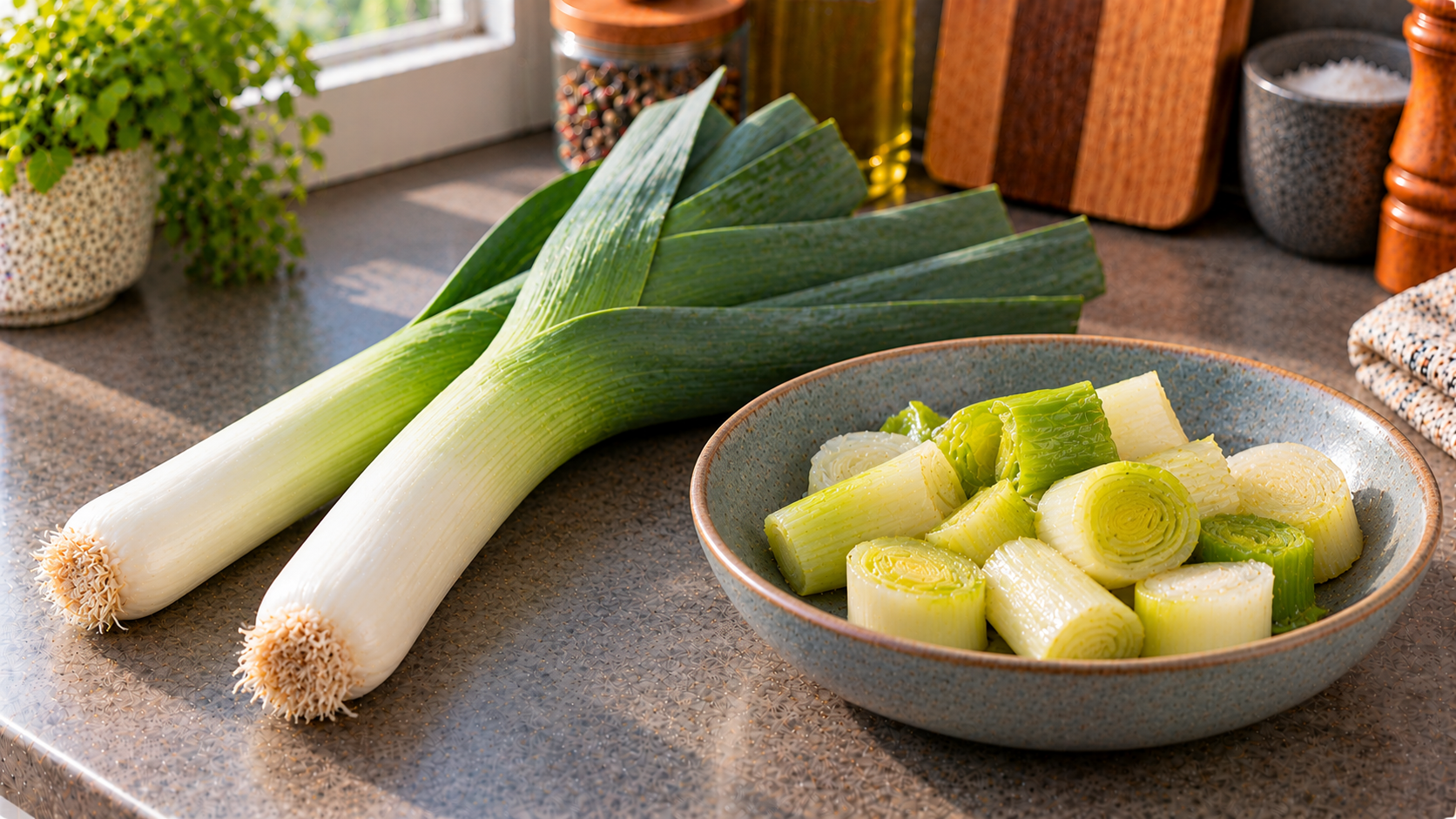
Leeks provide approximately 61 kcal per 100 g raw and 31 kcal per 100 g boiled, drained and prepared without salt in two specific USDA FoodData Central records. The raw entry measures the bulb and lower leaf portion; it does not necessarily describe the entire leafy top. Leeks add a mild onion-like flavour to soup, risotto, pasta and vegetable dishes, while their calories depend on which part is eaten, how it is weighed and what is added during cooking.
Raw and cooked leek nutrition per 100 g
| Nutrient | Raw leek | Boiled, drained leek |
|---|---|---|
| Calories | 61 kcal | 31 kcal |
| Protein | 1.50 g | 0.81 g |
| Carbohydrates | 14.20 g | 7.62 g |
| Total sugars | 3.90 g | 2.11 g |
| Fibre | 1.80 g | 1.00 g |
| Fat | 0.30 g | 0.20 g |
| Water | 83.0 g | 90.8 g |
Sources: USDA raw leek, FDC 169246 and USDA boiled leek without salt, FDC 168426. These are food-composition records for different states, not a controlled experiment showing that boiling always removes half of the calories of a given leek. Water uptake, draining, soluble compounds and the basis on which the sample is measured all matter.
Leek calories by portion and weight
Calculate portions using the relevant per-100-g value. The following figures exclude oil, cream, cheese and other ingredients.
| Edible weight | Raw leek | Boiled, drained leek |
|---|---|---|
| 25 g | 15 kcal | 8 kcal |
| 50 g | 31 kcal | 16 kcal |
| 75 g | 46 kcal | 23 kcal |
| 100 g | 61 kcal | 31 kcal |
| 150 g | 92 kcal | 47 kcal |
| 200 g | 122 kcal | 62 kcal |
| 250 g | 153 kcal | 78 kcal |
Formula: calories = edible grams × reference kcal per 100 g ÷ 100. For example, 180 g of raw trimmed leek corresponds to approximately 110 kcal in this reference. A separately weighed 180 g portion of boiled and drained leek corresponds to approximately 56 kcal. These are not necessarily the before-and-after energy values of the same leek: cooking weight and food composition can change.
How many calories are in one leek or one cup?
Leeks vary substantially in diameter, length and how much of their dark green leaves are retained. One medium leek is not a fixed nutrition unit. USDA's raw reference also lists a cup portion around 89 g, which corresponds to about 54 kcal at 61 kcal per 100 g; how tightly pieces are packed changes a household cup measurement. A scale gives a more reproducible answer.
Trim the roots and any leaves you will discard, rinse out trapped soil, then weigh the edible material. If you use the green tops in stock and later discard them, the consumed amount and nutrient extraction are not equivalent to eating all the leaves.
Why can boiled leeks have fewer calories per 100 g?
The raw reference contains 83% water; the boiled reference contains about 90.8%. A food with more water per unit of finished weight can have fewer calories per 100 g. Nutrients may also move into the cooking water, especially when the water is discarded. That does not establish a universal percentage of calorie loss for every cooking method.
If leeks are simmered directly in soup and the broth is consumed, some dissolved material remains in the meal. A boiled-and-drained reference may be less suitable than ingredient-based recipe accounting for that soup. The best entry matches both the food and its preparation.
Sautéed, roasted and buttered leeks
Plain leeks contribute relatively little fat, but cooking fat can dominate the calorie difference. Consider an illustrative pan containing 200 g of raw trimmed leek and 10 g olive oil. The ingredient calculation is approximately 122 kcal from the leek + 90 kcal from oil = 212 kcal for the entire pan, assuming all oil is eaten. That is not a per-100-g value for the finished sauté: the final weight depends on water loss.
A similar dish prepared with butter, cream or grated cheese requires those ingredients to be counted. Roasting changes moisture and may concentrate calories per 100 g of finished food even with no additional ingredients. Record the whole recipe, then divide by the edible portions actually served.
Leeks in soup, potato-leek soup and quiche
Leek soup can be mostly vegetables and water, or it may include potatoes, stock, butter and cream. There is no single trustworthy calorie value for all leek soups. In potato-leek soup, the potatoes and any dairy affect energy content substantially. Likewise, a leek quiche includes pastry, eggs and often cheese, so the nutrition of raw leek alone tells you little about a slice.
In potato-and-leek soup, the potato, added fat and other ingredients matter alongside the leek; see the leek and potato soup recipe for a complete example.
For homemade dishes, sum the quantities of every ingredient, estimate cooking losses where relevant, then divide the total calories by the number of equal servings or by the weight of each serving. For packaged soup, use its label rather than a generic vegetable database entry.
Leeks, onions and spring onions: are they interchangeable?
Leeks, bulb onions and spring onions belong to the Allium family but differ in edible structure, flavour and nutrient composition. Raw leeks in the specified USDA record supply 61 kcal per 100 g; that value should not automatically be assigned to onions, scallions or wild garlic. Nor should the boiled leek entry be used for raw onion salad.
Leeks' mild flavour makes them useful when a recipe needs bulk as well as an onion-like aroma. Choose the correct ingredient in nutrition tracking, particularly where the leek forms a large part of the dish.
Fibre, carbohydrates and digestion
The raw reference supplies 14.2 g total carbohydrates and 1.8 g fibre per 100 g. USDA's carbohydrate-by-difference convention is not identical to the carbohydrate line on many European labels, which ordinarily excludes fibre. Do not confuse total carbohydrate with sugars: the raw entry lists 3.9 g total sugars per 100 g.
Like onions and garlic, leeks contain fermentable fructans, which can trigger digestive symptoms in people sensitive to them. Cooking softens the vegetable but does not reliably eliminate its fermentable carbohydrates. Portion size and individual tolerance matter. Those following a medically indicated low-FODMAP diet should use appropriate specialist serving guidance rather than treating all cooked leeks as unrestricted.
Vitamins, minerals and meal quality
Leeks can contribute micronutrients and plant compounds within a varied diet, but a normal leek portion is not a concentrated protein source. Exact vitamin levels depend on which leaves are used, the reference entry and cooking method. Water-soluble nutrients can move into cooking liquid. Rather than relying on one vegetable for a particular vitamin, combine different vegetables with adequate protein and other food groups.
Leeks can work well in a weight-management diet because they provide flavour and vegetable volume. They are not a weight-loss treatment. The complete recipe, especially cooking fat and high-energy toppings, matters more than the leek alone.
How to log leeks accurately
- Decide whether the recorded weight is raw, cooked and drained, or part of a complete recipe.
- Weigh only the edible part you actually use or consume.
- Match the entry: 61 kcal per 100 g for the specified raw leek, 31 kcal for the specified boiled-and-drained leek.
- Count oil, butter, cream, pastry, cheese and other components separately.
- If the leek is cooked in a soup whose liquid is consumed, calculate from the recipe rather than switching mechanically between raw and drained reference weights.
Sources and calculation notes
- USDA FoodData Central — leeks, raw, FDC 169246.
- USDA FoodData Central — leeks, cooked, boiled, drained, without salt, FDC 168426.
All serving examples are mathematical calculations from the cited records; real varieties, kitchen trimming and cooking techniques can change the results.