
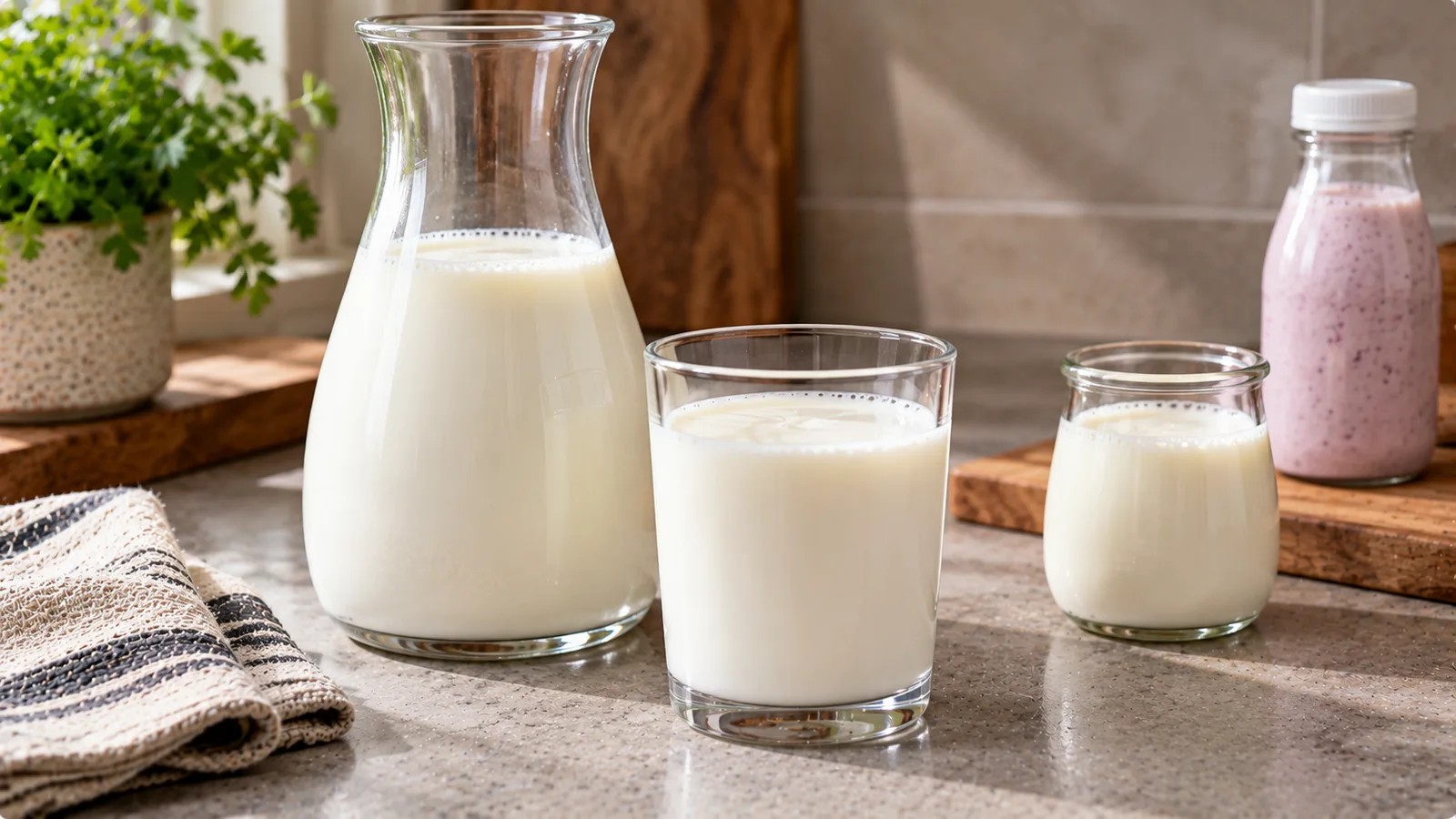
Kefir is a fermented milk drink whose calorie content can vary considerably depending on the milk used, fat percentage and whether sugar, fruit or flavorings have been added.
A plain dairy kefir commonly provides roughly 40–65 kcal per 100 g, but there is no single calorie value that applies to every kefir.
Low-fat products tend to be toward the lower end of the range, while whole-milk and sweetened products can contain more.
The most accurate number for a specific product is always the nutrition label.
Kefir calories at a glance
Representative values for plain dairy kefir can look like this:
| Portion | Approximate calories |
|---|---|
| 100 g | 40–65 kcal |
| 150 g | 60–98 kcal |
| 200 g | 80–130 kcal |
| 250 g | 100–163 kcal |
| 300 g | 120–195 kcal |
These are ranges rather than universal values because kefir products differ.
For accurate tracking, calculate the serving from the calories per 100 g printed on your bottle.
Calories in 100 g of kefir
Plain kefir often contains approximately 40–65 kcal per 100 g.
The main reasons for variation are:
- milk fat percentage;
- carbohydrate content;
- added sugar;
- fruit or flavoring;
- differences between manufacturers.
A low-fat plain kefir might contain around 40–45 kcal per 100 g, while a higher-fat plain product may be closer to 60–65 kcal.
These are examples, not fixed definitions.
Typical macros in plain kefir
A representative plain dairy kefir may provide approximately per 100 g:
- 3–4 g protein
- 4–5 g carbohydrates
- 1–3.5 g fat
The exact values depend on the product.
A kefir made from lower-fat milk usually contains less fat and fewer calories, while protein may remain relatively similar.
Example using 55 kcal per 100 g
To see how serving size changes the total, suppose your kefir label says:
55 kcal per 100 g
Then:
| Amount | Calories |
|---|---|
| 100 g | 55 kcal |
| 150 g | 83 kcal |
| 200 g | 110 kcal |
| 250 g | 138 kcal |
| 300 g | 165 kcal |
| 500 g | 275 kcal |
The calculation is:
portion in grams × calories per 100 g ÷ 100
For 250 g:
250 × 55 ÷ 100 = 137.5 kcal
Rounded, that is about 138 kcal.
How many calories are in a glass of kefir?
There is no standard glass size.
If a glass contains 250 g of kefir and your product has 55 kcal per 100 g:
250 × 55 ÷ 100 = approximately 138 kcal
If another kefir contains 42 kcal per 100 g:
250 × 42 ÷ 100 = 105 kcal
The same volume can therefore have a noticeably different calorie total depending on the product.
Low-fat kefir vs whole-milk kefir
Reducing milk fat generally reduces calorie density because fat provides more energy per gram than protein or carbohydrate.
A simplified comparison might look like this:
| Type | Typical calorie pattern |
|---|---|
| Low-fat plain kefir | Usually lower |
| Standard plain kefir | Moderate |
| Whole-milk kefir | Usually higher |
| Sweetened/flavored kefir | Can be higher depending on added sugar and fat |
Do not rely on the product name alone.
Two products both described as "low fat" or "whole milk" can still have different nutrition values.
Does full-fat kefir have more calories?
Usually, yes, when other factors are similar.
Dietary fat provides approximately 9 kcal per gram, while protein and carbohydrate each provide approximately 4 kcal per gram.
A kefir with more milk fat will therefore generally have more calories than a similar lower-fat kefir.
However, added sugar can change the comparison.
A sweetened low-fat kefir may contain as many or more calories than some unsweetened products with more fat.
Sweetened kefir can be different
Fruit-flavored and sweetened kefir should not automatically be logged using the nutrition values of plain kefir.
Additional carbohydrate from sugar or fruit preparations can raise calories.
For example, if a plain product contains 50 kcal per 100 g while a sweetened product contains 75 kcal per 100 g, a 300 g bottle would provide:
Plain:
300 × 50 ÷ 100 = 150 kcal
Sweetened:
300 × 75 ÷ 100 = 225 kcal
Difference:
75 kcal
That difference comes from the specific formulations, not from fermentation itself.
Protein in kefir
Many plain dairy kefirs provide around 3–4 g of protein per 100 g.
If a product contains 3.4 g protein per 100 g, then a 250 g serving provides:
250 × 3.4 ÷ 100 = 8.5 g protein
A 500 g serving would provide:
500 × 3.4 ÷ 100 = 17 g protein
Again, use the label for the exact product because milk composition and processing differ.
Carbohydrates in kefir
Plain dairy kefir commonly contains roughly 4–5 g carbohydrate per 100 g, although products vary.
Much of this carbohydrate originates from milk.
Fermentation changes the composition of the milk, but it does not mean kefir becomes carbohydrate-free.
Sweetened and flavored products may contain substantially more carbohydrate.
Fat in kefir
The fat content depends strongly on the milk and formulation.
Low-fat kefir may contain around 1 g of fat per 100 g or less, while whole-milk versions can contain approximately 3 g or more.
Because fat is energy-dense, this difference can noticeably affect calories when drinking a large portion.
200 g serving example
Suppose a plain kefir contains per 100 g:
- 55 kcal;
- 3.4 g protein;
- 4.5 g carbohydrate;
- 2.5 g fat.
For 200 g, multiply every value by two:
- 110 kcal
- 6.8 g protein
- 9 g carbohydrate
- 5 g fat
This is why calculating from the package is more accurate than selecting a generic kefir entry in a food database.
250 g serving example
Using the same example product:
55 kcal × 2.5 = approximately 138 kcal
Protein:
3.4 × 2.5 = 8.5 g
Carbohydrate:
4.5 × 2.5 = 11.25 g
Fat:
2.5 × 2.5 = 6.25 g
A 250 g glass would therefore provide approximately:
- 138 kcal
- 8.5 g protein
- 11.3 g carbohydrate
- 6.3 g fat
500 g bottle example
A larger bottle can represent several times the standard 100 g label amount.
With 55 kcal per 100 g:
500 × 55 ÷ 100 = 275 kcal
If you drink the whole bottle, log the entire 500 g rather than one 100 g label unit.
This is a common source of tracking errors with drinks.
Grams vs milliliters
Kefir is often sold by volume, while nutrition databases may use grams.
For everyday estimates, people sometimes treat 1 ml as roughly 1 g for milk-like drinks.
However, grams and milliliters measure different things:
- grams measure mass;
- milliliters measure volume.
The density of kefir is not necessarily exactly 1 g/ml.
When precision matters, follow the serving units provided by the manufacturer or weigh the amount you actually consume.
How to calculate calories from the label
If the bottle lists calories per 100 g, use:
grams consumed × kcal per 100 g ÷ 100
Example:
You drink 320 g of kefir containing 48 kcal per 100 g.
320 × 48 ÷ 100 = 153.6 kcal
Log approximately 154 kcal.
If the label uses 100 ml
If nutrition is listed per 100 ml and you know the volume consumed, use the same structure:
milliliters consumed × kcal per 100 ml ÷ 100
For 300 ml at 52 kcal per 100 ml:
300 × 52 ÷ 100 = 156 kcal
Do not automatically mix a per-100-ml label value with a weight measured in grams unless you have an appropriate conversion.
Kefir vs yogurt
Kefir and yogurt are both fermented dairy foods, but their calorie values cannot be predicted simply from the product category. For a direct comparison of these fermented dairy foods, see Greek yogurt versus kefir.
A low-fat plain kefir can contain fewer calories than a full-fat yogurt.
A sweetened kefir can contain more calories than an unsweetened yogurt.
The most useful comparison is between actual products with comparable serving sizes.
Kefir vs milk
Plain kefir made from milk can have a calorie density in a similar general range to the milk from which it is produced, but fermentation and product formulation can alter the final nutrition.
Added ingredients can create larger differences.
If calories matter for tracking, use the kefir label rather than substituting a generic milk entry.
Is kefir high in calories?
Plain kefir is not usually among the most calorie-dense foods because much of its weight is water.
However, total calories depend on portion size.
A product with 60 kcal per 100 g provides:
- 120 kcal in 200 g;
- 180 kcal in 300 g;
- 300 kcal in 500 g.
A drink that looks relatively light per 100 g can therefore contribute a meaningful amount of energy when consumed in a large bottle.
Does kefir fit a calorie deficit?
Kefir can fit into a calorie deficit if the amount consumed fits the person's overall energy intake.
No individual food determines whether a calorie deficit exists.
A practical approach is to count the actual serving and choose a product based on personal preferences, nutrition goals and total diet.
Does low-fat kefir always make more sense for weight loss?
Not necessarily.
Low-fat kefir generally provides fewer calories per 100 g than a comparable full-fat version, which can make it easier to fit into a lower-calorie intake.
But calorie density is only one consideration.
Taste, satiety, portion size, protein content and the rest of the diet also matter.
A product that works well for one person may not be the most practical option for another.
Plain vs flavored kefir
If you want predictable nutrition, plain kefir is often easier to compare because there are fewer added ingredients.
Flavored products may include:
- sugar;
- fruit preparations;
- syrups;
- starches;
- flavorings.
This does not make every flavored product nutritionally identical.
Check its own label.
How to log kefir accurately
For packaged kefir:
- check whether the label is per 100 g, per 100 ml or per serving;
- note the calories and macros;
- measure how much you actually drink;
- calculate the consumed amount;
- save the specific product if you use it regularly.
If you drink the entire package and the package provides total nutrition, using the package total can be even simpler.
Common logging mistake: using one serving for the whole bottle
Suppose a bottle contains 400 g but the database entry represents 100 g.
If you log only one unit, you record only one quarter of the amount consumed.
At 55 kcal per 100 g:
100 g = 55 kcal
400 g =
400 × 55 ÷ 100 = 220 kcal
Always check what the serving unit actually represents.
Common logging mistake: choosing the wrong kefir
Generic database entries can differ significantly.
One may represent:
- low-fat plain kefir;
while another represents:
- whole-milk kefir;
- sweetened kefir;
- fruit kefir.
If you have the package available, its nutrition label is usually the better basis for your entry.
Homemade kefir
Homemade kefir is harder to estimate precisely because its nutrition depends on:
- the starting milk;
- fermentation conditions;
- any ingredients added afterward;
- the amount consumed.
For practical tracking, the nutrition of the starting milk can provide a reasonable starting point, but the final fermented product is not necessarily identical to the original milk.
If exact nutrient composition is important, a generic estimate has limitations.
Does fermentation remove all the lactose?
No.
Fermentation can reduce lactose because microorganisms use some of it, but kefir should not automatically be treated as lactose-free.
The remaining amount varies by product and fermentation.
People who need to avoid lactose should rely on appropriate product labeling rather than assuming all kefir is lactose-free.
What determines the calorie count most?
For ordinary packaged kefir, the biggest practical factors are usually:
- fat content;
- added sugars or flavorings;
- serving size.
This is why two bottles labeled "kefir" can have noticeably different calorie totals.
Quick calculation table
If your kefir contains 50 kcal per 100 g:
| Amount | Calories |
|---|---|
| 100 g | 50 kcal |
| 150 g | 75 kcal |
| 200 g | 100 kcal |
| 250 g | 125 kcal |
| 300 g | 150 kcal |
| 400 g | 200 kcal |
| 500 g | 250 kcal |
If it contains 60 kcal per 100 g:
| Amount | Calories |
|---|---|
| 100 g | 60 kcal |
| 150 g | 90 kcal |
| 200 g | 120 kcal |
| 250 g | 150 kcal |
| 300 g | 180 kcal |
| 400 g | 240 kcal |
| 500 g | 300 kcal |
The product label determines which calculation applies.
Practical takeaway
Plain dairy kefir commonly falls somewhere around 40–65 kcal per 100 g, but fat content and formulation can move the number outside a simple generic estimate.
Instead of treating "kefir" as one fixed food entry:
- identify the specific product;
- check whether it is plain or sweetened;
- note its fat content;
- use the calories per 100 g or 100 ml from the label;
- measure the amount actually consumed.
That gives a much more reliable calorie and macro estimate than using one universal value for every kefir.
Nutrition data sources and product differences
The records below describe only the named foods, fat levels and preparation states. USDA figures are per 100 g; manufacturer figures retain their stated unit. These sources do not independently prove every approximate figure in the article.
The article’s 55 kcal per 100 g calculation is an illustrative assumption; the cited USDA low-fat plain kefir entry is 43 kcal per 100 g.
USDA FoodData Central (search by FDC ID):
- FDC 170904 — Kefir, lowfat, plain, LIFEWAY (43 kcal/100 g)