
Why a muffin substitution needs a recipe-specific test
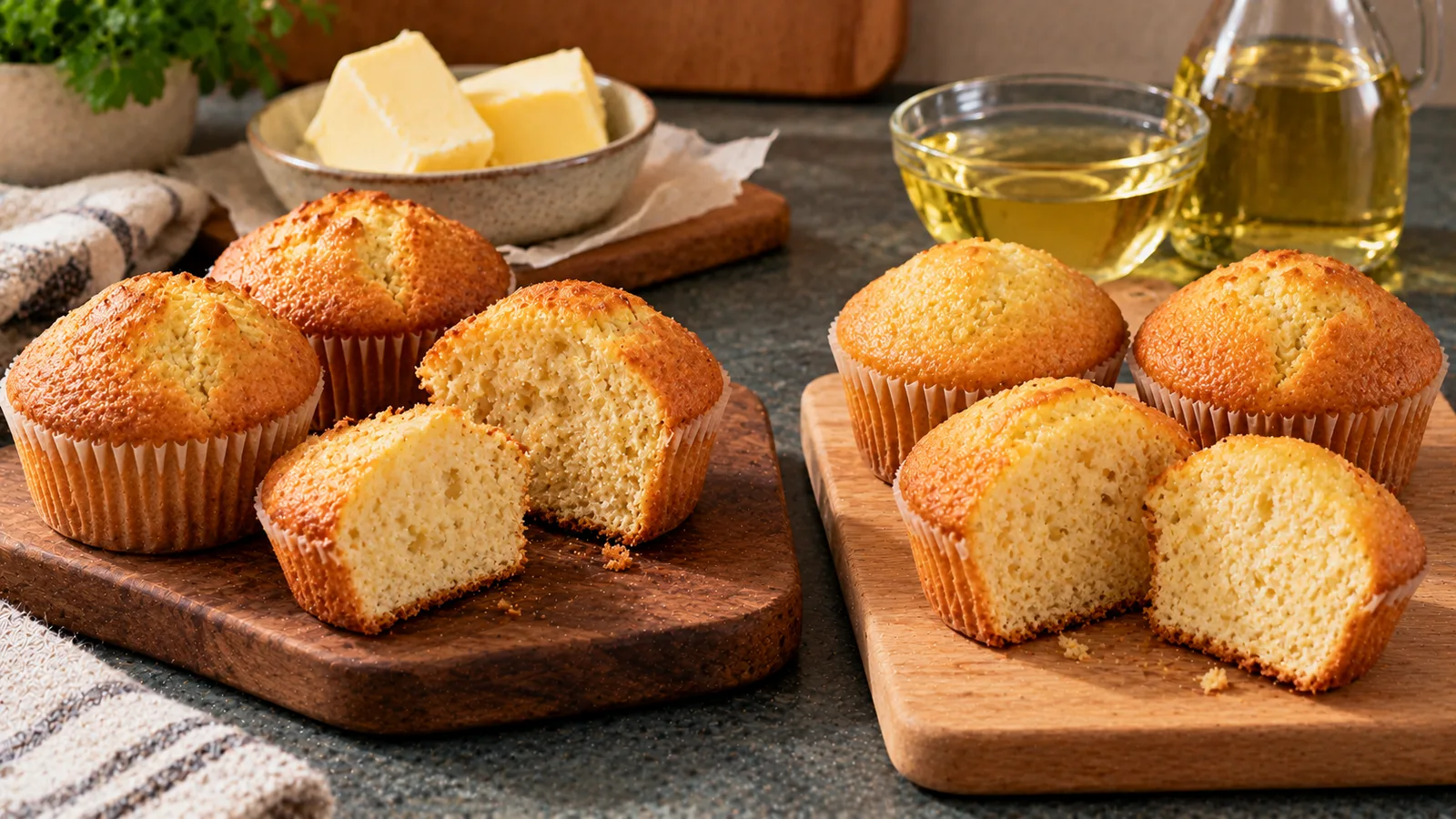
Swapping butter for oil in muffins is a practical baking change, not an exchange of two identical foods. Butter brings water, milk solids and its own flavour; liquid oil is virtually all fat. That can influence how flour hydrates, how air enters the batter and how tender a baked muffin feels after cooling. This guide uses one illustrative 12-muffin formula to show the arithmetic and a fair home comparison. It is not presented as a recipe that has already been baked and experimentally validated. A butter-and-oil comparison elsewhere on the site concerns nutrition and general cooking; here the question is whether one muffin batter can be adapted without losing control of its ingredients.
Butter is not pure fat: calculate grams first
USDA SR Legacy lists unsalted butter at 717 kcal, 81.11 g fat and 16.17 g water per 100 g (FDC 173430). Its reference soybean cooking oil has 884 kcal and 100 g fat per 100 g (FDC 171411). To approximate the fat from 100 g butter, calculate 81.11 g, then start with about 80 g oil and 16–18 g water. This is a starting formulation, not a universal replacement rule; milk solids and butter flavour are not restored by water. Do not equate a cup of melted butter with a cup of oil, because their weights and compositions differ. Measure in grams if possible.
Data note. Figures use an unsalted-butter and soybean-oil reference. Cooking oils and retail butter brands differ; the demonstration is not a nutrition claim about all products or all finished muffins.
| Reference | Energy | Fat |
|---|---|---|
| Butter, 100 g | 717 kcal | 81.11 g |
| Oil, 80 g | 707.2 kcal | 80 g |
| Added water, 16 g | 0 kcal | 0 g |
USDA FoodData Central · Reference values for butter · Reference values for oil.
A controlled twelve-muffin example
For a demonstration batch yielding 12 standard muffins, keep the non-fat ingredients fixed: 240 g plain flour, 110 g sugar, 100 g beaten egg without shell, 150 g milk, 10 g baking powder, and 2 g salt. Version B uses 100 g unsalted butter, melted and cooled if this is a stirred muffin batter. Version O uses 80 g neutral liquid oil plus 16 g water. Vanilla is optional but should be kept identical in both. These are planning quantities, not a claim of an independently tested perfect recipe. Line a 12-cup tin and portion each batter evenly. Since the batches may have slightly different total weight, compare muffins made from equal shares of their own batch rather than forcing the same raw gram weight.
| Ingredient | Butter version | Oil version |
|---|---|---|
| Plain flour | 240 g | 240 g |
| Sugar | 110 g | 110 g |
| Beaten egg (without shell) | 100 g | 100 g |
| Milk | 150 g | 150 g |
| Baking powder | 10 g | 10 g |
| Salt | 2 g | 2 g |
| Unsalted butter | 100 g | — |
| Neutral oil | — | 80 g |
| Extra water | — | 16 g |
Mixing the two batters without changing everything
Mix the flour, baking powder and salt separately. Stir the egg, milk and sugar together, then add either the cooled melted butter or the measured oil and water. Fold wet and dry mixtures together only until no dry flour remains; prolonged mixing can toughen either version. Keep oven temperature, muffin tin, liner type, filling level and baking conditions the same between batches. For a trial, an oven around 180 °C is a reasonable starting setting, with doneness checked rather than a promised exact time. If your original recipe depends on creaming solid butter with sugar, this melted-fat procedure changes the aeration method and is not a like-for-like experiment.
What may change in taste and texture
Oil stays liquid at ordinary room temperatures, while butter fat firms as the muffin cools. An oil-based muffin may therefore feel softer for longer; a butter version may have a more noticeable dairy aroma and a slightly different crumb. King Arthur Baking describes how oil can support tenderness in cakes, but that observation does not guarantee a particular muffin will rise higher or taste better. The type of flour, sugar ratio, eggs, baking powder and handling can matter as much as the fat. Cool both batches on a rack before comparing, and record whether the centre is baked through, whether the crumb tears or crumbles, and how each tastes the following day.
Calories and fat: calculate the actual difference
The fat ingredients in this example contribute 717 kcal from 100 g butter, compared with 707.2 kcal from 80 g oil. The water adds 0 kcal. The change is −9.8 kcal per batch, about −0.8 kcal per muffin if the batch is divided into 12. Total fat changes from approximately 81.11 g to 80 g. This calculation says nothing about the total calories of a finished muffin until the flour, sugar, eggs, milk and any toppings are added. It also does not mean that every plant oil has an identical label value. Use the specific butter and oil labels when available, and recalculate if the quantity changes.
When the substitution needs adjusting
If the mixture seems too stiff, first check that the flour and milk were measured correctly; do not automatically add a large splash of water. If the crumb seems greasy, a smaller amount of oil or a different mixing technique may be preferable. Some bakers replace only part of the butter to preserve flavour: that is a different recipe and needs a separate calorie calculation. Strongly flavoured oils can change a plain vanilla muffin, so a neutral oil is the simplest comparison. For recipes with fruit, nuts, chocolate or yoghurt, the additional ingredients alter moisture and calories; they should not disappear from the log when you record the fat swap.
Baking safely and interpreting your result
Raw flour and raw eggs can carry harmful microorganisms, so do not taste uncooked muffin batter; the CDC advises baking the mixture fully and cleaning utensils and surfaces afterwards. A pale top alone is not proof of a safely cooked centre. Allow muffins to cool, store them appropriately for their ingredients and avoid long periods at room temperature if they contain perishable fillings. For a meaningful baking trial, note the oil type, ingredient masses, oven setting and actual yield. Record the finished weight if comparing calories per 100 g: water loss can make the per-100-g figure diverge even when the batch calories change very little.