
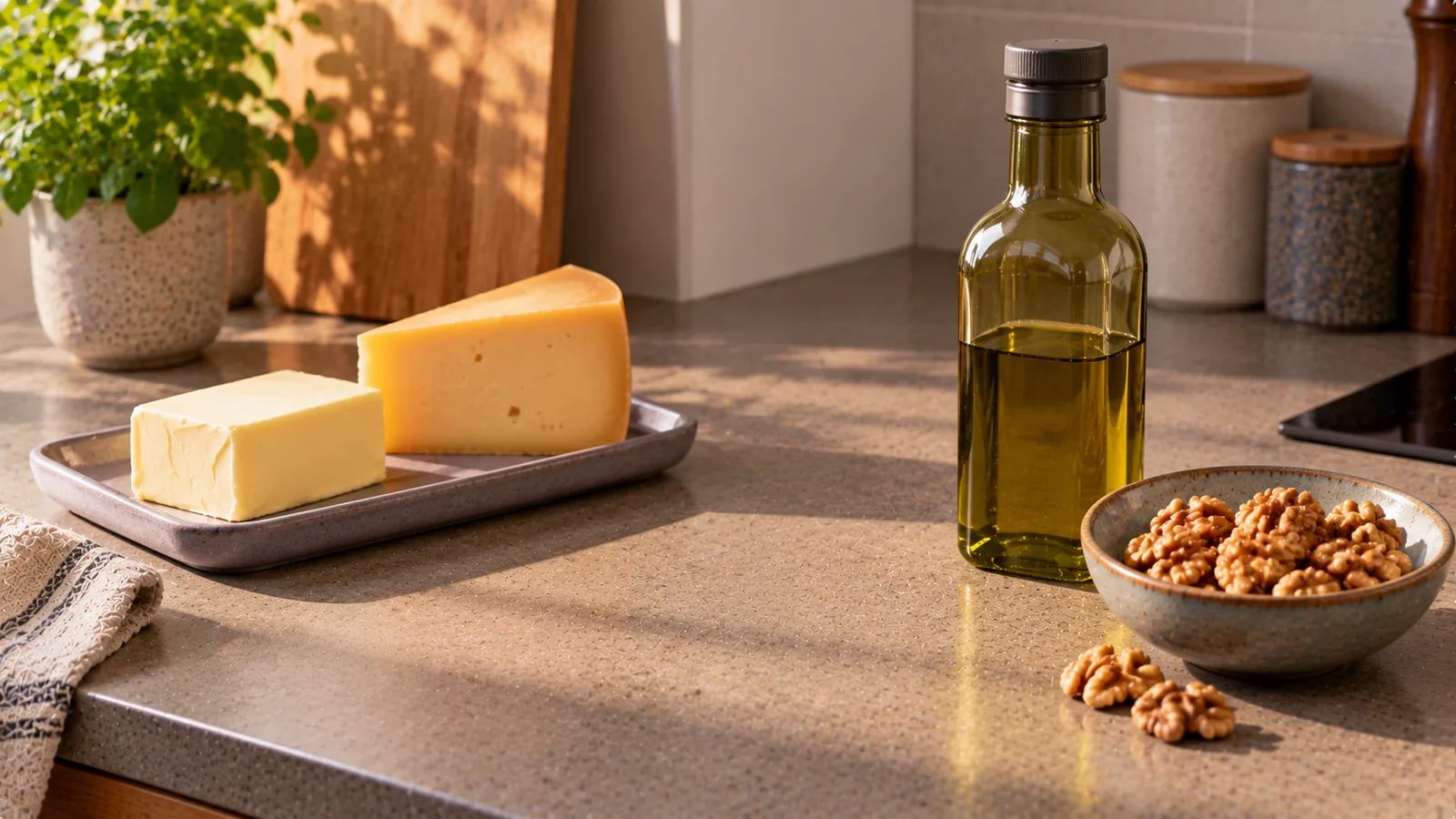
Saturated and unsaturated fats are both dietary fats, but they differ in their chemical structure, common food sources and effects on health.
The practical distinction is not that one category contains calories and the other does not.
Both provide energy.
Fat provides approximately 9 kcal per gram, whether the fat is saturated or unsaturated.
The more important difference is the type of fatty acids making up the fat.
Saturated vs unsaturated fat at a glance
| Saturated fat | Unsaturated fat | |
|---|---|---|
| Chemical structure | No carbon-carbon double bonds | One or more carbon-carbon double bonds |
| Main types | Saturated fatty acids | Monounsaturated and polyunsaturated fats |
| Common sources | Butter, fatty meats, high-fat dairy, coconut and palm oils | Olive oil, nuts, seeds, avocado, many fish |
| State at room temperature | Often solid | Often liquid, although not always |
| Calories | About 9 kcal/g | About 9 kcal/g |
| Role in macro tracking | Part of total fat | Part of total fat |
These are useful general patterns rather than perfect rules.
Foods usually contain a mixture of different fatty acids rather than only one type.
What is saturated fat?
Saturated fatty acids contain no carbon-carbon double bonds.
The term “saturated” refers to the chemical structure: the carbon chain is saturated with hydrogen atoms.
Foods relatively high in saturated fat include:
- butter;
- ghee;
- cream;
- cheese;
- high-fat dairy products;
- fatty cuts of meat;
- processed meats;
- coconut oil;
- palm oil;
- some baked and processed foods.
This does not mean every gram of fat in these foods is saturated.
For example, butter contains both saturated and unsaturated fatty acids, although saturated fat makes up a substantial proportion.
What is unsaturated fat?
Unsaturated fatty acids contain one or more carbon-carbon double bonds.
They are commonly divided into two broad groups:
- monounsaturated fats;
- polyunsaturated fats.
Monounsaturated fat
A monounsaturated fatty acid has one double bond.
Common sources include:
- olive oil;
- rapeseed or canola oil;
- avocados;
- almonds;
- hazelnuts;
- peanuts;
- some other nuts and seeds.
Polyunsaturated fat
A polyunsaturated fatty acid has more than one double bond.
Sources include:
- walnuts;
- sunflower seeds;
- flaxseed;
- chia seeds;
- many vegetable oils;
- fatty fish.
Omega-3 and omega-6 fatty acids are types of polyunsaturated fat.
Does saturated fat have more calories?
No.
A gram of saturated fat does not automatically contain more calories than a gram of unsaturated fat.
For macro calculations, dietary fat is commonly estimated at approximately:
9 kcal per gram
So:
10 g saturated fat ≈ 90 kcal from fat
and:
10 g unsaturated fat ≈ 90 kcal from fat
The nutritional difference is therefore not primarily about calorie density.
It is about fatty-acid composition and what replaces what in the overall diet.
How saturated and unsaturated fats appear on nutrition labels
A nutrition label may show:
Total fat: 15 g
Saturated fat: 5 g
The 5 g of saturated fat is already part of the 15 g total fat.
You should not add them together.
The remaining fat is not necessarily all one specific type. Depending on the labeling system, monounsaturated and polyunsaturated fat may or may not be listed separately.
For macro tracking, the primary fat value is generally the total-fat value.
Example
Suppose a food contains:
- total fat: 20 g;
- saturated fat: 6 g.
If you track macros, you normally log:
20 g fat
not:
26 g fat
The 6 g saturated fat is additional information about the composition of those 20 g.
Saturated fat and LDL cholesterol
One major reason saturated fat is discussed separately is its relationship with blood lipids.
Replacing some saturated fat with unsaturated fat, particularly polyunsaturated fat, can reduce LDL cholesterol.
This is different from simply adding unsaturated fat on top of an unchanged diet.
The replacement matters.
For example, replacing part of the butter in a dietary pattern with an unsaturated-fat source such as olive or rapeseed oil is different from keeping the butter unchanged and simply adding extra oil.
The replacement nutrient matters
Nutrition questions are often more complicated than asking whether one nutrient is “good” or “bad.”
If saturated fat is reduced, something else usually replaces those calories.
Possible replacements include:
- unsaturated fat;
- whole-grain carbohydrate;
- refined carbohydrate;
- protein.
These substitutions do not necessarily have identical effects.
This is why dietary guidance commonly emphasizes replacing saturated fats with unsaturated fats rather than simply removing fat from the diet.
Are all saturated-fat foods nutritionally identical?
No.
Foods should not be evaluated solely from one nutrient.
For example, cheese, butter, chocolate, processed meat and coconut oil can all provide saturated fat, but they have very different overall food matrices and nutrient profiles.
The amount eaten and the broader dietary pattern also matter.
The saturated-fat number is useful information, but it is not a complete description of the food.
Are all unsaturated-fat foods identical?
No.
Olive oil, walnuts, salmon, avocado and sunflower oil can all provide unsaturated fats, but they are nutritionally different foods.
For example:
- nuts can provide fiber and protein;
- fish can provide protein and long-chain omega-3 fatty acids;
- oils are concentrated sources of fat;
- avocado can provide fiber and micronutrients.
The category “unsaturated fat” describes fatty-acid composition, not the entire nutritional quality of a food.
What about trans fat?
Trans fats are unsaturated by chemical structure, but they should not be grouped with the unsaturated fats commonly emphasized as replacements for saturated fat.
Industrially produced trans fats have adverse effects on blood lipids and cardiovascular risk.
They are a distinct nutritional issue.
The simple phrase “unsaturated fat is better” therefore needs context: the beneficial replacement discussion generally refers to cis monounsaturated and polyunsaturated fats, not industrial trans fats.
Why room temperature is only a rough clue
You may hear:
saturated fats are solid at room temperature, unsaturated fats are liquid.
This can be a useful memory aid, but it is not a perfect classification system.
Butter is typically solid and olive oil is liquid, which fits the pattern.
But foods and oils contain mixtures of fatty acids, and physical state also depends on temperature and composition.
Use the label or reliable food-composition data rather than trying to classify every food by appearance.
How these fats fit into your macros
If your daily macro target includes:
70 g total fat
both saturated and unsaturated fats contribute to that 70 g.
For example:
- 15 g saturated fat;
- 25 g monounsaturated fat;
- 20 g polyunsaturated fat;
- 10 g other or unspecified fat.
Total:
70 g fat
You do not add the subcategories again after calculating total fat.
Example day
Consider a day containing:
- eggs;
- yogurt;
- olive oil;
- salmon;
- almonds;
- cheese.
The diet contains a mixture of saturated, monounsaturated and polyunsaturated fatty acids.
It is usually unnecessary to classify every gram manually.
A food-tracking app may calculate saturated fat separately when reliable nutrient data are available.
Your main macro total still uses total fat.
Food sources richer in unsaturated fats
Examples include:
- olive oil;
- rapeseed oil;
- avocado;
- almonds;
- walnuts;
- peanuts;
- seeds;
- oily fish.
These foods can make it easier to replace some sources richer in saturated fat without eliminating dietary fat.
Food sources that can contribute more saturated fat
Common sources include:
- butter;
- cream;
- cheese;
- high-fat dairy;
- fatty meat;
- processed meat;
- coconut oil;
- palm oil;
- pastries and some desserts.
This does not mean these foods must automatically be classified as forbidden.
Frequency, quantity and the overall dietary pattern matter.
What about coconut oil?
Coconut oil is plant-based but contains a high proportion of saturated fatty acids.
This illustrates why “plant fat” and “unsaturated fat” are not synonyms.
Similarly, an animal food is not necessarily composed entirely of saturated fat.
Classify fats by their fatty-acid profile rather than simply by whether the source is plant or animal.
What about fish?
Many fish contain unsaturated fat, and fatty fish can provide long-chain omega-3 fatty acids such as EPA and DHA.
Fish also provides protein.
Its nutritional role therefore cannot be described only by its fat content.
Do you need to track saturated fat every day?
Not everyone needs detailed daily tracking.
For many people, food-pattern choices can be more practical than trying to micromanage every gram.
Examples include:
- using unsaturated oils more often;
- eating nuts and seeds;
- including fish where appropriate;
- choosing a varied diet;
- moderating foods that contribute large amounts of saturated fat.
If your health professional has given you a specific saturated-fat target, follow that individualized guidance.
What if a food database does not show unsaturated fat?
That does not mean the food contains none.
Many databases and labels provide:
- total fat;
- saturated fat;
but do not provide complete values for monounsaturated and polyunsaturated fats.
The missing fields may simply reflect incomplete nutrient data.
Do not calculate “unsaturated fat” by subtraction unless the data source makes clear that all relevant fat categories are accounted for.
Avoid double-counting fat
Suppose an app shows:
Fat: 18 g
Saturated fat: 5 g
Your macro entry is:
18 g total fat
not:
23 g
Saturated fat is a subset of total fat.
The same principle applies if the app also displays monounsaturated or polyunsaturated fat.
Is unsaturated fat unlimited?
No.
Unsaturated fats are still energy-dense.
For example:
30 g oil × 9 kcal/g ≈ 270 kcal
Choosing an unsaturated-fat source does not make its calories disappear.
If total calorie intake matters for your goal, portion size still matters.
Nutritional quality and energy density are separate considerations.
Saturated vs unsaturated fat for weight management
For changes in body weight, overall energy balance remains important.
Replacing saturated fat with unsaturated fat does not automatically reduce calorie intake because both provide approximately 9 kcal per gram.
The reason to distinguish the two is primarily dietary quality and health context, not a difference in calories per gram.
If you replace 20 g of butter-derived fat with 20 g of oil-derived fat, the energy contribution from the fat itself remains broadly similar.
A practical way to think about fat quality
Instead of trying to remove all saturated fat, consider the balance of fat sources across the diet.
For example, you might use:
- olive or rapeseed oil for many meals;
- nuts or seeds as appropriate;
- fish regularly if it fits your diet;
- avocado as one possible fat source;
while still having foods containing saturated fat in reasonable amounts.
The overall pattern matters more than labeling a single meal as perfect or unhealthy.
Common mistakes
Adding saturated fat to total fat
If a label lists 20 g total fat and 6 g saturated fat, the total remains 20 g.
Assuming saturated fat has more calories
Both saturated and unsaturated fat contribute approximately 9 kcal per gram.
Assuming all plant fats are unsaturated
Coconut and palm oils are notable examples of plant fats relatively high in saturated fatty acids.
Assuming all animal fats are saturated
Animal foods usually contain mixtures of fatty acids.
Treating unsaturated fat as calorie-free
Unsaturated fat has the same approximate energy density as other dietary fat.
Looking at one nutrient in isolation
The overall food and dietary pattern provide more information than the saturated-fat number alone.
A simple comparison rule
When comparing two similar foods, ask:
- How much total fat does each contain?
- How much saturated fat does each contain?
- What type of food is providing the fat?
- What would this food replace in my diet?
- How does the choice fit into the overall eating pattern?
This provides more useful context than simply asking which food has “good” or “bad” fat.
The key difference
Saturated and unsaturated fats both belong to your total dietary fat intake and both provide approximately 9 kcal per gram.
Their main difference is their fatty-acid structure.
Unsaturated fats contain one or more carbon-carbon double bonds, while saturated fats do not.
In practical nutrition, replacing some saturated-fat sources with foods richer in unsaturated fats is generally more useful than trying to eliminate all fat or treating every saturated-fat-containing food as forbidden.
For macro tracking, remember the simplest rule:
saturated fat is part of total fat, not an additional macro.