
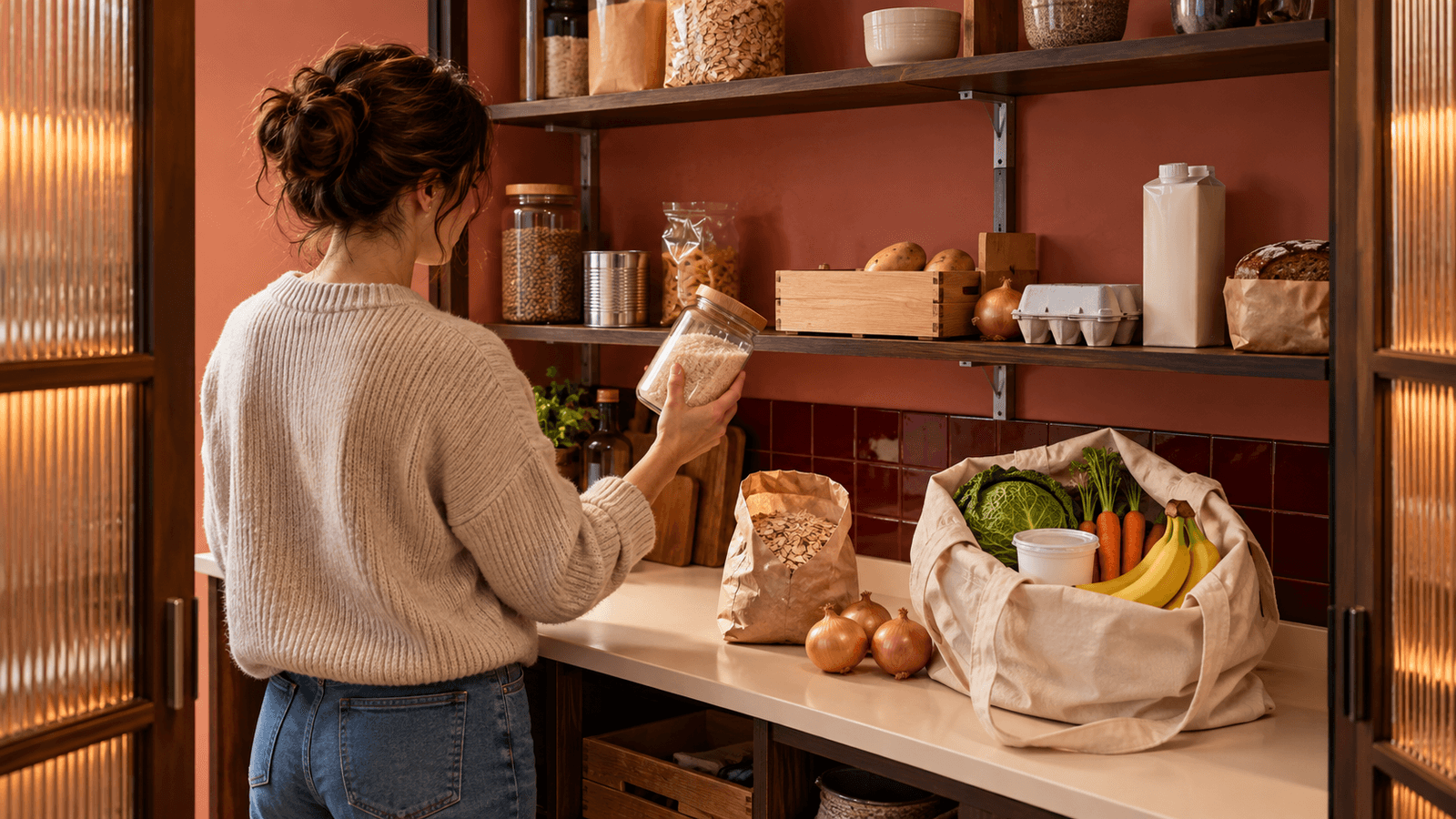
A weekly food budget gives you a practical spending limit for groceries and helps connect meal planning with what you can realistically afford.
It does not need to be a rigid number that never changes.
A useful food budget should help you answer three questions:
- How much can I reasonably spend this week?
- What food do I already have?
- What should I buy to cover the meals I actually plan to eat?
The goal is not simply to spend as little as possible.
It is to use your available money efficiently while buying enough food for your needs.
What is a weekly food budget?
A weekly food budget is the amount of money you plan to spend on food over approximately seven days.
Depending on how you organize your finances, it may include:
- supermarket groceries
- fresh produce
- bread
- meat and fish
- dairy products
- pantry staples
- frozen foods
- snacks
- drinks
You may also choose to include takeaway food, restaurants or workplace lunches, but it is often easier to track those separately.
The important part is consistency.
If one week includes restaurant spending and another does not, comparisons become less useful.
Why use a weekly budget instead of only a monthly budget?
Monthly budgets are useful for understanding overall spending.
Weekly budgets can be easier for day-to-day decisions.
A weekly limit gives you a shorter feedback loop.
If you spend too much early in the week, you can adjust before the month is over.
It also works naturally with weekly meal planning and grocery shopping.
You can still start with a monthly food budget and divide it into weekly amounts.
Just remember that months are longer than exactly four weeks.
A simple monthly total divided by four may therefore underestimate the average weekly allowance.
Step 1: Look at what you currently spend
Before choosing a new target, estimate your current food spending.
Review several recent weeks if possible.
Include the purchases that belong to the category you want to budget.
For example:
- supermarket trips
- small top-up shops
- bakery purchases
- drinks
- snacks
- delivery groceries
Do not worry about creating a perfect historical record.
You are trying to establish a realistic starting point.
If your spending varies substantially, calculate an approximate weekly average.
Step 2: Decide what belongs in your food budget
Define the category before setting the number.
For example, you might decide that your grocery budget includes:
- all food bought for home
- non-alcoholic drinks bought with groceries
But excludes:
- restaurants
- takeaway
- household cleaning products
- toiletries
Another household may choose differently.
Either approach can work.
The important thing is to know what the number represents.
Step 3: Choose a realistic weekly target
Your budget should reflect:
- household size
- local food prices
- dietary needs
- preferred foods
- cooking habits
- how often you eat outside the home
- available storage
- time available for cooking
There is no single correct weekly grocery budget for everyone.
A target that works for one person in one city may be unrealistic for a larger household or another region.
Instead of copying someone else's number, use your actual spending as the starting point.
Then decide whether you want to maintain it or reduce it gradually.
Step 4: Check your kitchen before planning
Before writing a grocery list, check what you already have.
Look in:
- refrigerator
- freezer
- pantry
- cupboards
Pay particular attention to foods that should be used soon.
Examples:
- vegetables beginning to soften
- opened dairy products
- cooked leftovers
- half-used packages
- frozen foods you have forgotten about
Food you already own should influence the next week's plan.
Otherwise you may repeatedly buy duplicates while older food is wasted.
Step 5: Plan the main meals first
You do not need to plan every bite.
Start with the meals that account for most of your spending.
For many households, that means dinners.
Choose meals that:
- fit your schedule
- use some ingredients you already have
- share ingredients where practical
- create useful leftovers
- fit your nutritional preferences
For a broader planning system, see Meal Planning for Beginners.
Step 6: Estimate how many portions you actually need
Overbuying often starts with planning too much food.
Ask:
- How many people will eat each meal?
- Which days will someone eat elsewhere?
- Will leftovers be used for lunch?
- Are there evenings when you will not cook?
- Are any meals already prepared in the freezer?
A seven-day plan does not automatically require seven different dinners.
For example, four cooked meals plus planned leftovers may cover most of the week.
Step 7: Build meals around versatile ingredients
Ingredients that can be used in several meals can make a budget easier to manage.
Examples include:
- potatoes
- rice
- oats
- eggs
- yogurt
- beans
- lentils
- frozen vegetables
- carrots
- onions
- cabbage
- canned tomatoes
- chicken
- tofu
Versatility reduces the risk that a specialized ingredient is used once and then forgotten.
Step 8: Compare cost per useful amount
The cheapest package is not always the best value.
Consider:
- package size
- amount you will actually use
- shelf life
- edible portion
- storage requirements
- whether leftovers can be frozen
A larger package may have a lower price per kilogram but still waste money if part of it is thrown away.
Step 9: Separate staples from flexible purchases
It can help to think of the grocery list in two parts.
Core items
These are foods needed for planned meals.
Flexible items
These might include:
- extra snacks
- premium ingredients
- convenience foods
- optional desserts
- additional drinks
If the estimated total is above budget, flexible purchases are often the easiest place to adjust first.
Step 10: Leave some room in the budget
Using 100% of the budget before you even shop leaves no flexibility.
Prices change.
Something may be unavailable.
You may need an extra ingredient later in the week.
A small buffer makes the plan more realistic.
The exact amount does not need to be fixed.
The principle is simply to avoid planning right to the absolute limit.
Step 11: Make the grocery list from the meal plan
Once meals are selected, translate them into ingredients.
For each meal:
- List the ingredients.
- Remove anything you already have.
- Combine duplicate ingredients.
- Adjust quantities for the number of portions.
- Add breakfast, lunch and snack essentials.
- Check the estimated total.
This creates a grocery list based on actual meals rather than impulse.
See How to Make a Grocery List From Your Meal Plan.
Step 12: Organize the list by store section
A practical grocery list might be grouped into:
- produce
- protein foods
- dairy
- grains and bread
- canned and dry goods
- frozen foods
- other items
This can reduce unnecessary wandering around the store and make it easier to see whether one category is taking too much of the budget.
Step 13: Use unit prices when they are useful
Package price alone can be misleading.
When comparing similar products, unit pricing can help you understand the cost per:
- kilogram
- 100 grams
- liter
- item
But unit price is only useful if you will actually use the quantity purchased.
A cheaper price per kilogram does not save money if the extra food is wasted.
Step 14: Decide where quality matters most to you
A budget does not require choosing the cheapest version of everything.
You may prefer to spend more on certain foods because of:
- taste
- convenience
- animal welfare
- production method
- ingredient quality
- personal preference
That is a budgeting decision.
You can compensate by choosing lower-cost options in categories that matter less to you.
A useful budget reflects priorities rather than treating every product equally.
Step 15: Use lower-cost protein sources strategically
Protein can represent a significant part of grocery spending.
Lower-cost options may include:
- eggs
- lentils
- beans
- chickpeas
- yogurt
- cottage cheese
- tofu
- canned fish
- selected cuts of meat
You do not need to replace every preferred protein source.
Using less expensive options for some meals can reduce the weekly total.
Step 16: Use frozen foods where they make sense
Frozen foods can be useful when:
- fresh produce frequently spoils
- you cook for one person
- you need convenient ingredients
- certain foods are out of season
Frozen vegetables and fruit can be portioned as needed and the rest returned to the freezer.
That can reduce waste.
Step 17: Treat food waste as part of the budget
Food that goes into the bin still cost money.
If you regularly discard food, look for patterns.
Common examples include:
- buying too much fresh produce
- forgetting leftovers
- opening several similar products at once
- cooking too many portions
- buying ingredients for unrealistic meal plans
Reducing waste can lower spending without requiring cheaper food.
For more ideas, see Healthy Eating on a Budget.
Step 18: Plan leftovers deliberately
Leftovers work best when they are intentional.
Before cooking, decide:
- Will this become tomorrow's lunch?
- Can part of it be frozen?
- Can one component be used in another meal?
For example, roasted vegetables may be used with dinner and later added to a grain bowl or omelet.
Cooked chicken may become part of another lunch.
This makes one purchase useful across multiple meals.
Step 19: Keep an emergency meal available
Plans change.
If the alternative to cooking is an expensive last-minute order, keeping one easy backup meal at home can protect the budget.
Examples might include ingredients for:
- pasta with tomato sauce
- eggs and toast
- lentil soup
- rice with frozen vegetables and protein
- a simple bean-based meal
Choose something you actually like and can prepare quickly.
Step 20: Be careful with frequent top-up shops
A large weekly shop is not automatically cheaper.
But frequent unplanned visits can make spending harder to track.
A small purchase for milk can easily turn into several additional items.
If this happens often, note which foods repeatedly run out.
Add them to the next planned shop in more appropriate quantities.
Step 21: Review convenience foods individually
Convenience foods are not automatically bad for a budget.
Sometimes they prevent more expensive alternatives.
For example, a frozen prepared option at home may cost more than cooking from scratch but less than ordering delivery.
Evaluate convenience based on:
- price
- time saved
- likelihood you will actually use it
- what it replaces
The cheapest theoretical meal is not useful if you never have time to prepare it.
Step 22: Track actual spending
After shopping, record what you actually spent.
You can keep this simple.
For example:
- planned budget
- first grocery shop
- later top-up purchases
- total
The purpose is not to account for every cent forever.
It is to learn whether your target matches reality.
Step 23: Compare planned and actual spending
At the end of the week, ask:
- Did I stay near the target?
- Which category cost more than expected?
- What food was left unused?
- What did I buy that was not planned?
- Did I need additional shopping trips?
- Did the meal plan match real life?
This turns the budget into a feedback system.
Step 24: Adjust instead of treating the budget as a pass-or-fail test
If you exceed the target, the budget has still provided useful information.
Perhaps:
- the target was unrealistically low
- prices increased
- you underestimated portions
- you bought more convenience foods
- the week included unusual events
- the meal plan was too ambitious
Use the information to improve the next week.
A simple weekly food budget structure
A practical system can look like this:
1. Set the weekly limit
Choose an amount based on your finances and recent spending.
2. Check existing food
Identify what should be used first.
3. Plan meals
Prioritize the main meals and realistic portions.
4. Create the grocery list
Buy what the plan actually requires.
5. Estimate the cost
Adjust optional items before shopping if necessary.
6. Shop
Compare alternatives where useful.
7. Track additional purchases
Include small shops later in the week.
8. Review
Compare the planned amount with actual spending and food waste.
Then repeat.
Example: adjusting a grocery list that is over budget
Imagine your planned grocery list is more expensive than your weekly target.
Instead of removing random items, review it systematically.
You might:
- replace one expensive protein meal with lentils or eggs
- use frozen vegetables for one recipe
- remove an optional snack
- choose a less expensive fruit
- use pantry rice instead of buying another grain
- plan leftovers for one lunch
- postpone a nonessential specialty ingredient
The goal is to preserve the structure of the week while reducing the total.
Should you buy in bulk?
Bulk buying can reduce unit costs, but only when the food is actually used.
It tends to work best for foods that:
- have a long shelf life
- are eaten regularly
- can be frozen
- are easy to store
Buying a large quantity of something simply because it is discounted is not automatically a saving.
Are supermarket promotions always worth it?
No.
A promotion saves money only if:
- you need the product
- the final price is competitive
- you can use the quantity
- it does not cause additional unnecessary purchases
Compare the actual value rather than the promotional label.
How much should one person spend on groceries per week?
There is no universal amount.
Food prices differ by country, city, store, dietary pattern and personal preference.
Instead of using a generic number, start with your own recent spending and adjust from there.
This gives you a target based on your real situation.
How much should a family spend?
The same principle applies.
Household size matters, but spending does not always increase in a perfectly linear way because some products can be shared and larger packages may reduce unit costs.
Use several weeks of actual household spending to establish a baseline.
Can healthy eating fit a limited budget?
It can, although the practical options depend on local prices and individual dietary needs.
Useful lower-cost staples can include:
- oats
- potatoes
- rice
- beans
- lentils
- eggs
- seasonal vegetables
- frozen vegetables
- selected fruits
- plain dairy products
A healthy budget does not require expensive specialty products.
How Mealisa can help with a weekly food budget
Mealisa can connect meal planning with food costs.
Instead of treating nutrition and spending as separate problems, a meal plan can consider:
- calorie and macro targets
- foods you already have
- preferred meals
- available cooking time
- ingredient reuse
- estimated food prices
- weekly budget
This makes it easier to identify expensive parts of the plan before shopping.
For example, if a proposed week exceeds your target, Mealisa can help adjust ingredients or meals while keeping the overall plan practical.
Weekly budget checklist
Before shopping, check:
- What is my weekly spending limit?
- What food do I already have?
- Which foods should be used soon?
- How many meals do I actually need?
- Which ingredients can be reused?
- Have I included realistic portion quantities?
- Are there unnecessary duplicates?
- Is there room for a small unexpected purchase?
- Do I have a quick backup meal?
- Does the estimated total fit the target?
After the week, check:
- What did I actually spend?
- What did I waste?
- Which unplanned purchases occurred?
- Which meals worked well?
- What should I change next week?
Common mistakes
Setting the budget without checking current spending
An arbitrary target may be unrealistic.
Planning too many different meals
This can increase the number of specialized ingredients required.
Ignoring food already at home
Duplicates increase spending and waste.
Choosing the largest package automatically
A lower unit price is irrelevant if food is discarded.
Forgetting small purchases
Several top-up shops can materially change the weekly total.
Treating all convenience foods as wasteful
Some convenient options can prevent more expensive last-minute choices.
Buying discounted food without a plan
A discount is not a saving if the food is never used.
Making the budget too rigid
A useful budget needs enough flexibility for real life.
Frequently asked questions
Should I budget weekly or monthly for groceries?
Both can work. A monthly budget is useful for overall finances, while a weekly budget can make meal planning and day-to-day spending easier to manage.
Should restaurants be included in the grocery budget?
You can include them, but tracking groceries and eating out separately often makes it easier to understand where money is going.
How can I reduce my grocery budget without eating less?
Focus on food waste, ingredient reuse, lower-cost alternatives, realistic portions, planned leftovers and fewer unplanned purchases.
Is meal planning worth it for budgeting?
It can be very useful because it connects grocery purchases to meals you actually intend to prepare.
Should I always buy the cheapest product?
No. A budget should reflect your priorities. Price is one factor alongside quality, convenience, preference and how much of the product you will actually use.
Are frozen vegetables good for a food budget?
They can be useful because you can use only the amount needed and keep the remainder frozen, which may reduce waste.
What if food prices change?
Adjust the plan. A food budget is a working target, not a permanent fixed number.
The bottom line
A weekly food budget works best when it is connected to real meals rather than treated as an isolated spending limit.
Start with your actual spending.
Define what the budget includes.
Check the food you already have, plan realistic meals, build a grocery list and estimate the cost before shopping.
Then compare your planned spending with what actually happened.
Over time, the goal is not to create a perfect grocery week.
It is to build a repeatable system that helps you eat well, waste less food and keep spending within a range that works for you.
This article provides general nutrition and budgeting information. Individual food needs, prices and financial circumstances vary.