
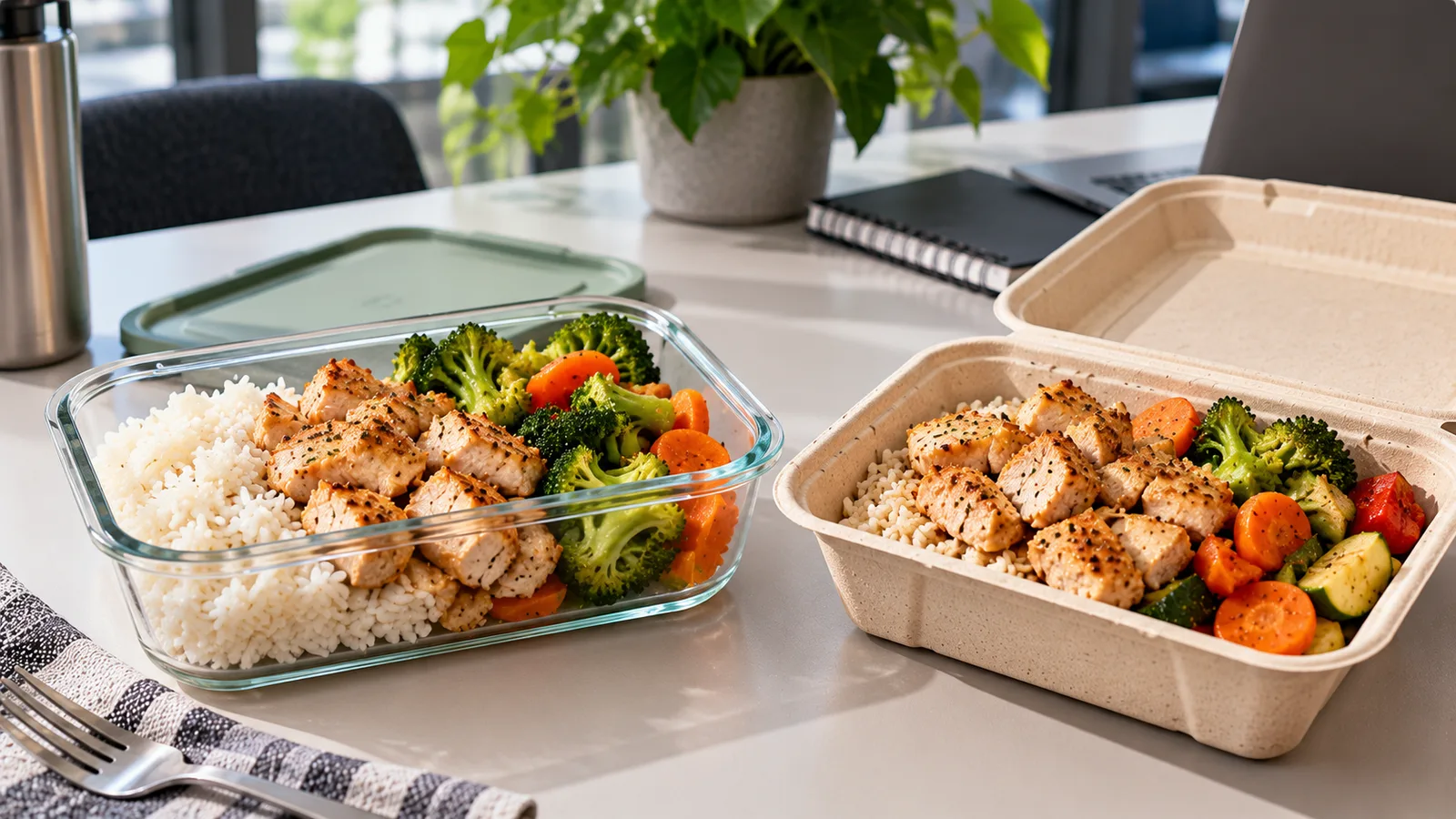
Buying lunch at work is convenient. Packing lunch at home usually takes more planning, but it can reduce spending significantly over a month.
The size of the difference depends on where you live, what you buy, what you pack, and how often you actually go to work.
Rather than assuming that every homemade lunch costs the same or that every purchased lunch is expensive, compare the full cost per meal and multiply it by the number of workdays.
For example, if a purchased lunch costs €11 and a packed lunch costs €4, the difference is €7 per day. Over 20 workdays, that becomes €140.
That is an illustration, not a measured average for Germany, France or any other market.
Monthly cost: packed lunch versus buying lunch
Start with a simple scenario: 20 lunches per month.
| Lunch option | Cost per lunch | Monthly cost for 20 lunches |
|---|---|---|
| Basic packed lunch | €3.00 | €60 |
| More substantial packed lunch | €4.50 | €90 |
| Inexpensive purchased lunch | €7.50 | €150 |
| Mid-priced purchased lunch | €11.00 | €220 |
| Higher-priced purchased lunch | €15.00 | €300 |
These are illustrative prices selected to demonstrate the calculation. They are not current national price averages.
Comparing a €4.50 packed lunch with an €11 purchased lunch gives a difference of €6.50 per workday.
Over 20 days, the potential monthly difference is €130.
The same comparison over 22 workdays produces €143.
Whether those amounts become actual savings depends on what you would otherwise buy and whether your packed lunches cause extra food waste or additional purchases.
The formula for monthly lunch savings
The basic formula is:
Monthly savings = (cost of bought lunch − cost of packed lunch) × number of lunches replaced.
For a mixed routine, calculate each type separately.
Suppose you work 22 days per month but pack lunch on 14 days and buy lunch on eight.
Your packed lunches cost €4 each and bought lunches cost €10 each.
- Packed lunches: 14 × €4 = €56.
- Bought lunches: 8 × €10 = €80.
- Total monthly lunch spending: €136.
If you bought lunch on all 22 days at €10, you would spend €220.
Your mixed routine would therefore cost €84 less in this example.
This calculation assumes the stated per-lunch prices already include relevant ingredients and extras.
How many workdays should you count?
Not every month contains the same number of working days.
A useful planning range for someone working five days per week is roughly 20–23 potential weekday lunches, before accounting for holidays, leave, remote work and other absences.
Use the number of days on which you would actually need lunch outside your normal home routine.
| Difference per lunch | 15 lunches | 20 lunches | 22 lunches |
|---|---|---|---|
| €2 | €30 | €40 | €44 |
| €4 | €60 | €80 | €88 |
| €6 | €90 | €120 | €132 |
| €8 | €120 | €160 | €176 |
| €10 | €150 | €200 | €220 |
A seemingly small daily difference becomes more visible over repeated workdays.
However, if you only commute twice a week, multiplying by 22 days would overstate the possible savings.
What does a packed lunch actually cost?
The price of a homemade lunch is more than the cost of its main ingredient.
Include the food you use, condiments, packaging where applicable and a reasonable share of ingredients that spoil before you eat them.
Consider a homemade chicken-and-rice lunch with vegetables.
| Component | Illustrative cost |
|---|---|
| Chicken portion | €1.50 |
| Rice portion | €0.35 |
| Vegetables | €0.90 |
| Oil, spices and sauce | €0.35 |
| Additional allowance for waste and small extras | €0.40 |
| Estimated packed lunch | €3.50 |
This is a constructed example, not a current supermarket quote.
Your actual cost may be lower or higher depending on ingredient prices, package sizes and portion weight.
Reusable containers have an initial cost. If you buy a €12 container and use it for 60 lunches, the allocated container cost is €0.20 per lunch before considering washing and replacement.
You can include such costs when you want a more complete comparison.
What does buying lunch really cost?
A purchased lunch may include more than the advertised price of the main dish.
For example:
| Purchase | Illustrative cost |
|---|---|
| Main dish | €9.00 |
| Drink | €2.00 |
| Small dessert or snack | €2.50 |
| Total | €13.50 |
If you normally buy only the main dish and drink tap water, do not add extras you never purchase.
Likewise, delivery fees, tips and service charges should be included only when they actually apply.
The goal is to compare your real behavior rather than the most expensive possible version of buying lunch.
Five realistic work-lunch scenarios
Scenario 1: Buying lunch every workday
You spend €10 per lunch over 20 workdays.
Monthly lunch cost: €200.
This is the baseline against which the other scenarios can be compared.
Scenario 2: Packing lunch every workday
Your packed lunch costs €4 per meal.
20 × €4 = €80 per month.
Difference from Scenario 1: €120 less per month.
Scenario 3: Packing lunch three days a week
Across four five-day weeks, you pack 12 lunches and buy eight.
12 × €4 + 8 × €10 = €128.
Difference from buying every day: €72 less.
Scenario 4: Using leftovers
Suppose you regularly cook dinner and deliberately prepare an extra portion.
The lunch portion still has a cost. It is not automatically free simply because the cooking was already happening.
If its incremental ingredient and packaging cost is €3, replacing 12 bought lunches at €10 creates an illustrative difference of:
12 × (€10 − €3) = €84.
This assumes the additional portion would otherwise not have been eaten and that it is stored safely.
Scenario 5: Expensive packed lunches
Not every packed lunch is cheap.
If you pack specialty ingredients, premium protein products and individually packaged snacks, a lunch might cost €8.
Compared with a €10 purchased lunch, the difference is only €2.
Over 20 lunches, that is €40, not €120.
This is why ingredient choices matter more than the label “homemade.”
What about the time needed to prepare lunch?
Time is a real consideration, but it should not automatically be converted into a wage expense.
For someone preparing lunch while already cooking dinner, the additional effort may be limited.
Someone who shops separately, cooks an entirely different dish and washes several extra containers may spend much longer.
You can evaluate the trade-off in two ways:
- Cash spending: compare actual euros spent on food, packaging and other direct costs.
- Time and convenience: consider whether the routine fits your schedule and whether the financial difference justifies the effort for you.
If you assign a monetary value to preparation time, show it separately rather than presenting it as an unavoidable cash expense.
Food waste can change the result
A low planned cost is not the same as a low actual cost.
Suppose you buy €25 of ingredients for five packed lunches, but enough food for one lunch spoils before use.
If the remaining ingredients provide only four lunches, the effective cost becomes €25 ÷ 4 = €6.25 per eaten lunch, not €5.
This example assumes the wasted food has no other use.
To reduce waste, build lunches around overlapping ingredients, check what you already own and buy quantities that match your schedule.
If you will be away from work on Friday, do not automatically prepare five lunches.
Can packed lunches be cheaper without being repetitive?
Yes. The most practical approach is to vary the format while reusing ingredients.
For example:
| Base ingredients | Lunch variation |
|---|---|
| Chicken, vegetables, rice | Rice bowl with yogurt sauce |
| Chicken, vegetables, wraps | Chicken wrap |
| Chickpeas, tomatoes, cucumber | Chickpea salad |
| Chickpeas, vegetables, bread | Hummus sandwich and vegetable side |
| Beans, potatoes, salad | Potato-and-bean bowl |
This is not a fixed nutritional meal plan. Adjust ingredients and portions to your dietary needs.
The financial advantage comes from using ingredients efficiently rather than preparing the same meal every day.
When buying lunch may be the better choice
Packing lunch is not always the most economical or practical option.
Buying may make sense when:
- Your employer provides subsidized meals.
- A cafeteria offers a complete meal at a low price.
- You cannot refrigerate or transport perishable food safely.
- You have a highly unpredictable schedule.
- You would otherwise waste most of the ingredients bought for packed lunches.
- The preparation effort is disproportionate to the potential savings.
For example, if your employer subsidizes a meal to €4.50 and your packed alternative costs €4, the difference is only €0.50.
Across 20 days, the maximum direct difference is €10.
In that case, convenience may reasonably matter more than the small cost gap.
How to track your real lunch spending
For two weeks, record:
- How many lunches you bought.
- How much you spent on each purchase, including actual extras.
- How many lunches you packed.
- What the ingredients and packaging cost.
- Whether any food was wasted.
- How many lunches were replaced rather than added.
Then calculate the average cost for each option.
For purchased lunches:
Average bought-lunch cost = total spent on bought lunches ÷ number bought.
For packed lunches:
Average packed-lunch cost = relevant packed-lunch spending ÷ number actually eaten.
Use those figures to forecast a normal month.
If prices vary widely, a four-week observation period may be more representative.
Does packing lunch automatically save money?
No. The savings depend on the difference between the alternatives you actually choose.
A €7 packed lunch replacing a €6 cafeteria meal increases spending by €1.
A €3.50 packed lunch replacing a €13.50 takeaway lunch reduces spending by €10.
Over 20 replaced lunches, the second example creates a potential €200 difference.
The same behavior—bringing food from home—can therefore produce very different financial outcomes.
Monthly cost versus annual savings
Annualizing a monthly saving can be useful, but avoid assuming that every month has identical workdays and habits.
If you save €100 during each of ten months with regular office attendance, the annual difference is €1,000.
That is different from multiplying by 12 if you take substantial leave, work remotely or receive subsidized meals during other months.
For a realistic estimate, count the months and days on which the substitution actually occurs.
Sources and calculation context
- Eurostat: Food price statistics — background on differences in consumer price levels between countries.
- USDA Food Plans — examples of structured food-cost planning.
- European Commission: Food waste — information on food waste and prevention.
The euro prices in this article are illustrative scenarios rather than quotations from these sources. Replace them with your own receipts and grocery prices for a personal budget.
Bottom line
Packed lunch can be substantially cheaper than buying lunch, but the monthly result depends on the actual cost difference multiplied by the number of lunches replaced.
A €6 daily difference across 20 workdays equals €120. A €2 difference equals €40.
Start with your own prices, account for extras and waste, and choose a routine that saves money without making your workday unnecessarily complicated.