
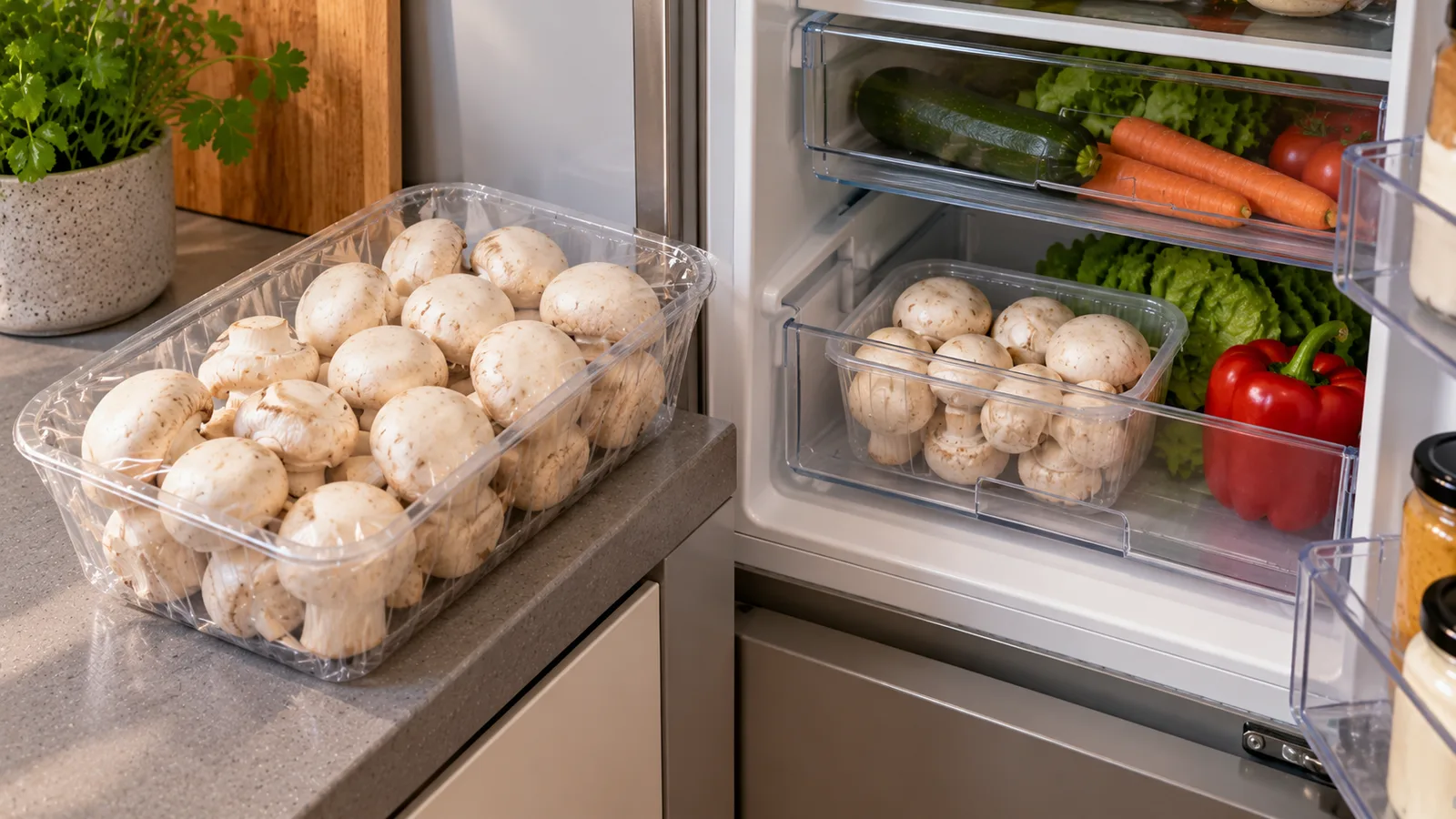
Buying the largest package is often described as an easy way to save money on groceries.
Sometimes it is.
But a lower price per kilogram, litre or item does not automatically mean a lower real cost for your household.
The useful question is:
How much will you pay for the amount you will actually use?
That distinction explains why bulk buying works extremely well for some foods and poorly for others.
The basic rule: compare unit prices first
Package prices are difficult to compare directly when the quantities are different.
Imagine two packs of rice:
| Option | Pack size | Price | Price per kg |
|---|---|---|---|
| Small pack | 500 g | €1.60 | €3.20/kg |
| Large pack | 2 kg | €5.20 | €2.60/kg |
The larger pack costs more at checkout but less per kilogram.
If you eventually use all 2 kg, it saves money compared with repeatedly buying the smaller pack at the same prices.
The calculation is:
Unit price = package price ÷ package quantity
For the large pack:
€5.20 ÷ 2 kg = €2.60/kg
For the small pack:
€1.60 ÷ 0.5 kg = €3.20/kg
The large pack is 60 cents cheaper per kilogram.
Lower unit price does not guarantee lower spending
Now consider fresh spinach:
| Option | Pack size | Price | Unit price |
|---|---|---|---|
| Small | 200 g | €1.80 | €9.00/kg |
| Large | 500 g | €3.50 | €7.00/kg |
The 500 g pack looks like the better deal.
But suppose your household normally eats only 250 g before the rest spoils.
You paid €3.50 to consume 250 g.
Your effective cost for the food actually eaten becomes:
€3.50 ÷ 0.25 kg = €14.00/kg consumed
The smaller pack could therefore have been the cheaper purchase despite its higher shelf unit price.
This is the central principle of bulk buying:
A discount on food you throw away is not a saving.
Calculate the break-even point
You can estimate how much of a larger pack must be used before it becomes cheaper than the smaller option.
Suppose:
- small pack = €4.00 for 500 g;
- large pack = €6.00 for 1 kg.
Small-pack unit price:
€4.00 ÷ 0.5 = €8.00/kg
The large pack costs €6.00.
To receive €6.00 worth of food at the small-pack rate:
€6.00 ÷ €8.00/kg = 0.75 kg
You need to use at least 750 g of the 1 kg pack for the larger purchase to beat the smaller pack economically.
If more than 250 g is likely to be wasted, the apparent bulk discount disappears.
A simpler decision formula
Before choosing the large pack, ask three questions:
- Is the unit price actually lower?
- Will I use enough of it?
- Can I store the remaining quantity safely and conveniently?
If all three answers are yes, bulk buying is often sensible.
If one answer is no, the smaller pack may be the better purchase.
Foods that often work well in larger packs
Bulk buying is easiest when the product has a long usable life and your household consumes it regularly.
Examples may include:
- rice;
- oats;
- dried pasta;
- dried beans and lentils;
- canned foods you regularly use;
- flour if you bake frequently;
- frozen vegetables when freezer space is available;
- nuts if stored appropriately and consumed regularly;
- household staples with predictable demand.
The exact choice depends on your household.
A 5 kg bag of rice is practical for someone who eats rice several times per week and much less useful for someone who cooks it twice per month.
Foods where smaller packs can make more sense
Smaller quantities can be economically better for foods with a high spoilage risk or irregular demand.
Examples can include:
- leafy greens;
- fresh herbs;
- berries;
- soft fruit;
- fresh bakery products;
- specialty cheeses;
- sauces used infrequently;
- unfamiliar ingredients bought for one recipe.
The relevant question is not whether the large package is cheaper per unit.
It is whether you can realistically use the larger quantity.
Shelf life changes the calculation
A lower unit price is much more valuable when there is enough time to consume the product.
Consider the difference between:
Dry rice: can be stored for a long time under suitable conditions.
Fresh raspberries: have a much shorter useful life.
A 20% bulk discount on rice may be easy to capture.
A 20% discount on a very large package of a highly perishable food can disappear quickly if part of the food is discarded.
Your consumption rate matters
Instead of asking, “How long does this food last?” ask:
Will my household use this quantity before quality or safety becomes a problem?
Suppose you use 250 g of oats every week.
A 2 kg pack represents roughly eight weeks of your usual consumption.
That may be completely reasonable.
If you use only 50 g per week, the same package represents about 40 weeks.
The purchase now requires a different storage and freshness calculation.
Freezing can make larger packs more practical
Some foods can be portioned and frozen, reducing the risk that a larger purchase becomes waste.
Depending on the food, this may work well for:
- bread;
- meat;
- fish;
- some cheeses;
- cooked beans;
- prepared meals;
- many fruits and vegetables;
- leftovers.
For example, a larger package of chicken may be economical if you divide it into meal-sized portions and freeze what you will not use soon.
But freezer space has value too.
Buying more than your freezer can conveniently hold creates a different problem.
Storage space is part of the decision
Bulk buying requires somewhere to put the food.
Large packages can be inconvenient in:
- small kitchens;
- shared refrigerators;
- compact freezers;
- apartments with limited pantry space.
If buying in bulk makes food difficult to see or access, forgotten products can eventually become waste.
A slightly higher unit price for a manageable package may be a rational choice.
Compare identical units
Unit-price comparisons only work when the units are comparable.
For example:
- €/kg vs €/kg;
- €/100 g vs €/100 g;
- €/litre vs €/litre;
- price per item vs price per item.
If one shelf label shows €/100 g and another shows €/kg, convert them.
For example:
€0.72 per 100 g = €7.20/kg
Without converting the units, the cheaper option can be easy to misidentify.
Bigger packages are not always cheaper per unit
Never assume the family pack has the best unit price.
Promotions, store brands and pricing strategies can produce situations where a smaller pack is equally cheap or even cheaper per unit.
For example:
| Product | Size | Price | Unit price |
|---|---|---|---|
| Small | 400 g | €1.20 | €3.00/kg |
| Large | 1 kg | €3.40 | €3.40/kg |
Here the smaller pack is cheaper per kilogram.
The word “family,” “value” or “economy” on a package is not a calculation.
Check the numbers.
Promotions can reverse the result
Suppose the usual prices are:
- 500 g = €2.00;
- 1 kg = €3.50.
Normally the 1 kg pack is cheaper per kilogram.
But if the 500 g pack is temporarily reduced to €1.50:
500 g pack = €3.00/kg
1 kg pack = €3.50/kg
Two discounted small packs would cost €3.00 for the same 1 kg quantity.
That is cheaper than the large pack.
Unit price should therefore be checked at the time of purchase rather than assumed from package size.
Store brands can matter more than pack size
Sometimes the biggest saving is not moving from a small package to a large one.
It is switching between comparable brands.
For example:
- branded large pack: €4.80/kg;
- store-brand small pack: €3.90/kg.
The smaller store-brand package is still cheaper per kilogram.
When comparing groceries, evaluate:
- product;
- brand;
- package size;
- unit price.
Do not isolate pack size from the rest of the comparison.
Bulk buying and cash flow
A bulk purchase can reduce long-term unit cost while increasing today's grocery bill.
Imagine a household has €60 available for the week's groceries.
Buying several large packages might offer better unit prices but consume too much of that €60, leaving insufficient money for other foods.
In this situation, the mathematically cheapest unit price is not necessarily the most practical purchase.
Budgeting happens in both:
- total long-term cost;
- money available now.
Household size changes the answer
A large family may use a large package quickly.
A one-person household may need weeks or months to consume the same quantity.
This is one reason there is no universally “best” package size.
Consider:
- number of people;
- frequency of use;
- portion size;
- storage;
- shelf life.
The best-value package is household-specific.
Do not bulk-buy just because something is on sale
A discount can create pressure to buy more than you need.
Before buying several packages, ask:
- Do I already have this at home?
- How quickly do I normally use it?
- Where will I store it?
- Is the discounted unit price actually good?
- Would I have bought this without the promotion?
Buying three discounted products instead of one does not save money if two remain unused.
Calculate cost per meal when useful
Unit price is not the only useful measure.
For foods used in predictable quantities, calculate the cost per meal.
Suppose a 1 kg bag of lentils costs €3.00.
If you use 100 g for a meal:
€3.00 × 100 ÷ 1000 = €0.30 per meal
Now suppose a smaller 500 g pack costs €1.80:
€1.80 × 100 ÷ 500 = €0.36 per meal
The difference is six cents per meal.
That helps you decide whether the storage space and larger upfront purchase are worth it.
Small savings can add up — but prioritize meaningful differences
A unit-price difference of €0.05/kg may have little effect if you buy one kilogram every few months.
A €2/kg difference on a staple your household uses every week can matter much more.
Focus your comparison effort on:
- frequently purchased foods;
- expensive categories;
- products where package-size differences are substantial.
You do not need to optimize every grocery item.
A practical bulk-buying scorecard
Before choosing the larger package, evaluate:
| Question | Good sign for bulk buying |
|---|---|
| Is unit price lower? | Yes |
| Do we use it regularly? | Yes |
| Is shelf life sufficient? | Yes |
| Can it be frozen if needed? | Yes |
| Is storage available? | Yes |
| Is waste unlikely? | Yes |
| Can the budget handle the upfront cost? | Yes |
The more “yes” answers you have, the stronger the case for buying more.
Example: rice
Small pack:
- 500 g;
- €1.70;
- €3.40/kg.
Large pack:
- 2 kg;
- €5.40;
- €2.70/kg.
If your household regularly eats rice and can store it properly, the larger pack has a clear economic advantage.
Cost of 2 kg using four small packs:
4 × €1.70 = €6.80
Large pack:
€5.40
Potential saving:
€1.40
Example: salad leaves
Small pack:
- 100 g;
- €1.30.
Large pack:
- 250 g;
- €2.50.
Unit prices:
Small = €13/kg
Large = €10/kg
But if you normally eat only 120 g before the rest becomes unusable, the larger package may not save money.
This is why per-kilogram price and real household cost are not always the same.
Example: frozen vegetables
Suppose:
- 450 g pack = €2.10;
- 1 kg pack = €3.60.
Unit prices:
450 g pack ≈ €4.67/kg
1 kg pack = €3.60/kg
If you have freezer space and regularly use the vegetables, the larger pack is likely to be practical because the waste risk is lower than with many fresh vegetables.
Example: a sauce you rarely use
Small jar:
- 200 g;
- €2.20.
Large jar:
- 500 g;
- €4.00.
The large jar has a much lower unit price.
But if you need only 100 g for one occasional recipe and do not expect to use the remainder, the smaller jar can still produce lower total spending.
The cheapest kilogram is irrelevant if you did not need a kilogram.
Build a personal “safe to buy large” list
Instead of making a new decision for every shopping trip, identify products that your household reliably uses.
Your list might include:
- oats;
- rice;
- pasta;
- canned tomatoes;
- frozen vegetables;
- lentils.
Then create a second category for products where you usually prefer smaller amounts:
- herbs;
- berries;
- specialty sauces;
- occasional ingredients.
This makes shopping faster and reduces impulse bulk purchases.
Track what you actually throw away
If you frequently buy large packages, pay attention to what ends up discarded.
You may discover patterns such as:
- large salad bags are rarely finished;
- family-size yogurt is always used;
- fresh herbs regularly spoil;
- large frozen vegetable packs work well;
- bulk bread works only when part is frozen immediately.
These observations are more useful than generic rules because they reflect your household's real behavior.
A better definition of “cheapest”
The cheapest product is not always the one with:
- the lowest package price;
- the largest package;
- the biggest discount;
- the lowest unit price.
For household budgeting, a more useful definition is:
the lowest reasonable cost for the amount you will actually consume.
That combines price with waste, storage and consumption.
How Mealisa can help with package-size decisions
When grocery prices and food usage are tracked together, you can compare more than the shelf price.
For recurring foods, useful information includes:
- price paid;
- package weight;
- unit price;
- how often the food is used;
- whether leftovers are repeatedly discarded.
That makes it easier to distinguish products where a larger pack genuinely lowers food costs from products where the theoretical saving disappears through waste.
Quick decision rule
Choose the larger package when:
- its unit price is meaningfully lower;
- you use the food regularly;
- you can store it properly;
- most or all of it is likely to be consumed;
- the higher upfront cost fits your current budget.
Choose the smaller package when:
- consumption is uncertain;
- spoilage risk is high;
- storage is limited;
- the unit-price difference is small;
- the larger pack would encourage you to buy more than you need.
Bulk buying can save money, but package size alone does not create savings.
The best deal is usually the quantity you can actually use at the lowest effective cost.