
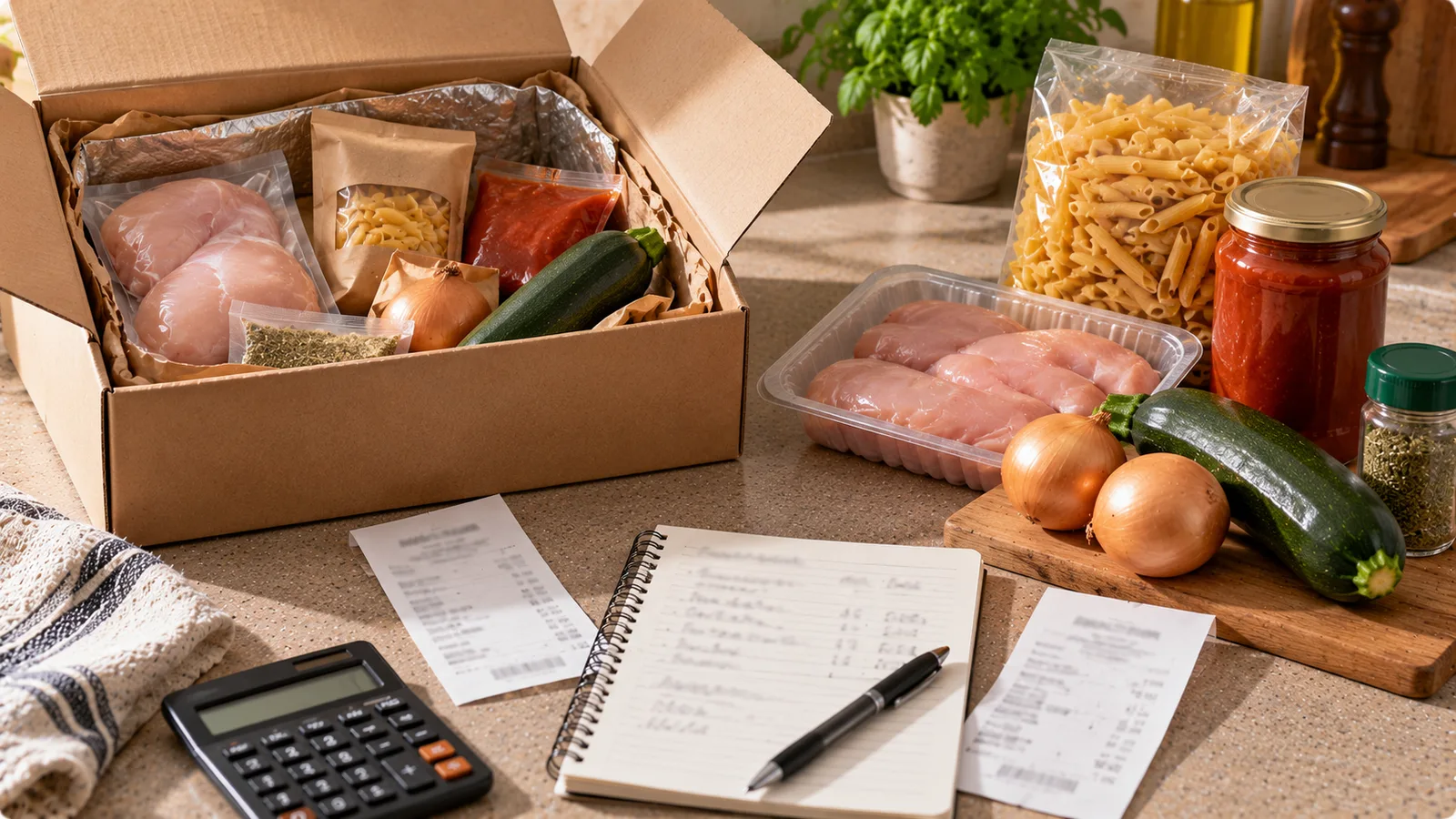
Meal kits promise convenient home cooking with measured ingredients and a recipe. Grocery shopping offers more flexibility, but it often requires buying larger packages than a single recipe needs.
Which option costs less?
The answer depends on more than the advertised price per meal.
A useful comparison must include everything you pay for and the number of edible servings you actually get.
That means considering delivery charges, minimum order requirements, ingredients left unused, food waste, leftovers and the size of each serving.
This guide provides a practical method for comparing the two options without relying on temporary promotions or misleading headline prices.
The basic comparison
Start with this formula:
Cost per edible serving = total relevant cost ÷ number of servings actually eaten
For meal kits, the total may include:
- The advertised meal-kit price.
- Delivery or shipping charges.
- Any mandatory service or packaging fees.
- Ingredients you must provide separately.
- Taxes where applicable and not already included.
For groceries, include:
- The price of purchased ingredients.
- Any grocery delivery or collection fees.
- Ingredients used from your pantry, valued at their actual consumption cost.
- The cost of unused food that will not be eaten later.
- Any other relevant purchasing costs.
The important word is edible.
If a recipe is advertised as four servings but produces only three portions of a size you normally eat, the meaningful denominator is three.
If leftovers become another meal, they should count rather than being treated as waste.
Worked example: meal kit versus grocery shopping
Imagine you want to prepare a chicken-and-vegetable rice dinner.
The following figures are hypothetical examples, not current prices from any retailer.
Option A: meal kit
| Cost component | Amount |
|---|---|
| Meal kit for four advertised servings | €27.96 |
| Delivery | €4.99 |
| Additional cooking oil and seasonings | €0.85 |
| Total cost | €33.80 |
If all four servings are eaten:
€33.80 ÷ 4 = €8.45 per edible serving.
But suppose the portions are small for your household and the food makes only three satisfying servings.
Then:
€33.80 ÷ 3 = €11.27 per edible serving.
The same purchase now looks substantially more expensive.
Option B: grocery shopping
| Purchased ingredient | Checkout cost |
|---|---|
| Chicken | €8.49 |
| Rice, 1 kg bag | €2.49 |
| Mixed vegetables | €5.20 |
| Sauce ingredients | €3.30 |
| Herbs and other ingredients | €2.10 |
| Total paid | €21.58 |
The grocery bill is €21.58, but the recipe may not use the entire bag of rice or every sauce ingredient.
Suppose the ingredients actually consumed in the dinner cost €17.10.
The remaining €4.48 is not automatically waste. If the unused ingredients will be eaten later, they remain useful food inventory.
For a four-serving dinner:
€17.10 ÷ 4 = €4.28 per serving, rounded.
However, if the remaining ingredients spoil or are discarded, that loss must be allocated somewhere in the household food budget.
This distinction is the foundation of a fair comparison.
Checkout cost versus consumption cost
Grocery shopping creates two different numbers.
Checkout cost is the money spent at the store today.
Consumption cost is the value of ingredients actually used in a particular meal.
Consider a 1 kg bag of rice costing €2.50.
If the recipe uses 300 g of dry rice:
€2.50 × 300 ÷ 1,000 = €0.75.
The other 700 g remains available for future meals.
Charging the full €2.50 to the first dinner would overstate its ingredient cost, assuming the remainder is eventually used.
On the other hand, assigning only €0.75 while throwing away the rest would understate the household's actual spending.
A practical system is to track recipe consumption and periodically account for discarded ingredients.
How to calculate usable ingredient cost
Not every gram you buy is edible.
Some ingredients include peels, bones, shells, stems or other discarded parts.
For foods with substantial preparation losses, compare the cost of the usable quantity.
Cost per usable kilogram = purchase price ÷ edible yield fraction
For example, imagine a vegetable costs €3.00 per kilogram and 80% remains usable after trimming.
€3.00 ÷ 0.80 = €3.75 per usable kilogram.
If you need 400 g of the usable vegetable:
0.4 × €3.75 = €1.50.
This is different from simply multiplying the shop price by 400 g.
Use realistic edible yields for the ingredients you prepare. The yield of boneless chicken, whole fish and leafy vegetables will not be identical.
A fair comparison needs equal portions
A meal kit might contain two advertised portions, while a homemade recipe produces three smaller ones.
Comparing the stated number of servings alone can be misleading.
Choose one consistent basis:
- Similar finished edible weight.
- Similar energy content, when relevant to your household's needs.
- A portion size your household would actually eat.
- The same number of main meals, rather than mixing mains and side dishes.
For example, a €16 meal kit labeled for two servings costs €8 per advertised serving before fees.
If the portions are too small and you add €3 of bread and vegetables to complete dinner, the practical cost becomes:
(€16 + €3) ÷ 2 = €9.50 per complete serving, before delivery.
The additional food matters because it is part of what you needed to make the meal sufficient.
Delivery fees and order frequency
Delivery can change the comparison significantly.
Suppose a household orders three meal-kit dinners with four servings each.
The order contains 12 advertised servings.
If delivery costs €5.99:
€5.99 ÷ 12 = €0.50 per serving, rounded.
If the household orders only one two-serving dinner with the same delivery charge:
€5.99 ÷ 2 = €3.00 per serving, rounded.
The delivery charge has not changed. Its impact per serving has.
For groceries, delivery fees should be allocated across all groceries purchased, not automatically charged entirely to one recipe.
If the order includes breakfast foods, snacks and several dinners, divide the delivery charge using a consistent approach.
One reasonable method is to allocate it proportionally by the cost of the groceries used.
Food waste can reverse the result
Meal kits may reduce waste by providing recipe-specific quantities.
This can matter particularly for:
- Fresh herbs used in small amounts.
- Specialty sauces.
- Vegetables sold in large packages.
- Ingredients you rarely use.
- Households cooking for one or two people.
Consider a grocery recipe requiring €12 of ingredients actually used.
If an additional €5 of perishable ingredients must be purchased and are ultimately discarded, the real attributable cost is €17.
For two servings:
€17 ÷ 2 = €8.50 per serving.
A meal kit costing €8 per complete serving could now be cheaper.
But if those extra ingredients are used in another meal, the grocery recipe may remain the lower-cost option.
Waste should be measured, not automatically assumed.
Leftovers are not waste
A common mistake is counting leftover cooked food as a cost without counting the meal it provides.
Suppose a grocery recipe costs €18 in consumed ingredients.
You plan for four servings, but the batch provides six useful servings.
If all six are eaten:
€18 ÷ 6 = €3 per serving.
If only four are eaten and two are discarded:
€18 ÷ 4 = €4.50 per edible serving.
If the two extra servings are frozen and eaten next week, they should still count toward the six-serving total.
This is why meal planning and appropriate storage can influence the financial result.
How to compare both options in a spreadsheet
Use the same columns for a meal kit and a grocery recipe.
| Field | Meal kit | Groceries |
|---|---|---|
| Advertised or purchased cost | Enter amount | Enter amount |
| Delivery and mandatory fees | Enter amount | Enter amount |
| Extra ingredients required | Enter amount | Enter amount |
| Ingredients used from existing pantry stock | Enter consumed value | Enter consumed value |
| Purchased ingredients left for future use | Usually limited | Record separately |
| Ingredients ultimately discarded | Enter attributable loss | Enter attributable loss |
| Servings actually eaten | Enter number | Enter number |
| Cost per edible serving | Total ÷ servings | Total ÷ servings |
Avoid double counting.
If you calculate the recipe cost from consumed ingredients, do not also add the full checkout cost for those same ingredients.
If you calculate from the full checkout cost, subtract the value of food retained for future use before allocating the cost to this recipe.
Both approaches can work if applied consistently.
Three household scenarios
Scenario 1: a family that cooks regularly
A family of four cooks five dinners per week and frequently reuses rice, vegetables, herbs and sauces.
In this situation, buying larger packages can be economical because the ingredients are likely to be used.
Grocery shopping may have a clear advantage, especially when the household plans multiple recipes around the same ingredients.
Scenario 2: a single-person household
Someone living alone wants to prepare a recipe requiring several fresh ingredients sold only in larger packages.
If those ingredients spoil before another meal, the apparent grocery savings may disappear.
A meal kit with smaller quantities may be competitive, although delivery fees and minimum order sizes remain important.
Scenario 3: an unpredictable work schedule
A household frequently changes dinner plans.
Both approaches can generate waste if fresh food is not used on time.
Meal kits do not automatically solve this problem because their ingredients are also perishable.
A combination of shelf-stable groceries, frozen ingredients and flexible recipes may reduce waste more effectively than either fixed weekly approach.
Should you include your cooking time?
Time is relevant to convenience, but it is not the same as an out-of-pocket food cost.
If you want to compare the value of your time, calculate it separately.
For example:
- Grocery shopping and meal planning: 45 minutes per week.
- Meal-kit ordering and unpacking: 15 minutes per week.
- Difference: 30 minutes.
Whether that time saving is worth paying for is a personal decision.
Do not automatically assign an hourly wage to unpaid household time and present the result as a universal financial saving.
Also remember that meal kits still require preparation, cooking and cleaning.
What about promotional discounts?
Introductory meal-kit discounts can make the first order look exceptionally inexpensive.
A fair long-term comparison should distinguish:
- The first-order promotional price.
- The standard recurring price.
- Shipping and mandatory fees.
- Any minimum-order requirements.
- The price after the promotion ends.
Do not assume that an advertised percentage discount applies to every future order.
The same principle applies to grocery loyalty offers and temporary supermarket discounts.
If you use current retailer prices, record the date and location because prices and promotions can change.
A five-step decision method
Step 1: Choose a comparable dinner
Compare a meal kit and a grocery recipe with similar ingredients and a similar finished meal.
Step 2: Record the full cost
Include fees and ingredients supplied from your pantry.
Step 3: Calculate the edible portions
Use the portions your household will actually eat, not only the number printed on a recipe card.
Step 4: Account for leftovers and waste
Count food used in future meals as useful inventory. Count food ultimately discarded as a loss.
Step 5: Repeat the comparison across several meals
One recipe may favor meal kits while another strongly favors groceries.
A two- to four-week sample is more informative than a single promotional order.
Which is cheaper overall?
Meal kits may be financially competitive when they prevent expensive ingredient waste, provide appropriately sized portions and have manageable delivery charges.
Groceries often offer better ingredient-level value when you regularly cook, reuse ingredients and take advantage of larger packages without wasting food.
Neither result is guaranteed.
The most useful number is not the advertised price per serving. It is the total relevant cost divided by the servings your household actually eats.
Sources and methodology
- USDA — Food Loss and Waste — background on household food waste.
- USDA FoodData Central — ingredient composition information where edible quantities or recipe calculations are needed.
- European Commission — Food Waste — European context for food-waste prevention.
All euro prices in this article are hypothetical calculations for teaching the method. They are not current quotations from meal-kit providers or supermarkets.