
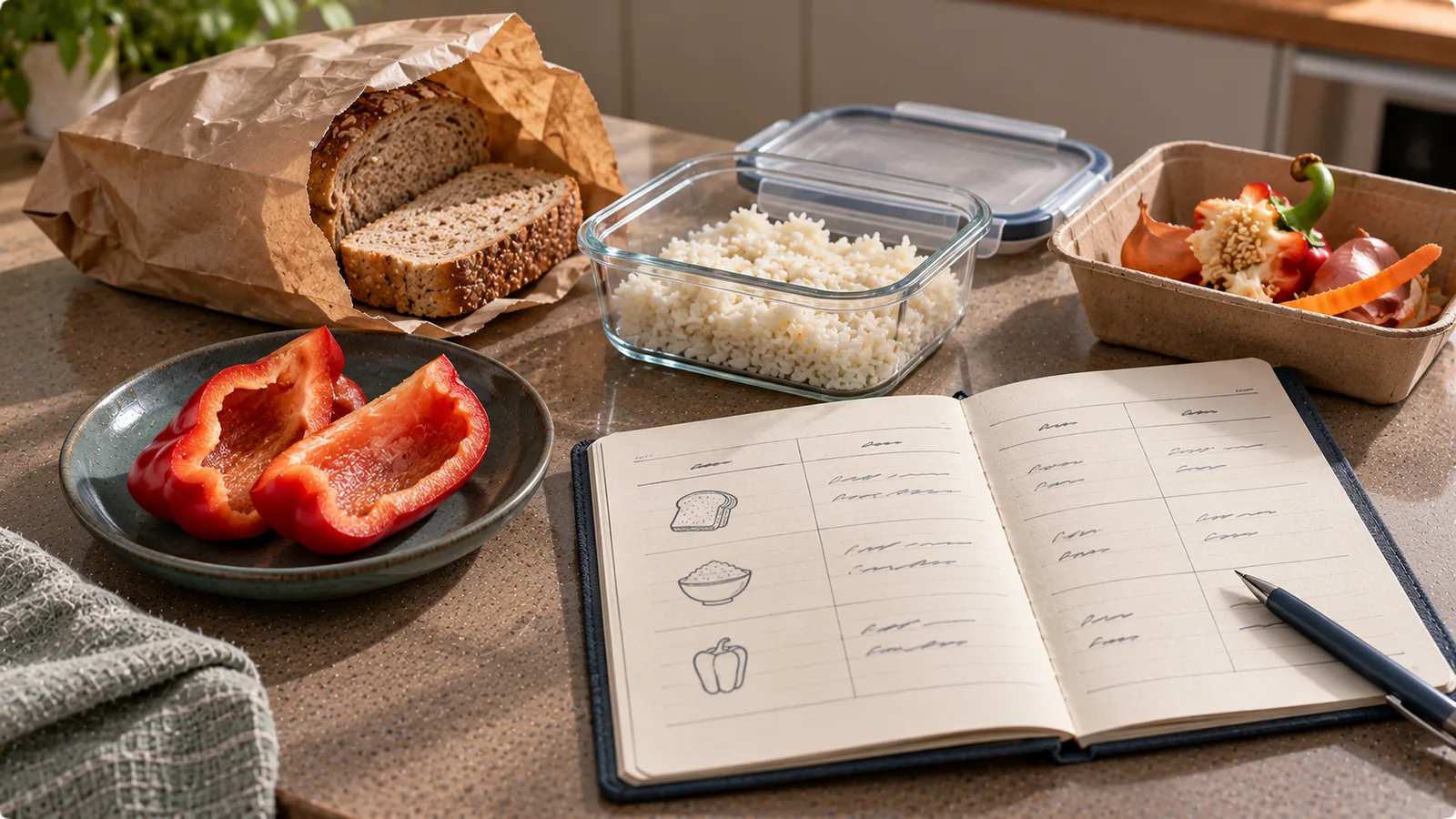
Food waste has a financial cost, but the amount is not always obvious.
Throwing away half a cucumber is different from discarding a whole unopened package. A cooked meal contains several ingredients, and the cost of a spoiled ingredient depends on how much of it was actually usable.
To calculate food waste accurately, you need to distinguish money spent, edible food discarded and food that was never intended to be eaten.
This guide explains how to calculate the cost of wasted groceries, including partial packages, spoiled produce, leftovers and meals prepared at home.
The basic food waste cost formula
For a food purchased and measured in the same units:
Cost of food wasted = purchase price × discarded quantity ÷ purchased quantity
Example:
- A 1 kg bag of carrots costs €1.80.
- You discard 250 g of usable carrots.
- The remaining carrots are eaten.
Calculation:
€1.80 × 250 ÷ 1,000 = €0.45 wasted.
This is the purchase cost allocated to the discarded portion. It is not a prediction of what you could sell the carrots for.
For a simple package, this formula is usually sufficient.
For foods with bones, peels or other inedible parts, a more careful calculation may be needed.
Start by deciding what counts as waste
Not everything placed in the bin represents avoidable food waste.
Examples of potentially avoidable waste:
- Bread that becomes mouldy before being eaten.
- Vegetables that spoil in the refrigerator.
- A half-used carton of yogurt that is discarded.
- Cooked leftovers that are never eaten.
- Edible parts removed unnecessarily during preparation.
Examples of generally unavoidable food residues:
- Eggshells.
- Inedible bones.
- Banana peels.
- Some hard pits or shells.
The distinction depends on the food, culinary practices and the definition used in a particular waste study.
For a personal grocery budget, the most useful number is usually the purchase cost of food you reasonably could have eaten but discarded.
Official food-waste statistics may use broader definitions, including inedible parts. Do not compare your household's avoidable-waste total directly with official statistics unless the definitions match.
The European Commission's food waste information and Eurostat's food waste estimates provide context on how food waste is measured.
Example 1: a partially used package
You buy 500 g of plain yogurt for €1.60.
You eat 320 g and throw away 180 g because it spoils.
| Item | Amount |
|---|---|
| Package price | €1.60 |
| Package weight | 500 g |
| Amount discarded | 180 g |
| Cost per gram | €0.0032 |
| Cost discarded | €0.58 |
Calculation:
€1.60 × 180 ÷ 500 = €0.576.
Rounded to the nearest cent: €0.58.
The fact that the package was opened does not change the calculation. What matters is how much of the purchased food was wasted.
Example 2: edible versus purchased weight
Some foods contain substantial parts that are not normally eaten.
Imagine buying a whole pineapple:
- Purchase price: €3.60.
- Purchased weight: 1,200 g.
- Edible flesh after trimming: 650 g.
- Edible flesh thrown away: 200 g.
If your goal is to allocate the purchase cost across the edible flesh, calculate:
€3.60 ÷ 650 g = approximately €0.00554 per edible gram.
Then:
200 × €0.00554 = €1.11 wasted, rounded.
This method allocates the full purchase price to the edible yield.
It assumes the discarded peel and core are normal preparation losses, not avoidable food waste.
Why not divide by the original 1,200 g?
If you calculate €3.60 × 200 ÷ 1,200, you get €0.60.
That is the cost based on purchased gross weight, not the allocated cost of edible flesh.
Both calculations answer different accounting questions.
For household decisions about the value of edible food lost, edible-yield costing is often more useful.
For comparison with a retail price per kilogram, gross-weight costing may be more appropriate.
Use one method consistently.
Example 3: food thrown away after cooking
Suppose you prepare a pot of vegetable soup.
| Ingredient | Quantity used | Allocated cost |
|---|---|---|
| Carrots | 300 g | €0.54 |
| Potatoes | 500 g | €0.90 |
| Onion | 150 g | €0.30 |
| Lentils, dry | 200 g | €0.80 |
| Oil and seasoning | — | €0.46 |
| Total | €3.00 |
The finished edible soup weighs 1,800 g.
You eat 1,200 g and discard 600 g.
Assuming the soup is evenly mixed:
600 ÷ 1,800 = one-third.
€3.00 × one-third = €1.00 of food wasted.
The soup's cooked weight includes water. That is fine because you are dividing the total recipe cost across the finished batch.
Do not calculate the cost of 600 g of soup as though it were 600 g of dry lentils or raw vegetables.
When the leftovers are not uniform
A mixed dish may contain unequal portions of expensive ingredients.
For example, if the discarded portion contains most of the meat, allocating cost strictly by finished weight may underestimate the loss.
In that case, estimate the actual ingredients in the discarded portion.
For ordinary soups and evenly mixed casseroles, weight-based allocation is usually a practical approximation.
Example 4: food wasted from a multi-buy offer
You buy three identical 400 g packages of berries for €6 in a promotion.
You eat two packages and discard the third.
The cost allocated to each package is:
€6 ÷ 3 = €2.00.
The wasted package costs €2.00.
Do not assign the full €6 to the discarded package.
Also avoid assuming the promotion saved money if it encouraged you to purchase more than you could use.
For comparing offers, calculate the cost of the food actually eaten.
In this example:
€6 ÷ 800 g eaten = €7.50 per kg consumed.
The advertised purchase price was:
€6 ÷ 1.2 kg = €5.00 per kg purchased.
Waste makes the effective cost of the food you consumed higher.
The effective cost per edible kilogram
A useful budgeting metric is:
Effective cost per kilogram eaten = total amount spent ÷ kilograms actually eaten
For example:
- You spend €12 on 4 kg of vegetables.
- You eat 3 kg.
- You discard 1 kg.
Purchase price:
€12 ÷ 4 = €3 per kg.
Effective price of food eaten:
€12 ÷ 3 = €4 per kg eaten.
This metric shows how food waste changes the value you receive from a purchase.
It does not mean the supermarket charged €4 per kg. It means the food you actually used cost that much after accounting for waste.
Example 5: a weekly food waste log
A simple household log might look like this:
| Discarded food | Amount | Allocated cost | Reason |
|---|---|---|---|
| Bread | 200 g | €0.70 | Went stale and mouldy |
| Yogurt | 180 g | €0.58 | Spoiled after opening |
| Tomatoes | 300 g | €0.90 | Bought too many |
| Cooked rice | 250 g | €0.35 | Leftovers not used |
| Soup | 600 g | €1.00 | Cooked too much |
| Apples | 2 pieces | €0.80 | Spoiled |
| Weekly total | €4.33 |
The prices are illustrative, not current store quotations.
If this exact weekly pattern continued for 52 weeks:
€4.33 × 52 = €225.16 per year.
This is a projection, not a measured annual loss.
Seasonal shopping, holidays and household size can make waste vary considerably.
How to track food waste without extra work
You do not need to weigh every crumb.
A useful lightweight system has five fields:
- Date.
- Food name.
- Quantity discarded.
- Estimated purchase cost.
- Reason for discarding.
Record only meaningful losses, such as a spoiled package, a large leftover portion or produce discarded from the refrigerator.
For low-value scraps, an approximate monthly category may be enough.
Use receipts or purchase history
Receipts help recover the original price.
If the receipt lists a promotion, use the actual amount paid rather than the regular shelf price.
For shared purchases or mixed bundles, allocate the total paid cost across the items using a consistent method.
Record the reason
Useful categories include:
- Bought too much.
- Forgotten in refrigerator.
- Spoiled before use.
- Cooked too much.
- Package too large.
- Date label misunderstood.
- Meal plans changed.
- Food preparation error.
Reasons matter because they suggest different solutions.
If most waste comes from fresh vegetables, buying smaller quantities may help.
If leftovers are the main problem, changing batch sizes or freezing portions may be more effective.
How to calculate food waste as a percentage
Two percentages can be useful.
Percentage of grocery spending wasted
Waste spending percentage = allocated cost of discarded food ÷ total grocery spending × 100
Example:
- Monthly groceries: €320.
- Food waste: €24.
€24 ÷ €320 × 100 = 7.5%.
This is the percentage of grocery spending allocated to discarded food.
Percentage of purchased weight wasted
Waste weight percentage = discarded weight ÷ purchased weight × 100
Example:
- Purchased edible food: 25 kg.
- Discarded edible food: 2 kg.
2 ÷ 25 × 100 = 8%.
Do not confuse these percentages.
Expensive foods can represent a large financial loss despite a small discarded weight.
For reliable comparison, use consistent edible or gross weight definitions in both numerator and denominator.
Should you include packaging, delivery and cooking costs?
That depends on what you want to measure.
Grocery-only cost
For ordinary household tracking, calculate the price paid for the food itself.
This is the easiest method to maintain.
Full meal cost
If you want to estimate the total cost of a discarded prepared meal, you can additionally allocate:
- Delivery fees.
- Cooking energy.
- Paid preparation services.
- Other directly attributable expenses.
However, these additional costs require assumptions.
For example, a delivery fee shared across an entire grocery order should not be charged fully to one discarded ingredient.
Keep grocery cost and additional preparation costs as separate categories so the result remains understandable.
How food date labels affect waste
Confusing “best before” and “use by” can lead to unnecessary waste or unsafe decisions.
In EU food information practice:
- Use by concerns food safety for certain highly perishable products. Do not consume the food after this date.
- Best before primarily concerns quality. A product may remain suitable after the date if it has been stored correctly and shows no signs of spoilage, subject to the food's characteristics.
Do not use smell or appearance to override a use-by date.
The European Commission explains date marking and food waste prevention.
For personal tracking, “discarded because of a misunderstood date label” can be a useful reason category.
What to do with the results
After two to four weeks, group your waste by reason and food category.
| Main problem | Possible response |
|---|---|
| Vegetables spoil before use | Buy smaller amounts or use frozen alternatives |
| Large packages remain unfinished | Compare smaller package cost with actual consumption |
| Cooked leftovers are discarded | Reduce batch size or freeze portions |
| Promotions lead to overbuying | Compare the effective cost of food actually eaten |
| Food is forgotten | Check the refrigerator before shopping |
| Plans change frequently | Plan fewer fixed meals and keep flexible ingredients |
Avoid trying to reduce waste to an unrealistic absolute zero.
The goal is to spend less on food that never becomes a meal, without compromising food safety or adequate nutrition.
A reusable monthly calculation
At the end of each month, calculate:
Monthly food waste cost = sum of allocated purchase costs for avoidably discarded edible food
Then compare:
- Total grocery spending.
- Total avoidable food waste cost.
- Waste percentage.
- Most frequently discarded foods.
- Most common reasons.
For example:
| Metric | Example |
|---|---|
| Grocery spending | €360 |
| Avoidable food waste | €27 |
| Waste share | 7.5% |
| Largest waste category | Fresh produce |
| Main reason | Overbuying |
The numbers are hypothetical.
A small, consistent log can reveal whether changing package sizes, shopping frequency or meal preparation actually reduces wasted spending.