
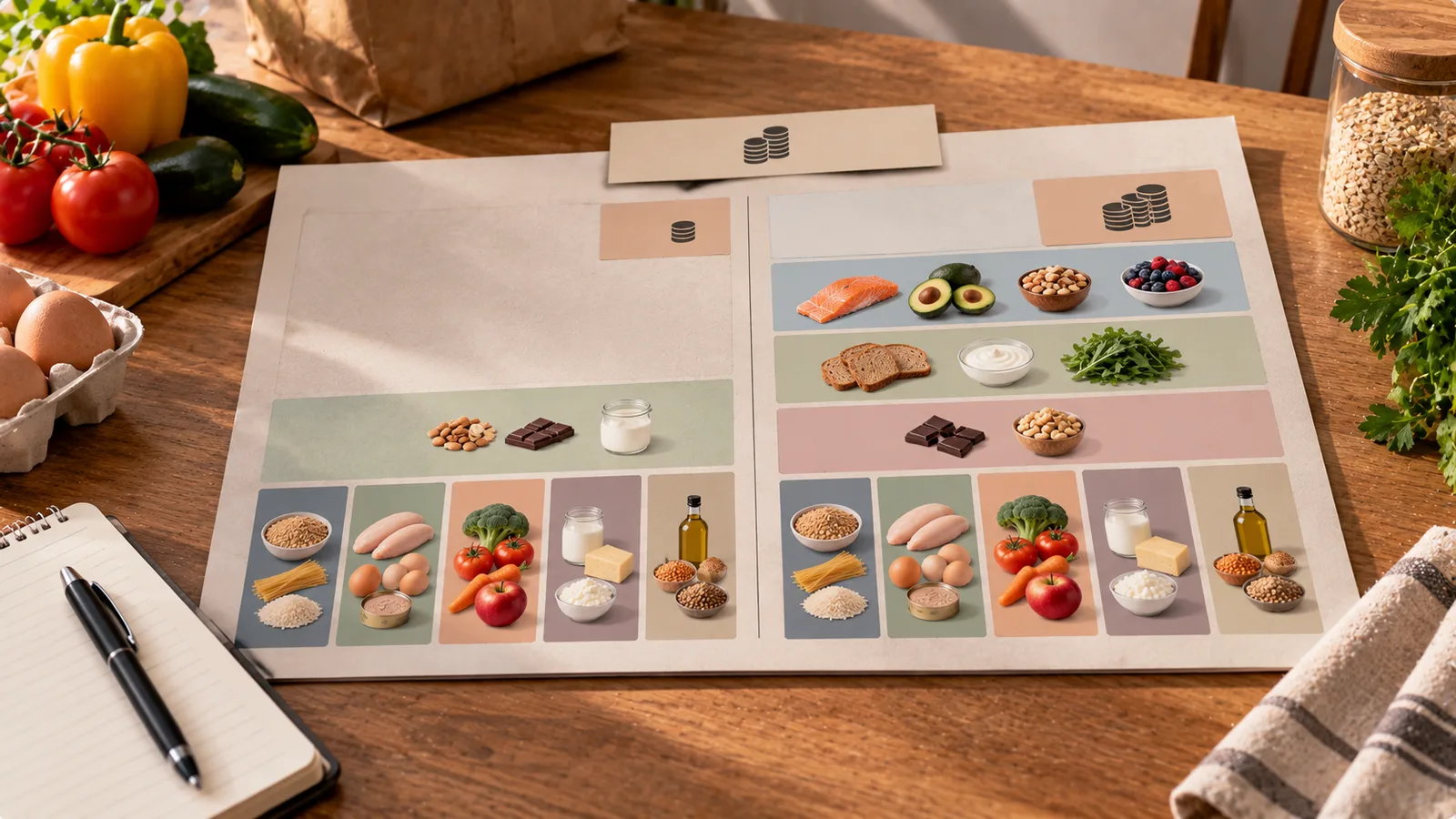
A fixed grocery budget is easy to understand when income is predictable. If your income changes every month, a single rigid number can be much harder to use.
Freelancers, self-employed workers, people paid by shifts or commissions, and households with seasonal income may have a strong month followed by a much weaker one.
The solution is not to rebuild your food budget from zero every time your income changes. A more practical approach is to separate grocery spending into an essential baseline, a flexible layer, and a buffer for future low-income periods.
Start with the amount your household actually needs
Before connecting grocery spending to income, estimate the minimum realistic amount required to feed your household.
This is not the lowest amount you could theoretically survive on.
It should be a workable grocery budget that covers ordinary meals using reasonably economical foods.
Review several weeks or months of grocery spending and separate purchases such as:
- staple foods;
- protein foods;
- vegetables and fruit;
- dairy or alternatives;
- bread, grains and potatoes;
- cooking ingredients;
- snacks and optional foods;
- household or non-food products.
If your grocery receipts include toiletries, cleaning products or other household purchases, separate them before calculating your food baseline.
Otherwise you may think your food costs are higher than they really are.
Build an essential grocery basket
Your essential basket is the food you would prioritize during a lower-income month.
It might include foods such as:
- oats;
- rice;
- pasta;
- potatoes;
- bread;
- eggs;
- beans and lentils;
- affordable meat, fish or tofu;
- milk or alternatives;
- yogurt;
- seasonal vegetables;
- frozen vegetables;
- fruit;
- cooking oil;
- basic sauces and seasonings.
The exact foods depend on your household.
The important point is that the basket should support normal meals rather than being a list of emergency foods you would dislike eating for more than a few days.
Example: finding the baseline
Suppose your last four months of food-only grocery spending were:
| Month | Food spending |
|---|---|
| Month 1 | €410 |
| Month 2 | €455 |
| Month 3 | €390 |
| Month 4 | €470 |
Average:
(410 + 455 + 390 + 470) ÷ 4 = €431.25
But after reviewing the receipts, you notice that around €60–€90 each month went to optional premium products, extra snacks and convenience foods.
Your realistic essential baseline might therefore be around €350–€370 per month, rather than €431.
That baseline becomes the first layer of the budget.
Use three layers instead of one number
A variable-income grocery budget can be divided into three layers.
Layer 1: essential food
This covers the basic grocery basket.
Example:
€360 per month
This is the amount you try to protect even during a weaker month.
Layer 2: flexible food spending
This covers purchases that are useful but easier to reduce temporarily:
- premium brands;
- more expensive cuts of meat;
- specialty ingredients;
- desserts;
- convenience foods;
- additional snacks;
- drinks;
- spontaneous purchases.
Example:
€80 per month
Layer 3: food-budget buffer
During stronger months, some money is set aside for future grocery spending.
Example:
€60 per month when income allows
This creates a reserve that can support the essential basket during a weaker month.
Example monthly structure
A normal target could look like:
| Budget component | Amount |
|---|---|
| Essential groceries | €360 |
| Flexible groceries | €80 |
| Buffer contribution | €60 |
| Total allocated | €500 |
This does not mean you must spend €440 on food every month.
If flexible spending is lower, the unused amount can remain available or move into the buffer.
Base essential spending on conservative income
If your income fluctuates, avoid building essential grocery spending around your best month.
Suppose recent take-home income has been:
| Month | Income |
|---|---|
| Month 1 | €2,100 |
| Month 2 | €2,850 |
| Month 3 | €1,900 |
| Month 4 | €3,200 |
| Month 5 | €2,300 |
The average is:
(2100 + 2850 + 1900 + 3200 + 2300) ÷ 5 = €2,470
But €2,470 may still be too optimistic as the basis for essential commitments because income has already fallen to €1,900.
A conservative planning level might be closer to the lower end of your normal range.
The exact number depends on the stability of your work and your other essential expenses.
Do not automatically budget groceries as a percentage of income
A percentage can be useful for broad financial planning, but food needs do not move proportionally with monthly income.
If income rises from €2,000 to €3,000, your household does not suddenly need 50% more food.
Likewise, if income falls sharply, there is a practical limit to how far grocery spending can be reduced.
This is why an essential-basket approach is often more useful than saying:
"I will always spend 15% of my income on groceries."
Low-income month example
Suppose your normal grocery framework is:
- €360 essential;
- €80 flexible;
- €60 buffer contribution.
Then you have a weak income month.
Instead of trying to reduce every grocery category equally, you might use:
| Component | Normal month | Low-income month |
|---|---|---|
| Essential groceries | €360 | €360 |
| Flexible groceries | €80 | €25 |
| Buffer contribution | €60 | €0 |
| Total | €500 | €385 |
The essential food budget remains intact.
Most of the adjustment comes from flexible spending and temporarily stopping the buffer contribution.
Very low-income month example
Suppose the month is unusually weak and even €385 is difficult.
If you previously built a food buffer of €180, you could use part of it.
For example:
- current-month grocery money: €320;
- transfer from food buffer: €40;
- essential grocery budget available: €360.
The buffer performs the job it was created for.
Using it during a genuinely weak month is not a budgeting failure.
High-income month example
Now suppose income is significantly higher than expected.
The goal does not need to be increasing grocery spending simply because more money is available.
You could keep:
- essential groceries: €360;
- flexible groceries: €80;
and increase the buffer contribution from €60 to €150.
Total allocated:
€360 + €80 + €150 = €590
Only €440 is intended for current food purchases. The remaining €150 strengthens future months.
How large should the grocery buffer be?
There is no universal target.
A useful starting point may be enough to cover part or all of one essential grocery month.
If your essential baseline is €360, possible milestones could be:
- first target: €90;
- next target: €180;
- stronger buffer: €360.
Someone with highly unpredictable income may prefer a larger reserve.
The food buffer can also be part of a broader household emergency fund rather than a separate bank account.
The important point is that money from stronger months remains available for essential costs during weaker periods.
Weekly limits can make the monthly budget easier
A monthly grocery number can be difficult to control if most of it is spent early.
If the essential monthly budget is €360, a simple four-week approximation would be:
€360 ÷ 4 = €90 per week
But calendar months are not exactly four weeks.
A more accurate weekly equivalent uses the average number of weeks per month:
€360 × 12 ÷ 52 = approximately €83 per week
This can be a more realistic long-term weekly reference.
Use a shopping cadence
Irregular income does not require irregular grocery shopping.
A predictable shopping rhythm can make spending easier to control.
For example:
- one main grocery shop each week;
- one small top-up for fresh foods;
- no additional convenience trips unless necessary.
If you shop without a routine, several small purchases can quietly increase total spending.
Give every shopping trip a limit
Suppose your weekly grocery target is €85.
You could plan:
- main shop: €70;
- fresh-food top-up: €15.
If the main shop costs €76, only €9 remains for the top-up.
This creates feedback during the week rather than discovering the overspend at the end of the month.
Keep a flexible category inside the grocery budget
A strict list of only essential foods can make a budget difficult to sustain.
Instead, deliberately reserve some money for flexible choices.
For example, with an €85 weekly target:
- €70 essentials;
- €15 flexible.
The €15 could cover:
- dessert;
- a favorite snack;
- a more expensive ingredient;
- convenience food;
- a specialty product.
If money becomes tighter, this is the first category that can shrink.
Use stronger months to stock up carefully
Buying extra food during a strong-income month can reduce future costs, but only when the purchase is genuinely useful.
Good candidates may include:
- rice;
- pasta;
- oats;
- canned beans;
- lentils;
- frozen vegetables;
- frozen meat or fish;
- cooking oil.
But buying something simply because it is discounted does not automatically save money.
Before stocking up, ask:
- Do we normally eat it?
- Can we store it safely?
- Will we use it before quality deteriorates?
- Does buying it now reduce a likely future purchase?
If not, the "saving" may simply move more money into this month's grocery bill.
Separate cash flow from food consumption
A bulk purchase can make one month look unusually expensive even though the food will be consumed over several months.
Suppose you buy:
- 10 kg rice for €22;
- several cans of beans for €18;
- frozen foods for €35.
That month includes €75 of stock-up purchases.
Your bank account still loses €75 immediately, so it matters for cash flow.
But when reviewing your normal grocery needs, distinguish between:
- food consumed during the month;
- pantry or freezer stock purchased for future months.
This helps explain unusual spending spikes.
Adjust the meal plan before cutting quantities
When money is tighter, changing the composition of meals is often more practical than simply buying less food.
For example, replace some higher-cost meals with:
- lentil soup;
- bean chili;
- pasta with beans and tomato sauce;
- egg-based meals;
- potato dishes;
- rice bowls;
- oatmeal breakfasts.
The objective is to reduce average meal cost while maintaining enough food.
Example: changing three dinners
Suppose three planned dinners would cost:
- salmon dinner: €14;
- beef dinner: €13;
- takeaway-style convenience meal: €16.
Total:
€43
You replace them with:
- lentil curry: €7;
- chicken and rice: €9;
- bean pasta: €6.
New total:
€22
Difference:
€43 - €22 = €21
A few targeted substitutions can therefore reduce weekly spending without changing every meal.
Protect foods that provide useful nutrition
When reducing grocery spending, cutting fruit, vegetables or protein foods indiscriminately is not necessarily the best first step.
Look first for spending that can be reduced with less effect on the overall diet, such as:
- duplicate snacks;
- premium versions of basic products;
- drinks;
- individually portioned foods;
- unnecessary convenience items;
- ingredients bought for one recipe and then wasted.
A lower-cost grocery plan can still contain a varied mix of foods.
Compare price per useful amount
The cheapest package price is not always the cheapest option.
Suppose:
- 500 g product = €2.20;
- 1 kg product = €3.60.
The larger pack is cheaper per kilogram.
But if half of it is regularly discarded, your effective cost is much worse.
For variable-income budgeting, waste matters because replacing discarded food creates additional future spending.
Use store brands selectively
Basic products such as:
- oats;
- rice;
- pasta;
- canned tomatoes;
- beans;
- flour;
- frozen vegetables
may have lower-cost store-brand options.
You do not need to replace every preferred product.
Start with products where the cheaper version works equally well for your household.
Even small recurring differences can accumulate across a month.
Watch recurring convenience costs
Small convenience purchases can be difficult to notice.
For example:
- €3 extra per shopping trip;
- two grocery trips per week;
- four weeks.
€3 × 2 × 4 = €24 per month
At €5 extra per trip:
€5 × 2 × 4 = €40 per month
This is why controlling shopping frequency can be as important as comparing individual prices.
Create rules before income arrives
Variable income can encourage reactive decisions.
A strong month may feel like permission to spend more, while a weak month creates sudden cuts.
Instead, decide in advance what happens at different income levels.
For example:
Lower-income month
- fund essential groceries;
- reduce flexible grocery spending;
- pause buffer contribution;
- use existing pantry/freezer stock strategically.
Normal month
- fund essential groceries;
- allow normal flexible spending;
- contribute to buffer.
Higher-income month
- keep current grocery spending near normal;
- increase buffer contribution;
- optionally make planned bulk purchases.
These rules reduce the number of decisions you need to make each month.
Example three-level system
Suppose your household uses these thresholds:
| Monthly income situation | Essential food | Flexible food | Buffer |
|---|---|---|---|
| Low | €360 | €20 | €0 |
| Normal | €360 | €80 | €60 |
| High | €360 | €80 | €150 |
Current food spending therefore ranges from €380 to €440, while stronger months contribute more toward future stability.
The exact numbers are only examples. Your baseline should reflect your own household, prices and dietary needs.
What if income arrives at irregular times?
Some people not only earn different amounts but also receive payments on unpredictable dates.
In that situation, a monthly budget alone may not be enough.
When income arrives:
- cover essential obligations due before the next expected payment;
- reserve grocery money for that period;
- avoid treating the remaining bank balance as fully spendable;
- maintain a buffer whenever possible.
For example, if you need approximately €83 of groceries per week and may wait three weeks for another payment:
€83 × 3 = €249
That €249 should be treated as committed grocery money.
Use separate budget categories even if the money stays in one account
You do not necessarily need multiple bank accounts.
A spreadsheet, budgeting app or simple note can track:
- essential groceries;
- flexible groceries;
- grocery buffer.
Suppose your account contains €1,500.
If €360 is reserved for food, €900 for rent and bills, and €100 for transportation, the full €1,500 is not available for discretionary spending.
Categories make those commitments visible.
Recalculate the baseline when prices or household needs change
An essential grocery baseline is not permanent.
Review it when:
- food prices change materially;
- household size changes;
- dietary needs change;
- you move to a different region;
- your normal shopping habits change.
If a €350 baseline consistently requires €390 despite careful shopping, the budget may simply be outdated.
Repeatedly setting an unrealistic target does not improve the budget.
Do not judge the plan by a single expensive week
One week may include:
- cooking oil;
- rice;
- coffee;
- frozen foods;
- other products that last much longer than seven days.
Another week may be unusually cheap because those items are already available.
Look at several weeks together before deciding whether your grocery budget is working.
A practical monthly workflow
At the beginning of each planning period:
- Estimate income conservatively.
- Fund the essential grocery baseline.
- Set the flexible grocery amount.
- Decide whether you can contribute to the buffer.
- Check pantry, refrigerator and freezer inventory.
- Plan meals around foods already available.
- Set weekly shopping limits.
- Track actual food spending separately from non-food purchases.
- Review the remaining budget once a week.
This creates a repeatable process even when income itself is not repeatable.
Worked example
Imagine a household with:
- essential grocery baseline: €360;
- normal flexible allowance: €80;
- target buffer: €360.
At the start, the existing buffer contains €140.
Month A: strong income
The household spends:
- essential food: €355;
- flexible food: €67.
It contributes €120 to the buffer.
New buffer:
€140 + €120 = €260
Month B: normal income
Spending:
- essential food: €365;
- flexible food: €70.
Buffer contribution:
€60
New buffer:
€260 + €60 = €320
Month C: weak income
Only €330 is comfortably available for groceries.
The household reduces flexible purchases and uses €30 from the buffer.
Available essential budget:
€330 + €30 = €360
Remaining buffer:
€320 - €30 = €290
The weak month does not require rebuilding the entire food plan because stronger months created capacity in advance.
What if you consistently use the buffer?
If the buffer is needed almost every month, one of three things may be happening:
- the essential grocery baseline is too high for current income;
- other household expenses are consuming money intended for food;
- the income assumption used for the overall budget is too optimistic.
The buffer is designed to smooth variation, not permanently cover a structural gap.
If withdrawals consistently exceed contributions, review the larger budget rather than repeatedly reducing the buffer.
What to do with unused grocery money
Suppose you budget €440 for current groceries but spend €405.
The remaining €35 can be:
- added to the food buffer;
- carried into the next grocery period;
- assigned to another financial priority.
Avoid automatically spending the remaining amount simply because it was budgeted.
A budget is a limit and a plan, not a requirement to spend every euro.
Keep the system simple enough to maintain
You do not need to track every ingredient to the cent.
A useful system may require only four numbers:
- essential monthly food baseline;
- flexible grocery allowance;
- current buffer balance;
- actual grocery spending.
The best system is one you can update consistently.
The core strategy
When income varies, food budgeting works better when grocery spending is not allowed to rise and fall automatically with every paycheck.
Build a realistic essential baseline first.
Then use flexible spending as the adjustable layer and stronger months to build a reserve.
A simple hierarchy is:
- protect essential groceries;
- reduce optional food spending when necessary;
- pause buffer contributions during weaker months;
- use the buffer when genuinely needed;
- rebuild it during stronger months.
That turns irregular income from a monthly budgeting reset into a variation your grocery plan is already designed to handle.