
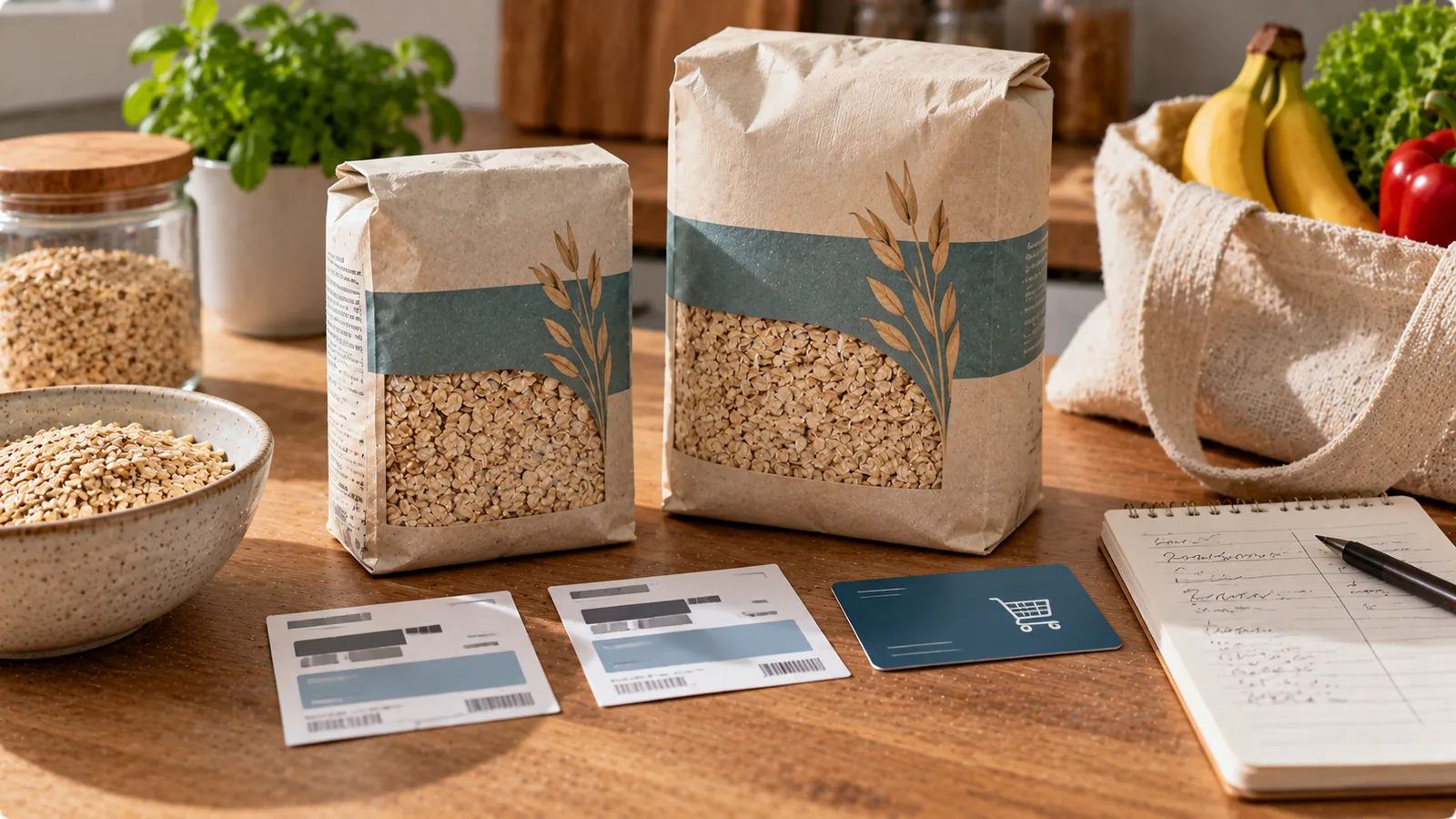
A supermarket loyalty price can look like an easy saving: scan a card, open an app or enter a membership number and pay less than the displayed regular price.
But the advertised difference is not always the amount you actually save.
A loyalty offer may be cheaper than the same product's current non-member price while still being more expensive than a competing brand, a larger pack or the price at another supermarket.
The useful question is not simply "How much is the loyalty discount?" It is "What is the cheapest suitable way to buy the amount I actually need?"
This guide shows how to answer that question using real prices, unit costs, coupon conditions and total basket calculations.
Loyalty price versus regular price: the basic calculation
A loyalty price is a price available only when specified membership conditions are met.
A regular price is the price charged to shoppers who do not use that offer.
For the same product, pack size and transaction, the immediate difference is:
Cash saving = regular price − loyalty price
The percentage discount relative to the regular price is:
Discount percentage = (regular price − loyalty price) ÷ regular price × 100
For example:
| Price | Amount |
|---|---|
| Regular price | €3.49 |
| Loyalty price | €2.79 |
| Immediate saving | €0.70 |
| Discount versus regular price | 20.1% |
The arithmetic is correct, but it does not prove that €2.79 is a good market price.
You still need a suitable comparison.
Compare the price per kilogram or litre first
When products have different package sizes, their shelf prices alone are misleading.
Use the unit price:
Unit price = package price ÷ package quantity
For a 750 g package, convert the quantity to 0.75 kg before calculating the price per kilogram.
Imagine three packs of oats:
| Product | Pack size | Shelf price | Price per kg |
|---|---|---|---|
| Brand A, regular price | 500 g | €1.99 | €3.98 |
| Brand A, loyalty price | 500 g | €1.59 | €3.18 |
| Store brand, regular price | 1 kg | €2.69 | €2.69 |
The loyalty offer saves €0.40 against the regular price of Brand A.
However, the store brand costs €0.49 less per kilogram than the discounted Brand A.
If you need one kilogram, buying two discounted Brand A packs costs €3.18. The one-kilogram store-brand pack costs €2.69.
The store brand is €0.49 cheaper for the same quantity, assuming both products meet your needs.
This is why unit prices matter more than the size of the advertised discount.
Use a four-step comparison
<escape>1.</escape> Check the actual checkout price. Confirm that the loyalty offer applies to your account, product variant, store and purchase date.
<escape>2.</escape> Compare equivalent quantities. Use euros per kilogram, litre, item or another meaningful unit.
<escape>3.</escape> Account for the amount you will use. A large package is not a saving if a substantial portion goes to waste.
<escape>4.</escape> Compare the total cost of suitable alternatives. Include conditions such as minimum spend, required multiples, coupons and any unavoidable extra purchases.
The best offer is the one that produces the lowest relevant cost, not necessarily the largest displayed percentage.
A loyalty discount is not the same as a historical price reduction
A supermarket might show:
- Regular price: €4.00.
- Loyalty price: €3.00.
- Advertised member saving: €1.00.
That describes the difference between the two prices offered at that moment.
It does not establish that the product previously cost €4.00, that €3.00 is its lowest recent price or that other shops charge more.
In the European Union, rules on price-reduction announcements include requirements concerning prior prices. However, the legal treatment of loyalty schemes depends on the precise nature of the offer and how it is advertised.
The European Commission's guidance on Article 6a of the Price Indication Directive) discusses price-reduction announcements and loyalty programmes.
For practical shopping, separate three questions:
| Question | What it tells you |
|---|---|
| Is the member price below today's non-member price? | Immediate membership saving |
| Is the member price below the product's usual or recent price? | Whether the deal is unusual for that product |
| Is it below comparable alternatives? | Whether it is competitively priced |
These are different comparisons.
Example: a discount that loses to a cheaper alternative
Suppose you want 500 g of pasta.
| Option | Quantity | Price | Price per kg |
|---|---|---|---|
| Premium pasta, regular | 500 g | €2.49 | €4.98 |
| Premium pasta, loyalty | 500 g | €1.79 | €3.58 |
| Store-brand pasta | 500 g | €1.29 | €2.58 |
The premium pasta's loyalty saving is €0.70, approximately 28.1% off its regular price.
But the store-brand pasta still costs €0.50 less for the same weight.
If both products are acceptable, the loyalty offer is not the lowest-cost choice.
If you specifically prefer the premium pasta, the loyalty price may still be useful.
A discount can be genuine without being the cheapest option.
How to compare different pack sizes
A larger pack often has a lower unit price, but not always.
Suppose a supermarket sells yoghurt in three formats:
| Option | Quantity | Price | Price per kg |
|---|---|---|---|
| Small pot | 200 g | €0.89 | €4.45 |
| Loyalty multipack | 4 × 200 g | €2.79 | €3.49 |
| Large tub | 1 kg | €2.99 | €2.99 |
The large tub has the lowest unit price.
However, the multipack may be more convenient if you want individual portions or if the large tub would not be finished before its safe use period.
A useful comparison considers both unit cost and usable quantity.
Adjust for food waste
If you buy one kilogram for €2.99 but use only 700 g before discarding the rest, the cost per kilogram actually eaten becomes:
€2.99 ÷ 0.7 kg = €4.27 per kg consumed.
That is higher than the €3.49 per kilogram of the loyalty multipack if you eat all 800 g.
The calculation does not mean small packages are always better. It shows why an unused portion can erase a bulk-buy saving.
Loyalty points are not always an immediate discount
Some supermarket programmes offer points instead of a lower checkout price.
Points can have value, but that value may depend on redemption rules.
Consider:
- Product price: €20.00.
- Points earned: 200.
- Stated redemption value: 100 points = €1.00.
If all points can eventually be redeemed at that rate, the nominal reward is €2.00.
The potential effective cost is:
€20.00 − €2.00 = €18.00.
But you still pay €20.00 at checkout.
The €2.00 benefit is conditional on future redemption.
Before treating points like cash, check:
- Whether they expire.
- Whether redemption requires a minimum balance.
- Whether they can be used on products you normally buy.
- Whether redemption excludes certain categories.
- Whether earning and redemption rates can change.
- Whether another discount would be lost by using the programme.
For budgeting, it is often clearer to record the full checkout payment now and record a points benefit only when it is actually redeemed.
Compare coupons separately from loyalty prices
A coupon can create an additional discount, but only if the rules allow it.
Suppose:
| Item | Amount |
|---|---|
| Regular price | €5.00 |
| Loyalty price | €4.20 |
| Eligible coupon | €0.50 |
| Final checkout price | €3.70 |
If the coupon stacks with the loyalty price, the final price is €3.70.
If the terms prohibit combining promotions, the final price may instead be €4.20 or €4.50, depending on which offer applies.
Never assume that two discounts can be combined.
Read the coupon conditions and verify the receipt.
Percentage coupons
If a 10% coupon applies to a €4.20 loyalty price:
€4.20 × 0.90 = €3.78.
If the coupon applies to the original €5.00 price instead, the result is €4.50.
The order and eligibility rules matter.
Minimum-spend offers can encourage unnecessary purchases
An offer such as "€5 off when you spend €40" may be useful if your planned basket already meets the threshold.
It becomes less attractive if you buy extra products only to qualify.
Example:
| Scenario | Checkout total |
|---|---|
| Planned groceries | €34 |
| Extra products to reach threshold | €6 |
| Coupon | −€5 |
| Final payment | €35 |
You pay €35 instead of €34.
If the additional €6 of products are genuinely useful and replace future purchases, the offer may still provide value.
If you did not need them, the coupon did not reduce your immediate spending.
The right comparison is your planned basket versus your final basket, not just the coupon amount.
Multi-buy offers: calculate the price per item
A promotion such as "3 for €6" can be compared with a single-item price.
If one item normally costs €2.40:
- Three regular items cost €7.20.
- Three promotional items cost €6.00.
- Saving on three items: €1.20.
- Promotional unit price: €2.00.
However, if you need only one item, buying three costs more cash today.
The offer is most useful when you will use all the items or can store them safely.
For perishable foods, include the risk of waste.
Compare the whole grocery basket
A store may offer excellent loyalty prices on selected products while charging more for other items.
Comparing only the advertised deals can therefore be misleading.
Imagine the same planned basket at two supermarkets:
| Category | Store A with loyalty prices | Store B without membership |
|---|---|---|
| Vegetables and fruit | €12.50 | €11.80 |
| Dairy and eggs | €8.20 | €8.50 |
| Grains and bread | €6.90 | €6.20 |
| Meat, fish and legumes | €15.40 | €14.90 |
| Other groceries | €7.00 | €7.20 |
| Total | €50.00 | €48.60 |
Store A may advertise several impressive member discounts, but Store B is €1.40 cheaper for the complete basket.
That is why the total basket price is often the most useful metric when choosing where to shop.
For a fair comparison, use equivalent products, quantities and quality requirements.
Also consider travel or delivery costs when they materially differ.
When loyalty prices are worth using
Loyalty prices can be genuinely useful when:
- You already shop at the store.
- Membership is free and easy to use.
- The discounted product is something you planned to buy.
- The unit price is competitive with suitable alternatives.
- You can use the full quantity.
- No extra spending is required.
- The privacy and account conditions are acceptable to you.
The most reliable saving is one that reduces the cost of a purchase you would have made anyway.
When a loyalty deal may not be worth it
Be more cautious when:
- The regular price is unusually high.
- A comparable store brand is cheaper.
- The offer requires buying more than you need.
- The discount depends on a future points redemption.
- A coupon has restrictive conditions.
- The product is close to its use-by date.
- You must make an extra trip to another store for a very small saving.
- The programme requires data sharing you are uncomfortable with.
A lower displayed price is not automatically a better decision.
Loyalty apps and personal data
Loyalty programmes may collect information about purchases and account activity.
The exact data collected and the purposes for which it is used depend on the programme.
Before registering, review the privacy notice and available consent settings.
In the EU, the General Data Protection Regulation establishes rules concerning the processing of personal data and provides rights to individuals, subject to applicable conditions.
Consider whether the programme's benefits justify the account requirements and data practices for you.
You do not need to join every programme simply because a shelf label displays a lower member price.
A simple spreadsheet for tracking loyalty savings
You can compare deals using a small table:
| Column | Example |
|---|---|
| Product | Oats |
| Package size | 500 g |
| Regular price | €1.99 |
| Loyalty price | €1.59 |
| Alternative product | Store-brand oats |
| Alternative price | €2.69 per kg |
| Loyalty unit price | €3.18 per kg |
| Best suitable option | Store brand |
| Quantity actually needed | 1 kg |
This approach helps prevent the same comparison from being repeated every shopping trip.
Update prices when they change rather than assuming old promotions are still active.
A five-minute shopping routine
Before visiting the supermarket:
- Write a short list of what you actually need.
- Check loyalty offers only for those items.
- Compare prices per kilogram, litre or item.
- Check store-brand and non-member alternatives.
- Add up the cost of the complete planned basket.
At checkout, confirm that the expected loyalty prices were applied.
After shopping, review the receipt and update your usual reference prices if useful.
The goal is not to optimise every cent. It is to avoid paying more because a discount label made an offer appear unusually attractive.
Practical conclusion
To compare loyalty prices with regular grocery prices, start with the actual checkout price and calculate the unit cost.
Then compare suitable alternatives, account for the quantity you will consume and evaluate the total basket.
Treat points, coupons and minimum-spend offers according to their actual conditions.
A loyalty price is a saving against the non-member price of the same product. It is not proof that the product is the cheapest available.