
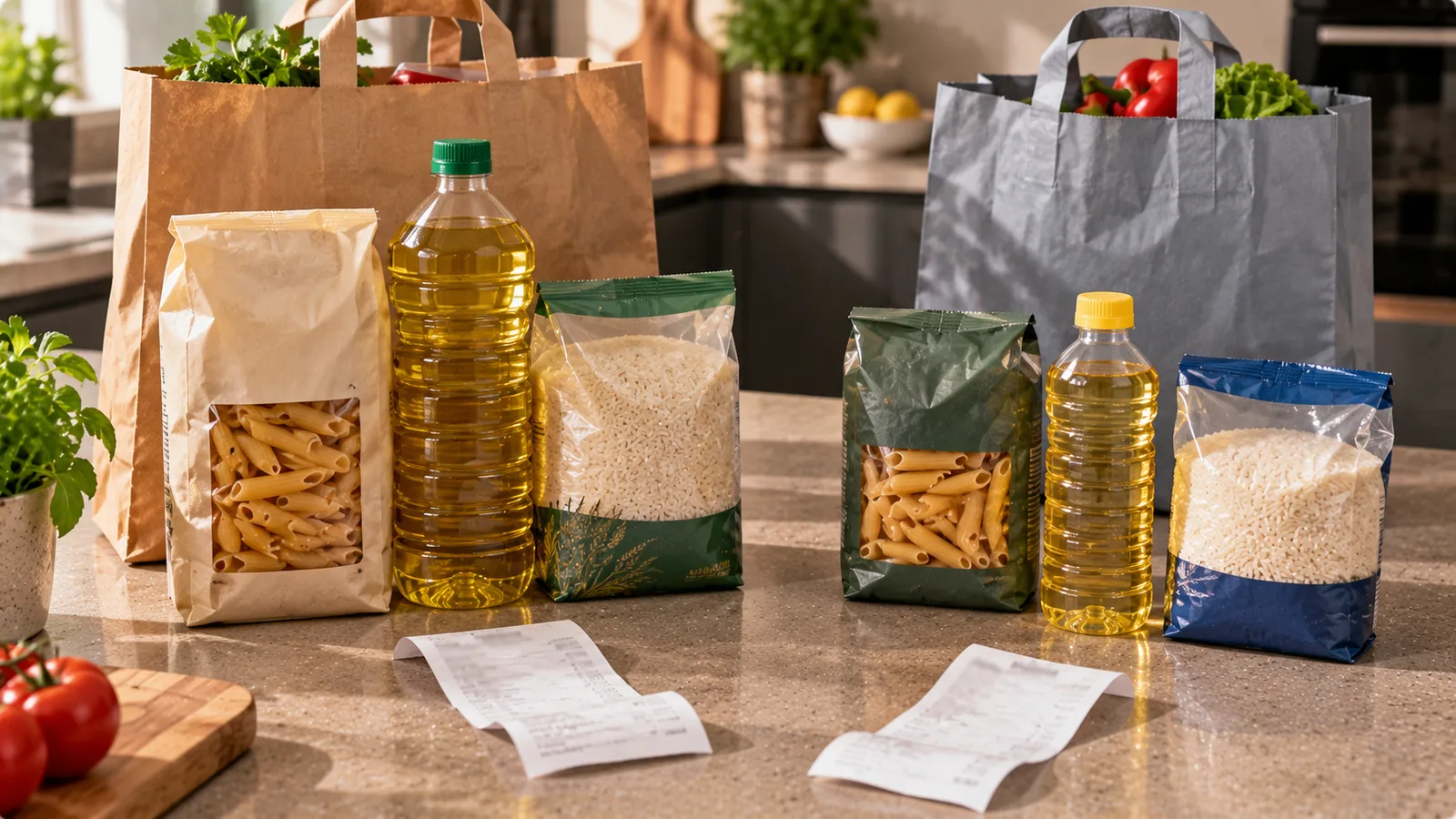
A grocery item can look cheaper in another country without actually costing less. Different currencies, package sizes, product specifications and travel expenses can change the comparison substantially.
The most useful method is to compare the same usable quantity of a reasonably equivalent product, convert prices using an exchange rate from the same date, and account for any extra costs involved in obtaining it.
This guide explains that process step by step. It does not assume that any particular country or supermarket is always cheaper.
Start with products that are genuinely comparable
Before calculating prices, check whether you are comparing equivalent items.
Two packages labeled as rice may differ in variety, quality, preparation time or cooking characteristics. Cheese can differ in fat content and maturity. Meat may be sold with or without bones. Fresh produce can vary by grade, season and country of origin.
For a useful comparison, record:
- Product type and relevant specifications.
- Package weight or volume.
- Price and currency.
- Whether the product is fresh, frozen or preserved.
- Any quantity discount or membership condition.
- The date and store where the price was observed.
If the products are not sufficiently similar, present them as alternatives rather than claiming a precise price advantage.
Convert package prices into comparable units
Package prices alone are often misleading.
A 750-gram bag of rice costing €2.40 is not directly comparable with a 1-kilogram bag costing €2.90.
The first product costs:
€2.40 ÷ 0.75 kg = €3.20 per kg.
The second costs:
€2.90 ÷ 1 kg = €2.90 per kg.
Although the first package is cheaper at checkout, the second is cheaper per kilogram.
The general formula is:
Unit price = package price ÷ package quantity
Choose the unit that matches the product:
| Product | Useful comparison unit |
|---|---|
| Rice, flour and dry pasta | Price per kg |
| Fresh vegetables and fruit | Price per kg |
| Milk and ordinary beverages | Price per litre |
| Cooking oil | Price per litre |
| Eggs | Price per egg or per 10 eggs |
| Coffee | Price per 100 g or kg |
| Meat with bones | Price per kg of edible portion when possible |
Avoid comparing a price per item with a price per kilogram unless you know the item's weight.
Convert currencies using a dated exchange rate
Cross-border comparisons require a common currency.
Suppose a product costs 18 units of Currency B for a 750-gram package.
For this hypothetical example, assume that on the comparison date:
1 unit of Currency B = €0.20.
The converted package price is:
18 × €0.20 = €3.60.
The price per kilogram is then:
€3.60 ÷ 0.75 kg = €4.80 per kg.
The exchange rate in this example is illustrative, not a current market quotation.
For a real comparison, obtain a dated reference exchange rate from a reliable source such as the European Central Bank. Use the same date and conversion convention for every product in the comparison.
The European Central Bank publishes reference exchange rates for a range of currencies. These are reference values, not necessarily the rates offered to consumers by banks or payment providers.
If your bank charges a conversion fee or uses a different rate, calculate the actual amount you would pay as a separate scenario.
Compare edible quantities, not just purchased weight
The cheapest price per kilogram is not always the cheapest price per kilogram of food you can eat.
Peels, shells, bones, trimming and spoilage may reduce the usable quantity.
For example, imagine two products:
| Product | Purchase price | Purchased weight | Assumed edible yield | Price per edible kg |
|---|---|---|---|---|
| Product A | €3.00 | 1 kg | 75% | €4.00 |
| Product B | €3.60 | 1 kg | 95% | €3.79 |
The calculation for Product A is:
€3.00 ÷ 0.75 kg = €4.00 per edible kg.
For Product B:
€3.60 ÷ 0.95 kg = approximately €3.79 per edible kg.
Product B costs more per purchased kilogram but less per usable kilogram.
The yields above are invented examples to demonstrate the method. Actual edible yields depend on the food, preparation and household practices.
Do not apply a single generic waste percentage to every product.
A worked cross-border grocery comparison
Consider two hypothetical supermarkets in different countries.
Store A prices products in euros. Store B uses Currency B.
Assume an illustrative exchange rate of 1 Currency B = €0.20 on the selected comparison date.
| Item | Store A | Store B in local currency | Store B converted to EUR |
|---|---|---|---|
| Rice, 1 kg | €2.90 | 13.50 | €2.70 |
| Pasta, 500 g | €1.20 | 5.50 | €1.10 |
| Milk, 1 litre | €1.30 | 7.00 | €1.40 |
| Apples, 1 kg | €2.50 | 11.00 | €2.20 |
| Eggs, 10 | €3.00 | 16.00 | €3.20 |
| Basket total | €10.90 | 53.00 | €10.60 |
The basket costs €0.30 less at Store B before transaction costs and travel.
This is a hypothetical teaching example, not a statement about real supermarkets or national price levels.
It also assumes that the listed products are sufficiently equivalent and that all advertised prices are available to the shopper.
A difference of €0.30 would be easily outweighed by a currency conversion fee, additional transport or a product that is not genuinely comparable.
Include the full cost of buying abroad
A cross-border purchase can involve more than shelf prices.
Relevant additional costs may include:
- Transport or delivery.
- Parking or road charges.
- Payment-provider currency conversion.
- Packaging or deposit differences.
- Extra time and the risk of buying more than planned.
- Food waste if perishables cannot be used before spoiling.
For a dedicated shopping trip, the simple financial comparison is:
Net saving = domestic basket cost − foreign basket cost − additional trip and payment costs
Suppose a comparable domestic basket costs €80 and a foreign basket costs €68 after currency conversion.
The shelf-price difference is €12.
If the trip and payment costs attributable to the shopping are €15, the net result is:
€80 − €68 − €15 = −€3.
In that scenario, the dedicated trip costs €3 more overall.
If the foreign store is already on a journey you would make anyway, only the incremental costs should be attributed to shopping. Avoid charging the full cost of an unrelated journey to the grocery basket.
Taxes, deposits and special offers
Shelf prices are not always presented in the same way across markets.
Check whether the amount shown is the final consumer price, whether a refundable container deposit applies, and whether the advertised discount requires a loyalty card or multiple purchases.
For products sold in the European Union, consumer price-indication rules generally require selling prices and, where applicable, unit prices to be displayed. National implementation and exceptions can differ.
A temporary promotion should be compared with a temporary promotion, not presented as a permanent national price advantage.
When a deal requires buying three units, calculate the total spend and consider whether the household will actually use all three.
Avoid misleading country rankings
A comparison of five products in one supermarket does not establish which country has the cheapest groceries.
Price differences can reflect:
- City and neighborhood.
- Retailer and store format.
- Brand and product quality.
- Season and promotions.
- Package size.
- Date and currency movements.
- Local taxes and distribution costs.
If you want to compare national price levels, use an appropriate statistical measure rather than extrapolating from a small shopping basket.
Eurostat publishes comparative price-level information for household consumption categories. Such statistics answer a different question from the price of a particular product in a particular store.
Both perspectives can be useful, but they should not be mixed.
A repeatable comparison worksheet
A simple spreadsheet can make future comparisons faster.
| Field | What to record |
|---|---|
| Date | Date of the observed price |
| Country and store | Exact source of the price |
| Product | Name and comparable specification |
| Local price | Amount in the original currency |
| Currency | Currency code |
| Package quantity | Weight, volume or count |
| Exchange rate | Dated rate and conversion direction |
| Price in EUR | Converted package price |
| Comparable unit | kg, litre or item |
| Unit price in EUR | Converted price divided by quantity |
| Edible yield | Only when relevant and supported |
| Additional costs | Delivery, travel or payment fees |
Keep the original price and exchange rate rather than saving only the converted result. That makes it possible to audit calculations later.
When a price comparison is useful
A normalized comparison helps with decisions such as choosing between supermarkets, evaluating imported staples, checking a cross-border shopping opportunity or building a household food budget.
For everyday grocery decisions, start with comparable products and unit prices. Add currency conversion only when currencies differ. Include edible yield when purchased weight and usable weight differ meaningfully.
For a trip across a border, compare the entire basket and the incremental costs rather than focusing on one discounted product.
The goal is not to find a universally cheapest country. It is to make a specific purchasing decision using transparent, reproducible numbers.
Sources and methodology
- European Central Bank: Euro foreign exchange reference rates — dated reference exchange rates and their interpretation.
- Eurostat: Comparative price levels — statistical framework for comparisons of price levels across countries.
- EUR-Lex: Directive 98/6/EC on consumer price indication — EU framework for selling-price and unit-price information.
All prices, currencies, exchange rates, yields and baskets used in the worked examples are hypothetical. Real comparisons require current store prices, the correct exchange rate for the selected date, verified package quantities and any additional costs that apply to the purchase.