
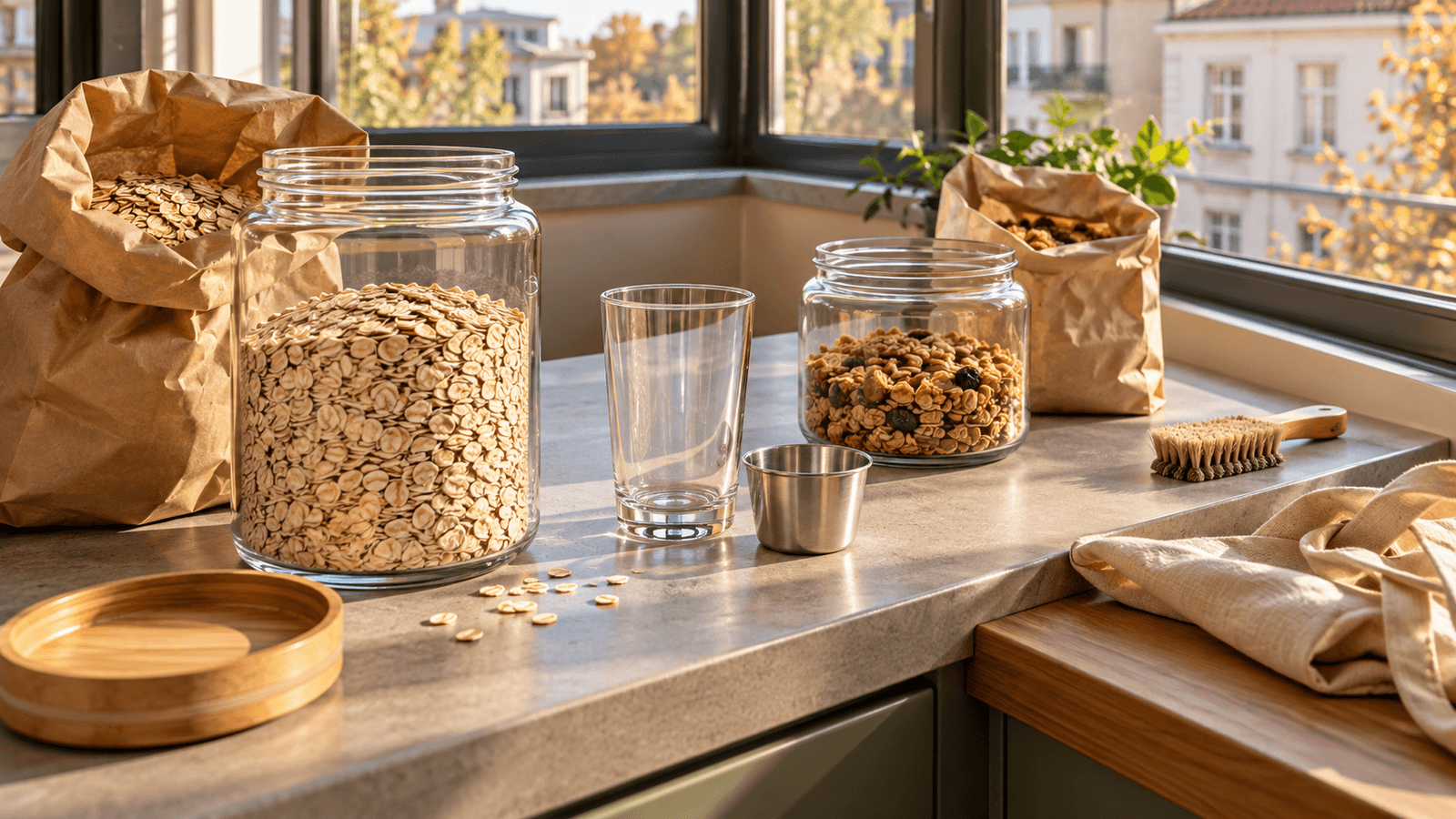
Oats and granola are often found in the same breakfast aisle, but nutritionally they are not the same thing.
Plain oats are a minimally processed cereal grain.
Granola is usually a prepared mixture built around oats and may also contain ingredients such as:
- nuts
- seeds
- oil
- honey or syrup
- sugar
- dried fruit
- chocolate
- flavorings
Those additions can change calories, sugar, fat, protein and portion size substantially.
So when comparing oats vs granola, the answer depends not only on the food category but also on the exact granola recipe and the amount you eat.
Oats vs granola at a glance
In general:
| Factor | Plain oats | Granola |
|---|---|---|
| Calorie density | Usually lower | Usually higher |
| Added sugar | Usually none in plain oats | Often present |
| Fat | Usually lower | Often higher due to nuts, seeds and oil |
| Fiber | Good source | Can also be a good source |
| Protein | Moderate | Varies with ingredients |
| Typical portion | Often larger by weight after preparation | Often smaller because it is energy-dense |
| Ingredients | Usually one ingredient | Usually multiple ingredients |
This is a general comparison.
Always check the nutrition label of the specific product you use.
Why granola is usually higher in calories
Granola often contains calorie-dense ingredients.
Common examples include:
- oil
- nuts
- seeds
- honey
- maple syrup
- sugar
- dried fruit
- chocolate
During baking, granola also loses moisture.
The result is a dry, concentrated food that can provide many calories in a relatively small volume.
Plain oats are also an energy-containing food, but they are usually not combined with added oils and sweeteners before you buy them.
Calories in oats
The exact calorie content varies slightly by oat type and product.
Dry oats are relatively calorie-dense compared with many fresh foods, but they absorb water during cooking.
This is important.
A portion of cooked oatmeal can become physically much larger because water adds weight and volume without adding calories.
If you cook oats with milk rather than water, the milk contributes additional calories and nutrients.
Toppings also count separately.
Calories in granola
Granola varies much more than plain oats.
One product may contain mostly oats with a modest amount of oil and sweetener.
Another may contain large amounts of:
- nuts
- seeds
- coconut
- chocolate
- dried fruit
- syrup
As a result, two granolas can have noticeably different calorie values.
For accurate tracking, use the label on the exact product rather than a generic granola entry whenever possible.
Portion size makes a major difference
Granola is easy to underestimate because a small portion can contain a substantial amount of energy.
A bowl that looks only partly filled may still contain a relatively large amount of granola by weight.
Oats are often eaten differently.
They may be cooked with water or milk, increasing the final volume.
Therefore, comparing one bowl of granola with one bowl of oatmeal visually is not very useful.
The bowls may contain very different amounts of dry food and calories.
Compare foods by weight when useful
Nutrition labels commonly provide information per 100 g.
This can be useful for comparing calorie density between oats and granola.
But a per-100-g comparison does not necessarily represent how much you will actually eat.
For practical meal planning, consider both:
- nutrition per 100 g
- your realistic portion
Oats vs granola: protein
Plain oats contain some protein.
Granola may contain a similar amount, more or less depending on its ingredients.
Granola containing nuts and seeds may have more protein than a simpler oat-based granola.
However, higher protein does not automatically mean lower calories.
Nuts and seeds also contain substantial amounts of fat and energy.
If protein is important to you, compare the actual protein value per 100 g and per portion.
Oats vs granola: fiber
Oats are a useful source of fiber and contain beta-glucan, a type of soluble fiber.
Granola can also contain significant fiber, particularly when it includes:
- whole-grain oats
- nuts
- seeds
- dried fruit
However, fiber content differs widely between granola products.
Do not assume that every granola is automatically high in fiber.
Check the label.
For more guidance, see How Much Fiber Do You Need Per Day?.
Oats vs granola: sugar
Plain oats naturally contain very little sugar.
Granola may contain sugar from:
- added sugar
- honey
- syrups
- dried fruit
- chocolate
- other sweetened ingredients
Some granolas contain relatively little added sugar, while others are much sweeter.
Check both:
- total sugars
- ingredient list
Where labeling rules provide added-sugar information, that can give additional context.
Oats vs granola: fat
Plain oats naturally contain some fat.
Granola often contains more because recipes may include:
- vegetable oil
- nuts
- seeds
- coconut
Fat is energy-dense, so these ingredients can contribute substantially to the calorie difference.
This does not mean dietary fat should be avoided.
It simply helps explain why granola can provide more calories in a smaller serving.
Which is more filling?
There is no universal answer because fullness depends on:
- portion size
- total calories
- protein
- fiber
- liquid content
- other foods eaten with it
- individual response
Cooked oats can provide a relatively large volume because they absorb liquid.
Granola is dry and concentrated, so the same number of calories may occupy less physical space.
On the other hand, granola can contain nuts, seeds and other ingredients that contribute fat, protein and fiber.
The complete meal matters more than the name of the cereal.
Oats for breakfast
Oats can be prepared with:
- water
- milk
- yogurt
- fruit
- seeds
- nuts
- nut butter
- spices
The final calorie content depends on everything added.
A plain bowl of oatmeal and oatmeal topped with nut butter, nuts, honey and dried fruit can have very different calorie totals.
Granola for breakfast
Granola is often eaten with:
- yogurt
- milk
- skyr
- fruit
Because granola can be calorie-dense, portion size is especially relevant.
Instead of filling an entire bowl with granola, some people use a smaller quantity as a crunchy topping on yogurt or fruit.
Whether that approach suits you depends on your preferences and nutritional goals.
Oats vs granola with Greek yogurt
Both can be combined with Greek yogurt.
Oats may provide a softer, less sweet base.
Granola provides crunch and often more sweetness and fat.
If you are tracking calories, record the yogurt and cereal separately.
See Calories in Greek Yogurt: Nutrition, Portions and Common Serving Sizes.
Which is better for weight loss?
Neither oats nor granola automatically causes weight loss.
Weight loss depends on maintaining an energy deficit over time.
Plain oats may make calorie management easier for some people because:
- they are usually less calorie-dense than granola
- cooked oats absorb liquid and increase in volume
- plain oats contain no added sugar or oil
Granola can still fit into a weight-loss diet.
The main practical issue is portion size because it is often energy-dense.
Choose the option that fits your overall calorie intake, preferences and eating habits.
Which is better for gaining weight?
Granola can be useful when someone wants a more energy-dense food because it can provide substantial calories in a relatively compact portion.
Adding granola to yogurt or milk can increase total energy intake without requiring a very large meal.
Oats can also support higher calorie intake when combined with ingredients such as:
- milk
- nuts
- seeds
- nut butter
- dried fruit
Again, the complete meal matters.
Which is better for protein?
Neither food is primarily a concentrated protein source.
If you want a higher-protein breakfast, you can combine oats or granola with foods such as:
- Greek yogurt
- skyr
- milk
- soy products
- other suitable protein sources
See Greek Yogurt vs Skyr: Nutrition and Protein Compared.
Which has fewer calories?
Plain oats usually contain fewer calories per 100 g than many commercial granolas, although exact products vary.
The practical difference can become even larger after oats are cooked with water because their volume increases.
However, toppings can quickly change the total.
Always compare the complete meal rather than assuming oatmeal is automatically low calorie.
Is granola healthy?
Granola can be part of a balanced diet.
Its nutritional profile depends heavily on its ingredients.
A granola containing whole grains, nuts and seeds is different from one containing large amounts of added sugar, chocolate and syrup.
Rather than asking whether all granola is healthy or unhealthy, look at:
- ingredients
- calorie density
- fiber
- protein
- sugar
- portion size
- how it fits into your overall diet
Are oats healthier than granola?
There is no universal answer.
Plain oats have a simple ingredient list and are usually lower in calorie density and added sugar.
Granola may provide additional nuts, seeds and other ingredients but can also contain more calories, fat and sugar.
Your goals and portion size determine which characteristics matter most.
How to choose granola
When comparing products, look at:
Calories per 100 g
This helps you compare energy density.
Realistic serving size
Ask how much you actually eat rather than relying only on the suggested serving.
Sugar
Compare total sugar and, where available, added sugar.
Fiber
Higher-fiber options may contribute more toward your daily fiber intake.
Protein
Useful if protein is one of your priorities.
Ingredient list
Ingredients are generally listed in descending order by weight.
This helps show what makes up most of the product.
How to make a granola portion easier to track
If you tend to pour granola directly from the bag, portions can vary considerably.
For more consistent tracking:
- place your bowl on a scale
- tare the scale
- add granola
- record the weight
- use the product's nutrition information
You do not need to weigh it forever if approximate tracking is sufficient for your goals.
How to track oats accurately
For dry oats, the simplest approach is often to weigh them before cooking.
Water adds no calories.
If you add milk, include the amount of milk separately.
Also record calorie-containing toppings such as:
- nuts
- seeds
- nut butter
- honey
- dried fruit
Dry oats vs cooked oats
This is a common source of confusion.
The weight of oats increases substantially after cooking because they absorb water.
If a database entry refers to dry oats but you enter the weight of cooked oatmeal, the calorie estimate can be very inaccurate.
Always check whether an entry refers to:
- dry oats
- cooked oatmeal
Use the state that matches what you measured.
Homemade granola
Homemade granola is not automatically lower in calories.
Recipes may contain substantial quantities of:
- oil
- nuts
- seeds
- honey
- syrup
The advantage of homemade granola is that you know exactly what went into the recipe.
For accurate nutrition:
- record every ingredient
- calculate the total recipe nutrition
- weigh the finished batch if practical
- calculate nutrition for the amount you actually eat
Common comparison mistakes
Comparing cooked oats with dry granola per 100 g
Cooked oats contain a large amount of water, so this is not an equivalent comparison.
Assuming granola is low calorie because it looks healthy
Nuts, seeds, oil and sweeteners can make it energy-dense.
Ignoring toppings on oatmeal
Nut butter, honey and nuts can substantially increase calories.
Using the suggested granola serving without checking your actual portion
Your real portion may be larger or smaller.
Treating every granola as nutritionally identical
Recipes differ substantially.
Practical examples
If you want a larger-volume breakfast
Cooked oats may be useful because they absorb liquid.
If you want crunch on yogurt
A smaller portion of granola can add texture without making granola the entire base of the meal.
If you want minimal added sugar
Plain oats are usually the simpler option.
If you need more energy in a compact portion
Granola may be useful because it is generally more calorie-dense.
If you want more protein
Combine either option with a protein-rich food rather than relying only on the cereal.
Frequently asked questions
Is granola more caloric than oats?
Usually, yes. Granola often contains oil, nuts, seeds and sweeteners and is typically more calorie-dense. Exact products vary.
Does granola contain more sugar than oats?
Plain oats contain very little sugar, while many granolas contain added sweeteners or dried fruit. Check the specific label.
Are oats good for weight loss?
Oats can fit into a weight-loss diet, but no individual food causes weight loss. Overall energy intake matters.
Can I eat granola while losing weight?
Yes. Portion size is particularly important because granola can be calorie-dense.
Which has more fiber?
Both can provide fiber. The exact amount depends on the granola recipe and the type of oats.
Should I weigh oats before or after cooking?
For consistent tracking, weighing dry oats before cooking is often simplest. Make sure the nutrition entry also refers to dry oats.
Is homemade granola healthier?
Not automatically. Its nutrition depends on the ingredients and quantities used.
Can oats and granola both be part of a balanced diet?
Yes. They simply have different nutritional characteristics and typical portion sizes.
The bottom line
Oats and granola may look similar because granola is often based on oats, but they are nutritionally different foods.
Plain oats are generally simpler and less calorie-dense, with little or no added sugar.
Granola is usually more concentrated and can contain additional fat, sugar, nuts, seeds and dried fruit.
Neither option is universally better.
Compare the actual product, consider your realistic portion and choose according to your nutritional goals and preferences.
This article provides general educational information and is not individualized medical or dietary advice.