
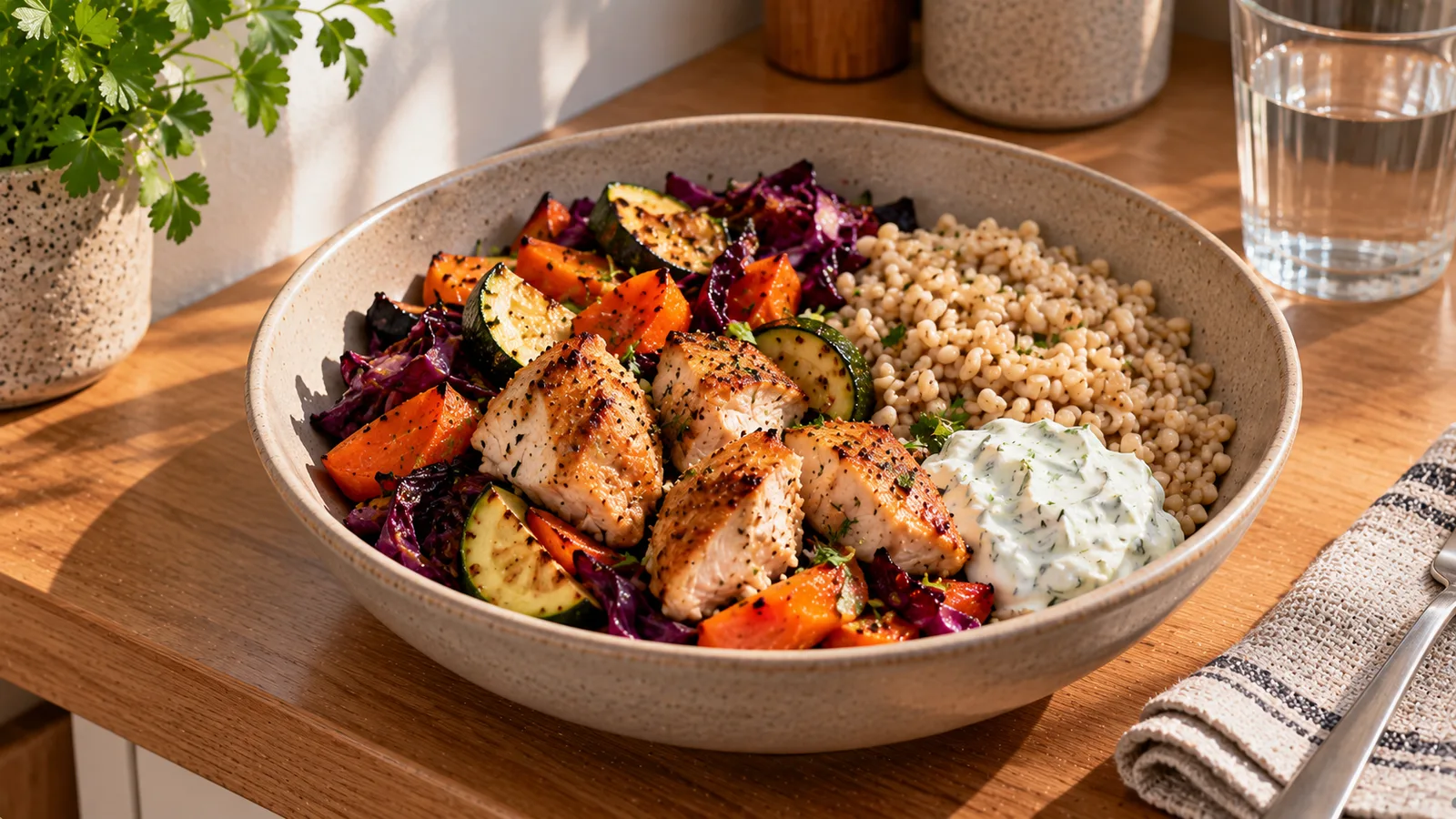
A lunch for weight loss does not need to be tiny, low-carb or made from special diet foods.
A practical lunch should help you stay within your overall energy needs while still providing enough food and nutrients to make the meal satisfying.
Instead of looking for one perfect weight-loss lunch, it is more useful to learn a simple structure that can be adapted to different foods, budgets and schedules.
What makes a good weight-loss lunch?
A useful lunch usually combines several elements:
- a meaningful source of protein;
- plenty of vegetables or some fruit;
- a fiber-rich carbohydrate when it fits the meal;
- a sensible amount of fat;
- a portion size that fits your daily energy needs.
The exact amounts are individual. Your calorie needs depend on factors such as body size, activity and overall goals.
The important point is that weight loss depends on the overall energy balance over time, not on one specific lunch food.
Start with a protein source
Protein gives the meal structure and can make it easier to build a substantial lunch without relying only on refined carbohydrates or added fats.
Examples include:
- chicken or turkey;
- fish;
- eggs;
- Greek yogurt or skyr;
- cottage cheese;
- tofu or tempeh;
- beans;
- lentils;
- chickpeas.
You do not need to use the same protein every day.
Rotating between animal and plant sources can also make lunches more varied.
Add a generous vegetable component
Vegetables can increase the volume and variety of a meal without requiring the lunch to become extremely energy-dense.
Examples:
- tomatoes;
- cucumber;
- peppers;
- broccoli;
- carrots;
- cabbage;
- leafy greens;
- courgette;
- mushrooms;
- mixed frozen vegetables.
Fresh vegetables are not the only option.
Frozen vegetables and suitable canned vegetables can be convenient choices, especially for work lunches or quick meals.
Include carbohydrates according to your needs
You do not need to remove carbohydrates from lunch to lose weight.
Useful options include:
- potatoes;
- brown rice;
- whole-grain pasta;
- quinoa;
- bulgur;
- oats in appropriate dishes;
- whole-grain bread;
- beans and other legumes.
The amount can vary according to your appetite, activity, total calorie target and what you plan to eat during the rest of the day.
If your lunch already contains a substantial amount of beans or lentils, remember that they contribute both protein and carbohydrates.
Do not forget fats — but watch the amount
Fat is an important part of a normal diet, but it is energy-dense.
Common lunch additions such as:
- olive oil;
- avocado;
- nuts;
- seeds;
- cheese;
- mayonnaise;
- creamy sauces
can increase calories quickly.
There is no need to eliminate them. The useful habit is simply to notice how much is being added.
For example, a salad with vegetables and chicken can change substantially in energy content when a large amount of oil, cheese, nuts and dressing is added.
A simple lunch-building formula
A practical framework is:
protein + vegetables + fiber-rich carbohydrate + optional fat
For example:
Chicken + vegetables + brown rice + olive-oil dressing
or:
Lentils + mixed vegetables + whole-grain bread + yogurt-based sauce
or:
Tofu + stir-fried vegetables + rice + sesame seeds
The purpose of the formula is not to create rigid rules. It is a quick way to check whether a meal is reasonably balanced.
A visual plate method
When you do not want to weigh or calculate everything, a visual structure can help.
One possible starting point is:
- about half of the meal: vegetables and/or fruit;
- about one quarter: a protein-rich food;
- about one quarter: a whole-grain or other suitable carbohydrate source;
- add a moderate amount of fat as needed.
This is a visual planning tool rather than a precise calorie formula.
Individual meals do not have to match these proportions exactly.
Example 1: chicken and rice lunch
A simple lunch could contain:
- grilled chicken;
- rice;
- broccoli and peppers;
- a small amount of olive oil or sauce.
To adjust the meal:
- need more protein? Increase the chicken;
- need more carbohydrates? Increase the rice;
- want more volume? Add vegetables;
- calories are higher than intended? Check oil, sauce and portion sizes first.
This method is more flexible than replacing the whole meal.
Example 2: lentil lunch
A plant-based lunch could include:
- lentils;
- tomatoes, cucumber and leafy vegetables;
- whole-grain bread;
- a yogurt-style or tahini-based dressing.
Because lentils provide both carbohydrate and protein, the meal structure differs from a chicken-and-rice lunch.
Balanced meals do not have to use identical proportions of every ingredient.
Example 3: quick work lunch
When time is limited:
- plain Greek yogurt or skyr;
- fruit;
- oats;
- a measured portion of nuts.
Or:
- whole-grain sandwich;
- chicken, tuna, egg or tofu filling;
- plenty of salad vegetables;
- fruit on the side.
Convenience does not automatically make a lunch unsuitable for weight loss.
What matters is the complete meal and its portion.
Example 4: leftover-based lunch
Lunch can simply be a planned portion of last night's dinner.
This can work especially well when the original meal already contains:
- a protein source;
- vegetables;
- a carbohydrate source.
Portion the leftovers before storing them so that lunch is ready rather than assembled when you are already hungry.
How many calories should lunch contain?
There is no universal calorie number for a weight-loss lunch.
Consider a person with a daily target of 1,800 kcal.
One possible distribution could be:
| Eating occasion | Example calories |
|---|---|
| Breakfast | 400 |
| Lunch | 500 |
| Snack | 200 |
| Dinner | 700 |
| Total | 1,800 |
Another person might prefer a 650-kcal lunch and a smaller dinner.
Both patterns can fit the same daily total.
The useful question is therefore not:
“How few calories can I eat at lunch?”
but:
“How does this lunch fit into the rest of my day?”
If you get hungry soon after lunch
Look at the composition before simply trying to make the meal larger.
Ask:
- Did the lunch contain a clear protein source?
- Were there vegetables, fruit or another fiber-containing food?
- Was the meal extremely small?
- Did most calories come from a small amount of energy-dense food?
- Was the lunch mostly refined carbohydrate with little protein?
- Are you routinely leaving too few calories for daytime meals?
A lunch that repeatedly leaves you very hungry may make the rest of the day harder to manage.
If lunch is too calorie-dense
You do not necessarily need a completely different meal.
Look first at ingredients that add substantial calories in relatively small amounts:
- oils;
- mayonnaise;
- creamy dressings;
- cheese;
- nuts;
- large avocado portions;
- fried coatings;
- large bread or grain portions;
- sugary drinks.
Reducing one or two of these can change the meal while keeping its basic structure intact.
Compare two versions of the same lunch
Imagine a chicken salad.
Version A
- chicken;
- mixed vegetables;
- beans;
- modest dressing.
Version B
- chicken;
- mixed vegetables;
- large amount of oil-based dressing;
- cheese;
- nuts;
- croutons;
- creamy sauce.
Both are called “salad,” but their calorie content can be very different.
Food labels such as “healthy,” “salad” or “high protein” do not tell you the total energy content.
Lunch at a restaurant
Restaurant lunches can still fit into a weight-loss plan.
Useful strategies include:
- check the menu before ordering when possible;
- identify the main protein source;
- look at how the food is cooked;
- notice calorie-dense sauces and dressings;
- choose vegetables as part of the meal;
- consider whether the restaurant portion is larger than you need;
- stop when comfortably satisfied rather than treating the served portion as a requirement.
You do not need to make the lowest-calorie choice every time.
The goal is to make a reasonable choice within the context of the whole day.
Lunch from a supermarket
A supermarket lunch can be assembled quickly.
For example:
- ready-to-eat protein such as cooked chicken, tuna, eggs, tofu or a suitable dairy product;
- pre-washed salad or vegetables;
- bread, potatoes, rice or another carbohydrate source;
- fruit;
- a portioned dressing or other fat source.
Check labels when buying prepared foods because sauces and portion sizes can vary substantially.
Sandwiches can fit
A sandwich is not automatically a poor weight-loss lunch.
A practical sandwich can include:
- whole-grain bread;
- a substantial protein filling;
- vegetables;
- a moderate amount of spread or sauce.
Add fruit, vegetables or yogurt if you need a more complete meal.
The total composition matters more than avoiding bread simply because you are trying to lose weight.
Soup can fit too
Soup can be a useful lunch, but soups differ greatly.
A more substantial soup may include:
- beans or lentils;
- chicken, fish or tofu;
- vegetables;
- potatoes or grains.
A very light vegetable broth may not provide enough protein or energy to function as a satisfying lunch on its own.
Cream-heavy soups, meanwhile, can be much more energy-dense than they appear.
Consider the ingredients rather than judging the meal only by the word “soup.”
Meal-prep lunches
For several workdays, use a repeatable template:
- choose one or two protein sources;
- cook a batch of vegetables;
- prepare a carbohydrate base;
- portion sauces and fats separately;
- assemble several combinations.
For example:
- chicken + rice + broccoli;
- chicken + potatoes + mixed vegetables;
- lentils + rice + vegetables;
- tofu + noodles + vegetables.
Changing sauces, vegetables or seasonings can add variety without requiring a completely different system every day.
When you do not track calories
You can still make lunch more structured.
Use:
- a consistent plate or container;
- a clear protein source;
- plenty of vegetables;
- a sensible portion of carbohydrate;
- visible rather than accidental fats;
- hunger and fullness feedback.
The hand portion method can also provide a practical visual approach when you do not want to use a food scale.
When you do track calories
If you track food, focus on the ingredients that most affect the result.
For a mixed lunch, these often include:
- cooking oil;
- sauces;
- cheese;
- nuts;
- grains;
- bread;
- protein portions.
Vegetables still matter nutritionally, but small errors in estimating low-energy vegetables usually affect the calorie total less than forgetting a large amount of oil or dressing.
Plan lunch in the context of dinner
A common mistake is treating every meal independently.
If you know dinner will be larger, lunch can be somewhat lighter while still containing protein, vegetables and enough food to be satisfying.
If dinner will be small or late, a more substantial lunch may fit better.
The daily pattern matters more than making lunch identical every day.
Weight loss does not require a “perfect” lunch
One meal can be higher in calories than planned.
Another may contain fewer vegetables.
You may occasionally eat pizza, pasta, a restaurant meal or dessert at lunch.
That does not determine the outcome of your overall weight-loss effort.
Return to your normal eating pattern at the next meal instead of trying to compensate with extreme restriction.
A practical lunch checklist
Before eating or planning lunch, ask:
- What is my main protein source?
- Is there a meaningful amount of vegetables or fruit?
- What is my main carbohydrate source?
- Where is most of the fat coming from?
- Does the portion make sense for my day?
- Is this likely to keep me reasonably satisfied?
- Can I realistically prepare, buy or repeat this meal?
If most of those questions have clear answers, the lunch is probably much easier to manage consistently.
How Mealisa can help
Mealisa can place lunch in the context of your entire day rather than judging it as an isolated meal.
After breakfast and lunch are logged, the remaining calories and macros can help guide the size and composition of later meals.
This makes it easier to adapt when lunch is larger or smaller than originally planned.
Key takeaway
A useful lunch for weight loss is not defined by one specific food or a very low calorie number.
Build the meal around:
- protein;
- vegetables or fruit;
- an appropriate carbohydrate source;
- a sensible amount of fat;
- a portion that fits your overall daily needs.
Then adjust the quantities to your appetite, schedule and calorie target.
The best lunch is one that supports your overall diet and is practical enough to repeat.