
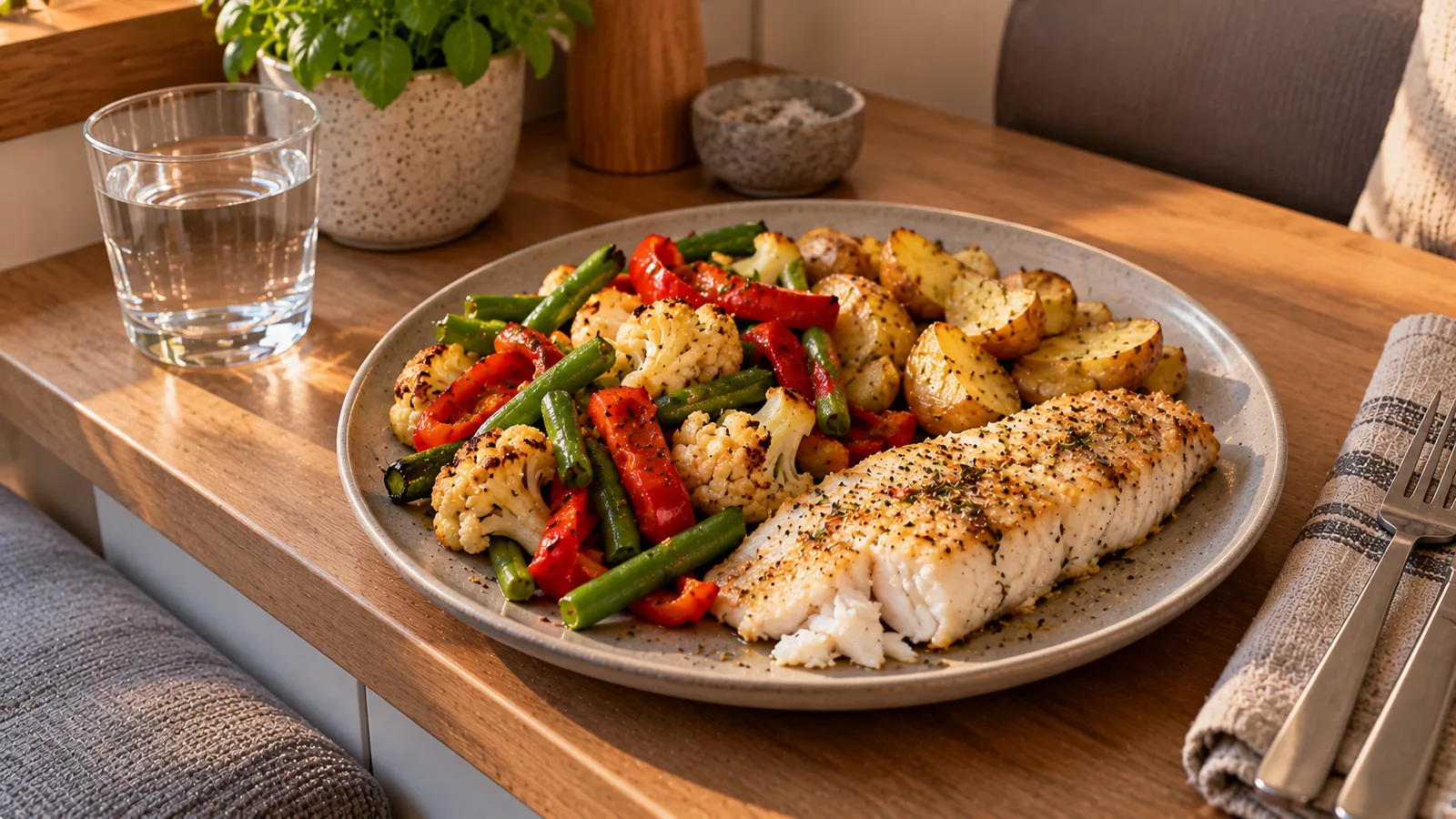
Dinner does not need to be tiny, carbohydrate-free or limited to salad when you are trying to lose weight.
A useful weight-loss dinner is one that helps you stay within an appropriate overall energy intake while still feeling like a real meal.
For many people, that means combining a meaningful protein source, plenty of vegetables or another high-volume food, an appropriate portion of carbohydrate, and enough fat or sauce to make the meal enjoyable without letting calorie-dense additions dominate it.
Start with the whole day, not dinner in isolation
Weight loss depends on your overall energy balance over time, not on whether dinner itself is especially low in calories.
A 600 kcal dinner can fit easily into one person's day and be too large or too small for another.
What matters is how dinner fits with:
- breakfast;
- lunch;
- snacks;
- drinks;
- your total energy needs;
- your preferred meal pattern.
If you prefer a larger evening meal, you can allocate more of your daily intake to dinner.
If you eat more earlier in the day, dinner may naturally be smaller.
There is no universal calorie target that every weight-loss dinner needs to meet.
A practical dinner structure
Instead of starting with a calorie number, start with the components of the meal.
A useful framework is:
| Component | Examples | Main role |
|---|---|---|
| Protein | Chicken, fish, eggs, tofu, tempeh, beans, lentils | Protein and meal structure |
| Vegetables | Broccoli, peppers, carrots, tomatoes, zucchini, salad | Volume, fiber and micronutrients |
| Carbohydrate | Potatoes, rice, pasta, whole grains, bread, legumes | Energy and meal satisfaction |
| Fat/flavor | Olive oil, avocado, cheese, nuts, sauces | Flavor, texture and energy |
This is a flexible framework rather than a rigid plate rule.
The appropriate amount of each component depends on your needs and the rest of the day.
1. Choose a meaningful protein source
Protein can help make dinner more substantial and supports the maintenance of lean tissue during weight loss when combined with appropriate overall nutrition and activity.
Practical dinner options include:
- chicken or turkey;
- fish or seafood;
- eggs;
- tofu or tempeh;
- lentils or beans;
- Greek yogurt or cottage cheese as part of a meal;
- lean meat if you eat it.
The goal is not to make dinner almost entirely protein.
Instead, make sure protein is a clear part of the meal rather than a small garnish.
For example, a vegetable stir-fry with a few pieces of tofu may feel very different from the same stir-fry with a substantial tofu portion.
2. Use vegetables to add volume
Vegetables can increase the physical size of a meal without necessarily adding a large number of calories.
Examples include:
- broccoli;
- cauliflower;
- zucchini;
- mushrooms;
- peppers;
- tomatoes;
- cabbage;
- carrots;
- leafy greens.
They can be roasted, steamed, grilled, stir-fried or incorporated into soups and sauces.
You do not need to eat a plain salad every evening.
A large portion of roasted vegetables, a vegetable-rich curry or a substantial soup can serve the same practical purpose.
3. Do not automatically remove carbohydrates
Rice, pasta, potatoes and bread do not need to disappear from dinner simply because you are trying to lose weight.
The more useful question is how much fits the meal.
Consider the difference between:
- a measured portion of pasta with vegetables and protein;
- a very large pasta serving with a calorie-dense sauce and little else.
The issue is not that pasta exists in the meal. The total composition and portion are different.
Carbohydrate options can include:
- potatoes;
- rice;
- pasta;
- couscous;
- bulgur;
- quinoa;
- bread;
- beans and lentils.
Choose the option that makes the dinner enjoyable and practical for you.
4. Pay attention to calorie-dense additions
A dinner can begin with relatively moderate-calorie ingredients and become much more energy-dense through additions that are easy to underestimate.
Examples include:
- cooking oil;
- creamy sauces;
- cheese;
- mayonnaise;
- pesto;
- nuts;
- seeds;
- butter;
- large amounts of dressing.
These foods do not need to be eliminated.
The useful step is simply to recognize that relatively small quantities can contribute meaningful calories.
For example, 20 g of oil contributes roughly 180 kcal.
That can be more than the calorie difference between two very different-looking portions of vegetables.
Three examples of satisfying dinner structures
Example 1: Chicken, potatoes and vegetables
- grilled chicken;
- boiled or roasted potatoes;
- a large portion of broccoli and carrots;
- yogurt-herb sauce.
This gives the meal a clear protein source, carbohydrate and substantial vegetable volume.
Example 2: Lentil curry with rice
- lentil and vegetable curry;
- a moderate portion of rice;
- extra vegetables;
- yogurt or herbs if desired.
The lentils contribute both protein and fiber.
Example 3: Tofu stir-fry
- tofu;
- mixed vegetables;
- rice or noodles;
- soy, ginger and lime-based seasoning.
The amount of cooking oil and sauce can be adjusted independently from the amount of vegetables.
What if you are hungry again after dinner?
Repeated evening hunger is useful information.
Before assuming you need more willpower, look at the meal and the rest of the day.
Ask:
- Was there a substantial protein source?
- Was the dinner physically large enough?
- Did it include fiber-rich foods?
- Was lunch unusually small?
- Did you skip meals?
- Was dinner mostly a small amount of highly calorie-dense food?
- Are you using a calorie target that is unnecessarily aggressive?
Sometimes the solution is not to make dinner smaller.
It may be to build a more complete dinner or distribute food differently across the day.
Large plate, low satisfaction
A physically large dinner is not automatically satisfying.
For example, a huge salad made almost entirely from lettuce, cucumber and tomatoes may have plenty of volume but very little protein or energy.
If you finish it and immediately want another meal, the structure may be incomplete.
Adding a meaningful protein source and an appropriate carbohydrate or fat component can make the meal more functional.
Small plate, high calories
The opposite can also happen.
A relatively small dinner can contain many calories if it includes large amounts of:
- oil;
- cheese;
- creamy sauce;
- fried foods;
- nuts;
- calorie-dense toppings.
This is why visual size alone is not a reliable guide to energy intake.
A plate method can be useful — but it is not a calorie calculator
A simple visual approach can help when you do not want to weigh every ingredient.
You might build a plate around:
- a substantial vegetable section;
- a clear protein section;
- a moderate carbohydrate section;
- smaller amounts of calorie-dense sauces or fats.
But plate fractions cannot tell you the exact calorie content.
A plate containing salmon, avocado and oil can have a very different calorie total from a visually similar plate containing white fish, potatoes and vegetables.
Use the visual method for structure, not false precision.
If you prefer estimating portions without a scale, see Hand Portion Method: How to Estimate Portions Without a Scale.
What about dinner after exercise?
Exercise does not require a completely different definition of a weight-loss dinner.
You can still use the same basic structure.
Depending on your activity, total diet and preferences, you may want an appropriate amount of protein and carbohydrate around training.
The key point is that the meal still needs to fit your overall intake rather than treating exercise as an automatic reason for an unlimited dinner.
What about late dinners?
Eating late does not automatically prevent weight loss.
The more important issue is total energy intake and whether your eating pattern works for you.
However, late dinners can create practical problems for some people if they:
- arrive home extremely hungry;
- snack heavily while cooking;
- eat a large dinner and continue snacking afterward;
- rely on takeaway because nothing is prepared.
In that situation, meal planning can matter more than the clock itself.
Having a prepared dinner or a reliable backup meal can reduce decisions made when you are already very hungry.
Restaurant dinners
Restaurant meals can be harder to estimate because portions, oils and sauces are less visible.
A practical approach is to identify the same basic components:
- protein source;
- vegetables;
- carbohydrate;
- sauces, oils and extras.
You do not need perfect information to make a reasonable decision.
If a dish is already rich in oil, cheese or creamy sauce, you may not need several additional calorie-dense sides.
But there is no need to turn one restaurant dinner into a compensatory fast the next day.
Return to your normal routine.
Takeaway dinners
Takeaway meals can still fit a weight-loss plan.
Useful strategies include:
- choosing a portion you actually need rather than automatically finishing the container;
- adding vegetables when the meal lacks them;
- saving part for another meal;
- keeping sauces separate when practical;
- checking nutrition information when the restaurant provides it.
The goal is not to find a magically “diet” takeaway.
It is to make the meal fit your broader eating pattern.
Five dinner combinations
Here are examples rather than fixed meal plans:
| Dinner | Protein | Vegetables | Carbohydrate |
|---|---|---|---|
| Chicken bowl | Chicken | Peppers, broccoli | Rice |
| Salmon dinner | Salmon | Green beans, salad | Potatoes |
| Lentil curry | Lentils | Tomatoes, spinach, carrots | Rice |
| Tofu stir-fry | Tofu | Mixed stir-fry vegetables | Noodles |
| Egg dinner | Eggs | Mushrooms, tomatoes, salad | Whole-grain bread |
Portions can be adjusted according to energy needs, hunger and what you have already eaten that day.
If dinner is your largest meal
That can still work.
There is no requirement that dinner must be the smallest meal of the day.
If you genuinely prefer eating more in the evening, you can plan around that preference.
The potential problem is not the existence of a large dinner.
It is when the large dinner is added on top of a day that already contains enough energy for your needs.
Planning the day intentionally is different from repeatedly reaching dinner with no idea how much you have already eaten.
If you prefer a smaller dinner
That can work too.
A smaller dinner may be comfortable if you eat a substantial breakfast and lunch.
Even then, try to make it coherent rather than simply removing food at random.
For example:
- vegetable soup plus a protein source;
- eggs with vegetables and bread;
- cottage cheese with vegetables and potatoes;
- tofu and vegetable bowl with a smaller grain portion.
Dinner does not need to be perfect every night
Weight loss is determined by patterns over time.
One larger dinner does not erase your progress, just as one very light dinner does not create meaningful long-term progress by itself.
A sustainable dinner strategy should be repeatable.
That usually means keeping foods you enjoy, using portions that fit your needs and avoiding rules that make normal social or family meals unnecessarily difficult.
A quick dinner check
Before changing your dinner, check these five questions:
- Is there a clear protein source?
- Is there enough food volume to make the meal feel substantial?
- Does the carbohydrate portion fit the meal and your needs?
- Are oils, sauces and toppings adding more calories than you realize?
- Does this dinner fit the rest of your day?
If the answer to those questions is generally yes, you probably do not need a special collection of “weight-loss foods.”
You need a dinner structure that you can use consistently.
Planning dinners ahead
If dinner decisions become difficult when you are tired or hungry, planning several dinners in advance can help.
You do not need to cook everything on Sunday.
Simply deciding which meals you are likely to make and having the ingredients available can remove a major point of friction.
See How to Plan Dinners for the Week.
For the broader principles of constructing filling meals during weight loss, see How to Build a Filling Meal for Weight Loss.
A useful dinner for weight loss is not defined by one specific food or calorie number. It is a meal that is satisfying enough to work in real life and structured well enough to fit your overall energy intake.