
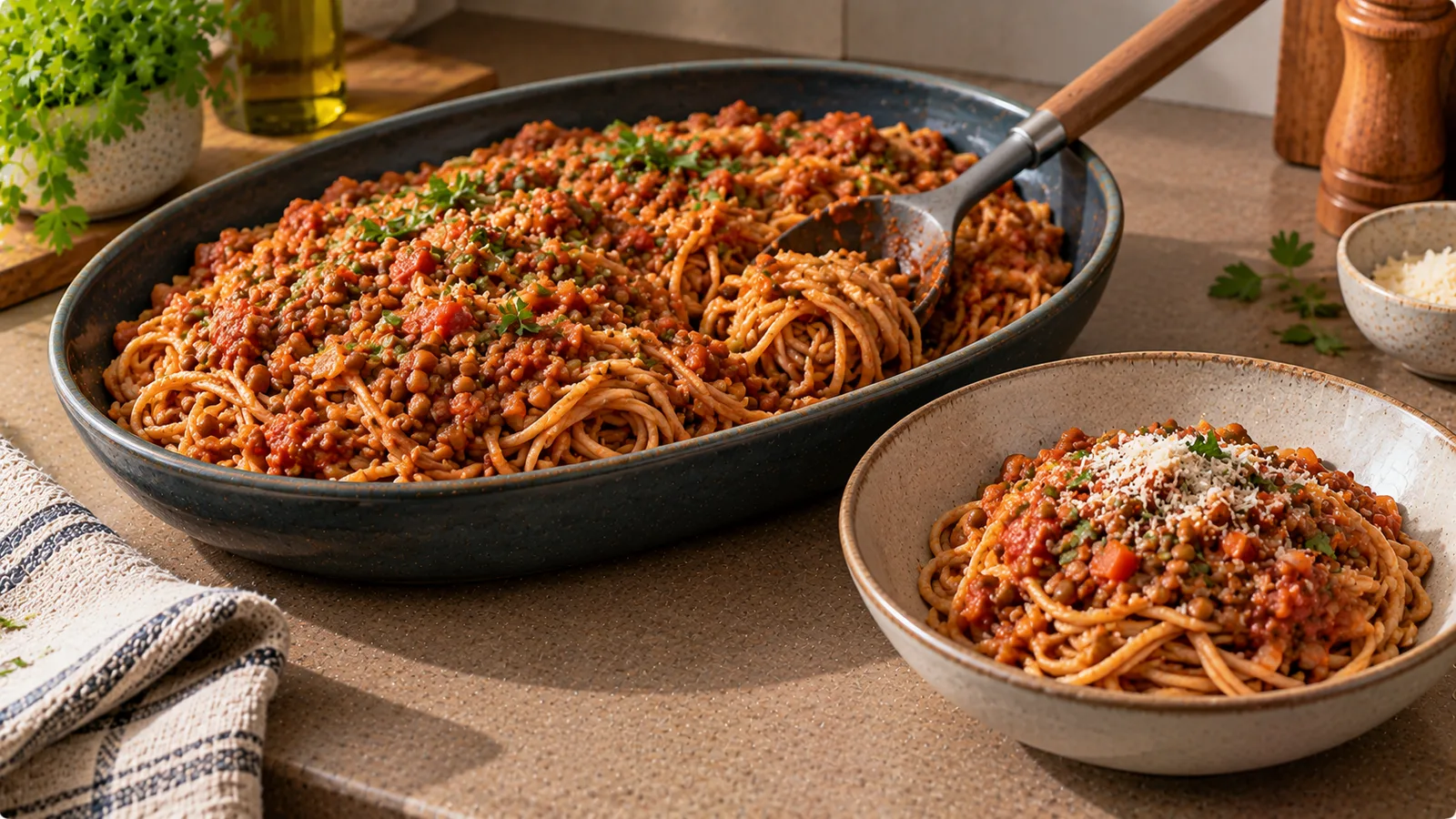
Lentil Bolognese is a practical vegetarian alternative to a traditional meat-based pasta sauce.
Lentils provide protein and fiber, while finely chopped vegetables and tomatoes create a thick sauce that works well with whole-wheat pasta.
This version makes:
4 substantial portions
and uses dry pasta and cooked lentils as the measurement basis.
Ingredients
For the lentil Bolognese
- 400 g cooked brown or green lentils, drained;
- 400 g canned chopped tomatoes;
- 300 g passata;
- 150 g onion, finely diced;
- 150 g carrots, finely diced;
- 120 g celery, finely diced;
- 15 g olive oil;
- 3 garlic cloves, minced;
- 20 g tomato paste;
- 1 teaspoon dried oregano;
- 1 teaspoon dried basil;
- 1/2 teaspoon smoked paprika;
- 150 ml water or vegetable stock;
- black pepper to taste;
- salt to taste.
For the pasta
- 300 g dry whole-wheat pasta.
Optional for serving:
- fresh basil or parsley;
- grated Parmesan or a vegetarian hard cheese;
- chili flakes.
Ingredient basis matters
The quantities in this recipe use:
400 g cooked and drained lentils
and:
300 g dry whole-wheat pasta
This distinction matters when calculating nutrition.
Dry pasta absorbs water during cooking and becomes substantially heavier.
The calories do not increase because of the absorbed water.
If 300 g dry pasta becomes approximately 700–750 g after cooking, it still contains the calories originally present in the 300 g dry pasta.
Step 1: Prepare the vegetables
Finely dice the onion, carrots and celery.
Smaller pieces integrate into the sauce more effectively and create a texture closer to a traditional Bolognese.
Heat the olive oil in a large saucepan over medium heat.
Add:
- onion;
- carrots;
- celery.
Cook for approximately:
7–9 minutes
until the vegetables begin to soften.
Stir regularly so they cook evenly without burning.
Step 2: Add garlic and tomato paste
Add the minced garlic and cook for approximately:
30–60 seconds
until fragrant.
Add the tomato paste.
Cook it with the vegetables for another:
1–2 minutes
Stir frequently.
Briefly cooking the tomato paste can deepen the flavor of the sauce.
Step 3: Build the sauce
Add:
- chopped tomatoes;
- passata;
- oregano;
- basil;
- smoked paprika;
- black pepper;
- 150 ml water or vegetable stock.
Stir well.
Bring the mixture to a gentle simmer.
Cook uncovered for approximately:
10 minutes
so the vegetables continue to soften and the sauce begins to thicken.
Step 4: Add the lentils
Stir in:
400 g cooked lentils
Simmer for another:
12–15 minutes
Stir occasionally.
If the sauce becomes too thick, add a small amount of water.
If it remains too thin, continue simmering uncovered for several additional minutes.
Taste before adding salt, particularly if the lentils, tomatoes or stock already contain sodium.
Step 5: Cook the whole-wheat pasta
While the sauce simmers, bring a large pot of water to a boil.
Cook:
300 g dry whole-wheat pasta
according to the package instructions until the texture is suitable for you.
Before draining, reserve approximately:
100 ml pasta water
Drain the pasta.
Do not rinse it unless there is a specific reason to do so.
Step 6: Combine or portion separately
You can combine the pasta directly with the Bolognese or portion the two components separately.
If combining them, add a small amount of reserved pasta water if necessary to help the sauce coat the pasta.
For precise meal preparation, keeping the pasta and sauce separate can make portioning easier.
Approximate nutrition per portion
Using the main ingredients listed above and dividing the complete recipe into four equal portions, one serving is approximately:
- 520–570 kcal;
- 23–27 g protein;
- 90–100 g carbohydrate;
- 8–12 g fat;
- 17–22 g fiber.
These values are estimates.
Actual nutrition depends on:
- the pasta brand;
- the type of lentils;
- canned tomato products;
- olive oil amount;
- optional cheese;
- exact portion size.
Why the recipe is filling
Several components contribute to satiety.
Lentils provide a combination of:
- protein;
- fiber;
- slowly digested carbohydrate.
Whole-wheat pasta also generally contains more fiber than standard refined pasta.
The vegetables add volume without requiring large amounts of oil.
Together, these ingredients create a substantial meal from relatively simple pantry staples.
Brown or green lentils work best
Brown and green lentils retain their shape relatively well after cooking.
That makes them useful for a Bolognese-style sauce where some texture is desirable.
Red lentils behave differently.
They soften and break down more readily, producing a smoother sauce.
Red lentils can still be used, but the final texture will be different.
Using canned lentils
Canned lentils make the recipe faster.
Drain them before weighing.
If the can contains a salty liquid, rinsing can also remove some surface sodium.
For this recipe, measure approximately:
400 g drained lentils
rather than using the total weight printed on the front of the can if that weight includes liquid.
Using lentils cooked from dry
You can also cook lentils from dry.
The exact yield depends on the variety and cooking method, but dry lentils gain substantial weight by absorbing water.
For the recipe, the simplest approach is:
- cook the lentils;
- drain excess water;
- weigh 400 g cooked lentils;
- add that amount to the sauce.
This avoids confusing dry and cooked database values when tracking the meal.
Why use whole-wheat pasta?
Whole-wheat pasta keeps more of the grain components than refined pasta and generally provides more fiber.
It also has a slightly firmer texture and nuttier flavor that works well with lentil sauce.
However, regular pasta can be substituted directly if preferred.
Use the same:
300 g dry pasta
as the starting quantity.
Nutrition values will change somewhat depending on the product.
How much pasta per person?
This recipe uses:
300 g dry pasta for four servings
That equals:
75 g dry pasta per serving
before cooking.
For larger portions, you could use 350–400 g dry pasta for the same amount of sauce.
For smaller portions, 240–280 g may be enough.
Changing the pasta quantity will also change the calories and carbohydrate per serving.
Adding mushrooms
Mushrooms can add more savory flavor and texture.
Add approximately:
200–250 g finely chopped mushrooms
after the onion, carrot and celery have begun to soften.
Cook until much of their released water evaporates before adding the garlic and tomato paste.
If you add mushrooms without changing the other ingredients, the recipe will produce slightly more total food.
Adding zucchini
Finely diced zucchini can also be used.
Approximately:
200 g
works well.
Because zucchini releases water, allow the sauce enough uncovered simmering time to reach the desired thickness.
Adding more protein
If you want to increase the protein content while keeping the recipe vegetarian, possible additions include:
- more lentils;
- crumbled firm tofu;
- textured vegetable protein;
- a protein-rich grated cheese at serving.
Each option changes the calorie and macronutrient profile.
If you change the ingredients substantially, update the recipe nutrition rather than relying on the original estimate.
Parmesan and other toppings
Cheese is not included in the base nutrition estimate.
For example, adding:
15 g Parmesan
to each serving adds roughly:
60 kcal
and several grams of protein, depending on the product.
Olive oil drizzled over the finished dish should also be counted separately if you are tracking calories.
A lower-calorie variation
The recipe already uses a moderate amount of oil.
If desired, you can reduce the olive oil from:
15 g to 10 g
The difference for the whole recipe is approximately:
45 kcal
or roughly:
11 kcal per serving
when divided into four portions.
Larger calorie changes usually come from adjusting pasta quantity, cheese or additional oil rather than tiny changes to vegetables.
A higher-energy version
For a more energy-dense meal, you could:
- increase the pasta portion;
- add grated cheese;
- finish with olive oil;
- serve with bread.
For example, increasing pasta from 300 g to 400 g dry adds 100 g of dry pasta to the recipe.
If that pasta contains 350 kcal per 100 g, the complete recipe gains approximately:
350 kcal
or:
88 kcal per portion
across four servings.
Meal-prep method
Lentil Bolognese works well for meal preparation.
One practical approach is to divide the sauce into four containers and store the pasta separately.
This helps prevent the pasta from absorbing too much sauce during storage.
Another option is to combine everything immediately if convenience is more important than maintaining the original pasta texture.
Portioning by weight
If you want four equal portions, you can simply divide the recipe visually.
For more consistent portions, weigh the cooked food.
Suppose the complete cooked pasta and sauce weigh:
2,000 g
and you want four equal servings.
Each serving would be:
500 g
If the final yield is 1,920 g:
1,920 ÷ 4 = 480 g per serving
The final cooked weight can vary because of water absorption and evaporation.
Tracking the recipe accurately
For nutrition tracking, enter the ingredients using the same state in which they were measured.
In this recipe:
- pasta is measured dry;
- lentils are measured cooked and drained;
- vegetables are measured as listed;
- olive oil is measured before cooking.
Do not enter 300 g cooked pasta if the recipe actually used 300 g dry pasta.
Those represent very different amounts of food and calories.
What happens when the sauce loses water?
Simmering removes water from the sauce.
This changes:
calories per 100 g
because the finished sauce becomes lighter and more concentrated.
It does not remove a meaningful amount of calories from the ingredients.
For example, if the sauce contains 1,200 kcal before simmering and loses 300 g of water, it still contains approximately the same total energy afterward.
The energy is simply distributed across a smaller finished weight.
Leftovers
Cool leftovers promptly and refrigerate them in suitable containers.
As a practical general guideline, cooked leftovers are commonly used within:
3–4 days
when continuously refrigerated at approximately:
4°C / 40°F or below
If you know you will not eat a portion within that period, freezing it is a useful option.
Freezing lentil Bolognese
The lentil sauce freezes particularly well.
For best texture, consider freezing the sauce separately and cooking fresh pasta later.
The complete pasta dish can also be frozen, but the pasta may become softer after thawing and reheating.
Label containers with the date so older portions are used first.
Reheating
Reheat leftovers until thoroughly hot throughout.
If the sauce has become very thick in the refrigerator, add a small splash of water before reheating.
For pasta stored separately, reheating it together with the sauce can help restore moisture.
Five-minute leftover variation
If you already have a portion of lentil Bolognese, you can change the meal without making a new sauce.
Try serving it with:
- a baked potato;
- cooked rice;
- couscous;
- roasted vegetables.
This can make leftovers feel different while using the same prepared base.
Grocery list
For the base recipe, buy or have available:
Produce
- 1 medium-large onion;
- 2 medium carrots;
- 2 celery stalks;
- 3 garlic cloves.
Pantry
- 300 g whole-wheat pasta;
- 400 g cooked lentils;
- 400 g canned chopped tomatoes;
- 300 g passata;
- tomato paste;
- olive oil;
- oregano;
- basil;
- smoked paprika;
- salt;
- black pepper.
Optional:
- Parmesan or vegetarian hard cheese;
- fresh herbs;
- chili flakes.
Approximate cooking timeline
A realistic workflow is:
0–10 minutes: chop vegetables and begin sautéing.
10–13 minutes: add garlic and tomato paste.
13–23 minutes: add tomato products and simmer.
Around minute 15: start heating pasta water.
23–38 minutes: add lentils and continue simmering while pasta cooks.
Around minute 38–40: drain pasta, adjust sauce and serve.
Total active and cooking time is approximately:
40 minutes
depending on chopping speed and the pasta used.
Scaling to two servings
For approximately two servings, halve the ingredients:
- 200 g cooked lentils;
- 200 g chopped tomatoes;
- 150 g passata;
- 75 g onion;
- 75 g carrots;
- 60 g celery;
- 7–8 g olive oil;
- 150 g dry whole-wheat pasta.
Seasonings can also be reduced, although they do not always need to be divided with perfect mathematical precision.
Scaling to eight servings
Double the base recipe:
- 800 g cooked lentils;
- 800 g chopped tomatoes;
- 600 g passata;
- 300 g onion;
- 300 g carrots;
- 240 g celery;
- 30 g olive oil;
- 600 g dry whole-wheat pasta.
Use a sufficiently large pot.
A larger quantity of sauce may need slightly more simmering time because more liquid must evaporate.
A practical vegetarian pasta dinner
The strength of lentil Bolognese is not that it perfectly imitates minced meat.
It is that lentils naturally work well in a thick tomato sauce while adding protein, fiber and texture.
Keeping the measurement basis clear makes the recipe easier to reproduce and track:
300 g dry whole-wheat pasta + 400 g cooked and drained lentils
for four substantial servings.
From there, vegetables and seasonings can be adjusted without changing the basic structure of the meal.