
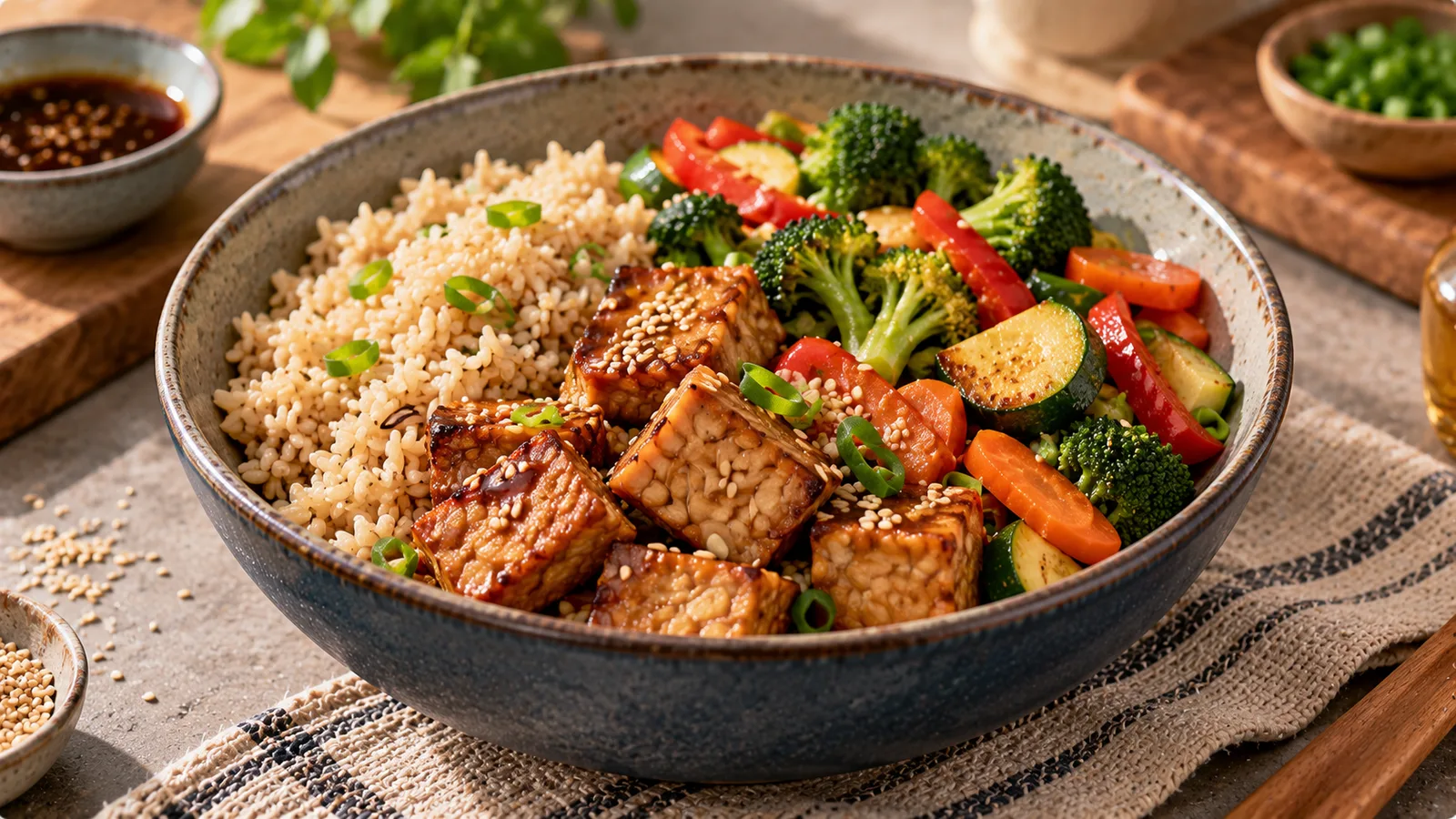
This tempeh rice bowl combines browned tempeh, brown rice, colorful vegetables and a simple soy-lime sauce in one complete meal.
The recipe makes 4 servings and uses exact quantities so the cooked batch can be divided consistently.
Tempeh rice bowl at a glance
- Servings: 4
- Preparation time: about 15 minutes
- Cooking time: about 30 minutes
- Total time: about 45 minutes
- Main protein: tempeh
- Grain: brown rice
- Cooking method: stovetop
Ingredients
For the rice
- 240 g dry brown rice
- water according to the rice package instructions
- small pinch of salt, optional
For the tempeh and vegetables
- 400 g plain tempeh
- 250 g broccoli
- 200 g red bell pepper
- 150 g carrots
- 150 g zucchini
- 100 g red or yellow onion
- 15 g neutral cooking oil
For the sauce
- 40 ml reduced-sodium soy sauce
- 25 ml fresh lime juice
- 15 g maple syrup or honey
- 10 g sesame oil
- 10 g fresh ginger, finely grated
- 2 garlic cloves, finely minced
- 60 ml water
Optional garnish
- sliced spring onion
- fresh coriander
- chili flakes
- sesame seeds
Optional garnishes are not included in the nutrition estimate unless stated otherwise.
Ingredient quantities by serving
The full recipe contains:
- 400 g tempeh;
- 240 g dry brown rice;
- 700 g vegetables;
- 15 g cooking oil;
- one measured batch of sauce.
When divided into four equal portions, each serving corresponds approximately to:
- 100 g tempeh;
- 60 g dry rice before cooking;
- 175 g raw vegetables before cooking;
- one quarter of the sauce.
Using dry rice weight rather than an assumed cooked volume makes the recipe easier to reproduce because cooked rice weight changes with water absorption.
How to make the tempeh rice bowl
1. Cook the rice
Rinse the brown rice if recommended on the package.
Cook 240 g dry brown rice according to the package directions.
Brown rice commonly requires around 25–35 minutes, although cooking time varies by variety.
Once cooked, remove it from the heat and let it rest covered for several minutes.
Fluff with a fork.
2. Prepare the tempeh
Cut the tempeh into cubes or short strips.
Keeping the pieces reasonably similar in size helps them brown evenly.
If your tempeh has a strong or slightly bitter flavor, you can steam it for approximately 8–10 minutes before frying. This step is optional.
3. Prepare the vegetables
Cut:
- broccoli into small florets;
- bell pepper into strips;
- carrots into thin slices or matchsticks;
- zucchini into half-moons;
- onion into thin slices.
Try to keep harder vegetables such as carrots smaller than faster-cooking vegetables such as zucchini.
4. Mix the sauce
In a small bowl, combine:
- 40 ml soy sauce;
- 25 ml lime juice;
- 15 g maple syrup or honey;
- 10 g sesame oil;
- ginger;
- garlic;
- 60 ml water.
Mix thoroughly.
Taste before adding extra salt because soy sauce already contributes significant sodium.
5. Brown the tempeh
Heat a large frying pan over medium-high heat.
Add approximately half of the 15 g cooking oil.
Add the tempeh in a single layer.
Cook for approximately 6–8 minutes, turning several times, until multiple sides are golden brown.
Transfer the tempeh temporarily to a plate.
6. Cook the vegetables
Add the remaining cooking oil to the pan.
Start with the onion and carrots.
Cook for approximately 2–3 minutes.
Add the broccoli and bell pepper and cook for another 3–4 minutes.
Add the zucchini last and continue cooking for approximately 2–3 minutes.
The vegetables should be cooked but still retain some texture.
7. Add the tempeh and sauce
Return the browned tempeh to the pan.
Pour in the prepared sauce.
Stir well so the tempeh and vegetables are evenly coated.
Cook for approximately 2–3 minutes until the sauce is hot and slightly reduced.
If the pan becomes too dry, add a small amount of water rather than automatically adding more oil.
8. Divide into four bowls
Divide the cooked rice equally between four bowls or meal-prep containers.
Then divide the tempeh and vegetable mixture into four equal portions.
If you want the most consistent servings, weigh the finished rice and the finished tempeh mixture separately and divide each cooked weight by four.
Estimated nutrition per serving
The exact values depend on the tempeh, rice, soy sauce and other products used.
A serving made from one quarter of this recipe is approximately:
| Nutrient | Approximate amount |
|---|---|
| Calories | 550–600 kcal |
| Protein | 27–31 g |
| Carbohydrate | 70–80 g |
| Fat | 20–24 g |
| Fiber | 9–12 g |
These estimates include the measured cooking oil and sauce but exclude optional garnishes.
For precise tracking, use the nutrition labels of your actual ingredients.
Why the dry rice weight matters
Rice absorbs water while cooking.
For example, 240 g of dry brown rice may produce roughly 650–750 g of cooked rice depending on the variety and cooking method.
The water increases the weight but does not add calories.
If the dry rice contributes a certain number of calories to the recipe, those calories remain in the batch after cooking even though the rice becomes much heavier.
This is why the recipe defines the rice as 240 g dry.
If your cooked yield is 720 g, four equal portions would contain:
720 ÷ 4 = 180 g cooked rice per serving
If the yield is 680 g:
680 ÷ 4 = 170 g cooked rice per serving
Both batches started with the same 240 g of dry rice and therefore have essentially the same rice calories. Their cooked weights differ because of water.
Tempeh portion size
This recipe uses 400 g of tempeh for four servings.
That gives:
400 ÷ 4 = 100 g tempeh per serving
Tempeh nutrition varies between brands because the soybean composition, fermentation and additional ingredients can differ.
Many plain tempeh products are relatively rich in protein and also contain a meaningful amount of fat.
Use the package values when calculating the exact nutrition of your bowl.
Why measure the cooking oil?
Oil is easy to underestimate when cooking directly from a bottle.
This recipe uses 15 g of neutral cooking oil plus 10 g of sesame oil in the sauce.
Measuring these amounts makes the recipe more reproducible and makes the nutrition estimate more useful.
If substantially more oil is added during cooking, the calorie content will increase.
For example, an additional 10 g of oil contributes roughly 90 kcal to the entire batch.
Across four servings, that would be approximately:
90 ÷ 4 = 22.5 additional kcal per serving
Can you use white rice?
Yes.
Replace the 240 g dry brown rice with the same dry weight of white rice if preferred.
Follow the cooking instructions for that rice because white rice generally cooks faster.
Calories may be relatively similar by dry weight, but fiber and other nutritional values can differ.
For accurate nutrition tracking, use the values for the rice you actually use.
Can you use another grain?
The bowl can also be made with:
- quinoa;
- bulgur;
- barley;
- couscous.
However, these are not direct nutritional equivalents.
If you replace the rice, calculate the new ingredient based on its dry weight and package nutrition information.
The amount of water absorbed during cooking does not need to be counted as calories.
Can you use frozen vegetables?
Yes.
Frozen broccoli, peppers or mixed vegetables can make the recipe faster.
A few adjustments help:
- cook off excess water before adding the sauce;
- avoid overcrowding the pan;
- add vegetables according to how quickly they cook.
If the vegetables release a large amount of water, the sauce may become thinner.
Let the mixture cook uncovered for an extra minute or two if necessary.
How to make the bowl more filling
The original recipe already contains a substantial combination of protein, carbohydrate, vegetables and fat.
If you need a larger meal, you can increase:
- rice;
- tempeh;
- vegetables;
- or a combination of them.
Each addition changes the nutrition.
For example, adding another 30 g of dry rice to one serving is different from simply adding 30 g of cooked rice.
When tracking, make sure you know whether a weight refers to the dry or cooked ingredient.
How to make a smaller portion
For a lower-energy serving, the simplest adjustment is usually to reduce the rice portion while keeping a generous amount of vegetables.
For example, instead of using one quarter of the cooked rice, you could use a smaller measured portion and save the remainder for another meal.
Do not change the saved nutrition for the whole recipe unless you actually change the ingredients in the batch.
Sauce adjustments
The soy-lime sauce is designed to provide saltiness, acidity, a small amount of sweetness and sesame flavor.
You can adjust it carefully.
For more acidity, add extra lime juice.
For more heat, add chili flakes or fresh chili.
For a sweeter sauce, add more maple syrup or honey, but remember that this adds carbohydrate and calories.
For a lower-sodium version, use a lower-sodium soy sauce and avoid adding extra salt before tasting.
Meal-prep instructions
This recipe works well for meal preparation.
After cooking:
- allow the components to stop steaming heavily;
- divide into four containers;
- refrigerate promptly;
- keep chilled until needed.
For best texture, the bowls are generally most enjoyable within approximately 3–4 days when stored properly in the refrigerator.
Follow appropriate food-safety practices and discard food that has been stored unsafely or shows signs of spoilage.
Reheating
Reheat until the food is thoroughly hot.
If the rice has become dry, add a small splash of water before reheating.
Stirring midway can help the vegetables, rice and tempeh heat more evenly.
Avoid repeatedly heating and cooling the same portion.
Can the tempeh mixture be frozen?
Yes.
The cooked tempeh and vegetable mixture can be frozen, although the texture of some vegetables, particularly zucchini, may soften after thawing.
Rice can also be frozen in individual portions.
Cool the food appropriately, portion it, freeze it promptly and thaw safely before reheating.
How to track the recipe accurately
The most reliable method is to create one recipe containing all ingredients:
- 240 g dry brown rice;
- 400 g tempeh;
- 250 g broccoli;
- 200 g bell pepper;
- 150 g carrots;
- 150 g zucchini;
- 100 g onion;
- 15 g cooking oil;
- all measured sauce ingredients.
Then define the finished recipe as four servings.
If every serving is divided equally, each bowl represents one quarter of the batch.
Tracking by cooked weight
If you prefer to portion by grams, weigh the entire finished edible batch.
For example, suppose the finished recipe weighs 2,050 g.
If all ingredients together contain 2,300 kcal, the calorie density is:
2,300 ÷ 2,050 = 1.122 kcal per gram
A 500 g portion would contain approximately:
500 × 1.122 = 561 kcal
This approach is useful when the four bowls are not exactly equal.
The actual numbers will depend on your ingredients and final cooked yield.
What if the cooked yield changes?
The total nutrition of the batch comes from the ingredients, not from the final weight.
If more water evaporates during cooking, the finished food weighs less but becomes more calorie-dense per gram.
If the same ingredients produce 2,000 g one day and 2,150 g another day, the total batch calories remain essentially the same.
Only the calories per gram change.
That is why weighing the final batch can improve portion accuracy when recipes are logged by weight.
A balanced bowl without complicated assembly
A useful rice bowl does not need a long list of toppings.
This recipe is built around four main components:
- measured brown rice;
- tempeh;
- a substantial amount of vegetables;
- a measured sauce.
Keeping the quantities defined makes the bowl easier to cook repeatedly and easier to track than a recipe where rice, oil and sauce are added without measurement.
For four consistent servings, divide both the cooked grain and the tempeh-vegetable mixture evenly, and count any additional toppings separately.