
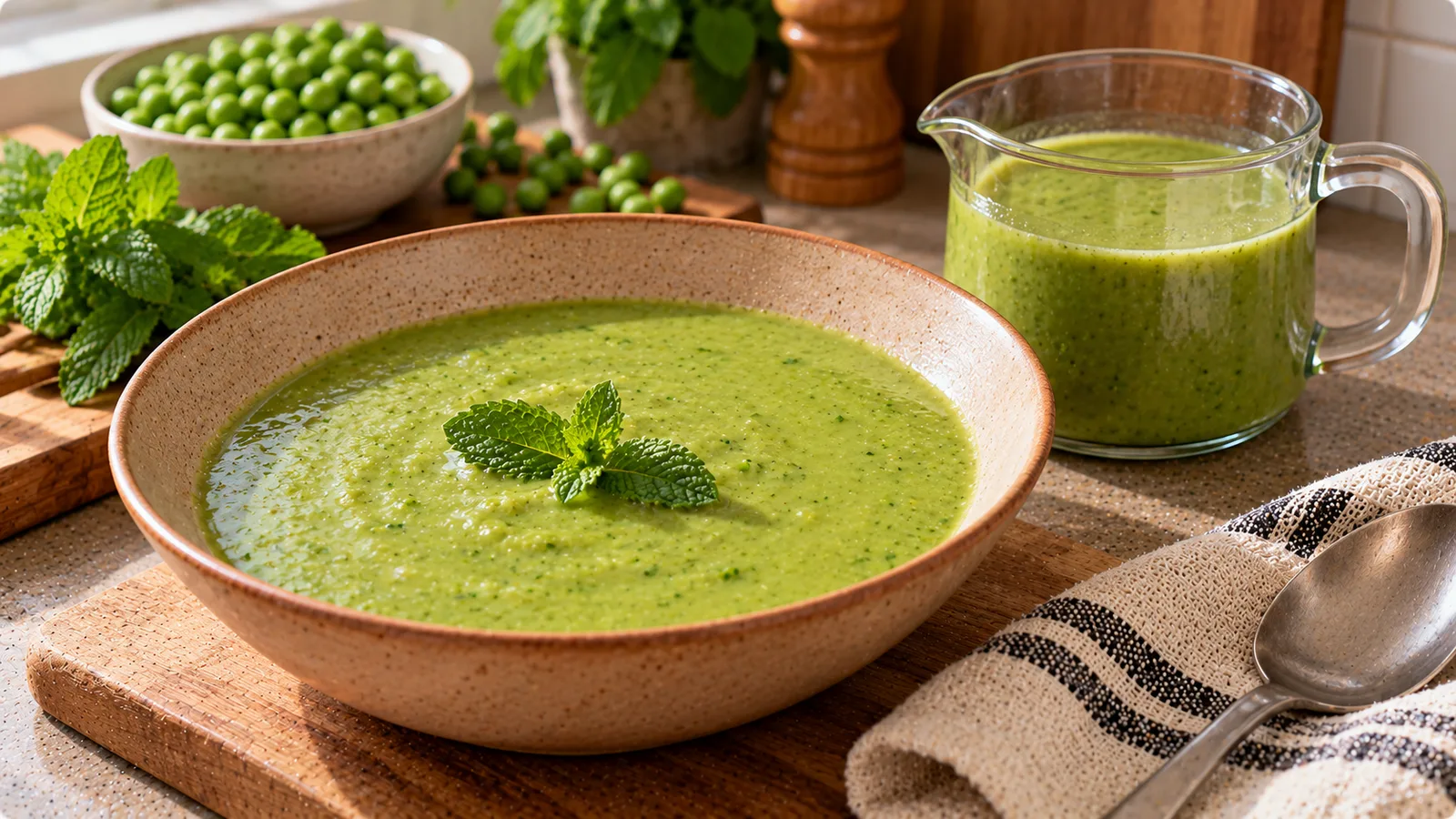
Pea and mint soup is a simple way to turn everyday ingredients into a bright, satisfying meal.
Sweet green peas give the soup its natural color and body. Fresh mint adds a cool, aromatic finish, while onion, garlic and vegetable stock create a savory base.
The recipe works with either fresh or frozen peas, needs no cream and takes approximately 25 minutes from start to finish.
It is especially useful when you want a quick lunch, a light dinner or a starter that can be prepared ahead.
Recipe overview
| Detail | Amount |
|---|---|
| Preparation time | 10 minutes |
| Cooking time | 15 minutes |
| Total time | About 25 minutes |
| Servings | 4 |
| Yield | Approximately 1.5–1.7 liters, depending on evaporation |
| Difficulty | Easy |
| Main ingredients | Green peas, mint, onion and vegetable stock |
| Dietary style | Vegan when made with vegetable stock and plant-based toppings |
This version uses a generous amount of peas for a creamy texture without relying on heavy cream.
Ingredients for four servings
| Ingredient | Quantity |
|---|---|
| Green peas, fresh or frozen | 600 g |
| Yellow onion, finely chopped | 150 g |
| Garlic | 10 g, about 2 cloves |
| Olive oil | 15 g, about 1 tablespoon |
| Low-sodium vegetable stock | 800 ml |
| Fresh mint leaves | 15 g |
| Lemon juice | 15 ml |
| Salt | To taste |
| Black pepper | To taste |
Optional toppings:
- A few extra mint leaves.
- A spoonful of plain yogurt or unsweetened plant-based yogurt.
- Toasted pumpkin seeds.
- A small drizzle of olive oil.
- Crusty bread served on the side.
The soup is naturally thickened by blended peas. There is no need to add flour or potatoes.
How to make pea and mint soup
Step 1: Prepare the vegetables
Peel and finely chop the onion.
Mince the garlic.
Wash the fresh mint and remove any particularly tough stems.
If using frozen peas, there is no need to thaw them first.
If using fresh peas in pods, shell them and weigh the peas after removing the pods.
Step 2: Soften the onion
Heat the olive oil in a medium-large saucepan over medium heat.
Add the onion and cook for approximately 4–5 minutes, stirring occasionally, until softened.
Avoid browning it heavily.
A gently cooked onion gives the soup sweetness without overpowering the fresh flavor of the peas.
Step 3: Add the garlic
Stir in the garlic and cook for about 30 seconds.
It should become fragrant but not brown.
Garlic can turn bitter if cooked too aggressively.
Step 4: Add peas and stock
Add the peas and vegetable stock.
Bring the mixture to a gentle simmer.
Cook for approximately 5–7 minutes, until the peas are tender and heated through.
Fresh peas may require slightly longer depending on their size and maturity.
Avoid prolonged boiling, which can dull the green color and make the flavor less fresh.
Step 5: Add mint and blend
Turn off the heat.
Add the mint leaves and lemon juice.
Blend until smooth using an immersion blender.
Alternatively, transfer the soup in small batches to a countertop blender suitable for hot liquids.
Follow the blender manufacturer's safety instructions and allow steam to escape as directed.
Do not fill a sealed blender jar with very hot soup.
Step 6: Adjust the texture
If the soup is too thick, add a little warm water or stock.
If it is too thin, simmer briefly to reduce it.
Taste and add salt and black pepper.
Add a little more lemon juice if you want a brighter finish.
Step 7: Serve
Divide the soup among four bowls.
Finish with a few mint leaves or another topping of your choice.
Serve immediately while warm.
Can you use frozen peas?
Yes. Frozen peas are one of the best options for this recipe.
They are convenient, available throughout the year and usually require no preparation beyond measuring the amount needed.
Because peas are typically frozen soon after processing, frozen peas can retain good flavor and nutritional value.
Add them directly to the simmering stock.
You may need an extra minute or two for the soup to return to temperature.
Choose plain frozen peas rather than a product containing butter, sauce or seasoning if you want to control the recipe's nutritional values.
Fresh peas versus frozen peas
| Feature | Fresh peas | Frozen peas |
|---|---|---|
| Preparation | May need shelling | Ready to use |
| Availability | Seasonal | Year-round |
| Cooking time | Depends on maturity | Usually quick |
| Flavor | Fresh and sweet when in season | Consistently sweet |
| Convenience | More preparation | Very convenient |
| Food waste | Pods and possible spoilage | Easy to portion |
Both work well.
If fresh peas are especially sweet and tender, they can give the soup a lovely seasonal character.
For an everyday version, frozen peas are often the practical choice.
How much mint should you use?
Mint can be surprisingly strong.
For 600 g peas, 15 g fresh mint leaves gives a noticeable but balanced mint flavor.
If you prefer a gentler taste, start with 8–10 g.
Blend, taste and add more gradually.
Peppermint can taste sharper than spearmint.
If your mint is particularly intense, use less.
Dried mint is not an exact substitute because it tastes different and can be more concentrated.
If using dried mint, start with a small pinch and adjust carefully.
How to make the soup creamy without cream
Peas contain starch, fiber and protein that help produce a naturally thick blended texture.
Three things improve creaminess:
Use enough peas. Too much stock can make the soup watery.
Blend thoroughly. A smooth purée gives a creamy mouthfeel without dairy.
Adjust liquid gradually. You can always thin the soup, but correcting an overly watery soup takes longer.
For an especially silky finish, you can pass the blended soup through a fine sieve.
That removes some skins and fiber, so it is optional rather than necessary.
Estimated nutrition per serving
The following figures are approximate recipe estimates, not laboratory measurements.
They assume four servings, 600 g plain green peas, 150 g onion, 10 g garlic, 15 g olive oil, 800 ml low-sodium vegetable stock, 15 g mint and 15 ml lemon juice.
Actual values depend on the pea variety, stock brand, portion size and any toppings.
| Nutrient | Approximate amount per serving |
|---|---|
| Calories | 175–195 kcal |
| Protein | 9–11 g |
| Fat | 4–5 g |
| Carbohydrate, including fiber under US-style definitions | 25–29 g |
| Fiber | 8–10 g |
The soup provides plant protein and fiber, but its energy content is relatively modest for a complete main meal.
A slice of bread, a sandwich or another protein-rich side can make lunch or dinner more substantial.
For accurate food logging, use the nutrition labels of your actual ingredients and divide the final recipe by the number of portions served.
How to make it more filling
If you want the soup to serve as a complete meal, consider adding something alongside it.
With wholegrain bread
A slice of wholegrain bread adds carbohydrates and may contribute additional fiber.
With a protein-rich topping
Plain Greek yogurt, skyr or a plant-based high-protein yogurt can add creaminess and protein.
Check the nutritional label because different products vary considerably.
With white beans
Blend a portion of cooked white beans into the soup.
This makes it thicker and increases the amount of food in each serving.
Add stock gradually to maintain the desired texture.
With a sandwich
A simple egg, cheese, tofu or hummus sandwich can turn a small bowl of soup into a more substantial meal.
Calculate the sandwich separately if tracking calories.
Variations worth trying
Pea, mint and spinach soup
Add 60–100 g fresh spinach during the last minute of cooking.
Blend with the peas and mint.
The spinach contributes extra greens without greatly changing the basic flavor.
Pea, mint and potato soup
Add 150–200 g diced potato to the stock and cook until tender before adding the peas.
The potato gives the soup more body and carbohydrates.
Allow additional cooking time.
Pea, mint and coconut soup
Replace some stock with unsweetened coconut milk.
The result is richer and more aromatic, but also usually higher in calories and fat.
Pea and mint soup with yogurt
Stir a spoonful of plain yogurt into each bowl after cooking.
Avoid vigorous boiling after adding yogurt because it may separate.
Spicy pea soup
Add a pinch of chili flakes with the garlic.
Keep the chili modest so it does not overwhelm the mint.
Common mistakes and how to avoid them
Boiling the peas too long. Cook only until tender to preserve their fresh flavor and attractive color.
Adding too much mint immediately. Mint intensity varies. Start with less and taste.
Using overly salty stock. Choose a low-sodium stock and season near the end.
Adding too much liquid. Begin with the specified quantity and thin after blending if needed.
Blending hot soup unsafely. Use an immersion blender or follow hot-liquid blender safety instructions.
Forgetting acidity. A small amount of lemon juice balances the natural sweetness of the peas.
How to store pea and mint soup
Cool the soup promptly and transfer it into shallow, food-safe containers.
Refrigerate perishable cooked soup within two hours of cooking, or within one hour when the ambient temperature is above approximately 32°C.
Keep the refrigerator at approximately 4°C or below.
A conservative general guideline is to consume refrigerated leftovers within 3–4 days.
Do not leave a large pot of soup at room temperature overnight.
If you want to keep the soup longer, freeze it in meal-sized portions.
Can you freeze pea and mint soup?
Yes.
This soup generally freezes well because it does not contain cream.
Let it cool safely, portion it into freezer-safe containers and leave suitable headspace for expansion.
For best quality, aim to use frozen portions within approximately 2–3 months, although food kept continuously frozen at safe temperatures may remain safe longer.
Thaw in the refrigerator or use an appropriate safe reheating method.
Reheat thoroughly, stirring so the temperature becomes even.
US food-safety guidance recommends heating many cooked leftovers to 74°C (165°F).
The color may become slightly less vivid after freezing, but the flavor should remain pleasant.
Can you serve it cold?
Yes, pea and mint soup can also be served chilled.
Prepare and cool it safely, then refrigerate until thoroughly cold.
Taste before serving because cold temperatures can change how strongly you perceive seasoning.
You may want a little extra lemon juice or mint.
Do not leave chilled soup sitting outside the refrigerator for extended periods.
Frequently asked questions
How long does pea and mint soup take?
Approximately 25 minutes, including preparation and cooking.
Do frozen peas need to be thawed first?
No. Add plain frozen peas directly to the hot stock and cook until tender.
Is pea and mint soup vegan?
This recipe is vegan when prepared with vegetable stock and without dairy-based toppings.
Can I make it without a blender?
You can mash the peas, but the soup will be much more textured. A blender gives the characteristic smooth consistency.
Can I use dried mint?
Yes, but the flavor differs. Start with a very small amount and adjust.
Is this soup high in protein?
Peas contribute plant protein, but this particular soup is moderate rather than exceptionally high in protein. Add beans, tofu or a protein-rich side if needed.
Can I make it ahead?
Yes. Refrigerate promptly and consume within the recommended storage period, or freeze portions for later.
Sources
- USDA FoodData Central — nutritional composition of peas and recipe ingredients.
- USDA Food Safety and Inspection Service — safe storage and reheating of cooked food.
- FoodSafety.gov — safe temperatures and leftover storage guidance.
Final tips
For the best pea and mint soup, use sweet peas, cook them briefly and add the mint near the end.
Blend thoroughly, season with lemon juice and adjust the thickness to your preference.
With frozen peas and a few everyday ingredients, this fresh green soup can be ready in approximately 25 minutes.