
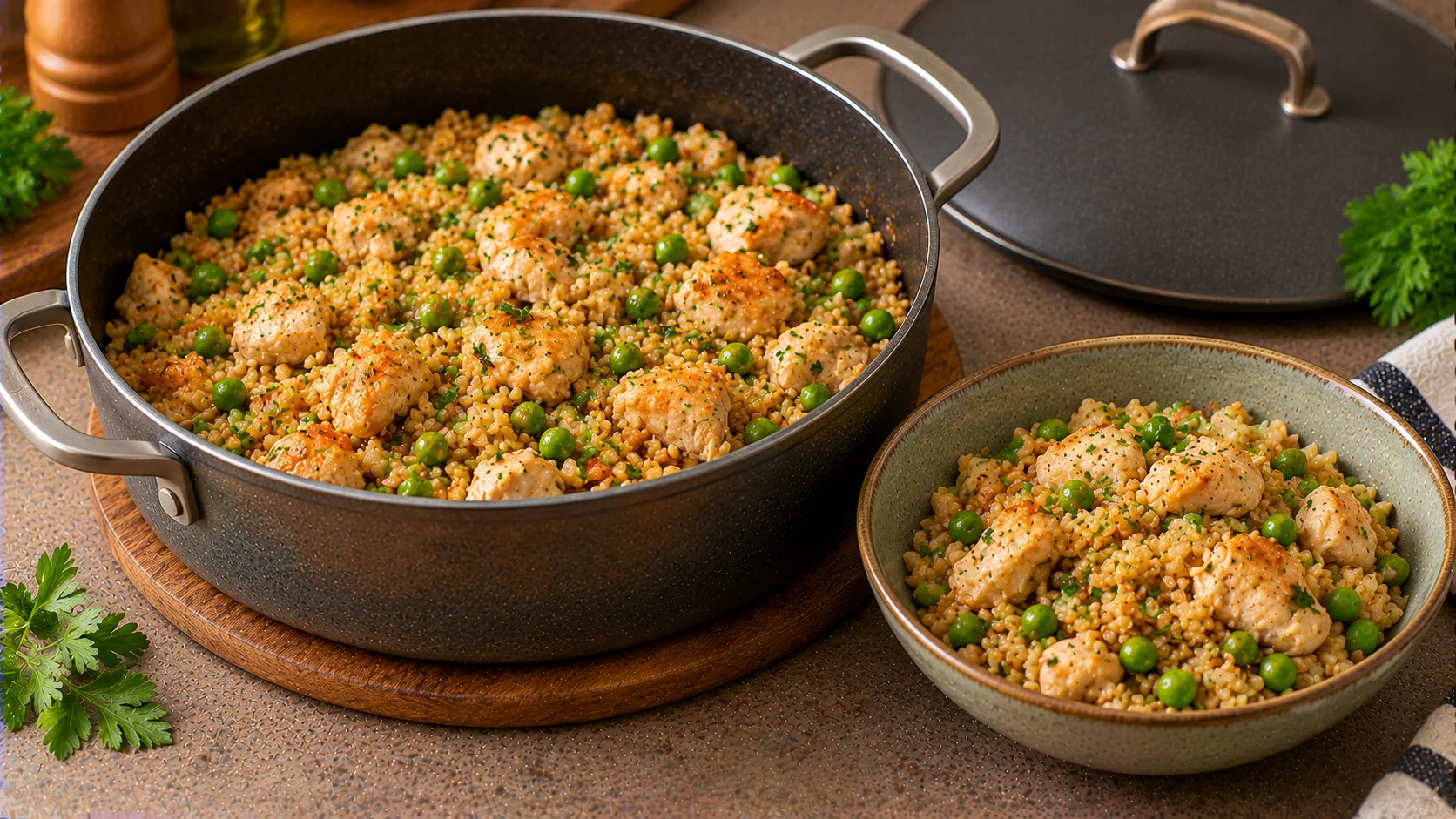
One-Pot Chicken, Frozen Pea and Bulgur Dinner
This practical dinner makes four portions in one lidded saucepan. Dried bulgur absorbs the stock while diced chicken cooks, and frozen peas go in near the end so they stay tender. The result is a grain-and-protein meal with vegetables, not a claim that every ingredient is equally cooked after a fixed number of minutes. Always verify that the thickest chicken pieces reach 74°C (165°F) with a food thermometer, as advised by USDA FSIS.
Recipe at a glance
| Item | Amount or guidance |
|---|---|
| Servings | 4 |
| Equipment | Large heavy-bottomed saucepan with lid; food thermometer |
| Active preparation | About 12 minutes |
| Covered cooking | About 15–20 minutes, depending on bulgur grade and chicken size |
| Rest | 5 minutes, covered |
| Allergens | Wheat (bulgur); check packaged stock |
The grain needs enough liquid, but water loss depends on pan width, lid fit and heating strength. Treat the starting volume as a guide, not an inflexible guarantee.
Measured ingredients for four
| Ingredient | Amount | Preparation |
|---|---|---|
| Raw boneless skinless chicken breast | 500 g | Cut into even 2 cm pieces |
| Dry medium-grind bulgur | 240 g | Inspect and rinse if package instructs |
| Frozen green peas | 300 g | Use frozen; do not thaw on counter |
| Carrot | 160 g | Dice small |
| Onion | 120 g | Finely chop |
| Olive or rapeseed oil | 15 g | Measure, rather than pour freely |
| Low-salt chicken or vegetable stock | 600 ml | Start here; keep extra hot water available |
| Lemon juice | 20 ml | Stir in at the end |
| Paprika | 2 g | Mild or smoked |
| Ground black pepper | To taste | Optional |
Use 240 g dry bulgur, not 240 g already cooked. Pre-cooked bulgur sold ready to eat behaves differently and should not be substituted at the same water ratio. This method is for medium-grind bulgur. Fine instant bulgur may overcook; coarse bulgur can require additional time and liquid.
Step-by-step cooking method
- Wash your hands and prepare the onion and carrot on a board separate from raw chicken. Dice chicken evenly and keep it cold until cooking. Never rinse raw chicken; splashing can spread microbes.
- Warm 15 g oil in the saucepan over medium heat. Cook onion and carrot for roughly 3–4 minutes until softened, without burning the oil.
- Add diced chicken and paprika. Stir for approximately 3 minutes, just until most exterior surfaces are opaque. This is not the safety endpoint: the chicken will finish cooking beneath the lid.
- Stir in the dry bulgur, then pour in 600 ml stock. Scrape the base of the pan to release any browned pieces. Bring to a gentle simmer.
- Cover, lower the heat and cook for roughly 8–10 minutes. Stir once, scraping the bottom. Check whether the bulgur still has adequate moisture. If the pot is drying while the grains are firm, add 50–100 ml hot water.
- Stir in frozen peas. Cover again and continue at a gentle simmer for approximately 5–8 minutes. The peas must be piping hot and the bulgur tender, but temperature of chicken controls when the dish is safe.
- Probe several large chicken pieces in their centres, avoiding contact with the pan. Continue cooking with additional liquid if any sample measures below 74°C / 165°F. Check again after stirring.
- Remove from heat, add lemon juice and pepper, and rest covered for five minutes. Loosen with a fork and divide into four portions.
Why add frozen peas later?
Peas are already blanched in many commercial freezing processes, but this does not make them ready to eat without following the package's cooking directions. Adding them only for the final simmer helps preserve their colour and limits mushiness. Stir thoroughly so frozen clumps heat all the way through. If your peas are very large or packaging calls for longer cooking, allow extra time; extend the simmer rather than serving them cool.
Liquid troubleshooting
| What you see | Likely cause | Next action |
|---|---|---|
| Dry grains, firm centres | Higher evaporation or coarse bulgur | Add 50 ml hot water, cover for 3–5 minutes |
| Chicken fully cooked, grains still firm | Bulgur needs more hydration | Add hot water in small increments and simmer |
| Wet surface but tender grains | Excess stock | Uncover briefly, stir and let steam escape |
| Grains sticking to the base | Heat too high or thin saucepan | Reduce heat; gently lift grains, add liquid |
Never continue cooking chicken until it becomes dry merely to absorb excess liquid. If the chicken is already safely cooked, finish reducing gently and serve while juicy. For especially fine bulgur, read its pack directions and shorten covered cooking.
Portion size and approximate nutrients
Raw ingredients add up to about 1.36 kg before stock and water absorption. The final dish weight is not reliably predictable because grains absorb water and steam escapes. Weigh the cooked batch if you need precise portions: cooked batch mass ÷ 4 is the equal serving size.
For a transparent illustrative energy calculation, apply commonly reported approximate values of 120 kcal/100 g to raw skinless chicken breast, 340 kcal/100 g to dry bulgur, 80 kcal/100 g to frozen peas, 40 kcal/100 g to carrots, 40 kcal/100 g to onions and 884 kcal/100 g to oil. Stock and lemon add a small variable amount. The arithmetic gives:
| Ingredient | Illustrative energy for batch |
|---|---|
| Chicken 500 g | 600 kcal |
| Bulgur 240 g dry | 816 kcal |
| Peas 300 g | 240 kcal |
| Carrot 160 g + onion 120 g | 112 kcal |
| Oil 15 g | 133 kcal |
| Subtotal, excluding stock/lemon | 1,901 kcal |
| Four equal portions | About 475 kcal each, plus stock/lemon |
These figures are not laboratory measurements or brand-specific label claims. Protein, sodium and energy vary with chicken cut, grain product, peas and stock. For a logged meal, use the actual labels and entries in USDA FoodData Central, then divide the full-batch totals by four. Water increases cooked weight without adding energy.
What does one portion cost?
This example uses hypothetical supermarket prices, not a verified live offer. Replace each price with your receipt to make a usable personal estimate.
| Ingredient | Example batch cost |
|---|---|
| Chicken 500 g at €9/kg | €4.50 |
| Bulgur 240 g at €2.50/kg | €0.60 |
| Frozen peas 300 g at €2.40/kg | €0.72 |
| Carrot 160 g at €1.50/kg | €0.24 |
| Onion 120 g at €1.50/kg | €0.18 |
| Oil 15 g at €5/kg | €0.08 |
| Stock, lemon, seasonings (allowance) | €0.50 |
| Total / per portion | €6.82 / €1.71 |
Purchased package cost differs from ingredient cost consumed. If you buy a 1 kg bag of peas and use 300 g, only 30% of that bag is charged to this batch; the other 700 g remain in your freezer. The same principle applies to bulgur and oil.
Substitutions without breaking the recipe
Chicken thigh can replace breast, but trim and weigh it raw, expect a different energy value and always verify the same safe 74°C centre temperature. Frozen sweetcorn can replace a portion of peas, but the fibre and protein balance will change. A vegetable stock and rapeseed oil work well; select lower-salt stock if you want to control sodium. If you omit the carrot, add another quick-cooking vegetable, not extra raw grain.
To make the meal gluten-free, do not use bulgur: it is cracked wheat. Rice or quinoa require a different liquid and cooking method and should be treated as a separate recipe rather than a one-for-one switch. If you're interested in practical grain preparation, see our guide to preparing grains; for additional economical meals with vegetables, see our guide to inexpensive vegetable meals.
Refrigeration, freezing and reheating
Cooked chicken and bulgur are perishable. Transfer leftovers to shallow containers and refrigerate promptly, within two hours of cooking (within one hour if ambient temperature exceeds 32°C). Keep refrigerated at 4°C or below and use within 3–4 days according to USDA guidance. For extra caution with cooked grains, you may choose to cool and consume them sooner. Freeze individual portions promptly if you will not use them within this window.
Reheat leftovers until their centre reaches 74°C / 165°F, stirring during microwave heating and letting the food stand before checking. Do not use smell or appearance as a substitute for safe time and temperature controls. Discard leftovers that have been held unrefrigerated beyond safe limits.
Common errors to avoid
Do not equate browned chicken surfaces with cooked centres; avoid adding frozen peas after the heat is off; and do not call dry grain and cooked grain the same amount. The simplest reliable checks are to measure dry ingredients, monitor pan moisture, test chicken temperature, and weigh the final batch if individual portion masses matter.
Sources
- USDA FSIS — Safe Minimum Internal Temperature Chart.
- USDA FSIS — Keep Food Safe!.
- USDA FoodData Central — food composition database. Values above are illustrative; check matched raw/dry entries and branded labels.