
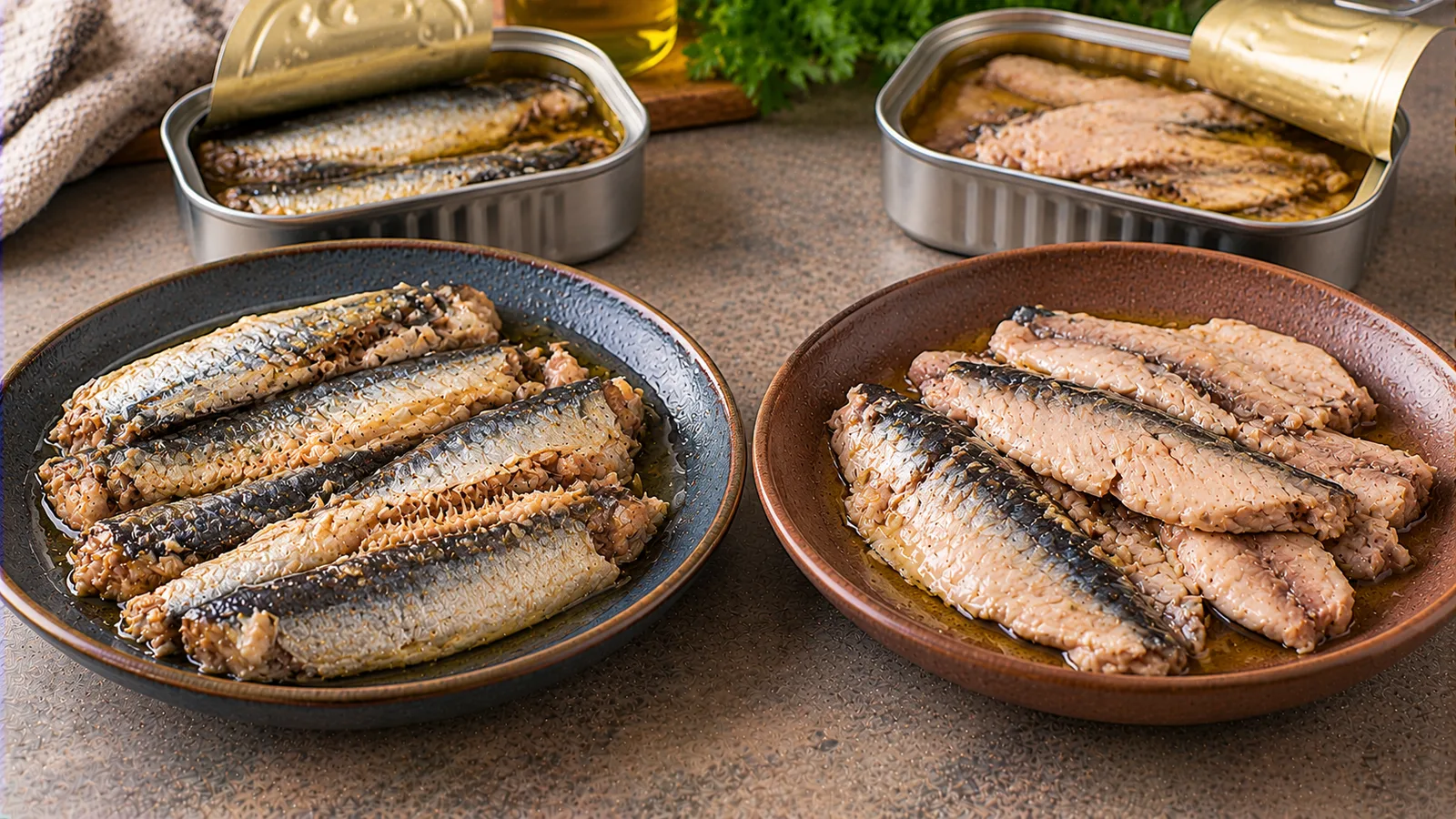
Sardines packed with their soft bones can supply substantially more calcium than boneless fillets, but “canned sardines” is not one uniform nutrition entry. The practical question is how much calcium you obtain from the fish you actually eat, not from the entire weight of a tin including water or oil. This comparison uses two named Brunswick products and a matched 84 g drained serving. It is a comparison of published labels, not a controlled study that removed bones from the same batch of fish.
For the regular Brunswick sardines in spring water, the maker lists 302 mg calcium per 100 g drained. The distinct boneless sardines in spring water list 98 mg calcium per 84 g drained. At the same edible weight, these work out to 254 mg versus 98 mg calcium after rounding. The higher-calcium product is a regular, not marketed as boneless sardine line; verify the actual presence of soft bones on the pack you buy. These particular international labels are useful reference examples, not a promise that every German or French supermarket sells these exact cans.
The matched 84 g drained comparison
Using the same drained weight avoids comparing a 100 g label on one item with an 84 g serving on the other. Both reference products are in spring water, reducing one obvious difference in packing medium; nevertheless, the manufacturer may use different fish, processing and recipes. Do not attribute every observed nutrition difference to bones alone.
| Nutrition-label comparison | Regular sardines (check bones on can) | Boneless sardine fillets |
|---|---|---|
| Original declared basis | 100 g drained | 84 g drained |
| Calcium as originally stated | 302 mg per 100 g | 98 mg per 84 g |
| Calcium for equal 84 g drained | 254 mg | 98 mg |
| Protein for 84 g | 16.8 g | 16 g |
| Energy for 84 g | about 134 kcal | 128 kcal |
| Calcium per 100 g, normalized | 302 mg | about 117 mg |
To reproduce the number, calculate 302 × 84 ÷ 100 = 253.68 mg, displayed as 254 mg. The boneless label already refers to 84 g, so its 98 mg requires no portion conversion. The gap is approximately 156 mg per equal 84 g portion; the regular product is approximately 2.6 times as high on these particular declarations. Those are product-specific observations, not typical guaranteed values for all bone-in or boneless sardines.
Why small canned bones matter
Fish bones are a calcium-containing structure. The NHS guide to fish explains that some oily fish, including canned sardines, have bones that can be eaten and provide calcium. Canning can soften small bones, so a person who is comfortable with their texture may consume them with the fish. Boneless does not mean calcium-free: the reference fillet still declares 98 mg per 84 g, and mineral content also depends on the product.
The US NIH Office of Dietary Supplements lists 325 mg calcium in 3 oz of oil-packed canned sardines with bones as another example. That 3-ounce benchmark (approximately 85 g) is a different reference food from the Brunswick water-packed pair. Do not average the numbers or use 325 mg to overwrite a particular product's label. Species, bones retained, processing and the test basis differ. The sensible inference is that edible bones can make canned sardines useful for calcium—not that every tin delivers a fixed 300 or 325 mg.
What exactly counts as edible weight?
A can marked 106 g may refer to total contents including packing liquid, whereas the nutrition table can use drained fish weight. The boneless Brunswick water-packed example explicitly reports nutrients per 84 g drained. Its nominal 106 g can weight is not the number to substitute into a per-84-g nutrition calculation. For the regular example the table is per 100 g drained, not automatically per can. If your can produces only 75 g of drained fish, scale from the weight you really eat instead of calling the entire tin an 84 g serving.
To compare products at home, first read the net weight, then the drained weight if stated, and finally the basis of the nutrition panel. Drain through a sieve for a consistent time, weigh only the fish on a tared plate, and note whether the bones are part of that edible serving. If you remove and discard them, the product is no longer equivalent to its with-bones analyzed edible portion. You cannot precisely subtract calcium by guessing that the bones weigh a certain number of grams; a matched laboratory measurement would be necessary.
How portions change the calcium numbers
A smaller snack and a larger dinner have different quantities even with the same product. The following uses the same Brunswick declarations with straight-line scaling. The 60 g and 100 g amounts are calculations, not additional manufacturer-stated serving sizes.
| Drained fish actually eaten | Regular product | Boneless product |
|---|---|---|
| 60 g | 181 mg calcium | 70 mg calcium |
| 84 g | 254 mg calcium | 98 mg calcium |
| 100 g | 302 mg calcium | 117 mg calcium |
For the boneless values, convert 98 ÷ 84 × portion weight. For the regular values, convert 302 ÷ 100 × portion weight. Round only at the final step, so comparisons remain reproducible. If you serve the fish alongside bread, potatoes or vegetables, weigh the fish separately: the nutrient difference in this table belongs to sardines, not the entire mixed meal. Oil left in the tin contributes energy if eaten, but not more fish weight for a drained-serving calculation.
What do 254 mg and 98 mg mean against a daily reference?
The EU food-labelling regulation, Regulation (EU) 1169/2011, Annex XIII, specifies an adult calcium nutrient reference value of 800 mg for labelling. Against this common denominator, an 84 g reference portion with 254 mg represents approximately 32% of that reference value, while 98 mg represents approximately 12%. This is a labelling comparison, not a personalized calcium requirement. Individual dietary needs vary by age and circumstances. The Canadian-market percentage figures displayed on the Brunswick pages may use a different denominator; do not transplant them onto EU-labelled products.
A plate does not become nutritionally superior solely because it has more calcium. Consider the rest of the day's foods, the calcium already supplied by dairy or fortified alternatives, and the product's sodium. Sardines also supply protein and marine omega-3 fats, yet these particular labels show different sodium values. Bones cannot explain all differences between brands and recipes, especially when one product is boneless and another is packed differently.
What about protein, omega-3 and sodium?
On the matched 84 g basis, the regular reference lists about 16.8 g protein and the boneless example 16 g protein. These numbers are close enough that removing bones is not a sensible reason to predict a dramatic protein gap. The fat, omega-3, vitamin D and salt lines should be checked independently on each actual tin. A boneless fillet packed in olive oil can look quite different from a regular sardine packed in water, even if both are called sardines.
The regular water-packed reference reports 235 mg sodium per 100 g, which would be about 197 mg per 84 g. The boneless example reports 351 mg sodium per 84 g. This is a product-label difference, not evidence that removing bones increases sodium. Seasoning, brine and formulation change the comparison. If salt matters for your diet, choose using the current salt/sodium line rather than the phrase “with bones” alone.
Are canned sardine bones safe to eat?
Commercially canned sardines often contain small softened bones that many adults eat. That does not make every fragment safe for every person: inspect the food, follow the package description, chew carefully and remove any hard or sharp piece. For young children, people with swallowing difficulties or anyone uncomfortable with texture, use age- and situation-appropriate precautions; boneless fish may be easier to serve, and “boneless” labels still do not guarantee that no stray bone could remain.
Sardines are also on the US FDA/EPA “Best Choices” low-mercury fish list. That advice is about fish species and intake patterns, not whether a sardine retains its bones. During pregnancy or when planning meals for children, follow current local recommendations on portions and fish variety rather than using high calcium content to justify unlimited servings.
Buying checklist: choose the right can for your purpose
If your aim is calcium, look for canned sardines with soft, edible bones and check whether calcium appears on the actual nutrition label. On EU packs calcium need not always be declared, so absence of a calcium line does not prove zero calcium. If you dislike the texture, select boneless fish while planning other calcium-rich foods in the meal. Taste and convenience are valid preferences; they are not nutrition errors.
If your aim is protein, compare per 100 g drained values rather than front-of-pack net weight. If you are comparing value for money, record both the price per can and the measured drained weight before calculating the cost of a genuine edible serving. A 106 g net tin and a tin with 84 g drained fish cannot automatically be treated as two equal 106 g servings. For a broader fish-versus-fish comparison, see tuna versus sardines: canned nutrition and portions; for the distinction between salmon and sardines as meal choices, see salmon versus sardines: practical nutrition and portions. Neither replaces the bone-versus-boneless calculation here.
A simple 84 g lunch example
Take 84 g drained sardines, a slice of whole-grain bread, tomato and cucumber, and lemon if desired. The sardine component contributes approximately 254 mg calcium with the regular reference or 98 mg with the boneless reference, assuming the respective labels apply. The complete lunch has more nutrients than this one ingredient, and its calcium total depends on the bread and vegetables chosen. It would be misleading to label the entire lunch as supplying exactly those fish-only calcium numbers.
If the fish you actually eat weighs 60 g instead, recalculate rather than copying the 84 g figure. If you scrape out bones and discard them, do not claim the 254 mg value necessarily survives. With a different brand, use that brand's analytical declaration or acknowledge that exact calcium is unknown. This is more useful than pretending all tinned sardines are identical.
Choosing between the two
For someone happy to eat the softened bones, the standard sardine style is often a practical source of extra calcium. For someone who prefers smooth fillets or needs to avoid bone fragments, boneless sardines still supply protein and some calcium, and they can be part of a balanced diet. The 254 mg versus 98 mg per 84 g example shows the scale of difference that the product labels can reveal—not a universal medical rule or a claim that calcium in a single tin guarantees bone health.
Sources
- Brunswick regular sardines in spring water: per 100 g drained.
- Brunswick boneless sardines in spring water: per 84 g drained.
- NHS: Fish and shellfish; edible bones in canned oily fish.
- NIH ODS: Calcium content in canned sardines with bones.
- FDA/EPA: Advice about eating fish.
- EU Regulation 1169/2011, Annex XIII: calcium NRV.