
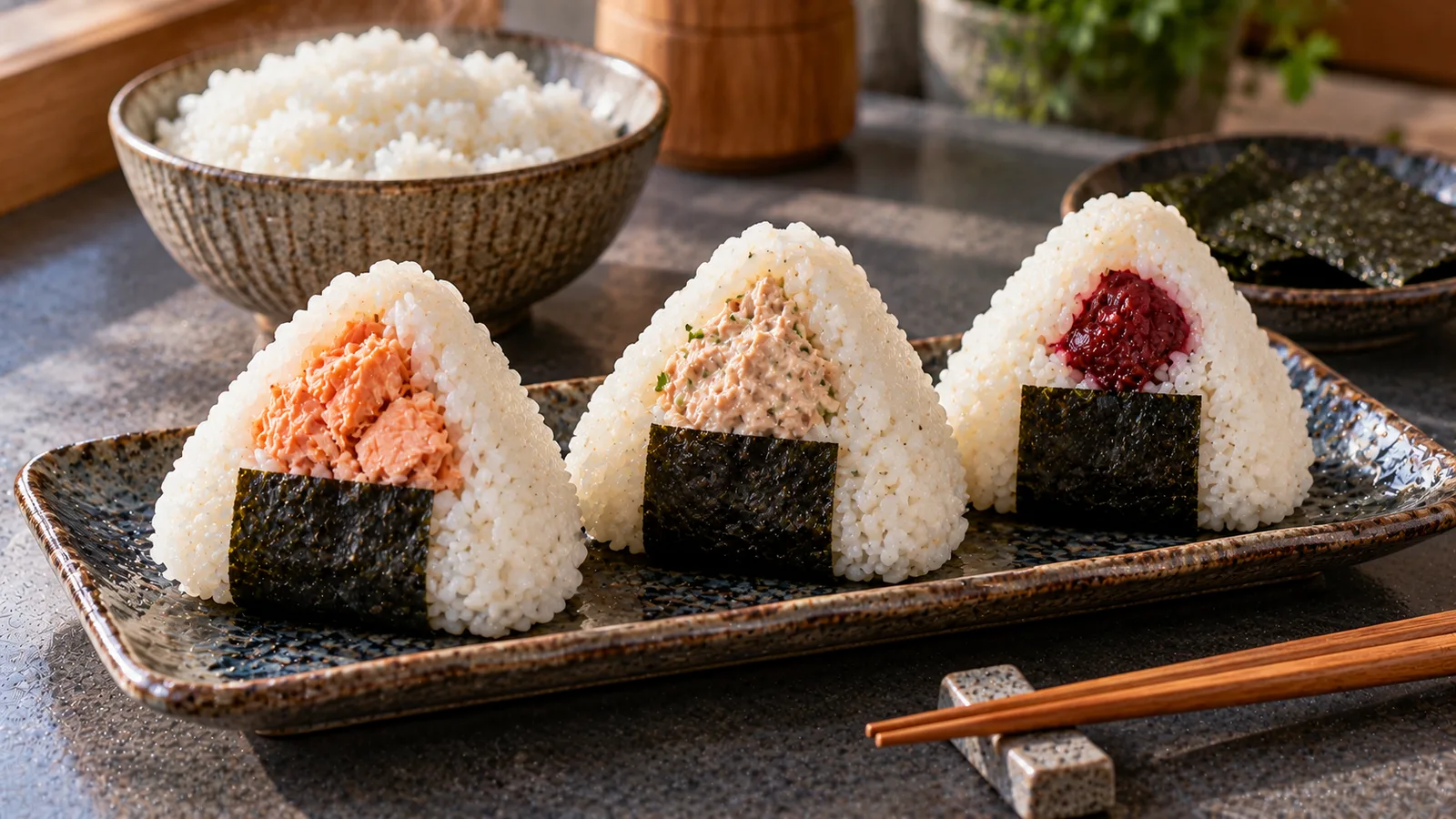
Onigiri are Japanese rice balls shaped around a small filling, often with a strip of nori. They are simple enough for a weekday lunch, but portion estimates become unreliable when a recipe says only “one bowl of rice.” The key measurement is the weight of cooked rice in each onigiri, not the dry rice poured into the cooker. This version makes six pieces: two with cooked salmon, two with tuna mayonnaise and two with umeboshi, the sharp, salty Japanese pickled plum.
The recipe uses 100 g of cooked short-grain rice per piece. You can make smaller or larger onigiri, but weigh the rice after cooking and use the same basis when comparing calories. The values below are estimates from specified ingredient examples, not laboratory analyses or universal values for shop-bought onigiri.
Ingredients for six onigiri
| Ingredient | Total for six | Used per onigiri |
|---|---|---|
| Cooked Japanese short-grain white rice | 600 g | 100 g |
| Cooked salmon, flaked | 40 g | 20 g, in two pieces |
| Canned tuna in water, drained | 40 g | 20 g, in two pieces |
| Regular mayonnaise | 20 g | 10 g, in two pieces |
| Umeboshi flesh, stones removed | 20 g | 10 g, in two pieces |
| Nori | About 6 g | About 1 g |
| Salt | Optional, very little | Adjust to filling |
These are finished cooked or drained weights. The 600 g of rice is not 600 g of uncooked rice. Cook enough Japanese short-grain or sushi-style rice to yield that amount, then weigh 600 g on the kitchen scale. Water absorption and rice variety make a fixed dry-to-cooked conversion unreliable. The original Japanese examples from MAFF and Japan Rice likewise use cooked rice for portioning.
Make the rice hold together without crushing it
Rinse short-grain rice according to the package directions, cook with the specified water and allow steam to settle briefly. The rice should be warm enough to shape comfortably, not scalding. Long-grain rice tends to be less cohesive; if it falls apart, use Japanese short-grain rice instead of pressing it harder.
Set out six 100 g portions of cooked rice before you begin. Keep the toppings separate so they can be weighed. Use freshly washed hands, a little water and a tiny pinch of salt, or put the rice in clean food-safe wrap. Flatten half a rice portion, make a small hollow, add the filling, then close it with the remaining rice. Press gently into a triangle or round shape. Onigiri should stay together while retaining the texture of individual grains; kneading it into a dense paste is unnecessary.
Three fillings, two onigiri each
Salmon: Cook salmon fully, remove skin and bones, and flake 40 g cooked salmon. Put 20 g into each of two rice portions. This is a cooked-fish weight, not a raw-fillet weight. Avoid adding extra oil if you want the reference calorie calculation to apply.
Tuna mayonnaise: Drain a can of tuna in water well. Mix 40 g drained tuna with 20 g regular mayonnaise, then divide into two equal portions. Each onigiri contains 20 g tuna plus 10 g mayonnaise. Different mayonnaise brands, oil-packed tuna and extra sauce can change the final energy considerably.
Umeboshi: Remove the pits and weigh 20 g edible umeboshi flesh. Chop it, if needed, and use 10 g per onigiri. Salt-only umeboshi taste sharply sour and can be very salty; seasoned varieties may contain more sugar and calories. Use the product label for the version you actually buy and do not automatically add the salt suggested for the other fillings.
Wrap each finished rice ball with roughly 1 g of nori. Add nori near serving time for a crisp texture; wrapping earlier gives softer nori, which is also common. Nori is a garnish and wrapper here, not a substitute for the weighed rice.
Calories: compare equal amounts of rice
For a reproducible illustration, use the following per 100 g reference values: cooked short-grain white rice 130 kcal; cooked Atlantic salmon 206 kcal; drained canned light tuna in water 116 kcal; regular mayonnaise 680 kcal; traditional salt-pickled umeboshi 29 kcal. Allow approximately 3 kcal per 1 g nori strip. These food composition values describe specific products or database entries; they are not the only possible values for every brand or preparation.
The comparison draws on USDA FoodData Central and Japan’s MEXT food tables; check actual product labels.
| Filling | Rice, 100 g | Filling calculation | Nori | Estimated per piece |
|---|---|---|---|---|
| Cooked salmon, 20 g | 130 kcal | 20 × 206 / 100 = 41 kcal | ≈3 kcal | ≈174 kcal |
| Tuna, 20 g + mayo, 10 g | 130 kcal | 20 × 116 / 100 + 10 × 680 / 100 = 91 kcal | ≈3 kcal | ≈224 kcal |
| Umeboshi, 10 g | 130 kcal | 10 × 29 / 100 = 3 kcal | ≈3 kcal | ≈136 kcal |
For two of each filling, the six onigiri total approximately 1,068 kcal (2 × 174 + 2 × 224 + 2 × 136). A three-piece plate containing one of each is approximately 534 kcal before side dishes. Rounding occurs at the piece level; this is a planning estimate, not an exact nutrition label. If you increase cooked rice from 100 g to 120 g, add approximately 26 kcal to each piece before changing the filling. If you add 5 g more mayonnaise, add about 34 kcal. These two examples show why weighing rice and mayonnaise is more useful than guessing from the apparent size of the triangle.
Cooked weight, batch yield and portion changes
Start the calculation with an empty plate on the scale and tare it. Record the cooked rice mass used in each piece, then the filling masses. One portion with 100 g rice and 20 g salmon weighs roughly 121 g including 1 g nori, before any salt or moisture loss. The tuna-mayo version weighs roughly 131 g; the umeboshi version roughly 111 g. These are ingredient sums, not promises about their size or final water content.
Do not apply the 130 kcal per 100 g cooked rice figure to raw rice. Dry rice is more energy dense per 100 g because it contains less water. Water added during cooking increases weight, not the total calories in the original dry grains. If you prefer 80 g cooked rice in a snack-sized onigiri, its rice contributes about 104 kcal; 100 g contributes 130 kcal; 120 g contributes 156 kcal. Fillings still need to be counted separately. For the rice-weight basis, see rice calories and cooked portions · quinoa versus rice and cooked weights.
Food safety: prepare for the time you will eat
Cooked rice requires particular care because Bacillus cereus spores can survive cooking and, with poor cooling or storage, may lead to illness. Fish and mayonnaise fillings also require careful chilled handling. If eating immediately, shape the onigiri with clean utensils and serve promptly. For later eating, cool cooked rice quickly, ideally within one hour, refrigerate promptly and eat within 24 hours, following the cautious Food Standards Scotland guidance. Keep the filled onigiri chilled during transport with appropriate cold packs rather than leaving them on a warm desk or in a bag for hours.
Do not rely on smell or reheating to make rice safe after unsuitable storage. Make a smaller batch if you cannot chill it correctly. Wash your hands, keep the fish fully cooked and avoid cross-contamination. Salted umeboshi is not a safety substitute for refrigeration. Rice balls with tuna mayonnaise or fish should not be treated as shelf-stable packed lunches.
Serving and practical substitutions
One onigiri works as a snack; two or three can form the starchy part of a meal alongside vegetables or soup, according to appetite. Some shop-bought onigiri contain sauces or seasoned rice, so use their labels rather than applying these figures automatically. If you replace regular mayonnaise with a lighter sauce, recalculate from its nutrition label. For canned tuna packed in oil, drain it and use its own values instead of the water-packed reference. If umeboshi is unfamiliar, taste a small amount first: a little can give the rice a strong salty-sour centre.
The recipe is deliberately measured, not a rule about how Japanese onigiri must be made. Traditional fillings and shapes vary. What makes the calculation consistent is always specifying the cooked rice amount, the edible filling amount and any sauce. That is enough to adapt this familiar Japanese food to the portion you want without disguising estimates as exact figures.