
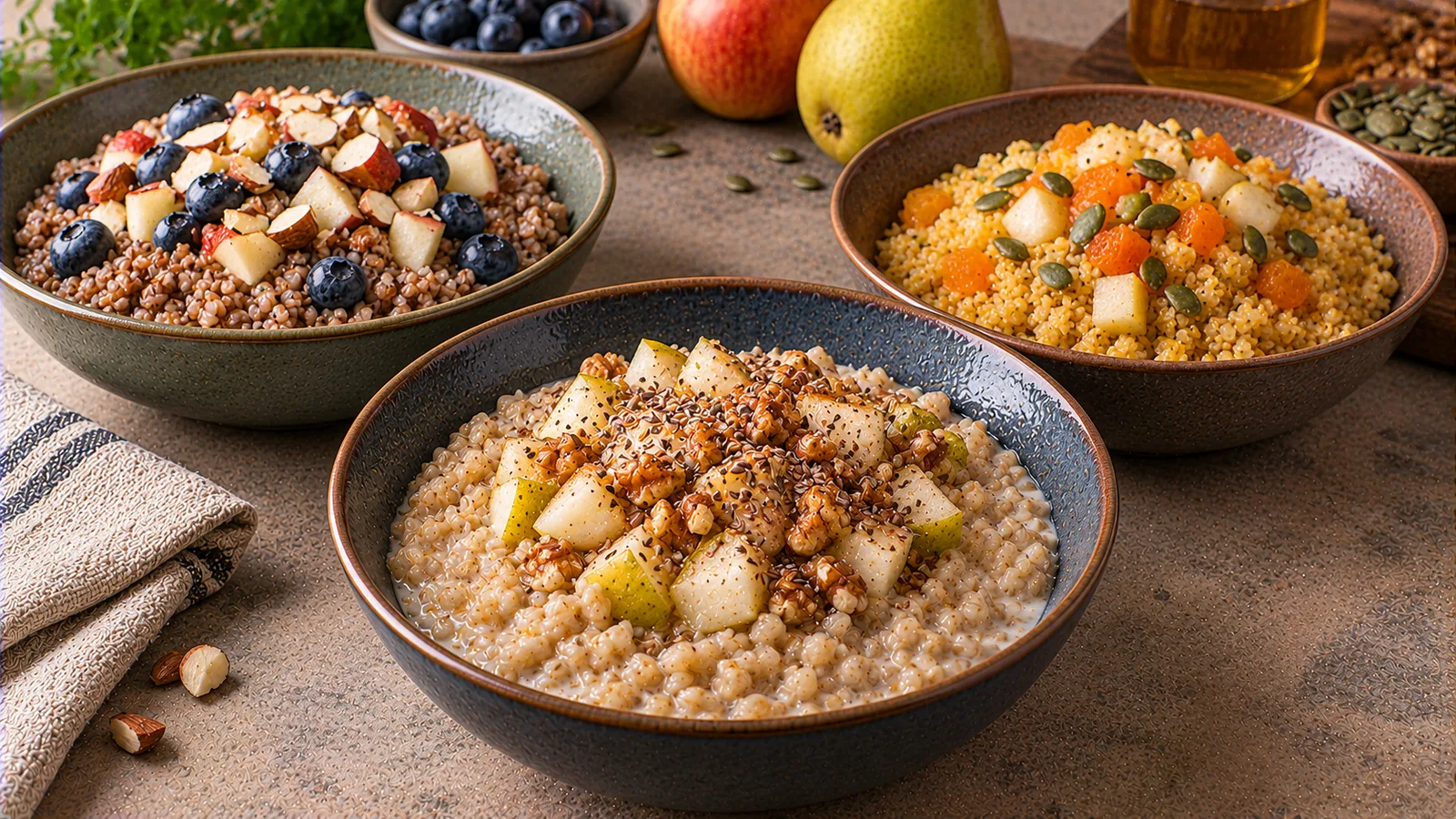
Three oat-free breakfast bowls, measured by cooked grain
Oats are convenient, but they are not required for a filling, fibre-rich breakfast. This guide offers three complete single-serving bowls with different cooked grains: roasted buckwheat with raspberries and chia, savoury bulgur with chickpeas and spinach, and barley with apple and ground flaxseed. Each has a real ingredient list and preparation method, not merely a suggested topping. The recipes deliberately make one bowl each, rather than a three-day diet prescription.
Our estimated contributions from the counted ingredients are 15.71 g, 14.91 g and 12.92 g of fibre per bowl, respectively. They are calculations from reference composition values, not laboratory measurements of the finished dishes. The basis matters: grain weights below mean cooked, drained grain, whereas chia and flax are weighed dry, apple and raspberries raw, and chickpeas cooked and drained. Do not use dry-grain nutrition figures against a cooked serving weight.
The German Nutrition Society (DGE fibre reference) gives adults an orientation value of at least 30 g fibre per day. A bowl delivering around 13–16 g can contribute meaningfully, but it does not automatically make the entire day balanced. Vary fruit, vegetables, grains and protein sources, drink adequately, and adjust portions to your appetite and needs. If you are looking for daily meal distribution rather than breakfast recipes, see the three-day high-fibre meal plan.
What counts toward the estimate?
Here is the fibre reference sheet used for every calculation. The values are g per 100 g of the specified edible food. USDA FoodData Central can be searched for the exact food descriptions via the USDA food search; the figures are typical reference entries, not mandatory values for every brand or batch. Store packaging may report different numbers, particularly for canned chickpeas or processed grains.
| Ingredient and measured state | Reference fibre per 100 g | Used in recipe |
|---|---|---|
| Buckwheat groats, roasted, cooked | 2.7 g | 150 g |
| Raspberries, raw | 6.5 g | 100 g |
| Chia seeds, dry | 34.4 g | 15 g |
| Bulgur wheat, cooked | 4.5 g | 150 g |
| Chickpeas, cooked, drained | 7.6 g | 90 g |
| Baby spinach, raw | 2.2 g | 60 g |
| Pearl barley, cooked | 3.8 g | 150 g |
| Apple with peel, raw edible flesh | 2.4 g | 130 g |
| Ground flaxseed, dry | 27.3 g | 15 g |
Water, lemon juice and cinnamon are not included in the calculated fibre totals. Plain yogurt, if used, does not add meaningful fibre. The totals exclude tiny contributions from optional herbs and seasonings. Multiply the ingredient's weighed grams by the per-100-g figure, then divide by 100; sum all included ingredients. Keep the state consistent: some nutrition apps list dry bulgur at a much higher fibre concentration, because it has not absorbed water.
Recipe 1: Warm buckwheat, raspberry and chia bowl
One serving. Gather 150 g cooked roasted buckwheat groats, 100 g raspberries, 15 g dry chia seeds, 100 g plain unsweetened yogurt (dairy or fortified soy alternative), 30–60 ml water and a pinch of cinnamon. Use frozen raspberries only according to the product's preparation instructions; heating them thoroughly is a practical choice where the package calls for it. No oats, honey or protein powder are necessary.
- Cook buckwheat groats in water according to the pack, drain if needed and weigh 150 g after cooking. If using yesterday's refrigerated grain, heat thoroughly before serving.
- Stir the warm buckwheat with the yogurt and a little water. Let it cool from piping hot so the yogurt does not split; you can also use a warm but not boiling bowl.
- Fold in the raspberries. Stir in 15 g chia and rest for 10 minutes to let the seeds hydrate. Add more water if the bowl becomes too thick. Finish with cinnamon.
Fibre worksheet: buckwheat 150 × 2.7 / 100 = 4.05 g; raspberries 100 × 6.5 / 100 = 6.50 g; chia 15 × 34.4 / 100 = 5.16 g. Total 4.05 + 6.50 + 5.16 = 15.71 g fibre, reported as about 15.7 g. If you halve the chia to 7.5 g, the estimate falls by 2.58 g to 13.13 g. Do not copy the 15.7 g claim onto a bowl with no chia or with only a spoonful of berries.
Taste and texture: buckwheat has a gently nutty flavour; raspberries provide sharpness while chia thickens the yogurt. For a sweeter taste, use ripe fruit before adding sugar. Yogurt changes protein, fat and calorie totals depending on the brand, so check its label instead of borrowing an invented energy total for the entire breakfast.
Recipe 2: Savoury bulgur, chickpea and spinach bowl
One serving. Prepare 150 g cooked bulgur, 90 g cooked and drained chickpeas (or canned chickpeas rinsed and drained), 60 g washed raw baby spinach, 100 g diced tomato, 10 ml olive oil, 10 ml lemon juice, black pepper and chopped parsley. The tomato and dressing complete the plate but are not counted in the three-ingredient reference fibre estimate; the true dish may contain a little more fibre.
- Cook dry bulgur as directed until tender, fluff, and weigh out 150 g cooked. Do not assume that 150 g dry bulgur equals 150 g cooked.
- Rinse and drain canned chickpeas; weigh 90 g after draining. Warm the chickpeas and cooked bulgur together in a pan with a splash of water.
- Wash spinach and tomato carefully. Fold 60 g spinach through the warm grains just until softened, or leave it raw if preferred and properly handled. Add the tomato, olive oil, lemon juice, herbs and pepper. Taste before adding any salt: canned chickpea sodium varies.
Fibre worksheet: bulgur 150 × 4.5 / 100 = 6.75 g; drained chickpeas 90 × 7.6 / 100 = 6.84 g; spinach 60 × 2.2 / 100 = 1.32 g. Total 6.75 + 6.84 + 1.32 = 14.91 g fibre, or about 14.9 g from the counted ingredients. The extra tomato makes the full bowl's actual fibre potentially higher, but its contribution is deliberately omitted from this reproducible core calculation.
Texture and protein: bulgur is pleasantly chewy, chickpeas make the meal more substantial, and spinach adds volume. The cooked chickpea entry is a reference; nutrition information on a specific canned product may be reported for the total contents rather than the drained portion. Use that product's clearly stated drained-weight basis if available. For people who prefer sweet breakfasts, the bowl can still serve as an early lunch; the recipe does not rely on a rule that breakfast must taste sweet.
Recipe 3: Barley, apple and ground-flax bowl
One serving. Use 150 g cooked pearl barley, 130 g cored raw apple with peel, 15 g ground flaxseed, 120 g unsweetened plain yogurt, 30–60 ml water, cinnamon and optional lemon zest. The apple amount means edible pieces after removing the core. Ground flax is preferable to relying on whole seeds as a fine topping, and it must be stored as the pack directs.
- Cook pearl barley until tender, following pack instructions. Drain it, allow it to cool safely if preparing ahead, and weigh 150 g cooked for this bowl.
- Wash the apple, remove its core but keep the peel, and weigh 130 g edible slices. Dice finely or grate for a softer texture.
- Combine barley, yogurt and water; warm gently if desired, then mix in apple, 15 g ground flaxseed and cinnamon. Add water so the flax does not leave the bowl dry; sprinkle with lemon zest.
Fibre worksheet: barley 150 × 3.8 / 100 = 5.70 g; apple 130 × 2.4 / 100 = 3.12 g; flax 15 × 27.3 / 100 = 4.095 g. The sum is 12.915 g, rounded to about 12.9 g fibre or 12.92 g to two decimals. Peeling the apple changes the fibre basis, and substituting rice for barley changes the grain contribution. Those alternatives require a fresh calculation; do not reuse 12.9 g unchanged.
Serving tip: barley has more bite than porridge oats, even after cooking. For softer texture, cook with extra water and stir longer, or chop the apple more finely. Avoid describing barley as a gluten-free substitute just because it is not oats.
Comparison: which bowl fits your breakfast?
| Finished single-serving bowl | Counted cooked grain | Counted additions | Estimated fibre from counted items |
|---|---|---|---|
| Buckwheat + raspberry + chia | 150 g buckwheat | 100 g raspberries + 15 g chia | 15.71 g |
| Bulgur + chickpeas + spinach | 150 g bulgur | 90 g chickpeas + 60 g spinach | 14.91 g |
| Barley + apple + flax | 150 g barley | 130 g apple + 15 g flax | 12.92 g |
The buckwheat bowl is fruit-forward and can be made with a naturally gluten-free grain if the product is protected from cross-contact. The bulgur bowl has a savoury, legume-rich profile. The barley bowl is mild, chewy and especially convenient when cooked barley is already in the fridge. The first row having the largest estimated fibre is not a reason to call it the universally healthiest or best-tolerated choice. Overall dietary variety and comfortable digestion matter more than a tiny numerical lead.
Oat-free does not mean gluten-free: practical allergen checks
Bulgur is wheat, and barley contains gluten. Both are unsuitable for people who must avoid gluten for coeliac disease. Buckwheat itself is not wheat and is naturally gluten-free, but contamination in production or packaging matters. The FDA gluten labelling explanation highlights wheat, barley and rye as gluten-containing grains and explains cross-contact. In the EU, also check the mandatory allergen declaration and a reliably gluten-free buckwheat pack if needed.
Dairy yogurt is an allergen for those with milk allergy; a soy alternative introduces soy. Chia and flax can cause individual reactions too. Do not assume that a food is allergy-safe from its breakfast appearance. For high-fibre newcomers, starting with smaller quantities may be more comfortable than moving abruptly from very little fibre to a 15 g breakfast; drink enough fluid. People on medically restricted diets should adapt the recipes to their professional advice.
Cook once, measure correctly and store safely
A sensible prep sequence is to cook each grain in its own pot, cool it promptly in shallow containers, refrigerate at 4 °C or colder, and keep wet ingredients and toppings separate until serving. The USDA FSIS leftovers guidance advises refrigerating perishables within 2 hours and using most cooked leftovers in 3–4 days; reheat leftovers to 74 °C (165 °F). Cooked grain is not exempt from careful cooling simply because the recipe contains no meat. Follow any more restrictive pack guidance. Freeze portions intended for later rather than leaving cooked grain on the counter.
To batch three bowls exactly as written, prepare 150 g of each cooked grain rather than 450 g of one. You also need 100 g raspberries, 15 g chia, 90 g drained chickpeas, 60 g spinach, 130 g apple, 15 g flax and 220 g yogurt across the sweet bowls. The savoury bowl needs its separate tomato, oil and lemon. Grain purchase weight cannot be deduced reliably without the package-specific cooking yield: buy dry grains by their pack instructions and weigh the cooked result.
How to adjust the recipe without losing the numbers
To increase fibre, add measured fruit, legumes or seeds and recalculate using the label for that actual ingredient. To reduce a large portion, halve ingredient weights and halve the estimated fibre for the counted components. If replacing cooked barley with cooked rice, or chickpeas with a different canned bean, update the relevant per-100-g entry. If you use a higher-fibre bran product, check the exact package and the potential gluten ingredient; it is not automatically interchangeable with the cooked grain base.
These recipes are for variety without oats, not a replacement for the established the general high-protein breakfast guide. Breakfast protein, fibre, price and overall energy are distinct questions: a recipe may contain plenty of fibre without meeting an individual protein need. If counting nutrients matters clinically, work with labelled products, real weights and your qualified healthcare professional instead of treating these approximate calculations as laboratory data.
Sources
- DGE: reference intake for dietary fibre — at least 30 g/day for adults.
- USDA FoodData Central food search — reference composition values; select the matching cooked, raw or dry food state.
- FDA: gluten-free labelling and cross-contact — grain and cross-contact distinctions.
- USDA FSIS: leftovers and food safety — cooling, refrigeration and reheating.