
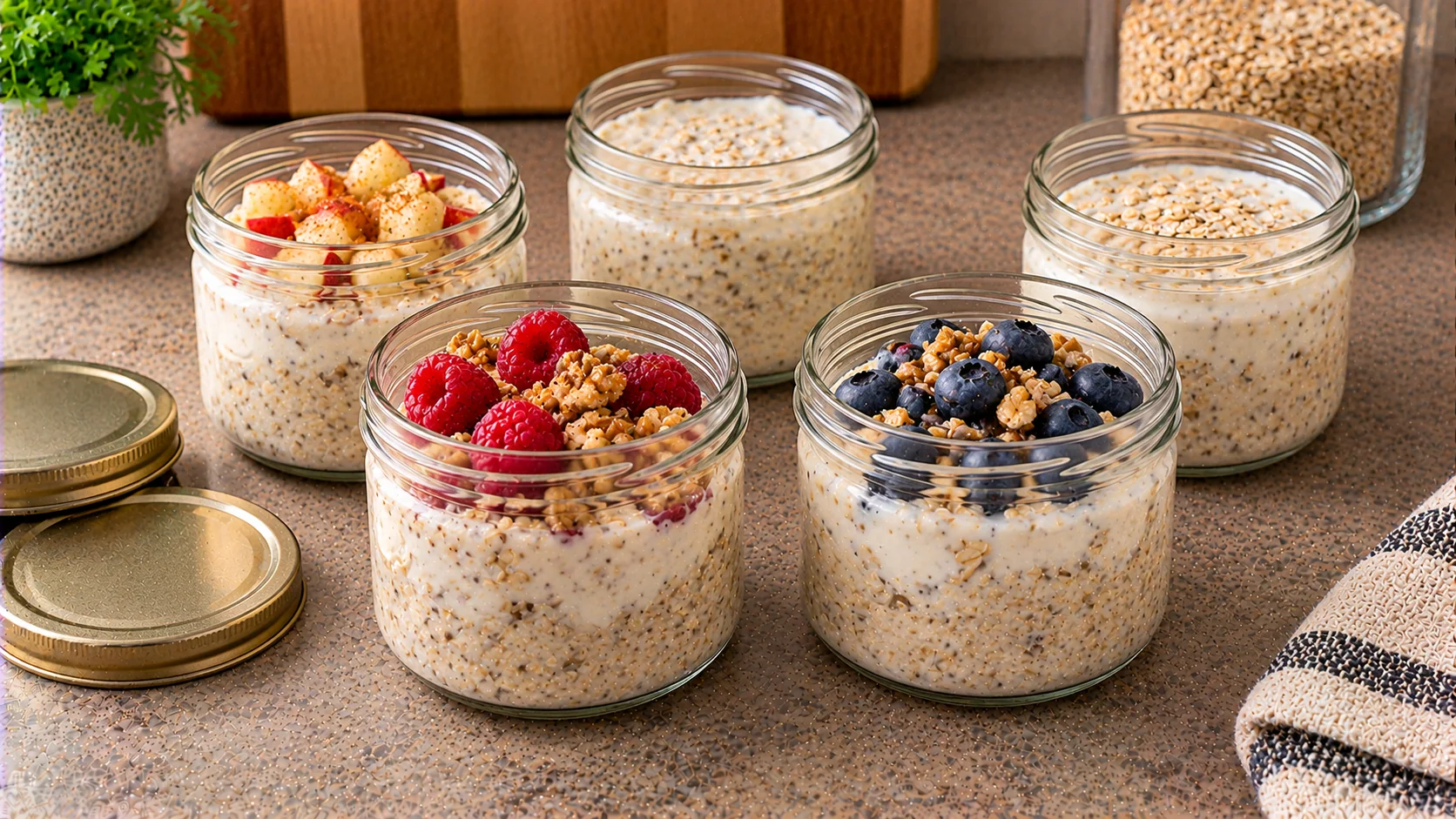
Greek Yogurt and Oat Breakfast Jars for Five Days
Five breakfast jars can save morning preparation time, but a five-day plan works best when the shopping list and storage schedule are realistic. This is one measured recipe divided into five single-serving jars, not five unrelated recipes. The chilled oat-and-yogurt base is made in two batches so the last jars are not left in the refrigerator all week.
Yield, equipment and timing
Makes five breakfasts, one jar per person per day. Use five clean food-safe containers of at least 450 ml each, with lids. Active preparation takes about 15 minutes total across two sessions, plus at least four hours of chilling for each batch. No cooking is needed if using ordinary ready-to-eat rolled oats. These jars are eaten cold; do not bake or microwave a sealed glass jar.
Grocery quantities for five jars
| Ingredient | Total to buy or use | Per jar | Measurement state |
|---|---|---|---|
| Rolled oats | 250 g | 50 g | dry |
| Plain Greek-style yogurt | 850 g | 170 g | as sold |
| Milk or unsweetened fortified soy drink | 300 ml | 60 ml | liquid |
| Chia seeds | 50 g | 10 g | dry |
| Mixed berries | 400 g | 80 g | fresh or safely thawed |
| Banana | 250 g edible | 50 g | peeled |
| Cinnamon | 2.5 g | 0.5 g | ground |
The 250 g banana amount excludes the peel. If shopping for whole bananas, allow extra weight. A 1 kg yogurt tub is convenient but leaves 150 g unused in the recipe; do not confuse the amount purchased with the amount eaten. Check whether your yogurt is plain and sweetened: their nutrition panels differ considerably. Use unsweetened dairy-free drink only when its label suits your needs; that swap does not make this dairy-containing recipe vegan.
Assemble the first three jars (Sunday)
- Wash your hands and clean the work surface. Set out three dry, clean jars with lids.
- Add 50 g oats, 10 g chia and 0.5 g cinnamon to each jar; stir the dry ingredients.
- Add 170 g plain Greek yogurt and 60 ml milk to each jar. Stir thoroughly, especially near the bottom, so no dry oats remain.
- Cover and refrigerate immediately at 5°C or colder. Leave for at least four hours, ideally overnight, for oats and chia to soften.
- Add 80 g berries and 50 g peeled banana shortly before eating when practical. If mixing fruit in ahead, use sound chilled fruit and keep the storage interval short. For frozen berries, follow the package's safety directions; some frozen berries require heating before eating.
Prepare the final two jars (Wednesday)
Repeat the same quantities for two jars on Wednesday evening. Keep the remaining unopened ingredients chilled as required; don't prepare all five yogurt jars on Sunday and assume Friday's serving is automatically safe. Dates on packages, refrigerator temperature and handling can change the safe window. When in doubt, shorten the storage interval or assemble a fresh jar. Yogurt should not be left at room temperature during commuting; transport it in an insulated bag with an ice pack.
Five breakfasts, with small variations
| Day | Jar assembly | Fruit or flavour | Storage action |
|---|---|---|---|
| Monday | Sunday batch | berries and banana | Keep chilled until eaten |
| Tuesday | Sunday batch | berries, cinnamon | Add banana when serving |
| Wednesday | Sunday batch | berries and banana | Finish first batch |
| Thursday | Wednesday batch | berries and cinnamon | Refrigerate promptly |
| Friday | Wednesday batch | berries and banana | Check chill chain |
All five use the same measured ingredient totals; changing the fruit type or substituting a different yogurt will change the calculation. This is a breakfast plan, not an entire day's menu. Add lunch and dinner to meet your individual energy needs.
Estimated nutrition: per jar and full batch
These estimates use explicit illustrative values per 100 g, not a tested laboratory analysis: oats 389 kcal, 16.9 g protein, 66.3 g carbohydrate, 6.9 g fat, 10.6 g fibre; plain 2%-fat Greek-style yogurt 73 kcal, 9.5 g protein, 3.9 g carbohydrate, 2.0 g fat; milk 50 kcal per 100 ml, 3.4 g protein, 4.8 g carbohydrate, 1.8 g fat; chia 486 kcal, 16.5 g protein, 42.1 g total carbohydrate, 30.7 g fat, 34.4 g fibre; berries 50 kcal, 1 g protein, 12 g carbohydrate, 0.5 g fat, 4 g fibre; banana 89 kcal, 1.1 g protein, 22.8 g carbohydrate, 0.3 g fat, 2.6 g fibre. Cinnamon is excluded as nutritionally small at 0.5 g. FoodData Central may report total carbohydrate including fibre; European label carbohydrate generally excludes fibre, so do not directly compare these carbohydrate figures to an EU package's digestible carbohydrate line.
| Calculation | One 50 g-oat jar | Five jars |
|---|---|---|
| Energy | about 482 kcal | about 2,410 kcal |
| Protein | about 29.6 g | about 148 g |
| Fibre | about 13.2 g | about 66 g |
Figures are rounded estimates; the final values depend on the actual yogurt, milk, oats and fruit. Compare brands using their package values and recompute if you need precision. This recipe contains milk; oats may contain gluten unless appropriately certified. Chia and oats add fibre, so increase quantities gradually if you are not used to fibre-rich breakfasts.
Worked example: grocery receipt versus ingredient cost
Suppose a 500 g oat pack costs €0.95, 1 kg plain Greek-style yogurt €3.29, 1 L milk €1.09, 100 g chia €1.49, 400 g berries €2.79, 500 g bananas €0.89 and a jar of cinnamon €0.99. The example checkout total is €11.49 (all packages purchased); it includes leftovers. The amount actually used, valued proportionally excluding the tiny cinnamon amount and without packaging loss, is approximately €7.58 for five jars, or €1.52 per jar. This is a transparent hypothetical basket, not a verified store quotation. If buying frozen berries, compare both price and any heat-treatment instructions.
Adjust texture and protein without distorting portions
For a thicker jar, reduce milk by 10–15 ml and mix thoroughly. For a looser jar, add a little milk at serving. If replacing Greek yogurt with standard yogurt, protein may fall substantially; consult the label rather than reusing the table above. Peanut butter, honey or granola are optional additions, but count them separately because they increase energy and alter allergens. A lid prevents spills; it is not a substitute for refrigeration.
Food safety and shopping notes
Check the use-by date and keep perishable yogurt and milk cold. As general guidance, the USDA Food Safety and Inspection Service recommends promptly refrigerating perishables; follow the stricter label or local guidance where applicable. Use USDA FoodData Central to inspect ingredients and preparation states. For another budget-friendly breakfast choice, see budget breakfasts without protein powder; for meal-prepping smaller household portions, see meal prep for one person.