
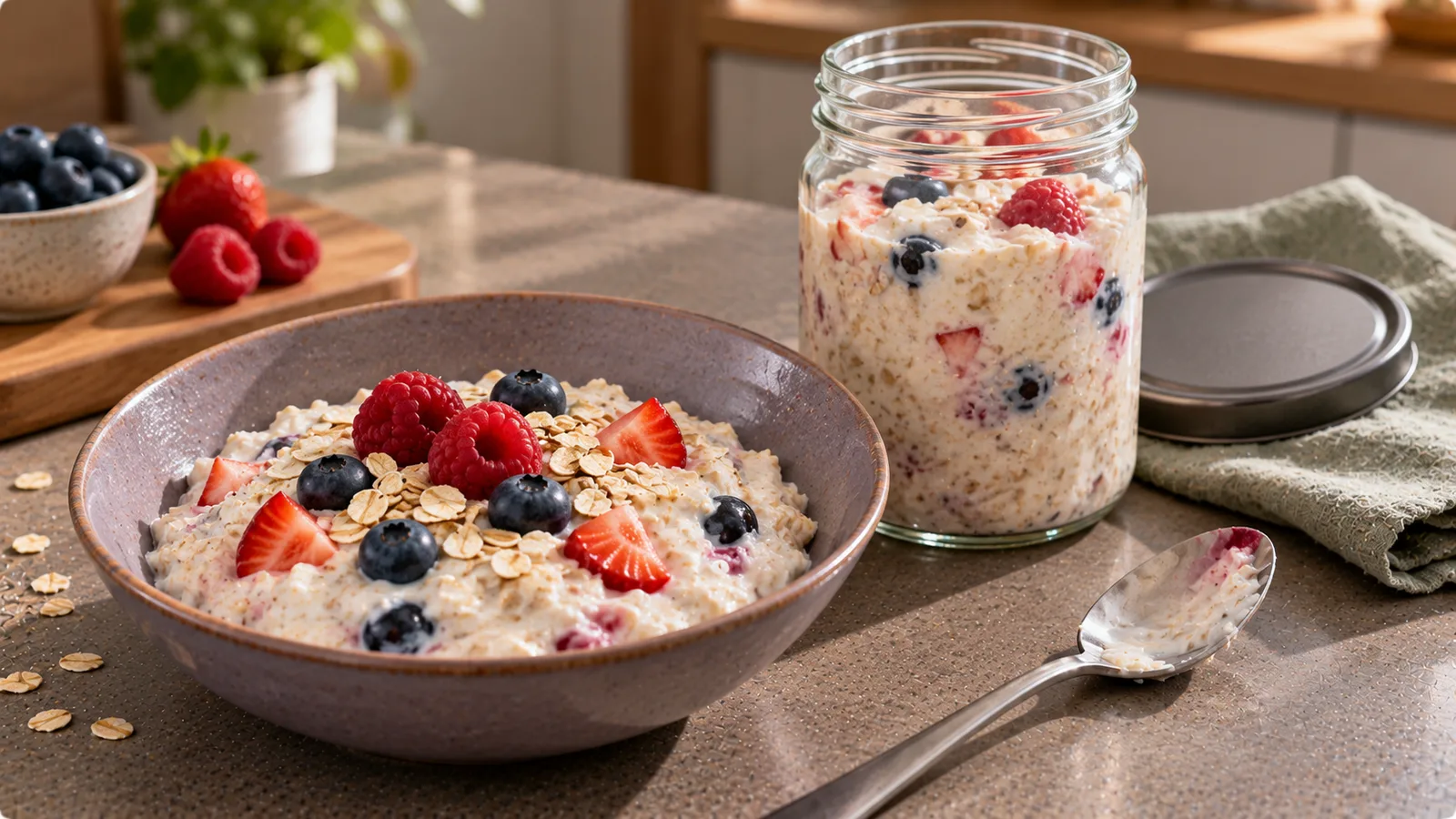
Overnight oats with yogurt and berries are a convenient breakfast you can prepare the evening before.
Rolled oats soften in milk and yogurt while the mixture rests in the refrigerator. By morning, the oats have a creamy texture without needing to be cooked.
Fresh or frozen berries add flavour, while chia seeds can make the mixture slightly thicker.
This recipe makes two servings and can be prepared in about 10 minutes.
Recipe at a glance
| Servings | 2 |
| Preparation time | 10 minutes |
| Refrigeration | At least 4 hours, preferably overnight |
| Cooking | None |
| Total hands-on time | About 10 minutes |
| Main ingredients | Oats, yogurt, milk, berries |
| Equipment | Bowl or two covered jars |
Ingredients
For two servings:
- 100 g rolled oats
- 200 g plain Greek-style yogurt, approximately 2% fat
- 150 ml milk, approximately 1.5% fat
- 150 g mixed berries, such as blueberries, raspberries or strawberries
- 10 g chia seeds
- 10 g honey, optional
- ½ teaspoon vanilla extract, optional
- A small pinch of cinnamon, optional
For serving, you can add a few extra berries or a spoonful of yogurt.
Choose plain yogurt without added sugar if you want to control the sweetness yourself.
How to make overnight oats with yogurt
1. Mix the base
Place the rolled oats and chia seeds in a bowl.
Add the yogurt and milk.
Stir thoroughly until all the oats are moistened and the chia seeds are evenly distributed.
Add vanilla and cinnamon if using.
2. Add the berries
If using fresh berries, wash them and drain well.
Cut large strawberries into smaller pieces.
Fold approximately two-thirds of the berries into the oat mixture.
Keep the remaining berries for serving.
Frozen berries can also be used. Thaw them safely in the refrigerator as part of the overnight mixture.
3. Adjust the sweetness
Taste the yogurt mixture before refrigeration.
Add the optional honey if you prefer a sweeter breakfast.
The berries will also contribute sweetness, so additional honey may not be necessary.
4. Divide into portions
Spoon the mixture into two clean jars or food-safe containers.
Cover each container.
5. Refrigerate
Place the containers in the refrigerator for at least 4 hours, ideally overnight.
The oats absorb liquid and soften while the chia seeds thicken the mixture.
Keep the mixture refrigerated rather than leaving it at room temperature overnight.
6. Stir and serve
In the morning, stir each portion.
If the oats are too thick, add a small splash of milk.
Top with the reserved berries and serve cold.
You can also warm the oats gently if you prefer, although this changes the texture.
Estimated nutrition per serving
The following values are approximate estimates for half the recipe, including the optional honey.
| Nutrient | Approximate amount |
|---|---|
| Calories | 365 kcal |
| Protein | 20 g |
| Fat | 9 g |
| Carbohydrates | 50 g |
| Fibre | 8 g |
The actual values depend on the yogurt, milk, berry mixture and sweetener.
Greek-style yogurt can vary considerably in protein and fat content. For accurate tracking, use the nutrition label of the specific product you buy.
Ingredient composition data can also be checked through USDA FoodData Central.
How thick should overnight oats be?
The ideal texture is a matter of preference.
The recipe starts with:
- 100 g oats.
- 200 g yogurt.
- 150 ml milk.
- 10 g chia seeds.
This produces a relatively thick, spoonable mixture after refrigeration.
For a softer consistency, add 30–60 ml more milk to the full batch.
For thicker oats, reduce the milk slightly or add a little more yogurt.
Avoid adding too much chia at once because the mixture can become very firm after several hours.
Can you use frozen berries?
Yes. Frozen berries work well in overnight oats.
They may release more liquid than fresh berries as they thaw, changing the colour and texture of the mixture.
If you want a neater presentation, keep the berries separate until serving.
For food safety, follow the instructions on the frozen berry package, including any recommendation to heat the berries before eating.
Public-health advice on frozen berries differs by product and jurisdiction, so the manufacturer's instructions and relevant local guidance take priority.
Which yogurt works best?
Different yogurts produce different results.
Greek-style yogurt
Provides a thick, creamy texture. Protein and fat vary by brand.
Skyr
Usually produces a thick mixture and can be a useful alternative when you prefer its taste and nutritional profile.
Plain natural yogurt
Often creates a looser consistency. You may need slightly less milk.
Unsweetened plant-based yogurt
Can be used for a dairy-free version, provided the milk is also replaced with a suitable plant-based drink.
Check the product label because protein, sugar and calcium content vary significantly between alternatives.
Easy variations
Banana and blueberry
Replace part of the mixed berries with sliced banana.
Add banana shortly before serving if you want it to retain a fresher appearance.
Raspberry and almond
Use raspberries and add 15 g chopped almonds to the full batch.
Nuts increase the fat and calorie content.
Strawberry and vanilla
Use chopped strawberries and the optional vanilla extract.
Omit the honey if the strawberries provide enough sweetness.
Higher-protein version
Use a higher-protein plain yogurt or skyr.
Calculate the nutrition using the exact product label rather than assuming every high-protein yogurt has the same values.
Dairy-free version
Use unsweetened plant-based yogurt and a compatible plant-based drink.
Choose fortified products where appropriate and check the nutrition information, especially for protein and calcium.
Preparing several breakfasts at once
Overnight oats are suitable for meal preparation because the base can be divided into individual portions.
To prepare four servings, double the recipe:
| Ingredient | Four servings |
|---|---|
| Rolled oats | 200 g |
| Plain yogurt | 400 g |
| Milk | 300 ml |
| Mixed berries | 300 g |
| Chia seeds | 20 g |
| Honey, optional | 20 g |
Use four separate containers or one larger covered container.
For the best texture, you can keep delicate toppings separate until serving.
Storage and food safety
Overnight oats contain perishable ingredients such as yogurt and milk.
Prepare them with clean utensils, cover the containers and refrigerate promptly.
Keep the refrigerator at 4°C (40°F) or below, consistent with FDA food-storage guidance. FDA — Are You Storing Food Safely?.
For quality, this recipe is best eaten within 1–2 days, particularly when mixed with fresh berries.
This is a conservative recipe recommendation, not a universal legal storage limit. Actual safe storage depends on ingredient freshness, handling and refrigeration.
Discard the mixture if it has been left unrefrigerated for an unsafe period or shows signs of spoilage. Remember that harmful bacteria do not always cause obvious changes in smell or appearance.
Common mistakes
Too little liquid: The oats remain dry or overly firm.
Too much liquid: The mixture becomes thin rather than creamy.
Using instant oats without adjusting texture: Instant oats can become softer and more paste-like than rolled oats.
Adding crunchy toppings too early: Nuts and granola may lose their crunch overnight.
Leaving the mixture on the counter: Yogurt and milk should be kept refrigerated.
Assuming every yogurt has the same nutrition: Check the specific product.
What to serve with overnight oats
The recipe is designed as a complete breakfast portion, but you can adjust it to your appetite.
For a larger meal, add a boiled egg or a slice of wholegrain toast.
For a smaller breakfast, divide the mixture into three portions instead of two.
If you change the serving count, divide the total recipe nutrition by the number of portions actually prepared.
Recipe notes
- Rolled oats provide a more distinct texture than instant oats.
- Mix the chia seeds thoroughly to prevent clumps.
- Keep dairy ingredients refrigerated throughout preparation and storage.
- Add extra milk after refrigeration if the mixture becomes too thick.
- Use actual ingredient labels for precise calorie and macro calculations.