
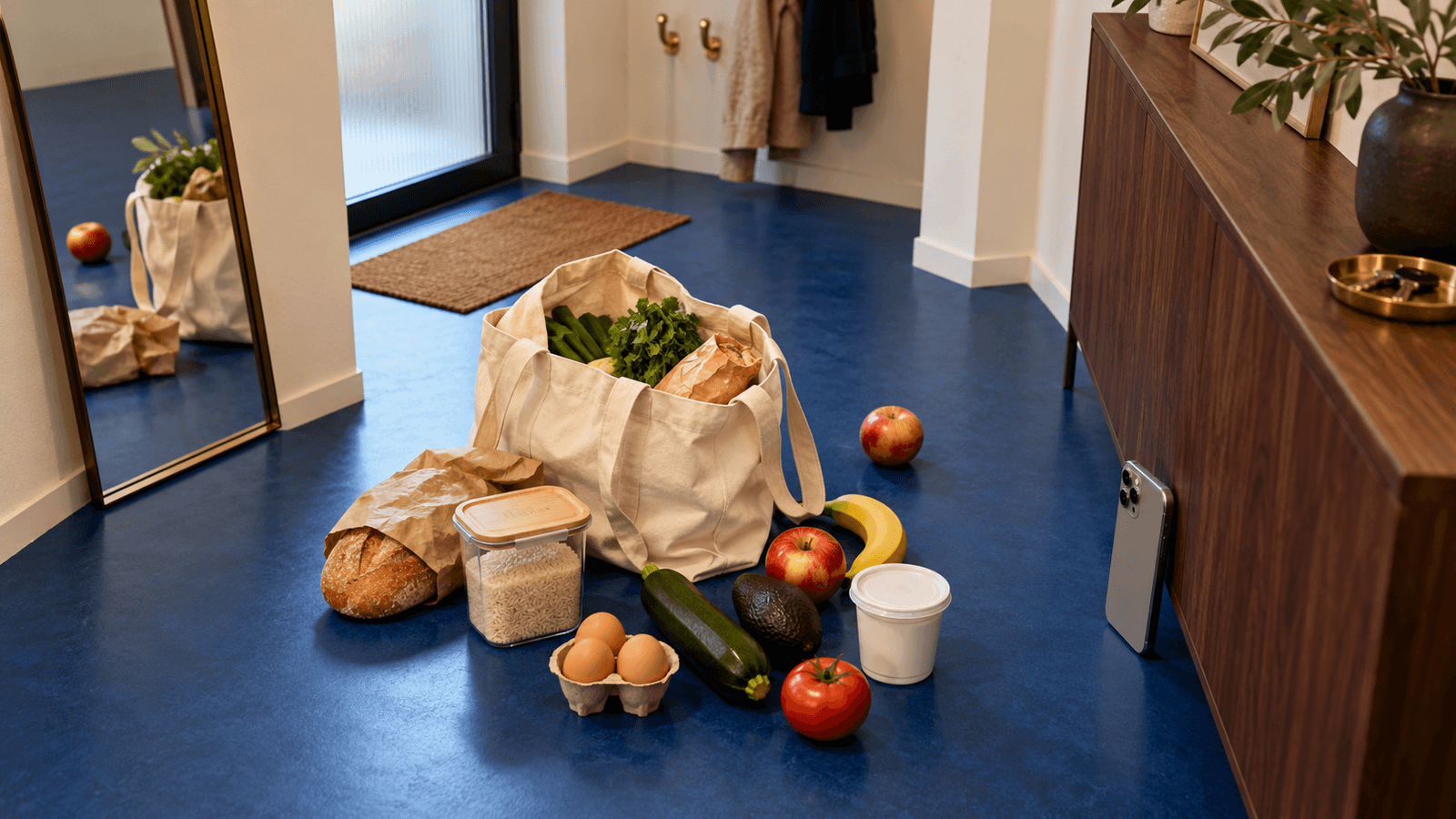
Tracking calories can be useful, but weighing every ingredient is not the only way to understand how much you eat.
For some people, a kitchen scale is useful when learning portions or checking calorie-dense foods. But weighing every tomato, slice of bread and spoonful of yogurt can add unnecessary friction.
A more practical approach is to combine several methods.
You can use:
- package information
- known portions
- household measures
- repeat meals
- visual estimates
- meal photos
- selective weighing
The goal is not perfect measurement.
The goal is to collect enough useful information to understand your overall intake.
Can you track calories without weighing food?
Yes.
Calorie tracking always involves some level of estimation.
Even when food is weighed precisely, other uncertainties remain:
- nutrition labels are not perfect measurements
- restaurant recipes may be unknown
- cooking changes water content
- sauces and oils may be difficult to quantify
- energy expenditure is also estimated
A food scale can improve portion information, but it does not transform calorie tracking into an exact science.
For many everyday meals, a reasonable estimate is enough to make the broader pattern visible.
Why people weigh food
Food scales are useful because portion size strongly affects calorie estimates.
For example, it can be difficult to visually distinguish between different amounts of:
- pasta
- rice
- cereal
- nuts
- cheese
- oils
- spreads
Weighing these foods occasionally can teach you what typical portions look like.
But that does not mean they must be weighed forever.
Use the nutrition label first
Packaged foods often provide useful information directly on the label.
If a product contains a known number of portions, you may be able to log it without weighing anything.
For example:
- one yogurt cup
- one protein bar
- one bread roll
- one individual cheese portion
- one canned product
- one frozen portion
If you eat the entire package or a clearly defined fraction of it, the package information may be enough.
Use unit-based portions
Many foods are naturally easy to count.
Examples:
- 2 eggs
- 1 banana
- 1 apple
- 2 slices of bread
- 1 tortilla
- 1 yogurt cup
The exact weight may vary, but a unit-based estimate can be practical for routine tracking.
Learn your common portions once
You do not need to measure the same familiar meal every day.
Suppose your regular breakfast is:
- yogurt
- oats
- berries
- two eggs
You might measure the ingredients once or several times while learning the meal.
After that, if you prepare approximately the same portion, you can reuse the saved meal or estimate.
This can dramatically reduce daily tracking effort.
Use household measures
Common kitchen measures can provide approximate portions.
Examples include:
- tablespoon
- teaspoon
- cup
- glass
- bowl
- ladle
They are less precise than a scale, but often more convenient.
For example, logging approximately one tablespoon of olive oil may be more practical than weighing the bottle before and after cooking.
Use visual portion estimates
Visual estimation becomes easier with experience.
You can compare food portions with familiar objects or parts of the hand.
For example:
- a palm-sized portion for some protein foods
- a fist-sized volume for some carbohydrate or vegetable portions
- a thumb-sized amount for some spreads or fats
These are rough guides, not precise calorie measurements.
Their value is speed and consistency.
Photograph your meals
A meal photo creates a record of what you actually ate.
This can be useful even without automatic AI analysis.
A photo helps you remember:
- which foods were present
- relative portion sizes
- sauces or toppings
- whether you had seconds
- how meals differed across days
If you log later, the photo can be much more useful than relying on memory.
AI photo-based calorie tracking
AI food tracking systems attempt to identify foods from an image and estimate portions and nutrition.
This can reduce manual entry.
A typical process may include:
- photograph the meal
- identify likely foods
- estimate visible portions
- match foods with nutrition data
- calculate approximate calories and macros
- allow the user to correct the result
For a broader explanation, see AI Calorie Trackers: How Photo-Based Food Tracking Works.
What a photo can estimate well
A clear photo may provide useful information about:
- visible foods
- approximate relative portions
- number of food items
- meal composition
Simple meals are generally easier to interpret than foods with many hidden ingredients.
For example, a plate containing chicken, potatoes and broccoli provides more visible information than a creamy casserole with an unknown recipe.
What a photo cannot reliably show
A photograph may not reveal:
- how much oil was used
- ingredients hidden inside a sauce
- sugar added to a drink
- exact recipe quantities
- the weight of a dense food
- ingredients underneath other foods
This is why photo tracking should allow corrections.
If you know that the meal contains two tablespoons of oil, adding that information can improve the estimate.
Use selective weighing
A practical compromise is to weigh only foods where small portion differences can meaningfully change the calorie estimate.
Examples may include:
- oils
- nuts
- nut butter
- cheese
- chocolate
- dry cereal
- calorie-dense sauces
Meanwhile, foods such as leafy vegetables may not require the same level of measurement for many people.
This reduces effort while preserving useful accuracy.
Measure oils differently
Cooking oil is a common source of tracking error because it may not be obvious in the finished meal.
You can estimate oil using:
- teaspoons
- tablespoons
- a measured dispenser
- the amount used for the entire recipe divided by portions
For example, if a recipe uses two tablespoons of oil and produces four similar servings, you can allocate approximately one quarter of the oil to each serving.
Save recipes
Homemade mixed dishes can be difficult to estimate repeatedly.
Instead of rebuilding the calculation every time, create the recipe once.
For example:
Homemade pasta sauce
Ingredients:
- minced meat
- tomatoes
- onion
- oil
- vegetables
Calculate the total recipe and divide it by the number of portions.
The next time you prepare a similar recipe, reuse or adjust it.
Use repeat meals
Most people do not eat completely different foods every day.
If you regularly eat:
- the same breakfast
- similar sandwiches
- the same coffee
- recurring snacks
- several favorite dinners
save them.
Repeated meals can make tracking much faster.
Estimate restaurant meals
Restaurant food rarely allows precise measurement.
Instead, identify the major components.
For example:
Grilled chicken bowl:
- chicken
- rice
- vegetables
- avocado
- dressing
Estimate each major component rather than trying to recreate the exact restaurant recipe.
If the restaurant provides nutrition information, use it when appropriate.
Otherwise, accept a reasonable range of uncertainty.
Do not confuse precision with accuracy
A log showing 623 kcal looks more precise than one showing about 600 kcal.
But the extra digits do not necessarily make the estimate more accurate.
If the portion size, oil or recipe is uncertain, the true calorie content may differ.
Calorie tracking works better when estimates are treated as estimates.
Consistency can matter more than perfect precision
Suppose your tracking method systematically underestimates your intake slightly.
If you use the same method consistently, your weight trend can still help you interpret the result.
For example, if your logged intake appears to be below estimated maintenance but your weight remains stable for a long period, your actual intake may be closer to maintenance than the log suggests.
Your real-world trend provides additional information.
See What Are Maintenance Calories and How Do You Estimate Them?.
Focus on the foods that matter most
Not every ingredient contributes equally to the calorie total.
Consider two ingredients:
- cucumber
- olive oil
A visual error in the cucumber portion may have relatively little effect on total calories.
A similar volume error with oil can matter much more.
This suggests a practical strategy:
be more precise where precision has more value.
Build a personal portion library
Over time, learn what your usual portions look like.
For example:
- your normal bowl of oats
- your usual rice serving
- your typical chicken portion
- your standard coffee with milk
- your normal handful of nuts
You can occasionally verify these portions with a scale.
Once familiar, you may no longer need to measure them every time.
Tracking breakfast without weighing
Suppose breakfast is:
- two eggs
- two slices of bread
- one yogurt cup
- one banana
- coffee with milk
Most of this can be logged using units and package information.
No food scale may be necessary.
Tracking lunch without weighing
Suppose lunch is:
- chicken breast
- rice
- vegetables
- sauce
You might:
- photograph the plate
- estimate the chicken portion
- estimate rice using a familiar serving size
- log vegetables approximately
- pay extra attention to the sauce
This can produce a useful estimate quickly.
Tracking dinner without weighing
For a homemade mixed meal:
- save the recipe
- estimate how much of the recipe you ate
- add obvious extras
- reuse the recipe next time
This is usually easier than measuring every ingredient on the plate.
What about snacks?
Many snacks are easy to track by unit or package.
Examples:
- yogurt cup
- protein bar
- piece of fruit
- packaged portion
For foods such as nuts, chocolate or spreads, occasional weighing may help you learn what your normal portion actually looks like.
What about drinks?
Do not forget drinks that contain meaningful energy.
Examples include:
- milk in coffee
- sweetened drinks
- juice
- smoothies
- alcohol
Water, plain tea and black coffee generally require little or no tracking effort from a calorie perspective.
Use ranges when uncertainty is high
Sometimes pretending to know an exact number is less useful than acknowledging uncertainty.
A restaurant meal might reasonably be treated as an approximate range rather than an exact calorie value.
The important question is whether this uncertainty materially changes your daily or weekly picture.
Track the meal, not every microscopic ingredient
If your salad contains:
- lettuce
- cucumber
- tomatoes
- herbs
- chicken
- avocado
- dressing
you may not need to spend time estimating every individual lettuce leaf.
Focus on the major contributors:
- chicken
- avocado
- dressing
and use a broader estimate for the vegetables.
Use calorie tracking as feedback
Tracking is most useful when it helps answer practical questions.
For example:
- Are my portions larger than I thought?
- Am I getting enough protein?
- Are drinks adding more calories than expected?
- Does my weekend intake differ from weekdays?
- Which meals keep me full?
- Am I approximately near my target?
Tracking should generate useful feedback, not just numbers.
Tracking and calorie deficits
If your goal is weight loss, tracking can help make a calorie deficit easier to understand.
But the logged deficit is still an estimate.
For example:
Estimated maintenance: 2,400 kcal
Logged intake: 2,000 kcal
The apparent deficit is 400 kcal.
The real deficit may differ.
Use the longer-term trend to evaluate whether the plan is working.
See What Is a Calorie Deficit?.
Do you need to track forever?
No.
Some people use tracking temporarily to learn:
- portion sizes
- calorie density
- meal composition
- common sources of extra calories
Later, they may rely more on habits and familiar portions.
Others prefer to continue tracking because they find the structure useful.
Both approaches can be reasonable.
When weighing food is useful
Although this article focuses on tracking without weighing everything, a scale can still be useful.
Consider weighing food when:
- you are learning an unfamiliar portion
- a food is particularly calorie-dense
- the portion is difficult to estimate visually
- a recipe needs a more accurate baseline
- your current estimates are not producing useful data
The goal is selective measurement rather than automatic measurement of everything.
When weighing may add little value
Measuring every low-calorie vegetable or repeating measurements of a meal you already know well may add effort without changing your decisions.
Ask:
Will knowing this number more precisely change anything useful?
If not, an estimate may be enough.
A practical three-level system
You can divide foods into three tracking levels.
Level 1: Count or scan
Examples:
- eggs
- bananas
- yogurt cups
- bread slices
- packaged portions
Use units or package information.
Level 2: Estimate visually
Examples:
- cooked rice
- potatoes
- chicken
- vegetables
- restaurant portions
Use experience, photos and familiar serving sizes.
Level 3: Measure when useful
Examples:
- oil
- nuts
- nut butter
- cheese
- calorie-dense sauces
Use a scale or household measure when greater precision is worthwhile.
This keeps the process efficient.
How Mealisa approaches low-friction tracking
Mealisa is designed around minimizing manual entry.
A meal can be recorded using a photo, while the system estimates visible foods, portions, calories and macros.
The user can then correct details when needed.
Other inputs can complement the photo:
- barcode or QR information
- nutrition labels
- saved recipes
- manual corrections
- restaurant information
The goal is not to pretend that every photograph produces a perfectly exact number.
The goal is to make everyday tracking fast enough to use consistently while keeping corrections available where they matter.
Combine tracking with meal planning
Tracking becomes more useful when it affects future decisions.
If breakfast and lunch have already used a large share of the day's calories, dinner can be adjusted.
If protein is low, a later meal can emphasize protein.
If the day has been lighter than usual, the remaining plan can adapt.
This connects food logging with actual meal decisions rather than treating tracking as a passive diary.
See Meal Planning for Beginners.
A simple no-scale tracking workflow
Step 1: Photograph the meal
Create a quick visual record.
Step 2: Identify the major foods
Focus on the components that contribute most to calories and macros.
Step 3: Use known units
Use pieces, slices, packages or saved portions where possible.
Step 4: Estimate familiar foods
Use your learned portion sizes.
Step 5: Measure only uncertain high-impact foods
Oil, nuts, cheese or sauces may deserve extra attention.
Step 6: Correct obvious errors
If the estimate identifies the wrong food or portion, change it.
Step 7: Look at the longer-term pattern
Do not judge the quality of your tracking from one meal.
Common mistakes
Trying to be perfectly precise
Calorie tracking contains uncertainty even with a scale.
Estimating calorie-dense foods too casually
Small differences in oil, nuts and sauces can meaningfully affect totals.
Ignoring drinks
Milk, sweetened beverages and alcohol can contribute energy.
Forgetting cooking ingredients
Oil and butter used during preparation still count.
Rebuilding repeat meals every day
Save meals and recipes you eat regularly.
Trusting AI estimates without checking
Photo analysis should be treated as an estimate that can be corrected.
Abandoning tracking after one uncertain meal
One restaurant dinner does not make the rest of the week's data useless.
Frequently asked questions
Can I count calories without a food scale?
Yes. You can use package information, units, household measures, visual estimates, photos and saved meals.
Is calorie tracking accurate without weighing food?
It can provide useful estimates, but it will not be perfectly precise. The required level of accuracy depends on what you are trying to learn from the data.
What foods are worth weighing?
Foods with high calorie density or difficult-to-estimate portions may benefit most from occasional measurement, such as oils, nuts, nut butter, cheese and some sauces.
Can AI estimate calories from a photo?
AI can estimate visible foods and portions from an image, but hidden ingredients, oils, sauces and exact weights can introduce uncertainty.
Should I weigh vegetables?
Usually there is no need to weigh every vegetable unless you have a specific reason to track them very precisely.
How do I track restaurant meals?
Use available nutrition information when provided. Otherwise estimate the main components and accept greater uncertainty.
Can I reuse previous meals?
Yes. Saving repeat meals and recipes is one of the easiest ways to reduce tracking effort.
Is it better to track approximately or not track at all?
If tracking is useful for your goal, a consistent reasonable estimate can provide more information than abandoning the process because perfect precision is impossible.
Do I need to track calories every day?
Not necessarily. Some people track continuously, while others use tracking temporarily or periodically to understand portions and eating patterns.
The bottom line
You do not need to weigh every food to track calories.
Use exact information when it is easy to obtain.
Count foods that naturally come in units.
Save repeat meals.
Learn your common portions.
Use photos and visual estimates.
Pay more attention to calorie-dense ingredients where small errors matter more.
Use a scale selectively when additional precision is actually useful.
The most practical tracking system is not the one that measures the greatest number of things.
It is the one that provides enough useful information without making normal eating unnecessarily difficult.
This article provides general nutrition information and is not individualized medical advice. Calorie tracking may not be appropriate for everyone, particularly people with a current or previous eating disorder or other circumstances where food tracking may be harmful. Seek individualized professional guidance when appropriate.