
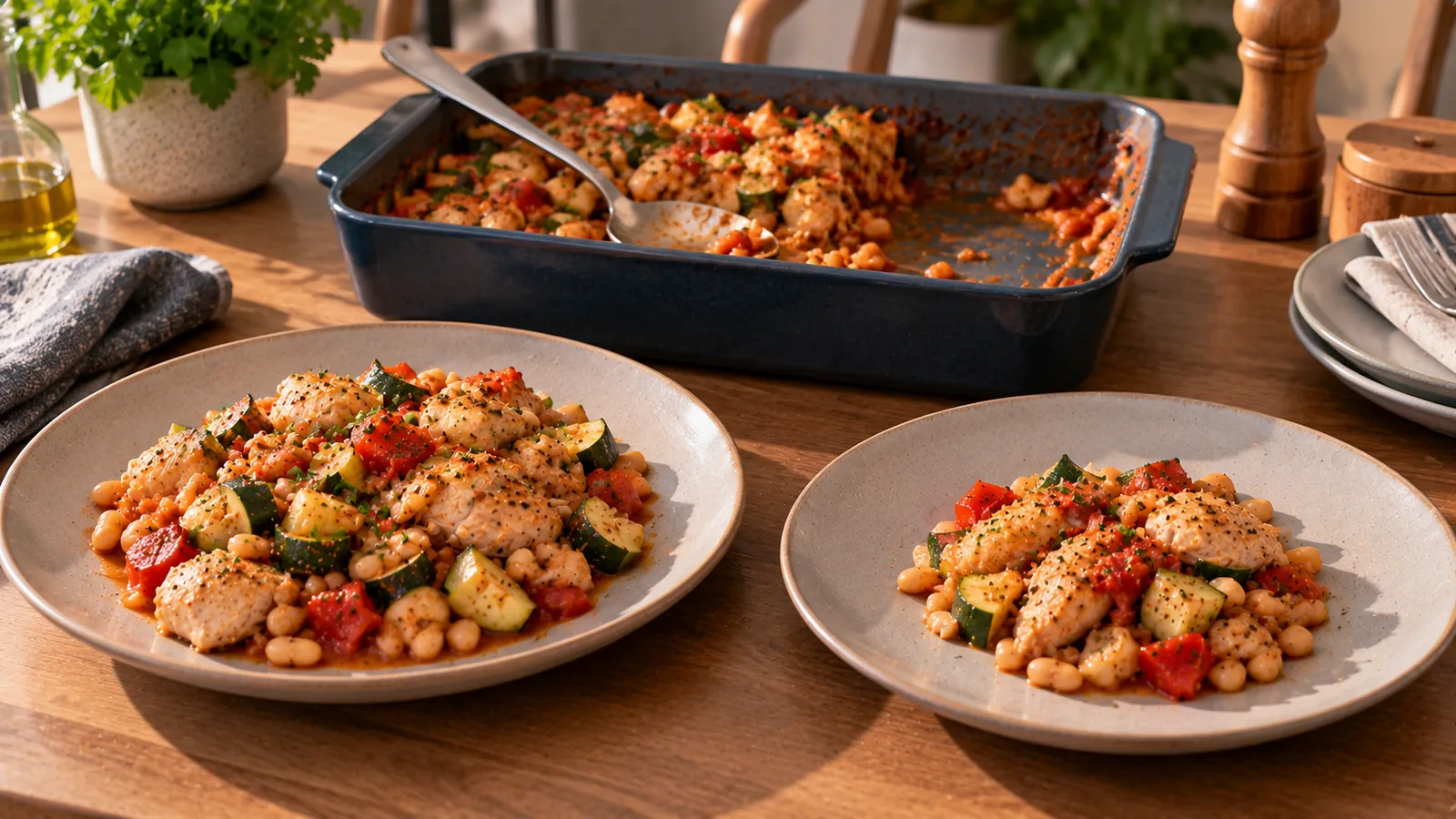
Sharing a meal creates a simple tracking problem: the recipe belongs to everyone, but your food diary needs only the amount you actually ate.
Dividing the total calories by the number of people works only when everyone eats equal portions.
Often they do not.
One person may eat 35% of a casserole, another 25%, and the rest may be saved for later. A shared curry may be divided unevenly. One person may take more pasta while another takes more sauce.
The most reliable approach is to separate two questions:
- What is in the whole meal?
- What fraction of that meal did you personally eat?
The most accurate practical method
For a mixed dish, use this workflow:
calculate the whole recipe → weigh the finished dish → weigh your portion → calculate your share
Suppose a cooked meal contains approximately 1,800 kcal in total.
After cooking, the edible finished dish weighs 1,500 g.
Your portion weighs 420 g.
Your share is:
420 ÷ 1,500 = 0.28
So you ate approximately 28% of the recipe.
Estimated calories:
1,800 × 0.28 = 504 kcal
The same fraction can be applied to the recipe's protein, fat and carbohydrate totals.
Why cooked weight is useful
Ingredients change weight during cooking.
Rice and pasta absorb water. Meat may lose water and fat. Vegetables may shrink. Sauces may reduce.
Because of this, comparing your cooked serving directly with the raw ingredient weights can produce confusing results.
For a mixed recipe, weighing the complete edible dish after cooking gives you a common basis for dividing it.
The formula is:
your cooked portion ÷ total cooked recipe weight = your fraction of the recipe
Then:
recipe calories × your fraction = estimated calories eaten
Example: shared pasta dish
Imagine a finished pasta dish contains:
- pasta;
- minced meat;
- tomato sauce;
- vegetables;
- olive oil.
The complete recipe contains approximately:
- 2,400 kcal;
- 140 g protein;
- 260 g carbohydrate;
- 90 g fat.
The cooked dish weighs 2,000 g.
Your plate contains 650 g.
Your share is:
650 ÷ 2,000 = 32.5%
Your approximate intake is therefore:
| Nutrient | Whole recipe | Your share |
|---|---|---|
| Calories | 2,400 kcal | 780 kcal |
| Protein | 140 g | 45.5 g |
| Carbohydrate | 260 g | 84.5 g |
| Fat | 90 g | 29.3 g |
This is more realistic than dividing the recipe equally between three people if their portions were different.
You do not need to create identical servings
A recipe does not need to be divided into four identical boxes to be trackable.
You can have:
- one 300 g portion;
- one 450 g portion;
- one 600 g portion;
- leftovers.
Each person logs the proportion represented by their actual serving.
That makes the method useful for couples and families with different energy needs.
Save the total cooked weight with the recipe
If you regularly cook the same dish, save two pieces of information:
- nutrition for the whole recipe;
- total cooked yield.
For example:
Chicken curry
- total cooked weight: 1,840 g
- total calories: 2,150 kcal
You can also calculate calories per gram:
2,150 ÷ 1,840 ≈ 1.17 kcal/g
A 400 g serving would then contain approximately:
400 × 1.17 ≈ 468 kcal
You can calculate macros the same way.
Per 100 g can make repeated serving easier
For recipes eaten over several days, converting the finished recipe to values per 100 g is convenient.
Suppose:
- finished recipe = 1,600 g;
- total energy = 2,080 kcal.
Then:
2,080 ÷ 1,600 × 100 = 130 kcal per 100 g
A 350 g serving is:
130 × 3.5 = 455 kcal
This allows each person to serve a different amount without recalculating the whole recipe.
When weighing the whole dish is difficult
Sometimes the food is already on the table before you remember to weigh it.
You still have options.
Method 1: weigh individual portions
If all servings and leftovers can be weighed, add them together to reconstruct the total.
For example:
- Person A: 420 g;
- Person B: 310 g;
- Person C: 380 g;
- leftovers: 290 g.
Total cooked amount:
420 + 310 + 380 + 290 = 1,400 g
Person A therefore ate:
420 ÷ 1,400 = 30%
Method 2: estimate fractions
If weighing is impossible, estimate your share of the complete dish.
For example:
- about one quarter;
- about one third;
- about 40%.
A reasonable fraction is usually better than automatically assuming everyone ate equal portions.
Equal division is fine when portions really are equal
There is nothing wrong with dividing by the number of servings when the portions were deliberately made equal.
For example, a recipe contains 2,000 kcal and is divided into four approximately equal containers.
Each portion is approximately:
2,000 ÷ 4 = 500 kcal
The problem is using this method when one person actually ate twice as much as another.
Mixed dishes versus separate components
The cooked-weight method works particularly well for reasonably uniform mixed dishes such as:
- soup;
- chili;
- curry;
- stew;
- casserole;
- risotto;
- mixed pasta dishes.
It can be less accurate when the meal contains separate components that are distributed very unevenly.
For example, one person may take much more chicken while another takes much more rice.
In that situation, tracking the components separately may be better.
Example: shared curry and rice
Suppose dinner contains:
- one pot of chicken curry;
- one pot of rice.
Do not necessarily combine both into one giant recipe.
Instead, calculate:
Curry
- total cooked weight: 1,200 g;
- your portion: 380 g.
Rice
- total cooked weight: 900 g;
- your portion: 220 g.
Your percentage of the curry and your percentage of the rice can be different.
That better reflects what is actually on your plate.
Shared pizza
Pizza can be tracked by fractions when slices are reasonably similar.
If the whole pizza contains approximately 1,600 kcal and you eat three of eight similar slices:
3 ÷ 8 = 37.5%
Estimated intake:
1,600 × 0.375 = 600 kcal
But slice count becomes less reliable when:
- slices differ greatly in size;
- toppings are concentrated unevenly;
- people leave crusts;
- additional toppings are added to individual slices.
In those cases, weight or a more specific estimate may be better.
Shared salad
A shared salad can be deceptive because dressing, cheese, nuts and other calorie-dense ingredients may not be distributed evenly.
If the salad is thoroughly mixed, using your portion by weight may be reasonable.
If toppings remain separate, consider logging major components individually.
For example:
- salad vegetables;
- chicken;
- feta;
- nuts;
- dressing.
This avoids assuming that 30% of the salad volume automatically means 30% of every ingredient.
Shared serving dishes
When food is served from a central dish, the easiest workflow is often:
- weigh the complete cooked food;
- note the weight;
- serve normally;
- weigh your plate portion;
- calculate your percentage.
If the serving dish itself is placed on a scale, remember to exclude the weight of the empty container.
Use tare weight correctly
Suppose:
- empty pot = 1,100 g;
- pot with cooked food = 2,850 g.
The food itself weighs:
2,850 - 1,100 = 1,750 g
Use 1,750 g as the total cooked yield, not 2,850 g.
The same applies when weighing your plate.
Use the food weight, excluding the plate or bowl.
What if you take seconds?
Add every serving you personally eat.
For example:
- first serving: 320 g;
- second serving: 140 g.
Total eaten:
460 g
If the complete dish weighed 1,600 g:
460 ÷ 1,600 = 28.75%
Do not calculate only the first plate.
What if someone takes food before you weigh the dish?
If possible, reconstruct the total.
Suppose:
- 300 g has already been served;
- 1,200 g remains in the pot.
Estimated original cooked yield:
300 + 1,200 = 1,500 g
You can then calculate portions against that total.
If the first serving was not weighed either, the result becomes more approximate. Record the best reasonable estimate rather than inventing precision.
Leftovers help verify the calculation
Imagine the recipe produced 1,800 g.
After dinner:
- you ate 500 g;
- another person ate 650 g;
- 650 g remains.
Check:
500 + 650 + 650 = 1,800 g
The quantities reconcile.
This simple check can reveal forgotten servings or weighing errors.
When ingredients are served separately
For meals such as:
- tacos;
- bowls;
- sandwiches;
- wraps;
- salads with toppings;
- build-your-own meals,
people may take very different combinations.
A single percentage of the entire meal may not work well.
Track the major components individually.
For example:
Your burrito bowl
- rice: 180 g;
- beans: 120 g;
- chicken: 140 g;
- salsa: 50 g;
- cheese: 25 g;
- guacamole: 40 g.
Another person can log a completely different combination from the same shared ingredients.
Sauces and oils need attention
Shared meals often contain ingredients that are easy to overlook:
- cooking oil;
- butter;
- dressing;
- cream;
- cheese;
- sauces.
If these ingredients are mixed throughout the recipe, include them in the whole recipe before calculating portions.
Do not add the oil separately again to your individual serving unless additional oil or sauce was actually added to your plate.
That would double-count it.
When distribution is not uniform
The cooked-weight method assumes that the portion you take is reasonably representative of the mixture.
That assumption works better for a well-mixed soup than for a dish containing large separate pieces.
Imagine a stew where most of the meat remains in one part of the pot.
Two 400 g servings could have different nutrition if one contains much more meat.
In such cases, either:
- mix the dish more evenly before serving;
- track important components separately;
- accept a wider estimation uncertainty.
Shared homemade meals and database entries
If you know the recipe, calculating the recipe from its ingredients is generally more specific than choosing a generic database entry such as “homemade casserole.”
A generic entry may represent a very different recipe.
However, if you do not know the ingredients—for example, someone else cooked the meal—a comparable prepared-food entry may be the practical option.
Use the information you actually have.
Someone else cooked the meal
If a partner, friend or family member cooked dinner, you may not have exact ingredient weights.
Ask only for information that materially improves the estimate.
Useful questions include:
- What is the main dish?
- Was oil or butter added?
- Is there cream, cheese or another rich sauce?
- Roughly how much was prepared?
- Was the recipe from a package or recipe page with quantities?
You do not necessarily need every spice or low-calorie ingredient.
Restaurant dishes shared at the table
For restaurant sharing, exact recipe calculation is usually impossible.
Instead:
- identify each shared dish;
- estimate how much of each dish you personally ate;
- use restaurant nutrition information if available;
- otherwise choose a reasonable comparable database entry.
Do not automatically divide every dish equally by the number of people.
If four people share fries but you eat roughly half, logging 25% would underestimate your portion.
Example: restaurant sharing
Three people order:
- one pizza;
- one salad;
- one portion of fries.
You eat:
- 3 of 8 pizza slices;
- about 20% of the salad;
- about 40% of the fries.
Track those shares separately.
There is no reason your percentage must be identical for every shared dish.
Shared meal with children
Equal division is especially unreliable when adults and children share food.
Instead of dividing a recipe by the number of people, use:
- actual serving weights;
- approximate portion fractions;
- individual components.
The method should describe the food eaten, not simply the number of diners.
Tracking macros
If the whole recipe contains:
- 120 g protein;
- 200 g carbohydrate;
- 80 g fat;
and you eat 30% of a well-mixed recipe, your approximate share is:
- protein: 36 g;
- carbohydrate: 60 g;
- fat: 24 g.
The same percentage applies because you are taking a fraction of the complete recipe.
Again, this assumes the mixture is distributed reasonably evenly.
Do not confuse recipe servings with actual servings
A recipe may say:
Serves 4
That does not prove each person ate exactly 25%.
“Serves 4” is a recipe yield description, not a measurement of your plate.
If your portion can be weighed, use the actual portion.
A fast method when you do not want to calculate much
For everyday tracking:
1. Calculate or save the complete recipe.
2. Weigh the finished food.
3. Weigh your portion.
4. Let the app calculate your percentage.
For example:
- recipe: 1,900 kcal;
- cooked weight: 1,650 g;
- your portion: 430 g.
Your share:
430 ÷ 1,650 ≈ 26.1%
Calories:
1,900 × 0.261 ≈ 496 kcal
This requires only two useful weight measurements after the recipe has been created.
If you cannot weigh anything
Use a hierarchy of evidence.
Prefer:
- actual portion weight;
- known fraction of the dish;
- serving utensils or household measures;
- visual estimate;
- equal division only when no better information exists and portions appear similar.
The result becomes less precise as you move down the list, but it can still be useful.
Avoid false precision
If your portion is visually estimated as roughly one third of a casserole, logging exactly 33.333% does not make the estimate more accurate.
Use a sensible approximation.
Likewise, if you do not know whether your serving was 350 or 450 g, do not pretend it was exactly 397 g.
Tracking quality comes from using better information, not from displaying more decimal places.
Common situations and the best method
| Situation | Practical method |
|---|---|
| Uniform soup or stew | Portion weight ÷ total cooked weight |
| Casserole cut into equal pieces | Number of pieces or weight |
| Curry and rice | Track curry and rice separately |
| Build-your-own bowls | Track individual components |
| Shared pizza | Slice fraction or weight |
| Shared restaurant dishes | Estimate your share of each dish |
| No scale available | Fraction, household measure or visual estimate |
The key principle
A shared meal should not automatically become an equal meal.
Track:
whole recipe → finished amount → your actual portion
For a well-mixed dish, your fraction of the cooked weight provides a practical way to estimate your fraction of calories and macros.
For meals with unevenly distributed components, track those components separately.
This allows two people to eat the same homemade meal in very different portions while each food diary still reflects what that person actually ate.
Sources
- USDA FoodData Central, reference nutrient data and food descriptions.
- U.S. Food and Drug Administration (FDA), nutrition and serving-size guidance.
- European Commission, food information and nutrition-labelling guidance.
- Regulation (EU) No 1169/2011 on the provision of food information to consumers.