
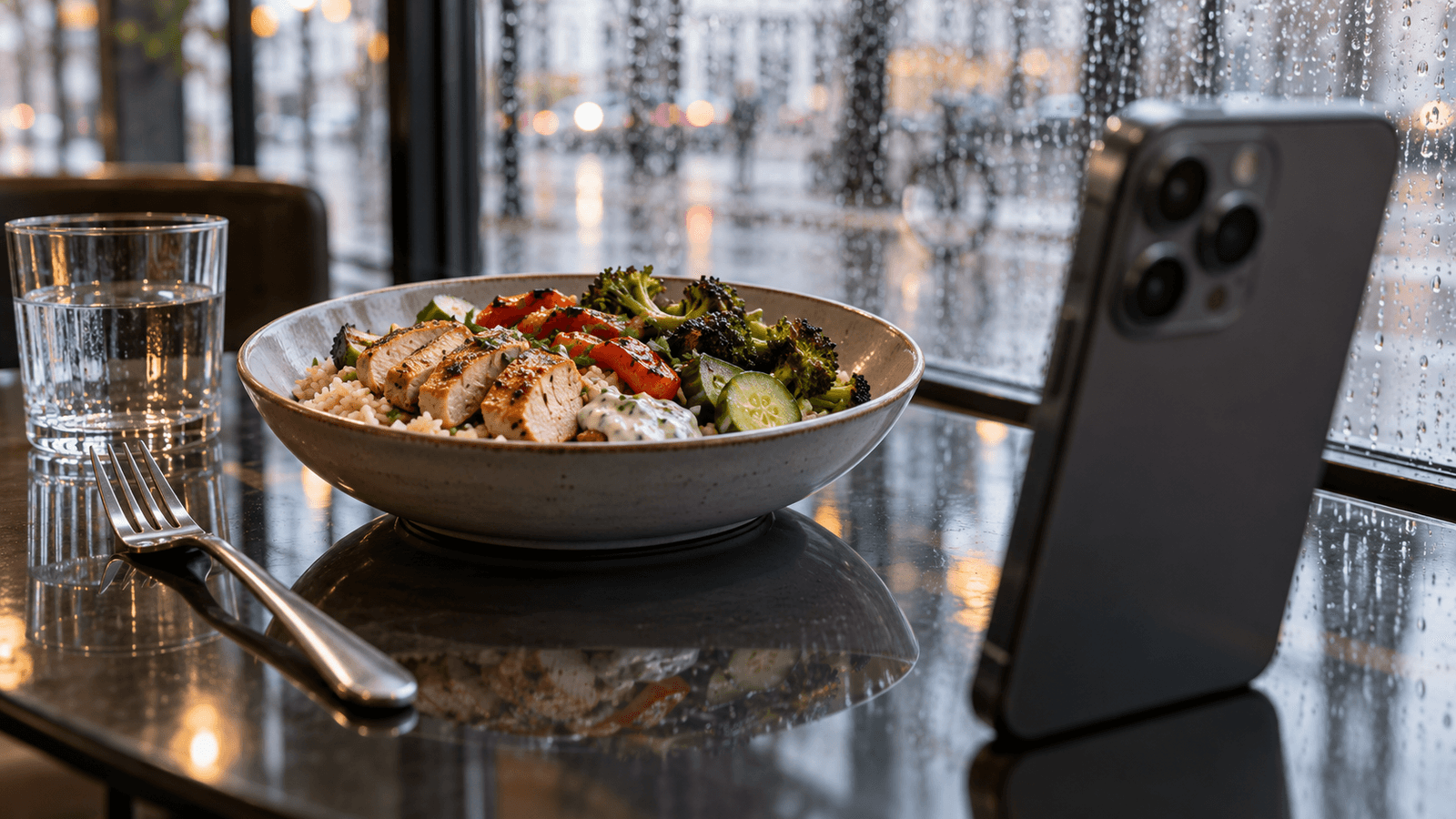
Logging every ingredient, searching a food database and estimating portion sizes can make calorie tracking time-consuming.
AI calorie trackers try to reduce that friction.
Instead of entering every food manually, you photograph a meal and artificial intelligence attempts to identify what is on the plate, estimate quantities and calculate nutritional information.
The idea is simple:
photo → food recognition → portion estimate → nutrition estimate
But the technology behind that process is more complicated than taking a picture and receiving a perfectly accurate calorie number.
This guide explains how photo-based food tracking works, what AI can estimate well, where errors occur and how to use these tools realistically.
What is an AI calorie tracker?
An AI calorie tracker is a food-tracking tool that uses artificial intelligence to help identify foods and estimate nutritional information.
Depending on the app, input may include:
- a photo of a meal
- a barcode
- a food label
- typed text
- a restaurant menu
- a recipe
- manual corrections
Photo recognition is particularly useful because it can reduce the amount of typing required.
Instead of manually searching for chicken, rice, broccoli and sauce, the system can attempt to recognize all of them from one image.
How does photo-based food tracking work?
A typical workflow has several stages.
1. You take a photo
The image becomes the main source of information.
Image quality matters.
The system may have difficulty when:
- food is hidden underneath other food
- the image is very dark
- several ingredients look similar
- the meal is photographed from too far away
- sauces cover the ingredients
- the plate is partly outside the frame
A clear photograph gives the model more useful visual information.
2. AI identifies the foods
Computer-vision models analyze visual characteristics such as:
- shape
- color
- texture
- edges
- context
- relationships between objects
The system may recognize obvious foods such as:
- eggs
- rice
- broccoli
- salmon
- chicken breast
- potatoes
- berries
Mixed dishes are more difficult.
A bowl of pasta may contain oil, cheese, meat, vegetables and sauce that cannot all be identified reliably from appearance alone.
3. The system estimates portion size
Recognizing the food is only part of the problem.
Calories depend heavily on quantity.
For example, identifying rice correctly does not tell the system whether the portion contains 100 g or 220 g.
A photo-based tracker may estimate portion size using visual information such as:
- the apparent dimensions of the food
- plate or bowl size
- relative size of different foods
- depth and volume cues
- known characteristics of common foods
This is an estimate.
A single two-dimensional photograph does not provide perfect information about weight or volume.
4. Foods are matched with nutrition data
Once the system has estimated the food and quantity, those results can be matched with nutritional data.
The app can then estimate values such as:
- calories
- protein
- carbohydrates
- fat
- sometimes fibre and other nutrients
The quality of the result depends not only on AI recognition but also on the nutrition data used for the identified food.
5. You review the result
This is one of the most important steps.
AI-generated food logs should generally be treated as estimates rather than measurements.
A useful tracker lets you correct:
- the identified food
- portion size
- ingredients
- preparation method
- additional sauces or oils
The combination of fast AI input and human review is often more practical than expecting the photograph alone to know everything about the meal.
What can AI recognize from a food photo?
Visually distinctive foods are often easier to identify.
Examples include:
- banana
- strawberries
- boiled eggs
- broccoli
- avocado
- salmon fillet
- chicken breast
- rice
- potatoes
Recognition becomes more difficult when foods are visually ambiguous.
For example:
- mashed foods
- soups
- stews
- casseroles
- curries
- pasta with mixed sauces
- homemade baked dishes
Two dishes can look similar while containing very different ingredients and calorie amounts.
Why portion estimation is difficult
Imagine two photographs of pasta.
Both plates look similar from above.
One contains:
- 150 g cooked pasta
- a light tomato sauce
The other contains:
- 250 g cooked pasta
- olive oil
- cheese
- a richer sauce
The visual difference may be smaller than the nutritional difference.
This is one reason photo-based calorie estimates should not be interpreted as laboratory measurements.
Hidden ingredients are a major limitation
Some of the largest calorie differences may come from ingredients that are difficult or impossible to see.
Examples include:
- cooking oil
- butter
- mayonnaise
- cream
- sugar
- cheese inside a dish
- salad dressing
- sauces
- marinades
A tablespoon of oil mixed into food may be visually almost invisible.
AI cannot reliably determine information that is not visible or otherwise provided.
Cooking method matters
The same food can have different nutritional characteristics depending on preparation.
For example:
- boiled potatoes
- oven-roasted potatoes with oil
- deep-fried potatoes
may look related but have substantially different energy density.
Similarly, grilled chicken and breaded fried chicken are not nutritionally equivalent.
A useful food tracker therefore benefits from allowing the user to confirm or change the preparation method.
Homemade recipes are especially challenging
A homemade lasagna can contain different amounts of:
- pasta
- meat
- cheese
- oil
- vegetables
- sauce
A photograph can recognize that the meal resembles lasagna.
It cannot know the exact recipe unless additional information is available.
For frequently cooked meals, saving the recipe can provide a better estimate than asking AI to reconstruct the recipe from a photograph every time.
Restaurant meals create additional uncertainty
Restaurant meals are difficult because the user usually does not know:
- exact ingredient weights
- amount of cooking oil
- sauce quantities
- recipe formulation
AI can still provide a useful estimate, but the result should be understood as approximate.
If official nutrition information is available from the restaurant, that information may be more useful than visual estimation alone.
Photo tracking versus manual calorie tracking
Traditional tracking usually requires several steps:
- Search for the food.
- Select the correct database entry.
- Enter the amount.
- Repeat for every ingredient.
This can be precise when you know exact quantities.
But it also creates friction.
Photo tracking changes the workflow:
- Take a photo.
- Let AI create the initial estimate.
- Review the result.
- Correct anything important.
The goal is not necessarily to eliminate manual input completely.
The goal is to reduce it.
Photo tracking versus barcode scanning
These methods solve different problems.
Photo tracking
Useful for:
- homemade meals
- restaurant food
- unpackaged foods
- mixed plates
- fruit and vegetables
Barcode scanning
Useful for:
- packaged products
- foods with known nutrition labels
- repeat purchases
A barcode can identify a product, but it does not automatically know how much of that product you ate.
Photo tracking can estimate a portion but may not know the exact product formulation.
Combining several input methods is therefore useful.
Can AI calculate macros from a photo?
AI can estimate macros after identifying foods and estimating portions.
The main macronutrients are:
- protein
- carbohydrates
- fat
You can learn more in What Are Macros?.
Suppose a photo appears to contain chicken, rice and broccoli.
The system can estimate quantities and then use nutrition data to calculate approximate protein, carbohydrate and fat values.
But if the chicken was cooked with an unknown amount of oil or the rice portion is visually misjudged, the macro estimate will change.
The result is therefore only as good as the underlying food and portion estimates.
Can AI calculate calories accurately from a photo?
It can provide an estimate.
The word estimate is important.
Accuracy varies according to:
- image quality
- food visibility
- portion complexity
- dish type
- preparation method
- hidden ingredients
- database quality
- availability of additional user information
A clearly separated meal containing grilled chicken, rice and broccoli is generally easier to estimate than a creamy homemade casserole.
How to get better results from photo tracking
You can make the input more informative.
Keep the meal visible
Try not to hide large portions of food under other ingredients.
Use reasonable lighting
Very dark images make recognition harder.
Keep the full plate in frame
Cropping part of the meal removes useful information.
Photograph mixed dishes clearly
If possible, make major components visible.
Correct important mistakes
If the system identifies salmon as chicken, correct it.
Add hidden ingredients when they matter
If you know the meal contains a substantial amount of oil, dressing or sauce, add it.
The purpose is not to turn fast tracking back into a complicated manual process.
Correct the information that materially changes the estimate.
Do you need perfect calorie accuracy?
For many everyday tracking goals, consistency can be more useful than pretending every number is exact.
Even manual calorie tracking contains uncertainty.
Potential sources include:
- inaccurate portion estimates
- differences between database entries
- cooking changes
- recipe variation
- restaurant preparation
- incomplete food logs
A tracker should therefore help you understand patterns rather than create a false impression that every meal has been measured perfectly.
AI tracking can reduce logging friction
One of the biggest potential advantages of AI is speed.
A tracking system is not very useful if you stop using it because recording food takes too long.
Reducing manual entry can make it easier to track:
- breakfast
- lunch
- dinner
- snacks
- restaurant meals
That can create a more complete picture of daily eating.
AI does not replace nutrition judgment
Recognizing calories and macros is not the same as determining whether a meal is appropriate for a particular person.
Nutrition needs vary according to factors such as:
- age
- body size
- activity
- goals
- dietary preferences
- allergies and intolerances
- medical circumstances
Calorie estimates are information, not a complete nutrition plan.
For context on energy needs, see How Many Calories Should You Eat Per Day?.
What should a useful AI food tracker allow you to edit?
At minimum, you should be able to review important assumptions.
Useful controls include:
- food name
- amount
- meal category
- preparation method
- additional ingredients
The best workflow is not necessarily the one with zero interaction.
It is the one that minimizes unnecessary interaction while still allowing obvious errors to be corrected.
Combining AI with meal planning
Food tracking becomes more useful when the information can influence future decisions.
For example, a system could use logged meals to understand:
- approximate calorie intake
- protein intake
- eating patterns
- frequently eaten foods
- meal timing
That information can then help personalize future meal suggestions.
This connects tracking with planning rather than treating the food diary as an isolated record.
For a basic planning workflow, see Meal Planning for Beginners.
How Mealisa approaches photo-based food tracking
Mealisa is designed around a photo-first workflow.
Instead of requiring every meal to begin with a manual database search, the user can photograph food and use AI to generate an initial analysis.
The goal is to reduce the amount of input required while keeping the result reviewable.
Mealisa can combine several types of food input depending on the situation, including:
- meal photos
- product scanning
- nutrition information
- recipes
- restaurant food information
- manual corrections
The purpose is not to claim that a photograph can reveal information that is physically invisible.
The purpose is to make everyday food tracking faster.
When manual input is still useful
Manual information can improve the result when you know something the image cannot show.
For example:
- "I used 15 g of olive oil."
- "This contains 200 g of chicken."
- "The yogurt is the 0% version."
- "I ate half of the portion."
- "This is my saved homemade recipe."
A good AI workflow should make it easy to add this information without forcing the user to enter everything manually.
Photo tracking for weight loss
Photo-based tracking can be useful for weight management because it reduces the effort required to record food.
But taking photographs does not itself cause weight loss.
The useful part is the information created from the record.
Tracking may help you notice patterns such as:
- portions becoming larger
- frequent snacks
- calorie-dense drinks
- restaurant meals
- low protein intake
- differences between weekdays and weekends
For a broader weight-management approach, read How to Lose Weight Sustainably.
Photo tracking for protein
If your goal includes protein intake, photo tracking can help estimate how much protein your meals provide.
Protein-rich foods are often visually recognizable, but portion estimation still matters.
A small chicken portion and a large chicken portion are both "chicken" but provide different amounts of protein.
For protein-specific guidance, see How Much Protein Do You Need Per Day?.
What AI should not pretend to know
A trustworthy food tracker should not imply certainty where none exists.
From a single photograph, AI may not know:
- exact weight
- exact amount of oil
- exact recipe
- ingredients hidden inside a dish
- exact restaurant preparation
- exact brand
- how much of the photographed meal was actually eaten
These limitations do not make photo tracking useless.
They define what the result actually is: an informed estimate that can be improved with additional information.
A practical photo-tracking workflow
A simple workflow looks like this:
1. Photograph the meal
Make the food clearly visible.
2. Review the detected foods
Check whether the main components were recognized correctly.
3. Check portions
Correct obvious portion errors.
4. Add important hidden ingredients
Include significant oils, sauces or other ingredients when known.
5. Save the meal
Do not spend several minutes trying to make an inherently approximate estimate look perfectly exact.
6. Focus on patterns
Use the accumulated information to understand your diet over days and weeks.
Common mistakes with AI calorie trackers
Treating estimates as exact measurements
A food photograph does not directly measure calories.
Ignoring hidden oils and sauces
These can materially change the estimate.
Never reviewing the result
Fast input is useful, but obvious recognition errors should be corrected.
Taking unclear photos
Poor visibility reduces the information available to the system.
Obsessing over tiny differences
There is little value in debating a few calories when the portion itself is only an estimate.
Tracking only "good" meals
A food diary becomes less useful when snacks, drinks or restaurant meals are consistently omitted.
Frequently asked questions
Can AI identify food from a picture?
Yes. Modern computer-vision systems can identify many visually recognizable foods, although performance varies with the image and dish.
Can a photo tell exactly how many calories are in a meal?
No. A photo can support an estimate, but exact calorie content depends on quantities, ingredients and preparation details that may not be visible.
Can AI detect cooking oil?
Sometimes oil may be visually apparent, but the exact amount is usually difficult to determine from a photo. Adding known cooking fats can improve the estimate.
Is a barcode more accurate than a photo?
A barcode can identify a specific packaged product when reliable product data is available. It still does not automatically determine the amount consumed. Photos and barcodes solve different parts of the tracking problem.
Can AI track homemade meals?
Yes, but complex homemade recipes create more uncertainty. Saved recipes or additional ingredient information can improve estimates.
Can AI track restaurant meals?
It can estimate them, but unknown recipes, oils, sauces and portion weights make restaurant meals inherently uncertain unless official nutrition information is available.
Should I correct every AI estimate?
Correct meaningful errors. The goal is useful tracking, not spending excessive time refining tiny differences in an approximate measurement.
The bottom line
AI calorie trackers can make food logging significantly faster by turning a photograph into an initial estimate of foods, portions, calories and macros.
Their biggest advantage is not magical precision.
It is lower friction.
Photo-based tracking works best when AI handles the first pass and the user can quickly review information that the image cannot reliably determine.
A photograph can recognize a lot.
It cannot see hidden oil, know every recipe or directly weigh the food.
Used with those limitations in mind, AI can turn food tracking from a repetitive manual task into a much faster everyday workflow.
Photo-based calorie and nutrient values are estimates and should not be treated as medical measurements. People who require precise nutritional intake for a medical condition should follow individualized guidance from an appropriate healthcare professional.