
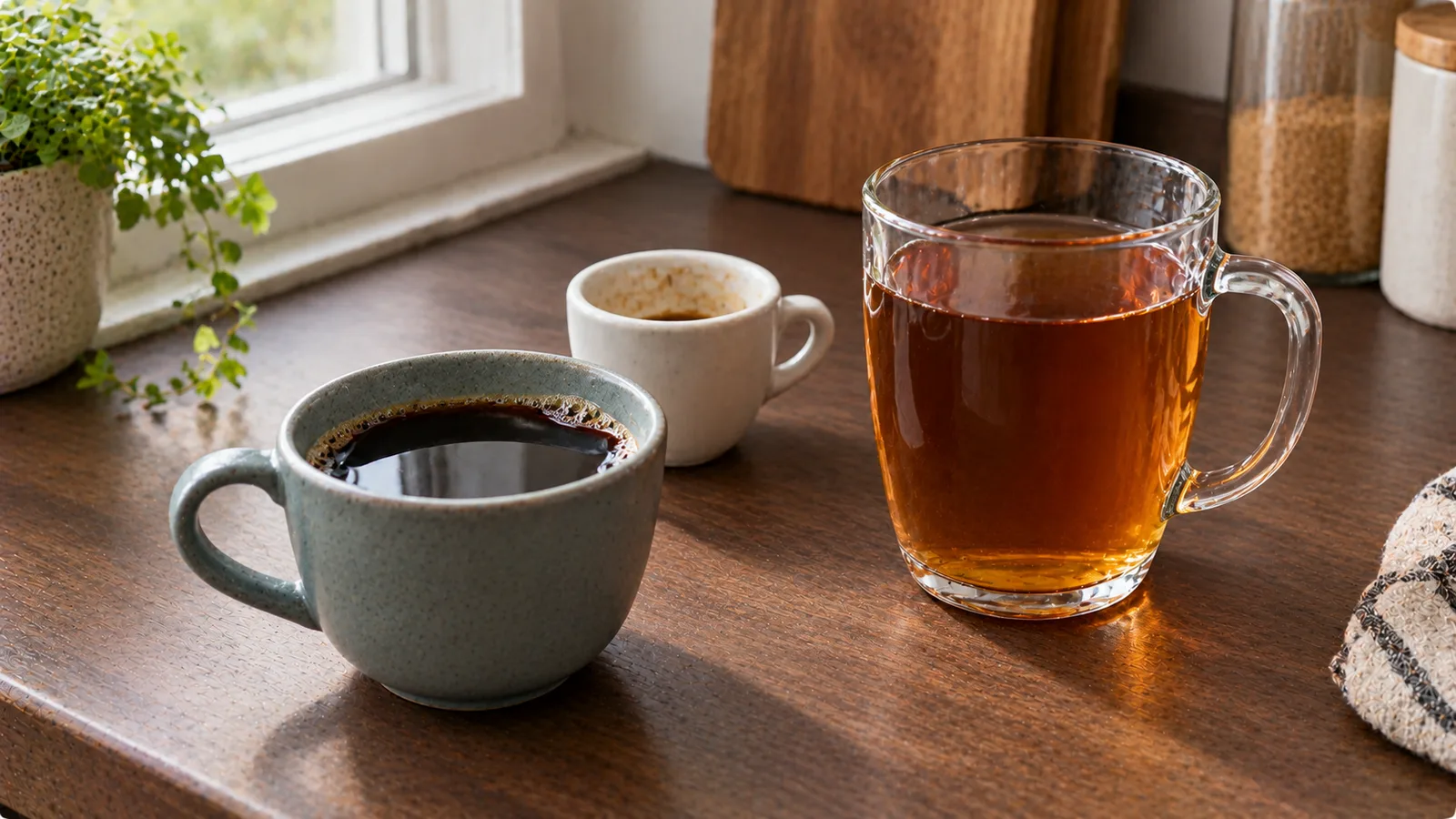
A food diary can show how many calories, grams of protein or carbohydrates you consume. Caffeine is different: many food-tracking tools do not record it automatically, even when they recognize coffee or tea. A packaged protein coffee combines caffeine and a nutritional label; ready-to-drink protein coffee explains what to compare.
That matters because caffeine comes from several sources, and the amount in a drink can vary substantially. A small espresso, a large filter coffee and a mug of black tea do not necessarily contain predictable amounts based on their names alone.
The most useful way to track caffeine is to record the drink, its actual serving size, its preparation and the best available caffeine estimate. When a product provides a specific caffeine value, use that rather than a generic average.
Typical caffeine amounts in coffee and tea
The figures below are practical reference estimates, not fixed amounts for every beverage.
| Beverage | Reference serving | Approximate caffeine |
|---|---|---|
| Brewed coffee | 240 ml | 95 mg |
| Espresso | 30 ml | 63 mg |
| Instant coffee, prepared | 240 ml | 60–65 mg |
| Decaffeinated brewed coffee | 240 ml | 2–5 mg |
| Black tea, brewed | 240 ml | 45–50 mg |
| Green tea, brewed | 240 ml | 25–35 mg |
| Cola containing caffeine | 355 ml | Around 30–40 mg |
| Energy drink | Depends on product | Use label |
These values are rounded examples based on commonly cited beverage composition data. Actual caffeine content may be lower or substantially higher.
A 240 ml serving is approximately an 8 US fluid-ounce cup. It is not necessarily the size of the cup used at home or in a café.
Useful references include USDA FoodData Central and FDA guidance on caffeine.
Why one universal number is not enough
Caffeine concentration depends on the type of coffee or tea, the amount of material used, preparation and extraction.
Two coffees with the same volume may contain different amounts.
A larger serving of a weaker drink can also contain more total caffeine than a smaller serving of a stronger drink.
That is why tracking both the beverage type and volume is more informative than recording only “one coffee.”
How to calculate caffeine from serving size
If a reference value is given for a particular volume, a simple proportional estimate is:
Estimated caffeine = reference caffeine × actual volume ÷ reference volume
This works as a rough calculation when the larger or smaller serving is made from the same beverage at approximately the same concentration.
It does not establish the actual concentration of an unknown café drink.
Example: 300 ml of brewed coffee
Assume the coffee contains 95 mg caffeine per 240 ml.
95 × 300 ÷ 240 = approximately 119 mg caffeine.
Example: 150 ml of black tea
Assume the tea contains 47 mg caffeine per 240 ml.
47 × 150 ÷ 240 = approximately 29 mg caffeine.
Example: 400 ml of brewed coffee
Using the same coffee concentration:
95 × 400 ÷ 240 = approximately 158 mg caffeine.
These calculations are estimates. If the coffee is brewed differently or diluted with water, the original reference concentration may not apply.
Coffee: what changes the caffeine amount?
Coffee bean species and blend
Coffee varieties and blends differ in caffeine concentration.
Robusta beans generally contain more caffeine than arabica beans by dry bean weight, although the final drink also depends on preparation.
A café blend may contain one species or a mixture.
Without information about the beans and brewing recipe, the exact amount cannot be inferred from the drink name.
Amount of ground coffee
Using more ground coffee can increase the caffeine available for extraction.
However, extraction is not perfectly proportional across all brewing methods.
A strong-tasting coffee is not automatically the one with the highest total caffeine.
Brewing method
Filter coffee, espresso, French press and other methods use different coffee-to-water ratios, contact times and extraction conditions.
Espresso is concentrated, but its serving is usually much smaller than a mug of filter coffee.
Comparing caffeine per milliliter and caffeine per serving gives different answers.
Serving size
The size of a purchased coffee may be 200 ml, 350 ml, 450 ml or more.
A large cup is not equivalent to a standardized reference cup.
For café drinks, check whether the provider publishes caffeine information by size.
Number of espresso shots
A latte or cappuccino may contain one, two or more espresso shots.
Milk changes the volume and nutritional composition but does not remove caffeine from the espresso.
A double-shot drink will usually contain more caffeine than an otherwise identical single-shot version.
Espresso versus filter coffee
A common misconception is that espresso always contains more caffeine than filter coffee.
Espresso generally contains more caffeine per milliliter, but a typical serving is small.
Consider the illustrative values:
| Drink | Serving | Estimated caffeine |
|---|---|---|
| Single espresso | 30 ml | 63 mg |
| Double espresso | 60 ml | 126 mg |
| Filter coffee | 240 ml | 95 mg |
| Filter coffee | 360 ml | 143 mg |
The double-espresso calculation assumes two shots with the same caffeine content.
Real espresso shots can vary significantly.
A 360 ml filter coffee may contain more total caffeine than one espresso shot even though the espresso tastes more concentrated.
The relevant comparison for a food diary is milligrams per consumed serving, not strength of flavor.
Caffeine in black, green and other teas
Tea caffeine depends on the tea leaves, amount used, brewing temperature, steeping time and serving size.
Black tea often has more caffeine than green tea in standard prepared-drink reference tables, but the ranges overlap.
A strongly brewed green tea can contain more caffeine than a lightly brewed black tea.
Black tea
A standard 240 ml reference serving may contain around 45–50 mg.
A large mug made with additional tea leaves or multiple tea bags may contain more.
Green tea
A typical reference estimate is around 25–35 mg per 240 ml.
Actual amounts vary considerably.
White tea
White tea is not automatically caffeine-free or consistently lower in caffeine than every green tea.
Its caffeine content depends on the tea material and preparation.
Matcha
Matcha is prepared using powdered tea leaves that are consumed as part of the drink.
The caffeine amount depends strongly on the grams of matcha powder used.
For tracking, record the actual powder weight and use reliable product-specific caffeine information when available.
Herbal infusions
Many herbal infusions, such as plain peppermint or chamomile, naturally contain no caffeine.
However, a product marketed as an herbal blend may also include green tea, black tea, yerba mate or other caffeine-containing ingredients.
Check the ingredient list instead of assuming that every infusion is caffeine-free.
How to track café drinks
Café drinks are often mixtures of coffee, milk, syrups and toppings.
For caffeine tracking, the coffee component is usually the main contributor.
For calorie tracking, milk, sugar, syrups and cream also matter.
These are two separate calculations.
Latte
Record the number of espresso shots and their estimated caffeine.
Then record the milk and any sweeteners for the nutritional calculation.
Adding more milk does not increase caffeine unless additional coffee is also used.
Cappuccino
The foam changes texture and volume but contributes little to the caffeine calculation.
The espresso shots determine most of the caffeine.
Americano
An americano is espresso diluted with water.
Adding water increases the drink's volume without adding caffeine.
A 300 ml americano with one espresso shot does not contain the same caffeine as 300 ml of filter coffee simply because the volumes match.
Iced coffee
Check whether the drink uses espresso, brewed coffee, cold brew or coffee concentrate.
Ice changes the final volume but does not add caffeine.
A bottled iced coffee may contain a stated caffeine amount on the packaging.
Cold brew
Cold-brew caffeine content varies widely with the coffee-to-water ratio, extraction and dilution.
Concentrated cold brew should not be treated as equivalent to a ready-to-drink product.
Use the manufacturer's information whenever possible.
A practical caffeine diary
A useful caffeine diary includes more than the drink name.
| Field | Example |
|---|---|
| Time | 08:30 |
| Beverage | Filter coffee |
| Volume | 300 ml |
| Preparation | Brewed at home |
| Caffeine estimate | 119 mg |
| Source | Reference value, scaled by volume |
| Confidence | Approximate |
For another entry:
| Field | Example |
|---|---|
| Time | 14:00 |
| Beverage | Double espresso |
| Volume | 60 ml |
| Preparation | Café |
| Caffeine estimate | 126 mg |
| Source | Two reference espresso shots |
| Confidence | Approximate |
The diary should distinguish an estimated number from a manufacturer-confirmed value.
If exact information is unavailable, a range or a clearly marked approximation is more useful than false precision.
Example: tracking caffeine over one day
Consider the following illustrative day:
| Time | Beverage | Estimated caffeine |
|---|---|---|
| 08:00 | 240 ml filter coffee | 95 mg |
| 11:30 | Single espresso | 63 mg |
| 15:00 | 240 ml black tea | 47 mg |
| 18:00 | 240 ml green tea | 30 mg |
| Total | 235 mg |
The daily total is:
95 + 63 + 47 + 30 = 235 mg caffeine.
This is an example of tracking, not a recommendation to consume that amount.
If the drinks were stronger or larger than assumed, the actual total could be higher.
The timing is also worth recording because caffeine consumed later in the day may affect sleep in some people.
What about energy drinks and other sources?
Coffee and tea are not the only sources of caffeine.
Other possible sources include:
- Energy drinks.
- Caffeinated soft drinks.
- Some pre-workout supplements.
- Caffeine tablets.
- Certain chocolate products.
- Some medicines.
Caffeine from supplements or medicines should not be estimated using coffee averages.
Use the declared amount and follow the product's instructions.
For packaged drinks, look for caffeine information in milligrams per 100 ml or per container.
Example: energy drink with 32 mg per 100 ml
If the label states 32 mg caffeine per 100 ml:
| Amount consumed | Caffeine |
|---|---|
| 100 ml | 32 mg |
| 250 ml | 80 mg |
| 330 ml | 106 mg |
| 500 ml | 160 mg |
For a 500 ml can:
32 × 500 ÷ 100 = 160 mg caffeine.
This is a calculation based on the example label, not a claim about every energy drink.
General caffeine intake guidance
The European Food Safety Authority has assessed caffeine safety for healthy adults.
Its scientific opinion indicates that, for the general healthy adult population excluding pregnant women, single doses up to 200 mg and habitual daily intakes up to 400 mg do not raise safety concerns under the conditions evaluated.
These figures are general safety reference levels, not individual targets or guarantees of safety for every person.
They do not mean that everyone should consume 400 mg daily.
The EFSA assessment also notes that even 100 mg consumed close to bedtime may affect sleep in some adults.
For pregnant women, EFSA considers caffeine intake up to 200 mg per day from all sources not to raise safety concerns for the fetus under its assessment.
People who are pregnant, breastfeeding, taking medication or managing medical conditions may need individualized advice.
Source: EFSA — Caffeine.
Why the daily total is not the whole story
Two people may consume the same total amount at different times.
One may drink most of it in the morning, while another consumes caffeine close to bedtime.
The effect on sleep, alertness and tolerability can differ.
Individual sensitivity, habitual use, medications and health conditions also matter.
A food diary can help identify patterns, but it cannot diagnose caffeine sensitivity or a sleep disorder.
Caffeine and sleep
Caffeine can promote wakefulness by acting on adenosine signaling.
Its effects may persist for several hours, but the duration varies between individuals.
The same afternoon coffee may have little noticeable effect on one person and interfere with another person's sleep.
If you want to understand your own pattern, record:
- The time caffeine was consumed.
- The estimated amount.
- Bedtime.
- Sleep onset difficulties, if any.
- Other relevant factors, such as unusual stress or late exercise.
Review several days rather than drawing conclusions from one night.
Avoid assuming that caffeine is the only explanation for poor sleep.
Persistent sleep problems warrant appropriate professional evaluation.
Caffeine and intermittent fasting
Black coffee and unsweetened tea generally contain very few calories.
However, caffeine tracking and calorie tracking are separate questions.
Adding milk, cream, sugar or syrup changes the energy content.
It usually does not change the caffeine supplied by the original coffee or tea unless the amount of coffee or tea changes.
For example, adding 100 ml milk to an espresso changes the calories and macronutrients but does not remove the espresso's caffeine.
Whether a drink fits a particular fasting protocol depends on the rules and purpose of that protocol.
A caffeine diary should therefore record caffeine and any calorie-containing additions separately.
How to handle uncertainty
Exact caffeine values are often unavailable for homemade or café drinks.
Use a consistent hierarchy of information:
- Manufacturer or café data for the exact product and size, when available.
- Measured product information, such as caffeine per 100 ml.
- Reliable food composition references for a comparable beverage.
- A clearly labeled estimate based on volume and preparation.
Do not assume that an espresso, tea bag or coffee capsule always contains one universal caffeine amount.
If a café lists a range, retain the range.
If a drink contains several shots, record the number.
If the beverage is diluted with water or milk, calculate caffeine from the original coffee or tea component rather than total volume alone.
Mistakes that distort a caffeine diary
Recording every coffee as 95 mg
A standard reference cup does not represent every espresso, café drink or large mug.
Confusing concentration with total caffeine
Espresso may be more concentrated while a large filter coffee contains more caffeine overall.
Forgetting tea
Several cups of tea can contribute meaningfully to the daily total.
Assuming decaf means zero
Decaffeinated coffee usually contains much less caffeine, but it is not necessarily completely caffeine-free.
Ignoring other sources
Energy drinks, some supplements and medicines can contribute additional caffeine.
Treating estimates as laboratory measurements
An estimate should remain labeled as an estimate.
Looking only at daily milligrams
Timing and individual response can also matter.
A simple seven-day tracking method
For one week, record each caffeine-containing drink and its time.
Use the best available caffeine value for the serving consumed.
At the end of each day, add the estimated milligrams.
After seven days, look for patterns:
- Are weekday totals different from weekend totals?
- Do larger café drinks account for most of the intake?
- Is caffeine commonly consumed in the evening?
- Are energy drinks or supplements being overlooked?
- Do sleep patterns appear to coincide with later caffeine use?
This exercise can improve awareness without requiring every drink to be measured in a laboratory.
The goal is consistent, transparent estimates rather than perfect certainty.
Sources
- EFSA — Caffeine — scientific assessment and general safety reference levels.
- USDA FoodData Central — representative beverage composition data.
- FDA — Caffeine in Foods — caffeine sources, variability and consumer information.
Caffeine amounts in the tables are approximate unless explicitly identified as label-based examples. General population guidance is not a personalized medical limit.