
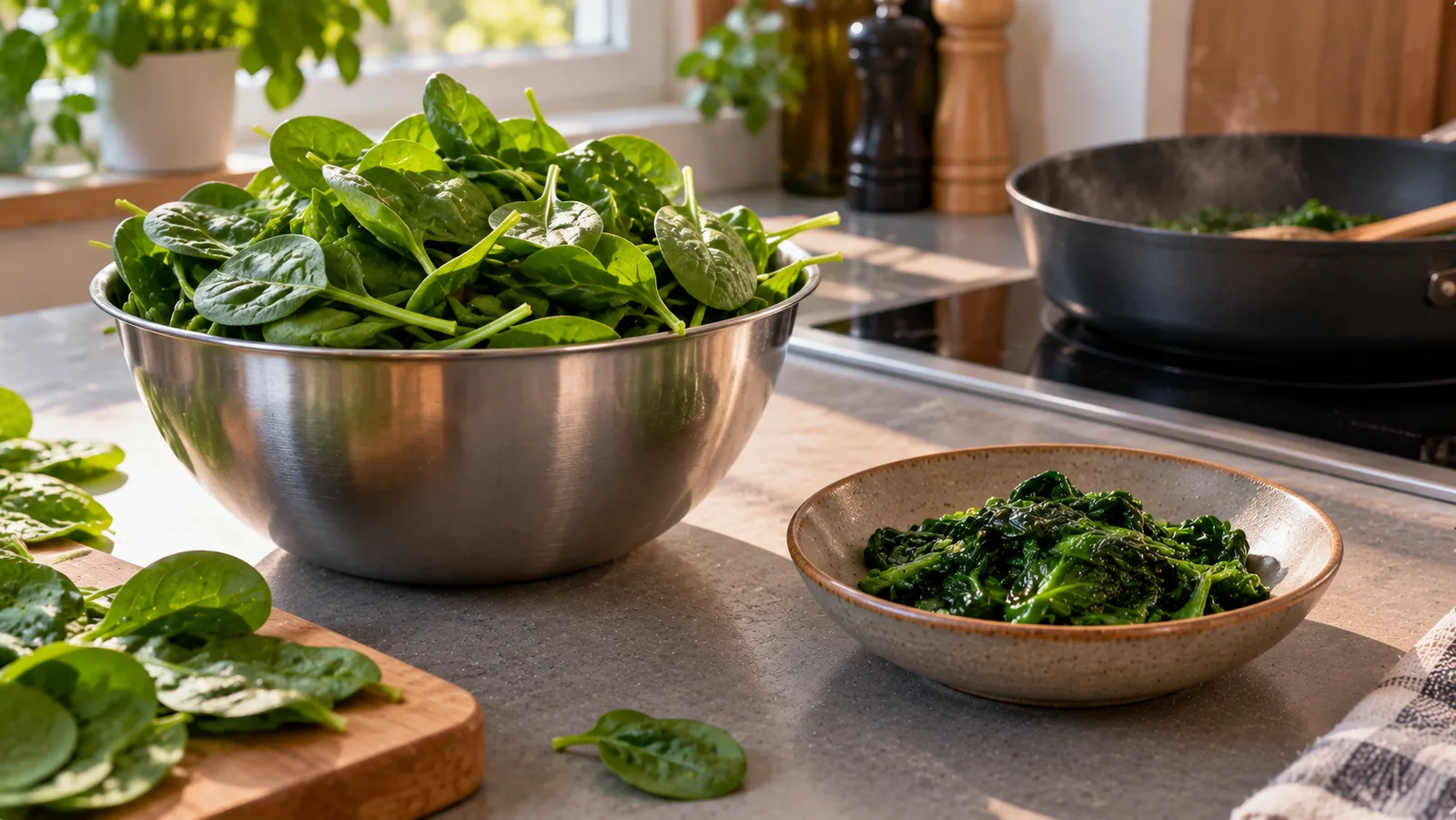
Raw and cooked vegetables are both useful parts of a varied diet.
Cooking does not simply make vegetables "better" or "worse." It changes them.
Heat can reduce some heat-sensitive nutrients, improve the availability of certain other compounds, soften plant tissues, change water content and dramatically alter how much food fits into a bowl or onto a plate.
That makes the comparison more useful than the common question: "Are raw vegetables healthier than cooked vegetables?"
The better question is: what changes when a particular vegetable is cooked, and does that change matter for the meal you are eating?
Raw vs cooked vegetables at a glance
| Factor | Raw vegetables | Cooked vegetables |
|---|---|---|
| Water content | Usually close to the food's natural state | May decrease or increase depending on cooking method |
| Volume | Often larger for the same starting amount | Often becomes smaller after cooking |
| Texture | Usually firmer and crunchier | Usually softer |
| Heat-sensitive nutrients | No cooking-related heat loss | Some losses may occur |
| Availability of some compounds | Can be lower for certain foods | Cooking can improve availability of some compounds |
| Added ingredients | Depends on preparation | Oil, sauces or salt may be added during cooking |
| Portion estimation | Raw weight and volume | Cooked weight and volume can differ substantially |
There is no universal winner.
Cooking changes the food matrix
Vegetables are made of plant cells containing water, fiber, vitamins, minerals and many other compounds.
Heating changes their physical structure.
Depending on the vegetable and cooking method, this can:
- soften cell walls;
- release water;
- make the vegetable shrink;
- allow water to enter the food;
- make certain compounds easier to access;
- reduce some heat-sensitive vitamins;
- move water-soluble nutrients into cooking liquid.
The result depends on the vegetable, temperature, cooking time and whether the cooking liquid is eaten or discarded.
Some nutrients are sensitive to heat
Vitamin C is a familiar example of a heat-sensitive, water-soluble vitamin.
Cooking can reduce vitamin C content, particularly when vegetables are exposed to heat for longer periods or cooked in water that is later discarded.
Some B vitamins can also be affected.
This does not mean cooked vegetables contain no vitamin C or that they become nutritionally poor.
It means that nutrient retention varies with preparation.
A short cooking time can produce a different result from prolonged boiling.
Cooking can improve the availability of some compounds
Heat can also make certain compounds more accessible.
A well-known example is carotenoids in some vegetables.
Cooking can soften plant tissue and disrupt cellular structures, which may increase the bioavailability of compounds such as beta-carotene in carrots or lycopene in tomatoes.
The amount present in the food and the amount the body can absorb are not always the same thing.
That is one reason why "raw preserves everything" is too simplistic.
Raw weight and cooked weight are not interchangeable
One of the most important practical differences is weight.
Suppose you begin with 300 g of raw vegetables.
After cooking, they might weigh less because water has evaporated.
Alternatively, some foods may absorb water during preparation.
Therefore:
300 g raw is not automatically equivalent to 300 g cooked.
This matters when:
- logging food;
- following a recipe;
- comparing nutrition databases;
- estimating portions.
If a nutrition entry says "cooked," use it for a cooked amount.
If it says "raw," use it for the raw state whenever possible.
Why cooked vegetables often look like a smaller portion
Many vegetables contain a large amount of water and air within their physical structure.
Cooking can soften and collapse that structure.
A large pan of raw spinach, for example, can become a relatively small cooked portion.
The vegetables did not suddenly lose all of their nutrients.
Their volume changed substantially.
This distinction matters when visually comparing portions.
A cup of raw spinach and a cup of cooked spinach are not equivalent amounts of the original vegetable.
Calories per 100 g can change even without adding calories
Imagine a vegetable containing a certain amount of energy before cooking.
If cooking removes water, the finished food weighs less.
That means 100 g of the cooked vegetable can contain more of the original vegetable matter than 100 g of the raw vegetable.
As a result, the calorie value per 100 g may appear higher even when no oil or other calorie-containing ingredient was added.
This is a concentration effect.
It does not mean heat created calories.
The reverse can occur when a food absorbs water.
Added oil is a separate issue
When comparing raw and cooked vegetables, cooking method matters.
Steamed carrots and carrots roasted with oil are not the same comparison.
Oil contributes energy.
For example, vegetables roasted with a measured amount of olive oil contain the calories from both:
- the vegetables;
- the oil that remains in the finished dish.
If you are tracking calories, log the added oil separately or include it accurately in the recipe.
Do not attribute the calorie difference entirely to cooking.
Boiling
Boiling surrounds vegetables with hot water.
Advantages include:
- simple preparation;
- soft texture;
- no added fat required.
However, some water-soluble nutrients can move into the cooking water.
The practical significance depends partly on whether that liquid is discarded.
In soup or stew, the cooking liquid is often eaten.
When boiled vegetables are drained, the liquid is usually discarded.
Steaming
Steaming cooks vegetables using hot steam rather than submerging them in water.
It can:
- soften vegetables;
- avoid the need for added fat;
- reduce direct contact with cooking water.
Cooking time still matters.
Steaming does not guarantee that every nutrient remains unchanged, but it is a useful everyday preparation method.
Roasting
Roasting exposes vegetables to dry heat.
It can:
- reduce water content;
- concentrate flavor;
- create browning;
- change texture substantially.
Oil is frequently used during roasting.
When comparing calories, the amount of oil matters much more than the fact that the vegetables were heated.
Stir-frying and sautéing
These methods typically use:
- relatively high heat;
- shorter cooking times;
- some added fat.
The finished nutrition depends on both the vegetables and the amount of cooking fat.
A small measured amount of oil and an unmeasured generous pour can produce very different calorie totals.
Microwaving
Microwaving can cook vegetables quickly with little added water.
Because cooking time can be short, it can be a practical way to prepare vegetables while limiting prolonged exposure to heat and cooking water.
As with every method, the exact result depends on the food and preparation.
Raw vegetables have practical advantages too
Raw vegetables can be convenient because they may require little preparation.
Examples include:
- tomatoes;
- cucumbers;
- peppers;
- carrots;
- radishes;
- salad leaves.
They can add:
- crunch;
- freshness;
- volume;
- variety
to meals.
Raw preparation also avoids cooking-related losses of heat-sensitive nutrients.
But that does not make raw vegetables universally superior.
Cooked vegetables can be easier to incorporate into meals
Cooking changes texture and volume.
That can make vegetables easier to include in:
- soups;
- sauces;
- curries;
- casseroles;
- omelets;
- pasta dishes;
- grain bowls;
- stews.
Someone who struggles to eat a large volume of raw vegetables may find a cooked portion easier to include.
The most useful preparation method is often the one that helps vegetables become a regular part of the diet.
Example: spinach
Spinach illustrates why portion state matters.
Raw spinach is bulky and light.
Cooking causes it to shrink dramatically.
Therefore, comparing:
- 100 g raw spinach;
- 100 g cooked spinach
does not represent the same starting amount of spinach.
The cooked serving may represent much more raw spinach before water loss and volume reduction.
When using nutrition data, always check the state described by the entry.
Example: carrots
Carrots can be eaten raw, steamed, boiled or roasted.
Raw carrots retain their firm texture and avoid heat-related nutrient changes.
Cooking softens their structure and can improve accessibility of carotenoids.
If oil is added during roasting, the finished dish also contains the energy and fat from that oil.
Therefore, "raw carrots vs cooked carrots" is not one fixed nutritional comparison. The cooking method matters.
Example: tomatoes
Tomatoes are another example where raw and cooked forms can both be valuable.
Fresh tomatoes provide vitamin C and are easy to use in salads and sandwiches.
Heating tomatoes can increase the bioavailability of lycopene.
Tomato sauce may therefore provide a different nutritional profile from raw tomato.
At the same time, commercial sauces can contain added salt, oil or other ingredients, so the whole product should be considered.
Example: broccoli
Broccoli can be eaten raw or cooked.
Cooking changes its texture and can affect heat-sensitive and water-soluble compounds.
Very long boiling and brief steaming are not nutritionally identical processes.
This illustrates why simply labeling vegetables as "cooked" can hide meaningful differences in preparation.
Portion size can change after cooking
Imagine a recipe using:
- 500 g raw vegetables;
- no added water retained in the finished dish;
- 10 g oil.
After roasting, the vegetables may weigh substantially less because of water loss.
If the final dish weighs 380 g, the calories from the original 500 g of vegetables plus the oil are now distributed across 380 g of cooked food.
If you eat half the final dish, you are eating half of the original ingredients regardless of the cooked weight.
For homemade dishes, recipe-level tracking is often more reliable than trying to reconstruct every ingredient from a generic cooked-food entry.
Use the correct database entry
Food databases commonly distinguish between states such as:
- raw;
- boiled;
- steamed;
- roasted;
- cooked from fresh;
- cooked from frozen;
- drained.
Choose the entry that most closely matches what you actually ate.
Avoid weighing cooked vegetables and logging them with a raw-per-100-g entry unless you know how the conversion was handled.
This is especially important for vegetables that lose a large amount of water.
Does cooking destroy fiber?
Normal cooking does not simply make dietary fiber disappear.
Cooking can change the physical properties and structure of plant foods, but cooked vegetables can remain important sources of fiber.
The more noticeable change for tracking is often the difference in weight and volume.
For example, a cooked vegetable may appear to contain more fiber per 100 g because water has been lost and the food has become more concentrated.
Should you eat vegetables raw or cooked for weight management?
There is no need to choose one category.
Both can fit into weight-management diets.
What matters more is the complete meal.
Compare:
Meal A
- raw salad;
- large amount of calorie-dense dressing;
- cheese;
- croutons.
Meal B
- cooked vegetables;
- lean protein;
- potatoes;
- modest amount of oil.
The raw vegetables do not automatically make Meal A lower in calories.
Likewise, cooked vegetables do not automatically make Meal B higher in calories.
Preparation and accompanying ingredients matter.
Food safety also matters
Not every vegetable or plant food is appropriate to eat raw.
Some foods require cooking for safety, digestibility or both.
Preparation guidance should be followed for the specific food.
Basic practices include:
- washing produce appropriately;
- keeping preparation surfaces clean;
- separating produce from raw meat and other contamination sources;
- refrigerating perishable prepared foods promptly;
- following specific cooking instructions for foods that should not be eaten raw.
"Raw" should not be treated as a universal nutritional goal.
A mixed approach provides variety
There is little reason for most people to make every vegetable raw or every vegetable cooked.
A day might include:
- berries and fruit at breakfast;
- raw peppers and cucumber at lunch;
- cooked broccoli at dinner;
- tomato sauce in another meal;
- carrots eaten raw on one day and roasted on another.
Different preparation methods create different textures, flavors and nutrient profiles.
Variety can make a vegetable-rich diet easier to maintain.
If your goal is nutrient retention
Instead of asking whether all vegetables should be raw, consider preparation choices.
Useful approaches can include:
- avoiding unnecessarily long cooking times;
- using cooking methods that fit the vegetable;
- using cooking liquid in soups or stews when appropriate;
- eating a mixture of raw and cooked vegetables;
- avoiding excessive reliance on one preparation method.
There is no single cooking method that preserves every nutrient in every vegetable.
If your goal is accurate food tracking
Use a different rule:
Match the database state to the state you weighed.
If you weigh a food raw, use an appropriate raw entry.
If you weigh it cooked, use an appropriate cooked entry.
For mixed homemade dishes, build the recipe from ingredient amounts and divide by the finished portions.
Also include:
- cooking oil;
- sauces;
- cheese;
- dressings;
- other calorie-containing additions.
These ingredients often change the calorie total more than cooking the vegetable itself.
Raw vs cooked is not a quality ranking
Raw vegetables are not automatically "cleaner" or more nutritious.
Cooked vegetables are not nutritionally empty.
Each preparation can have advantages.
Raw foods may preserve more of some heat-sensitive nutrients.
Cooking may improve accessibility of some compounds, reduce volume and make vegetables easier to use in meals.
The best approach for most people is not choosing a winner but using preparation methods that create a varied and practical diet.
The main takeaway
Cooking changes vegetables in several ways at once.
It can alter:
- water content;
- weight;
- volume;
- texture;
- nutrient retention;
- availability of certain compounds.
These changes explain why raw and cooked nutrition values should not always be compared gram for gram without context.
When tracking food, match the nutrition entry to the state in which the vegetable was weighed.
When planning meals, use both raw and cooked vegetables according to taste, practicality and the dish being prepared.
A varied diet containing vegetables in different forms is more useful than treating either raw or cooked vegetables as universally superior.
Sources
- European Food Safety Authority (EFSA), scientific information on nutrient requirements and dietary reference values.
- U.S. Department of Agriculture (USDA), FoodData Central food composition database.
- World Health Organization (WHO), healthy diet guidance on fruit and vegetable consumption.
- Bundeszentrum für Ernährung (BZfE), consumer guidance on vegetables and food preparation.
- U.S. Food and Drug Administration (FDA), produce and food-safety guidance.