
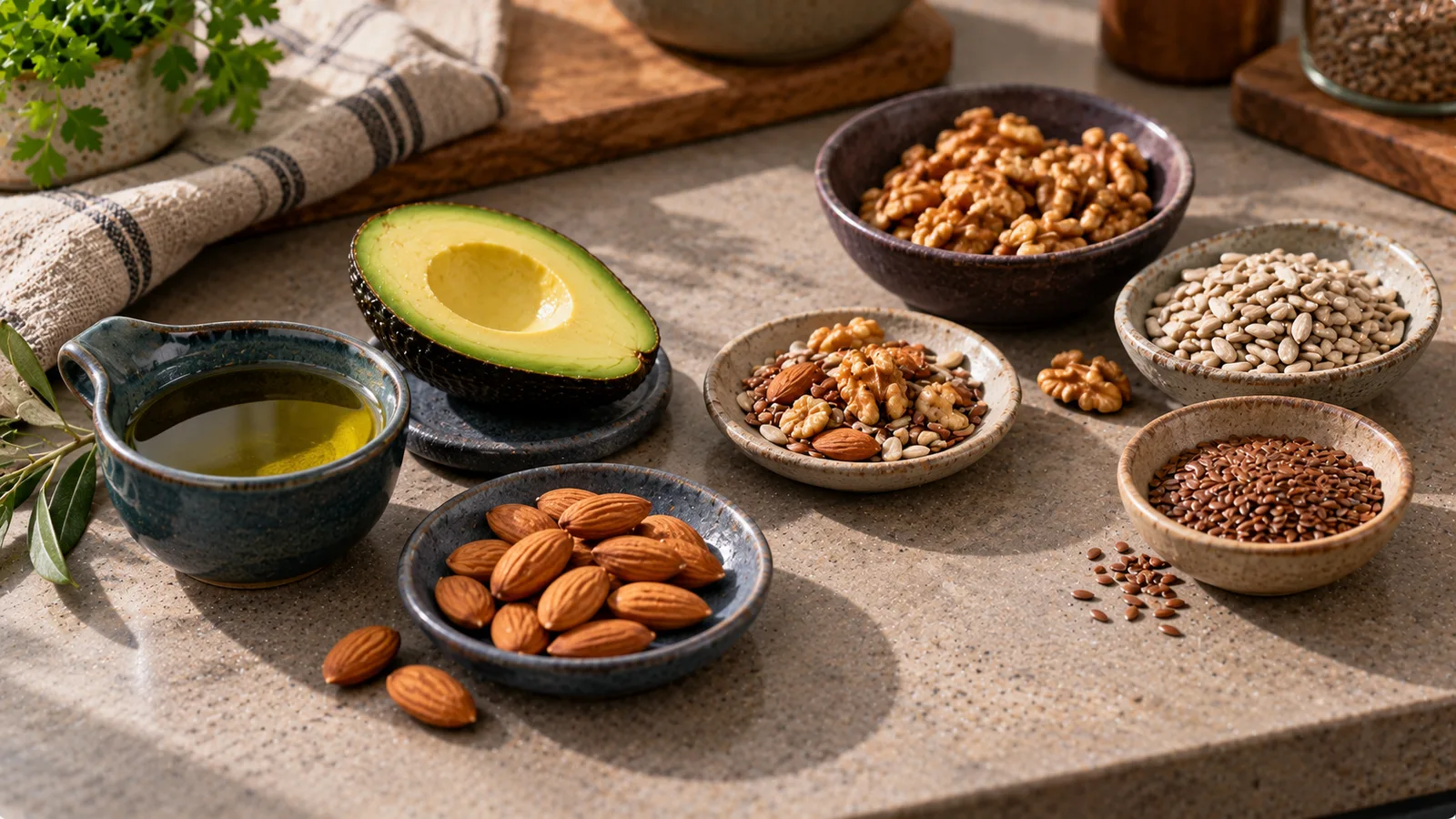
Monounsaturated and polyunsaturated fats are the two main categories of unsaturated fat found in food.
Both can be part of a balanced diet, but they are not chemically identical and their main food sources differ.
A practical way to understand the difference is:
- monounsaturated fats (MUFA) are especially common in olive oil, avocados and many nuts;
- polyunsaturated fats (PUFA) include omega-3 and omega-6 fatty acids and are common in foods such as fatty fish, walnuts, seeds and several vegetable oils.
Many foods contain a mixture of several types of fat rather than only one.
Monounsaturated vs polyunsaturated fats at a glance
| Monounsaturated fats | Polyunsaturated fats | |
|---|---|---|
| Common abbreviation | MUFA | PUFA |
| Main structural feature | One carbon-carbon double bond | Two or more carbon-carbon double bonds |
| Important families | Oleic acid is a common example | Omega-3 and omega-6 |
| Common food sources | Olive oil, avocado, almonds, hazelnuts, peanuts | Fatty fish, walnuts, flaxseed, sunflower seeds, soybean oil |
| Calories | 9 kcal per gram | 9 kcal per gram |
| Type of dietary fat | Unsaturated | Unsaturated |
The structural difference matters biologically, but for everyday food choices the source of the fat is often more useful than memorizing its chemistry.
What is monounsaturated fat?
A monounsaturated fatty acid contains one carbon-carbon double bond in its fatty-acid chain.
"Mono" means one.
One of the most common monounsaturated fatty acids in food is oleic acid.
Foods rich in monounsaturated fat can still contain polyunsaturated and saturated fats. The classification usually reflects which type makes up a relatively large share of the total fat.
Foods high in monounsaturated fat
Common sources include:
- olive oil;
- olives;
- avocado;
- avocado oil;
- almonds;
- hazelnuts;
- pecans;
- peanuts;
- peanut oil;
- pumpkin seeds;
- sesame seeds;
- canola oil.
Olive oil is a particularly clear example.
Its fat is predominantly monounsaturated, although it also contains smaller amounts of polyunsaturated and saturated fat.
What is polyunsaturated fat?
A polyunsaturated fatty acid contains two or more carbon-carbon double bonds.
"Poly" means multiple.
Polyunsaturated fats include two nutritionally important families:
- omega-3 fatty acids;
- omega-6 fatty acids.
Some fatty acids from these families are essential, meaning the body cannot synthesize them in sufficient form from scratch and they need to come from the diet.
Foods high in polyunsaturated fat
Important sources include:
- walnuts;
- flaxseed;
- chia seeds;
- sunflower seeds;
- sunflower oil;
- soybean oil;
- corn oil;
- flaxseed oil;
- fatty fish such as salmon, sardines, herring and mackerel.
Canola oil contains both substantial monounsaturated fat and polyunsaturated fat.
This illustrates why foods do not always fit perfectly into one category.
MUFA and PUFA food-source comparison
| Food | Predominant unsaturated-fat characteristic |
|---|---|
| Olive oil | High in monounsaturated fat |
| Avocado | High in monounsaturated fat |
| Almonds | Mostly monounsaturated fat |
| Hazelnuts | High in monounsaturated fat |
| Peanuts | Rich in monounsaturated fat |
| Walnuts | Rich in polyunsaturated fat |
| Flaxseed | Rich in polyunsaturated fat, including ALA omega-3 |
| Chia seeds | Rich in polyunsaturated fat, including ALA omega-3 |
| Sunflower oil | Usually rich in polyunsaturated fat, depending on variety |
| Soybean oil | Contains substantial polyunsaturated fat |
| Fatty fish | Source of long-chain omega-3 polyunsaturated fats |
| Canola oil | Mixture with substantial MUFA and PUFA |
Exact fatty-acid proportions vary by cultivar, processing and product formulation.
Where do omega-3 fats fit?
Omega-3 fatty acids are a family of polyunsaturated fats.
Important dietary omega-3s include:
- alpha-linolenic acid, or ALA;
- eicosapentaenoic acid, or EPA;
- docosahexaenoic acid, or DHA.
ALA is found mainly in plant foods such as:
- flaxseed;
- chia seeds;
- walnuts;
- canola oil;
- soybean oil.
EPA and DHA are found primarily in aquatic foods, especially fatty fish such as:
- salmon;
- sardines;
- herring;
- mackerel.
The body can convert some ALA into EPA and DHA, but the conversion is limited.
That is why ALA-containing plant foods and EPA/DHA-containing seafood should not be treated as nutritionally identical simply because both provide omega-3 fats.
Where do omega-6 fats fit?
Omega-6 fatty acids are also polyunsaturated fats.
Linoleic acid is an essential omega-6 fatty acid commonly found in foods such as:
- sunflower oil;
- soybean oil;
- corn oil;
- nuts;
- seeds.
Omega-6 fats are sometimes discussed as if they should be eliminated from the diet, but that oversimplifies their role.
They are normal components of many foods and include essential fatty acids.
For most people, the more useful dietary question is the overall pattern of fat sources rather than attempting to eliminate an entire unsaturated-fat family.
Are monounsaturated fats healthier than polyunsaturated fats?
It is usually not useful to treat this as a competition in which one category must always be better.
Both are unsaturated fats.
Dietary guidance generally emphasizes replacing sources high in saturated fat with foods rich in unsaturated fats rather than trying to choose exclusively between MUFA and PUFA.
For example, practical substitutions can include:
- olive oil instead of butter for suitable cooking;
- nuts instead of some highly processed snack foods;
- fish in place of some meals centered on fatty processed meat;
- seeds added to meals where they fit naturally.
The overall food and dietary pattern matters.
Does unsaturated fat have fewer calories?
No.
Monounsaturated and polyunsaturated fats provide approximately the same amount of energy as other dietary fats:
9 kcal per gram
A food does not become low-calorie simply because most of its fat is unsaturated.
For example, olive oil is rich in monounsaturated fat, but it remains highly energy-dense because almost all of its weight is fat.
Nuts and seeds are also calorie-dense despite providing substantial unsaturated fat.
Example: olive oil
Suppose you add 15 g of olive oil to a meal.
Because fat provides roughly 9 kcal per gram:
15 × 9 = approximately 135 kcal
The exact value on a product label may differ slightly because of rounding.
The fact that much of the fat is monounsaturated does not change the basic energy value.
Example: walnuts
Walnuts are notable because much of their fat is polyunsaturated.
A typical 30 g portion is still calorie-dense because walnuts contain a large amount of total fat.
This demonstrates an important distinction:
fat quality and calorie density are different questions.
A food can provide mostly unsaturated fat and still contribute substantial calories.
Do almonds contain only monounsaturated fat?
No.
Almonds contain several kinds of fat.
Most of their fat is typically monounsaturated, but they also contain polyunsaturated and saturated fatty acids.
The same principle applies to most whole foods.
Calling almonds a "monounsaturated-fat source" means monounsaturated fat is an important or predominant part of their fat profile, not that every gram of fat is MUFA.
Do walnuts contain only polyunsaturated fat?
No.
Walnuts are particularly rich in polyunsaturated fat and are also a plant source of ALA omega-3.
But they still contain monounsaturated and saturated fats.
Again, food categories describe the overall profile rather than an exclusive composition.
What about avocado?
Avocado is commonly considered a source of monounsaturated fat.
It also provides:
- fiber;
- carbohydrates;
- small amounts of protein;
- polyunsaturated fat;
- saturated fat.
The total nutritional profile matters more than a single fatty-acid category.
What about fish?
Fatty fish is especially important as a source of the long-chain omega-3 polyunsaturated fats EPA and DHA.
Examples include:
- salmon;
- sardines;
- herring;
- mackerel.
Fish also contains other types of fat.
The proportion depends on species, diet, farming conditions and other factors.
What about seeds?
Different seeds have different fatty-acid profiles.
For example:
- flaxseed is notable for ALA omega-3;
- chia seeds also provide substantial ALA;
- sunflower seeds tend to contain considerable omega-6 polyunsaturated fat;
- sesame seeds contain both mono- and polyunsaturated fats.
Using several different foods can provide a broader mix than relying on a single source.
What about cooking oils?
Cooking oils can differ substantially in fatty-acid composition.
Olive oil
Typically dominated by monounsaturated fat.
Canola oil
Usually contains substantial monounsaturated fat plus polyunsaturated fats, including some ALA omega-3.
Sunflower oil
Many conventional sunflower oils are rich in polyunsaturated linoleic acid, although high-oleic sunflower oils have a different profile and contain much more monounsaturated fat.
Soybean oil
Contains a substantial proportion of polyunsaturated fat, including linoleic acid and some ALA.
This is why the specific oil variety matters.
High-oleic oils can change the picture
A common mistake is assuming that every oil made from the same plant has exactly the same fatty-acid profile.
For example, high-oleic sunflower oil is specifically produced to contain much more oleic acid.
Its profile can therefore be dominated by monounsaturated fat rather than the polyunsaturated fat typical of conventional high-linoleic sunflower oil.
When the distinction matters, check the product information rather than relying only on the plant name.
How to read fat on a nutrition label
Depending on the country, a nutrition label may show:
- total fat;
- saturated fat;
- sometimes monounsaturated fat;
- sometimes polyunsaturated fat.
Not every label provides a full MUFA/PUFA breakdown.
If only total and saturated fat are shown, you cannot precisely calculate the exact monounsaturated and polyunsaturated amounts without additional product data.
Avoid inventing the missing values.
Total fat is not the same as saturated fat
Suppose a food contains:
- 20 g total fat;
- 3 g saturated fat.
It would be incorrect to assume automatically that the remaining 17 g is all monounsaturated fat or all polyunsaturated fat.
That remainder may include a mixture of:
- monounsaturated fat;
- polyunsaturated fat;
- other fatty acids.
Use a detailed nutrition database or manufacturer information when an exact fatty-acid breakdown is needed.
MUFA vs PUFA in a normal meal
A meal does not need to contain only one type.
Consider a meal containing:
- salmon;
- vegetables;
- olive-oil dressing;
- walnuts.
The olive oil contributes substantial monounsaturated fat.
The salmon contributes long-chain omega-3 polyunsaturated fats.
The walnuts contribute substantial polyunsaturated fat, including ALA.
The meal therefore naturally contains a mixture.
Practical ways to include monounsaturated fats
Examples include:
- use olive oil in dressings;
- add avocado to a sandwich or salad;
- eat a portion of almonds or other nuts;
- use peanut butter without excessive added ingredients where appropriate;
- add sesame or pumpkin seeds to meals.
Portion size still matters when tracking calories because these foods can be energy-dense.
Practical ways to include polyunsaturated fats
Examples include:
- include fatty fish in meals;
- add walnuts to oatmeal or yogurt;
- use ground flaxseed or chia seeds;
- use suitable vegetable oils;
- include seeds in salads or other dishes.
There is no need for every meal to contain every type of fat.
The pattern across days and weeks is more useful.
Should you track MUFA and PUFA separately?
For most everyday food tracking, monitoring calories and broad macronutrients does not require separately targeting exact grams of monounsaturated and polyunsaturated fat.
More detailed tracking may be useful in specific contexts, but many food labels do not provide complete fatty-acid data.
If your goal is simply to improve the quality of dietary fat, food choices may be easier to use than chasing precise MUFA and PUFA numbers.
Examples include choosing more:
- olive or canola oil;
- nuts;
- seeds;
- avocado;
- fish.
Is a low-fat diet necessary to improve fat quality?
Not necessarily.
Improving fat quality is different from simply reducing all fat.
A meal can contain a moderate amount of fat while obtaining much of it from unsaturated sources.
Conversely, a low-fat food is not automatically nutritionally superior if the overall food quality is poor.
Consider the complete diet rather than treating total fat as the only metric.
Monounsaturated and polyunsaturated fats vs saturated fat
The key distinction is not merely MUFA versus PUFA.
Both belong to the unsaturated-fat category.
Saturated fats form a separate category and have a different chemical structure.
Foods high in saturated fat include many fatty meats, butter and some full-fat dairy products, as well as tropical oils such as coconut and palm oil.
Many foods still contain mixtures.
Butter, for example, contains some unsaturated fat even though saturated fat makes up a large proportion of its fat.
Simple food swaps
Instead of trying to calculate every fatty acid, practical substitutions can make the distinction easier.
| If you often use | Possible unsaturated-fat alternative |
|---|---|
| Butter for a salad dressing | Olive-oil dressing |
| Highly processed snack | Nuts or seeds |
| Fatty processed meat as a frequent protein | Fish, beans or other alternatives depending on the meal |
| Creamy fat-heavy topping | Avocado where appropriate |
A substitution only makes sense when it fits the dish, nutritional needs and personal preferences.
Can you eat both MUFA and PUFA?
Yes.
There is no need to choose only one category.
A varied diet naturally provides both.
For example, using olive oil, eating nuts and seeds, and including fish can provide several types of unsaturated fatty acids.
Quick food-source guide
Mainly associated with monounsaturated fats
- olive oil;
- olives;
- avocado;
- almonds;
- hazelnuts;
- peanuts;
- pecans.
Important polyunsaturated-fat sources
- walnuts;
- flaxseed;
- chia seeds;
- sunflower seeds;
- soybean oil;
- conventional sunflower oil;
- fatty fish.
Foods providing a meaningful mixture
- canola oil;
- many nuts and seeds;
- various vegetable oils.
The exact composition varies, so these categories are practical guides rather than absolute classifications.
The main distinction
The simplest way to remember the difference is:
Monounsaturated fat has one double bond. Polyunsaturated fat has two or more.
In everyday eating, however, you usually do not need to analyze chemical structures.
Think in terms of food sources.
Olive oil, avocado and many nuts are useful examples of monounsaturated-fat-rich foods.
Fish, walnuts, flaxseed, chia seeds and several vegetable oils are important sources of polyunsaturated fats.
Both can contribute to a varied dietary pattern, and many foods naturally provide a mixture of the two.