
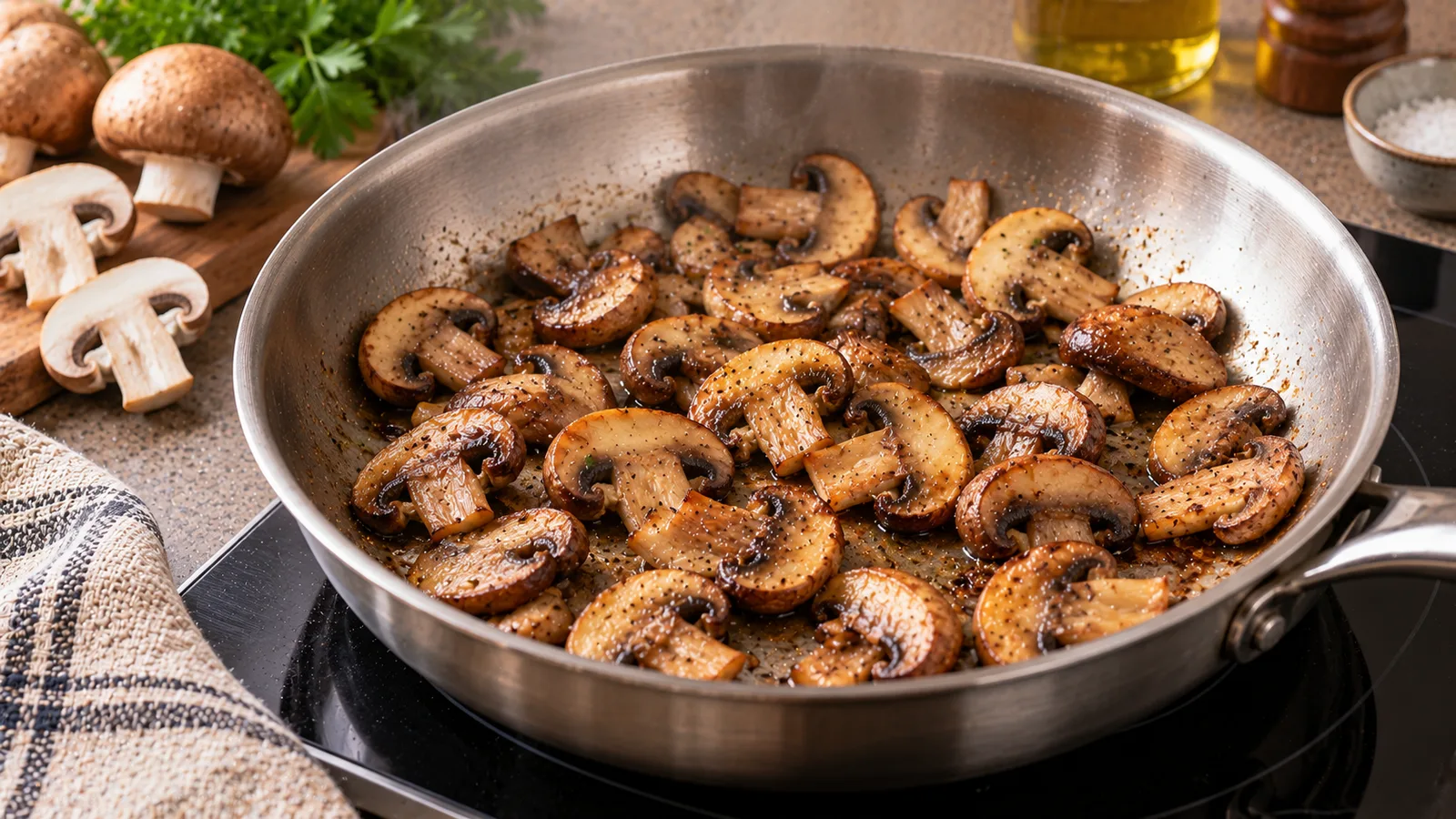
Sautéed mushrooms can be golden and concentrated rather than pale and sitting in a puddle. The trick is not to stop mushrooms releasing water: fresh mushrooms contain a great deal of it. The trick is to control how quickly that liquid leaves the pan and when the surface can brown. The method below works with common cultivated button and cremini mushrooms and can be adapted for other varieties.
For a repeatable starting point, use 300 g fresh mushrooms, 10 g olive oil and a wide, heavy frying pan. Divide the mushrooms into two 150 g batches if they cannot lie in one layer. These are example quantities, not a universal limit: pan diameter, burner output and cut size all matter. Record your own result once and repeat what works in your kitchen.
Why mushrooms turn a frying pan watery
USDA FoodData Central's SR Legacy entry for raw white mushrooms (FDC 169251) lists approximately 92.45 g water and 22 kcal per 100 g. Heated mushrooms lose moisture and become smaller. When many pieces are crowded together, the released liquid pools, and the surface stays near the temperature of simmering water instead of browning efficiently. Lower heat, repeated stirring and a covered pan can keep that wet phase going longer.
Water in the pan is not a ruined meal or evidence that the mushrooms were washed incorrectly. It is a normal stage. Continue cooking uncovered until the liquid evaporates, then let the mushrooms contact the hot pan. The Mushroom Council recommends a hot pan, a single layer, minimal early stirring and small batches for a browned finish.
A repeatable two-batch method
- Prepare and weigh. Weigh 300 g mushrooms after trimming. Brush away dirt or rinse briefly under cool running water; pat dry just before cooking. Cut into similar halves, quarters or moderately thick slices so pieces cook at comparable speeds.
- Divide the load. Split into two bowls of 150 g. If your pan holds all 300 g loosely in one layer, one batch may work; if the pieces overlap substantially, use two.
- Preheat. Warm a heavy frying pan over medium-high to high heat, adapting the setting to your hob. It should be hot enough to sizzle but not so hot that the oil smokes heavily.
- Measure the oil. Add 5 g oil for the first batch. Weighing is more reliable than describing the amount as a splash or a spoonful.
- Let contact happen. Spread mushrooms in one layer. Leave them alone until their underside colors, then turn or stir selectively. Watch the pan instead of obeying one rigid number of minutes.
- Finish the wet stage. If a pool forms, keep the pan uncovered. Let it boil away; when sizzling replaces bubbling and the edges color, the mushrooms are ready for seasoning.
- Repeat and combine. Remove the first batch, add the other 5 g oil and cook the second 150 g. Add garlic only near the end if using it, to reduce burning risk. Season, combine and serve.
| Step | Example amount | What to watch |
|---|---|---|
| Raw mushrooms | 300 g | Trimmed, ready for the pan |
| Per batch | 150 g | Mostly one layer |
| Oil per batch | 5 g | 10 g added overall |
| Finished batch | Weigh it | There is no fixed cooked yield |
Can you cook a big batch without doing two rounds?
Yes, but distinguish steam-then-brown from immediate searing. A crowded pan first releases moisture and steams. If you uncover it and continue until the liquid is gone, you may still achieve good browning. A tested technique described by Serious Eats deliberately begins with steam, then evaporates the water and browns the mushrooms. What does not work well is turning off the heat as soon as the pile has softened while liquid still covers the pan.
For delicate slices that must look browned quickly, small batches are usually easier. For chopped mushrooms destined for a filling, sauce or mushroom mince, deliberately cooking off their water in one larger batch can be practical. Choose the method based on the final texture, not on a blanket rule that mushrooms must never touch each other.
Pan size, heat and stirring: how to troubleshoot
Pale with a puddle: the pan is holding more liquid than it can evaporate quickly. Increase uncovered cooking time, or transfer half the mushrooms to another pan. Do not immediately pour in more oil: fat does not remove water.
Dark outside, raw-feeling inside: the pan may be too hot or pieces too thick. Lower the heat slightly and let the interior cook. Very thick mushroom quarters can benefit from a brief covered stage followed by uncovered browning.
Sticking or scorched garlic: check whether the pan is excessively hot or the oil is too little for its surface. Add garlic after the mushrooms have largely browned, not at the beginning of a long high-heat batch.
Mushrooms shrinking: expected. They lose water during cooking. Do not assume that 300 g raw always becomes a particular cooked weight; your own scale is the best source.
Too salty or dry: add seasoning near the end for greater control. Salting early is not automatically an error, but early released moisture still needs time to evaporate. A small splash of water or stock can intentionally turn browned bits into a sauce, though the result will no longer be dry sautéed mushrooms.
Oil and calories: count the ingredients, not just cooked grams
Using the USDA reference of 22 kcal per 100 g, 300 g raw white mushrooms provide about 66 kcal. If all 10 g olive oil is counted at roughly 884 kcal per 100 g, it contributes approximately 88 kcal. The whole example pan therefore contains about 154 kcal before other additions. That estimate assumes the full oil amount is part of the dish; oil clearly left in the pan can change actual intake.
Suppose you weigh 180 g after cooking. This is an illustrative measured yield, not a reference conversion factor. On that assumption the finished mushrooms contain about 86 kcal per 100 g, or 77 kcal for a 90 g half-batch. The energy did not appear because water evaporated: the smaller cooked mass simply concentrates the calories per gram. If your cooked result weighs 220 g instead, do the calculation again using 220 g; never transfer the hypothetical 180 g yield to another pan.
Oil can be the largest calorie variable in this dish. For tracking, record oil actually added, check whether a visible quantity remains behind, and avoid counting oil twice when adding the mushrooms to pasta or a sauce. Mushrooms prepared without oil will have a very different calorie density from mushrooms cooked with butter or generous oil.
For related reading, see mushroom calories and raw portions · one-pan dinner ideas.
Cleaning, serving and storing
Health Canada advises cleaning mushrooms with a soft brush, damp cloth or cool running water, then drying them; there is no need to wash them with soap. Clean close to cooking time. The FDA recommends keeping perishable mushrooms refrigerated and observing basic produce hygiene. Discard spoiled or slimy mushrooms rather than trying to rescue them with high heat.
For immediate serving, finish with pepper, herbs or lemon after the wet stage. For risotto, omelets or a sandwich, brown the mushrooms separately before mixing with wetter ingredients; otherwise the dish's liquid can make their surface soft again. If making a deliberately saucy mushroom dish, sautéing is still useful for flavor, but a little liquid in the finished meal is the goal rather than a failure.