
Count the whole order, not just the pieces
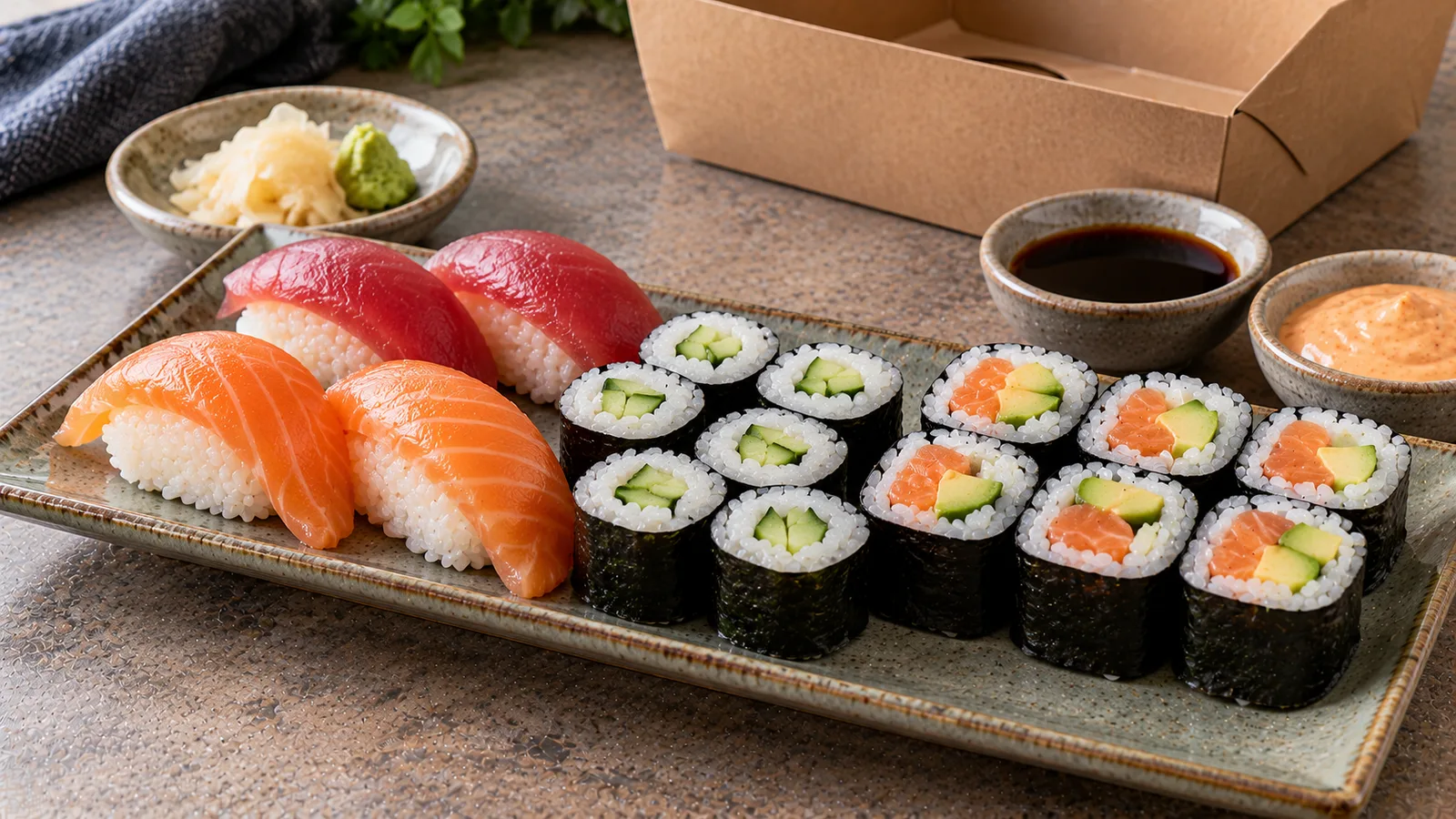
A plate described as “12 pieces of sushi” is not one standard serving. Six delicate hosomaki may contain much less rice than six large inside-out rolls; one nigiri can have a thicker rice base than another. The practical question is not “how many calories does sushi have?” but “how many grams of cooked seasoned rice, fish, vegetables and sauce did this order contain?” Start by writing down every part of the order, including sides and drinks. A photograph can help remember what was served, but cannot reveal the hidden weight of rice or mayonnaise.
This guide is for estimating restaurant orders when the restaurant does not publish reliable nutrition information. Use the restaurant's official numbers first if they include the same piece count and extras. Do not transfer a numerical estimate from one chain or country to another without checking the portion. The goal is a transparent interval, not an artificially precise answer.
A reference table for a realistic calculation
The following values are calculation inputs, not a nutrition claim about a named sushi restaurant. The cooked, unseasoned short-grain white-rice reference is approximately 130 kcal/100 g in USDA FoodData Central. Sushi rice usually has a vinegar-sugar seasoning; added sugar is not included in that plain-rice baseline. The remaining round values below are illustrative ingredient assumptions that must be replaced with a label or a suitable composition entry when accuracy matters.
| Component in example | Assumed kcal per 100 g | Weight in example |
|---|---|---|
| Cooked plain short-grain rice | 130 | 90 g or 110 g |
| Salmon filling or topping | 200 | 60 g |
| Lean tuna | 110 | 45 g |
| Cucumber | 15 | 30 g |
| Nori seaweed | 300 | 2 g |
| Mayonnaise-based sauce | 600 | 15 g |
Rice, fish and sauce figures are rounded for educational arithmetic. Species, farmed or wild fish, brand, recipe, and whether rice is sweetened can change them. Soy sauce belongs on the order too, particularly when tracking sodium; its calories and salt vary by label. Never apply the 600 figure to every sauce: a thin soy-based dip is not mayonnaise.
Worked example: six salmon nigiri
Imagine six nigiri with 90 g cooked rice total and 60 g salmon total. That is an assumption for this example, not an average proven for six pieces across restaurants. At 130 kcal/100 g, 90 g plain cooked rice contributes 117 kcal. If the selected salmon is represented by an illustrative 200 kcal/100 g, 60 g adds 120 kcal. The subtotal is therefore 237 kcal before sushi-rice seasoning, sauce, extra fish, garnish, or drinks.
If the restaurant forms particularly large nigiri, the rice could be substantially heavier. Even a 30 g difference in cooked rice changes the estimate by 39 kcal at the plain-rice reference, before seasoning. This is why piece count alone is a weak calorie measure. When possible, look for a menu weight or weigh a similar homemade piece and use that as a starting point.
Worked example: six tuna-cucumber maki
Now imagine six small maki pieces whose full roll contains 110 g rice, 45 g tuna, 30 g cucumber, and 2 g nori. Use the same plain-rice baseline: 110 × 130 ÷ 100 = 143 kcal. At illustrative values of 110, 15 and 300 kcal/100 g, the other components add roughly 50, 5 and 6 kcal. Total: approximately 204 kcal for the six-piece example, before seasoning and added sauces.
The result is not a general calorie value for all tuna maki. A roll with avocado, tempura, cream cheese or more rice is a different calculation. A large uramaki may be sliced into eight pieces; a hosomaki may be sliced into six. Compare actual ingredients and weights, not just the word “roll”.
Adding sauce and the complete order
Suppose you eat both example sets: six salmon nigiri (237 kcal) plus six tuna-cucumber maki (204 kcal). Their ingredient-based subtotal is 441 kcal. Add 15 g of a mayonnaise-style sauce modeled at 600 kcal/100 g and the sauce adds 90 kcal. The illustrative order becomes 531 kcal before any sweetening of the rice, other toppings, side dishes and drinks.
This example shows why recording sauces separately matters. It does not mean every 12-piece sushi order has 531 kcal. A sauce served on the side might remain mostly untouched; a thick spicy-mayo topping may be difficult to measure. Record what you actually used. If an ingredient's weight is unknown, show a low/high range rather than inventing one exact number.
How to estimate at the table without a scale
First, split the menu item into nigiri, thin maki, inside-out rolls, fried rolls and sauces. Next, check whether the menu gives grams, a piece photo or an ingredient list. Third, estimate the share represented by rice rather than assigning every piece a single calorie figure. Fourth, note additions that change the result most: mayonnaise, tempura batter, frying oil, cream cheese, avocado and sweet glazes. Finally, total the pieces plus the dipping sauce and any sides.
If you only have a photo, treat hidden filling weights as unknown. A photo is useful for identifying types and piece count, not for confirming exact grams. A restaurant nutrition table tied to the same recipe should take precedence over image-based estimates. When logging an order, note the uncertainty as well as the estimate, particularly for takeaway assortments.
What changes the estimate most?
Rice can dominate a maki calculation because it occupies so much of the roll. Nigiri typically displays the fish on top but still contains a rice base. Sashimi is fish without sushi rice; that distinction changes how you calculate a comparable portion. Raw fish is not inherently calorie-free, and salmon may differ substantially from lean tuna. Fried rolls include oil absorbed during cooking; estimating only raw ingredient weights will undercount them.
Seasoning matters too. Vinegar contributes relatively little, but sugar added to rice is an energy source. There is no universal quantity of sugar in restaurant sushi rice. Soy sauce generally needs greater attention for sodium than for energy, while a creamy topping can be energy-dense. If you cannot verify how much was added, keep the result qualified instead of claiming laboratory accuracy.
A useful range, not false precision
A practical log can keep three columns: clearly seen items; estimated gram weights; and unknowns. For example, you might be confident that you ate six nigiri and six maki yet uncertain whether the salmon weighed 60 g or 80 g, or whether the topping held 5 g or 20 g sauce. Vary those assumptions and recalculate. This exposes which unknown really affects the estimate, instead of debating single-digit calories.
When comparing two orders, hold the same assumptions for comparable ingredients. Do not claim that one roll is “healthier” merely because its modelled calories are lower: nutrition also involves protein, variety, sodium, ingredient quality and personal needs. For routine tracking, a sensible estimate is often enough; the purpose is consistency, not perfect measurement.
Food-safety note for raw seafood
Calorie estimates say nothing about microbiological safety. The US Food and Drug Administration notes that cooking seafood is the safest way to reduce foodborne-illness risk and that raw seafood can be especially risky for pregnant people, young children, older adults and people with weakened immune systems. Freezing may address some parasites but not all harmful germs. People in these groups should choose suitable fully cooked alternatives and follow applicable local guidance.
This safety guidance is separate from the calorie calculation. A roll with cooked fish can still be high or low in calories depending on rice, frying and sauces; raw fish does not automatically make an order more nutritious.
Sources and how to reuse this method
Use USDA FoodData Central to identify the correct food and preparation state for rice and other ingredients, rather than treating an unrelated entry as a sushi standard. Consult the FDA seafood-safety guidance for raw-fish precautions. Neither source certifies the gram weights of a particular restaurant order; the 90 g, 60 g, 110 g, 45 g, 30 g, 2 g and 15 g quantities above are transparent worked assumptions.
For your next order, copy the same approach: identify piece type, estimate or measure rice and fillings, calculate each gram weight against a matching ingredient reference, then add sauces and sides. Record the result as a portion-specific estimate. A number without the assumed grams is difficult to reproduce or improve later.
For related context, see rice calories and serving sizes · correcting AI food estimates · limits of macros from a food photo.