
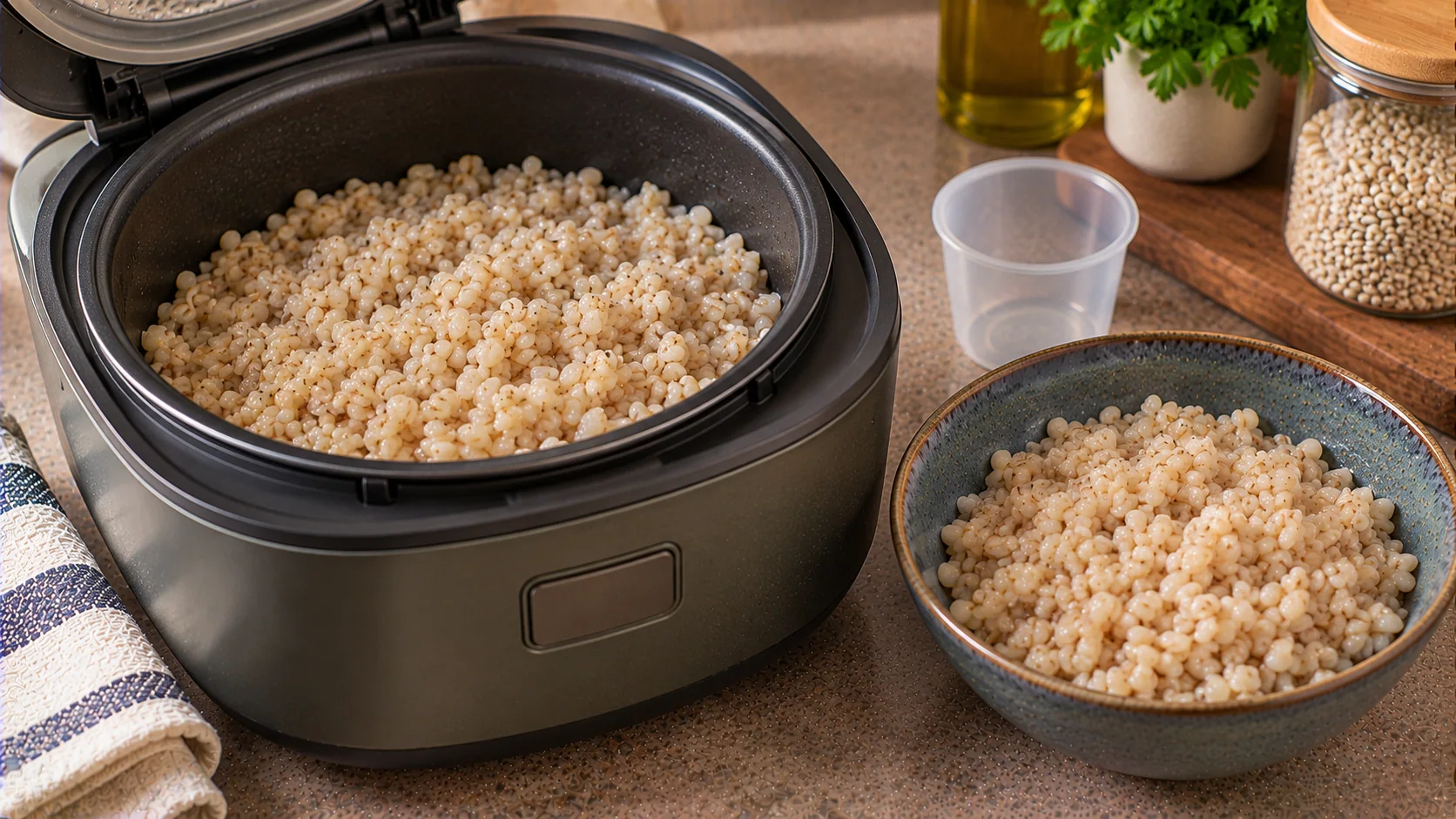
Pearl barley can be cooked in many rice cookers, but it does not behave exactly like white rice. A useful starting test is 1 volume of dry pearl barley to 2.5 volumes of water, using the same measuring cup for both. Select a brown-rice or grain cycle if the appliance permits it, check whether the grains are tender, and adjust your next batch. The ratio is a starting point, not a universally tested setting for every model.
Before you start: which barley do you have?
Pearl barley is polished barley with some outer layers removed. Hulled barley retains more of the grain structure and often takes longer; quick-cooking barley has been pretreated to cook faster. The following method is for ordinary dry pearl barley, not either of those alternatives. Check the label, especially if it says quick, instant, hulled or whole barley. Barley contains gluten and is unsuitable for people who need a gluten-free diet.
Practical starting quantities
Use standard kitchen measurements below, not a line marked “rice” inside your cooker: its markings are calibrated for specific rice portions. The ratios below are measured by volume. Do not confuse 1:2.5 by volume with 1:2.5 by weight.
| Dry pearl barley | Water to start | Approximate use |
|---|---|---|
| 1/2 cup | 1 1/4 cups | Small trial batch |
| 1 cup | 2 1/2 cups | Several side portions |
| 1 1/2 cups | 3 3/4 cups | Only if cooker capacity permits |
One standard US cup is about 240 ml; a manufacturer's rice-cooker cup may be about 180 ml. Either cup works for a ratio if it is used consistently. For a concrete small batch, 100 g dry barley plus 250–300 ml water is only a practical test range, not an exact translation of the volume table: dry-grain bulk density varies. Measuring both ingredients by volume avoids this ambiguity.
Equipment and ingredients
For the basic batch, measure 1 cup dry pearl barley and 2 1/2 cups water. Optional: a little salt, a bay leaf, or unsalted broth instead of some water. You need a functioning rice cooker whose manual permits cooking grains beyond rice, a sieve and a heat-safe spoon. Do not exceed the manufacturer's recommended maximum or minimum fill. Barley starch can foam, so never defeat the vent, obstruct steam outlets or open a pressurised appliance prematurely.
Step-by-step rice-cooker method
- Read your rice cooker's instructions for grains and its maximum fill. If the manufacturer prohibits barley or other grains, use a pot instead.
- Check the dry barley for debris. Rinse briefly in a fine sieve under running water and drain.
- Put 1 cup barley and 2 1/2 cups water in the inner pot. Season lightly if desired. Do not fill using the cooker’s white-rice water line.
- Select brown rice, whole grain or a manufacturer's grain program when available. A single-switch model may change to Keep Warm before the barley is tender; that is not proof of doneness.
- As an orientation, start checking around 40–55 minutes on appropriate grain programs, but some units take longer. Time is an estimate, never a safety or texture guarantee. Follow the appliance manual on opening and steam release.
- Taste several grains. They should be cooked through with a pleasantly chewy centre, not dry and chalky. If the grains are firm and the pan is dry, add 2–4 tablespoons of hot water and continue using a permitted cooking cycle.
- If tender but wet, drain excess liquid. Let stand 5–10 minutes with the lid closed only if your cooker manual allows it, then fluff and serve. Note your successful water amount and cycle for next time.
What if my cooker only has a white-rice button?
A simple on/off cooker senses water and heat differently from a programmable model. It might finish the cycle early or leave extra water. Cook a half-cup trial batch, keep the steam vent clear and follow the unit's directions about restarting. Some models will not permit an immediate restart. If the cooker cannot finish barley without overheating or repeatedly shutting off, transfer the mixture to a saucepan and simmer until tender. Do not wedge the switch down or modify the appliance.
Texture troubleshooting
| Result | Likely explanation | Next safe adjustment |
|---|---|---|
| Dry, hard centre | Too little water or insufficient cooking time | Add a little hot water and finish cooking |
| Soft but watery | More liquid than the grain absorbed | Drain, then reduce water slightly next time |
| Sticky or creamy | Extra starch, vigorous cooking or too much water | Rinse before cooking and try less water |
| Bottom browns too fast | Cooker switches modes or runs too hot | Stop, consult manual; use a pot if repeated |
| Foamy steam | Starch and high fill level | Stop according to manual; use a smaller batch |
Do not increase the batch size until the trial is successful. The number of cups of cooked barley can vary with brand, soaking, water level and how much liquid is drained. Weigh the finished barley if you are dividing it into precise meal-prep portions.
Why the water ratio varies
Grain size and age, pearling degree, soaking, water hardness, appliance wattage and programmed cycle all affect absorption. A labelled pearl-barley product from Signature Select recommends 2.5 cups water per 1 cup barley for stovetop cooking; that is a credible place to start, but it is not a manufacturer's guarantee for a rice cooker. The Whole Grains Council likewise notes that time and water requirements vary across grains and cooking conditions. If your barley packet and cooker instructions disagree with this guide, prioritise those product-specific directions.
Soaking: necessary or optional?
Pearl barley typically does not need overnight soaking. A short soak may change the time and amount of liquid needed, so avoid using the same ratio unquestioningly after soaking. If soaked, drain it and do a smaller test with slightly less water. Hulled barley is a different product and should not be substituted without changing the plan. Do not leave soaked grains indefinitely at room temperature.
Portion sizes and nutrition tracking
A dry 1-cup batch is not one serving. The finished mass includes absorbed water, which changes weight but adds no calories. For example, if your weighed 160 g dry barley ends at 430 g cooked, one 143 g cooked serving represents approximately one third of the original dry batch (53.3 g dry). This is an illustrative yield, not a promise. Divide dry-batch nutrients by the number of equal portions; for uneven portions, multiply the batch nutrients by each portion's measured cooked weight divided by the total cooked weight. Consult the matching product label or USDA FoodData Central for a specific barley entry, distinguishing raw and cooked data. our guide to weighing cooked grains explains more about measuring cooked grains.
Serving ideas without changing the cooking method
Use the cooked barley as a base for roasted vegetables and beans, or toss cooled grains with chopped cucumber, herbs and lemon dressing. For a warm lunch, add mushrooms and a spoonful of yogurt after cooking. These additions change the nutrition and moisture of the finished meal; do not add large amounts of tomato sauce, dairy or beans into the first rice-cooker test unless the manual supports mixed dishes. our mushroom and barley risotto offers a barley-based meal idea once the plain grain method works.
Cooling, storage and reheating
Serve immediately or cool leftovers promptly in shallow containers and refrigerate within 2 hours; aim for a fridge temperature at or below 4°C / 40°F. Use properly refrigerated cooked grains within 3–4 days, or freeze individual portions. Reheat thoroughly until steaming hot; for leftovers, the US guidance target is 74°C / 165°F. Reheating cannot reliably undo problems caused by prolonged room-temperature storage. See USDA leftovers guidance. Barley is not a shelf-stable food after cooking.
Questions worth checking before another batch
Can I use stock? Yes, replace water by the same volume of broth; watch salt on the label. Can I add oil? Optional; it changes calories but not the basic water measurement. Does a porridge setting work? Only if your manual recommends it for this grain; porridge settings can make barley softer and wetter. Can I keep it warm for hours? Do not assume your unit maintains a food-safe holding temperature. If not serving immediately, cool and refrigerate promptly.
Sources
- Signature Select pearl barley cooking directions — 1:2.5 stovetop ratio; product-specific, not rice-cooker validation.
- Whole Grains Council: Cooking Whole Grains — variation in cooking time, absorption and storage.
- USDA FoodData Central — nutritional entries; choose the correct raw/cooked type.
- USDA FSIS: Leftovers and Food Safety — refrigeration and reheating guidance.