
Start with the dry weight, not the cooked bowl
For a conventional side dish, plan 50–60 g of uncooked quinoa per adult. When quinoa is the substantial grain base of a bowl or the main starchy component, 70–90 g dry per adult is a useful starting range. These are practical meal-planning estimates, not medical portions or fixed dietary rules. Children, very active adults, and meals already rich in bread, potatoes or legumes can call for different amounts. If the main course already contains beans and plenty of vegetables, a smaller amount of quinoa may feel generous. Weigh it while dry: the cooked product contains absorbed water and is not directly comparable gram for gram.
A separate question is how much you will eat of the finished dish. A side made from 50 g dry quinoa is not the same thing as a serving weighing 50 g after cooking. This guide keeps the two measurements distinct throughout.
Practical dry quinoa amounts for one to six people
| People | Side, 50–60 g each | Main grain base, 70–90 g each |
|---|---|---|
| 1 | 50–60 g | 70–90 g |
| 2 | 100–120 g | 140–180 g |
| 3 | 150–180 g | 210–270 g |
| 4 | 200–240 g | 280–360 g |
| 5 | 250–300 g | 350–450 g |
| 6 | 300–360 g | 420–540 g |
Use the low end for a plate with another starch and the higher end when quinoa makes up most of the energy-containing base. This table scales the same suggested dry grams per person; it is not a nutrient requirement or a precise prediction of appetite. For a group with mixed appetites, record the actual amount used once, then adjust on your next cooking day. A kitchen scale makes the result more repeatable than an unlabelled cup or a heaped spoon.
How much cooked quinoa will that produce?
A convenient first estimate is that quinoa becomes about three times as heavy when cooked, but the exact result depends on rinsing, draining, simmering, resting and residual water. For example, 50 g dry may become roughly 150 g cooked, while 80 g may become around 240 g. Treat these as example yields, not guarantees. A recipe using drained quinoa can finish lighter than one that absorbs all its liquid. The familiar claim that one cup dry makes about three cups cooked refers to volume, not identical gram weights or a universal factor for every pot.
To calibrate your kitchen, weigh 100 g dry, cook it by your usual method and weigh the fully drained finished quinoa. If it yields 280 g one day, record a factor of 2.8; if it yields 310 g another day, use 3.1 for that batch. These measurements improve shopping and portion estimates without pretending the cooking water contributes calories.
Calorie examples: calculate from the dry grain
USDA FoodData Central SR Legacy describes uncooked quinoa (FDC 168874) at 368 kcal per 100 g, and cooked quinoa without additions (FDC 168917) at 120 kcal per 100 g. The values belong to different food descriptions and water contents. For meal planning, multiply the dry grams by 3.68 kcal/g before adding oil, sauce or other ingredients. The dry-grain examples are 50 g = 184 kcal, 60 g = about 221 kcal, 70 g = about 258 kcal, 80 g = about 294 kcal and 90 g = about 331 kcal. These are energy estimates for the quinoa ingredient, not the entire meal.
If you estimate from the cooked weight instead, use the correct cooked-food entry and understand that your own cooking yield may differ. Multiplying a dry quantity by 120 kcal/100 g would substantially undercount. Conversely, applying 368 kcal/100 g to a finished bowl of hydrated quinoa would overcount. Water expands the food; it does not introduce new energy.
A side dish is not automatically a main meal
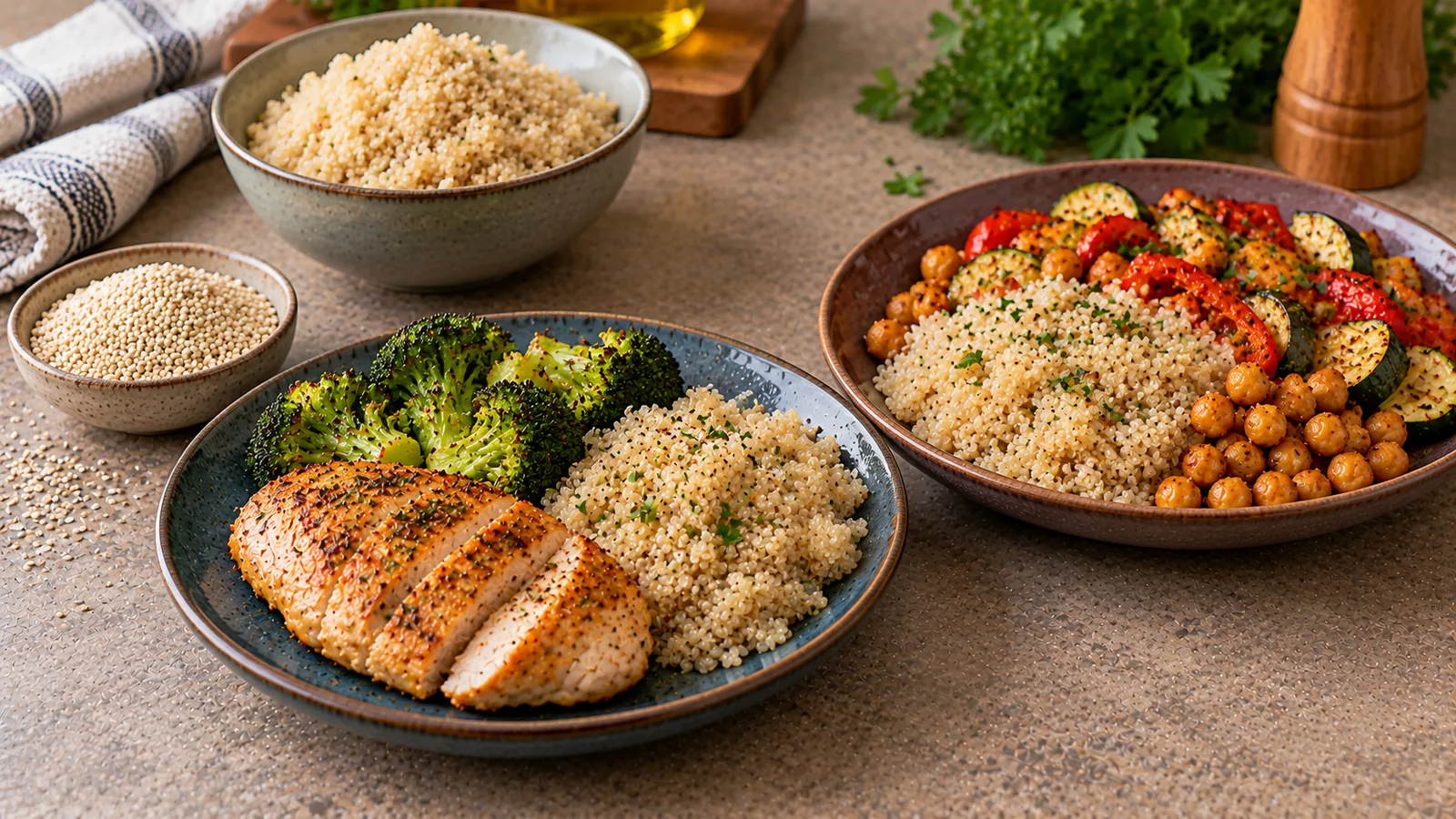
When you serve roast vegetables, fish, tofu or a stew with quinoa on the side, 50–60 g dry per adult leaves space for the rest of the plate. In a bowl built mainly around quinoa, 70–90 g dry may be a better starting point, but add vegetables and a protein source rather than assuming a larger helping of quinoa makes the meal balanced. A bean-heavy salad may need less quinoa than a simple vegetable bowl. The same amount can look very different when packed into a small lunch container versus spread across a wide dinner plate.
Consider the structure of the whole recipe. If it contains 200 g cooked chickpeas for two people, those chickpeas contribute substantially to the portion. If you intend quinoa to replace all the rice in a familiar recipe, use the dry recipe weight as a test quantity, then judge the final volume. Do not swap 100 g cooked rice for 100 g dry quinoa.
Worked examples for two and four diners
Two people, a side: measure 110 g dry quinoa, halfway through the 100–120 g suggested band. With a purely illustrative threefold mass gain, that is approximately 330 g cooked, or 165 g per diner. Dry-grain energy is 110 × 3.68 = about 405 kcal for the pot, before dressing; divided equally, roughly 202 kcal each.
Four people, a substantial grain bowl: use 320 g dry quinoa (80 g each). A threefold illustration would give about 960 g cooked. The quinoa contributes about 1,178 kcal for the pot, or 294 kcal each, plus anything added. A dressing made with 20 g olive oil raises the pot total further; calculate it separately from the quinoa. Both examples are transparent arithmetic, not measured cooking experiments. If you leave leftovers or one person eats more, the final per-person share changes.
Measuring cups, packets and ready-to-eat pouches
A cup of dry quinoa does not reliably mean the same number of grams in every kitchen. Grain size, settling, and whether a cup is level or heaped all change the weight. USDA's uncooked reference lists one US cup at roughly 170 g; that is a particular household measure, not the weight of every mug. Use a scale for the first batch, then mark your usual scoop with the resulting grams if you prefer cooking by volume. For two sides, a package containing 250 g dry quinoa therefore offers more than one meal under these assumptions.
Ready-to-eat quinoa pouches are different. A label describing 250 g cooked quinoa means 250 g as sold, not 250 g dry. Check the label for energy per 100 g, any added oil or seasoning, and how many servings are actually in the package. Do not apply dry-quinoa calorie numbers or our yield multiplier to a cooked ready-meal pack.
How to cook the measured portion
Rinse dry quinoa in a fine-mesh sieve if the packet recommends it, especially if you notice bitter-tasting surface residues. A practical starting recipe is one part dry quinoa to approximately two parts water by volume, but the packet and saucepan matter. Bring to a boil, cover, simmer gently for roughly 10–15 minutes and let it rest covered for about 5 minutes before fluffing. Check that the grains have softened and that any excess water has been handled appropriately. Some recipes start with more or less liquid, so do not turn an illustrative ratio into a universal law.
For larger batches, use a pot with enough space and cook in an even layer. If your recipe calls for frying dry quinoa briefly in oil before adding liquid, count that oil in the meal, too. Salt changes flavour, not the underlying dry-portion arithmetic. Record your actual yield if you are calculating portions for repeated weekly meal preparation.
Common counting mistakes and leftovers
Mistake one: treating 150 g cooked as 150 g dry. Mistake two: interpreting a cup measure as an exact gram weight. Mistake three: adding the energy of both the raw and the cooked quinoa, even though they describe the same ingredient before and after water absorption. Mistake four: using a cooked-food label for a dry pouch. Mistake five: counting all of a salad's olive oil, feta and beans as if those calories came from quinoa itself.
If cooking for tomorrow, divide the finished pot into weighed portions, cool promptly and refrigerate according to local food-safety advice. Keep the cooked weight and date on the container, and follow the handling information for any mixed ingredients. The amount you prepare can be larger than the amount you serve today: a planned leftover is not a measurement error. For repeated meal-prep batches, the weighed final pot is the most useful reference.
Choosing the amount that actually fits your meal
Start at 50–60 g dry per person for a side or 70–90 g for a main grain base. Adjust for other ingredients, appetite and your previous leftovers. Write down dry weight and finished yield separately. If a 4-person side leaves half the pot uneaten, use a lower quantity next time rather than asserting that everyone should eat an identical standard serving. If your diners consistently ask for more, increase the dry amount in measured steps.
This article answers how much uncooked quinoa to buy and cook per person. For a stand-alone profile of quinoa calories and nutrients, use the existing dedicated quinoa food page rather than treating this meal-size guide as a second nutrition database entry.
For related food data, see the quinoa calorie and nutrient profile · the quinoa-versus-rice comparison.
Sources
- USDA FoodData Central — SR Legacy, quinoa uncooked FDC 168874 and quinoa cooked FDC 168917; compare dry and cooked entries by state.
- USDA SR Legacy raw-quinoa report — food group 20, uncooked quinoa.
- Good Food: basic quinoa — 200 g dry quinoa for 4 servings and cooking method.
- The Kitchn: how to cook quinoa — cooking method and volume-yield illustration.