
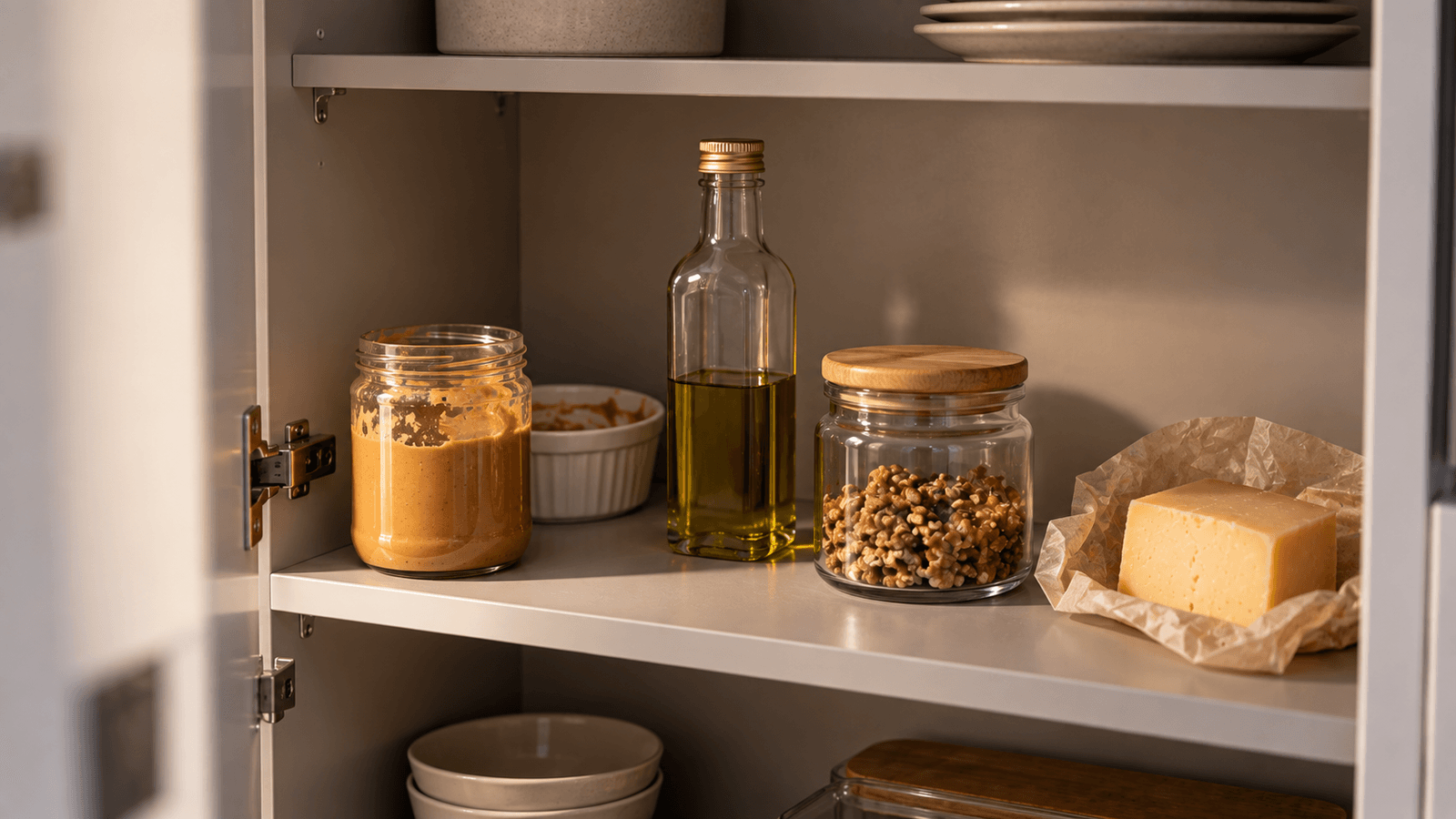
High-calorie foods provide a relatively large amount of energy for a given weight or volume.
That description is often treated as automatically negative. But calorie density is simply a property of food. Depending on a person's needs, appetite and circumstances, foods that provide more energy in a smaller amount can sometimes be useful.
The more useful question is not whether a food is "high calorie," but what else it provides and how it fits into the overall diet.
What makes a food high in calories?
Calories come primarily from three macronutrients:
- carbohydrate
- protein
- fat
Carbohydrate and protein each provide about 4 kcal per gram, while fat provides about 9 kcal per gram.
Alcohol provides about 7 kcal per gram, although it is not an essential nutrient.
Because fat contains more energy per gram, foods with a higher fat content are often more calorie-dense.
Water has no calories. Foods containing a lot of water therefore tend to provide fewer calories for the same weight.
This is why 100 g of cucumber and 100 g of nuts can have dramatically different calorie contents even though both are foods measured at the same weight.
High-calorie foods are not all nutritionally equivalent
Two foods can provide a similar number of calories while having very different nutritional profiles.
Some energy-dense foods also provide substantial amounts of:
- protein
- unsaturated fats
- fibre
- vitamins
- minerals
Others may provide energy with relatively fewer essential nutrients.
Calories therefore tell you how much energy a food provides, but not its complete nutritional value.
Examples of energy-dense foods
Many familiar foods naturally contain a relatively high amount of energy in a small serving.
Examples include:
| Food | Why it is energy-dense |
|---|---|
| Nuts | High natural fat content |
| Nut and seed butters | Concentrated fat with protein |
| Seeds | High fat content in a small volume |
| Olive and other oils | Almost entirely fat |
| Avocado | Relatively high fat content |
| Cheese | Combination of fat and protein with little water |
| Dried fruit | Much of the original water has been removed |
| Granola | Often combines dry grains, nuts, seeds and fats |
| Dark chocolate | Contains substantial fat and carbohydrate |
The exact calorie content varies by product and serving size.
A food does not need to be avoided simply because it appears on this list.
Why removing water increases calorie density
Fresh fruit contains substantial water.
Dried fruit contains much less.
Imagine grapes and raisins. Raisins are essentially grapes with much of their water removed.
The energy from the original fruit becomes concentrated into a smaller volume and weight.
As a result, it is much easier to consume the calories from several grapes' worth of fruit in a small handful of raisins.
The same general principle helps explain why dry foods can be more calorie-dense than foods with high water content.
Oils are an extreme example
Cooking oils are among the most energy-dense everyday foods because they are almost entirely fat.
A tablespoon of oil can add a meaningful amount of energy without adding much food volume.
This matters in both directions.
If someone is trying to reduce calorie intake, unmeasured cooking oil can make meals more calorie-dense than expected.
If someone needs more energy without dramatically increasing meal volume, adding an appropriate amount of oil can increase calories efficiently.
The food itself has not changed. The usefulness depends on the context.
When high-calorie foods can be useful
Energy-dense foods may be practical when someone needs to obtain more energy without eating a very large volume of food.
Examples can include situations where a person:
- has high energy requirements
- has a limited appetite
- finds large meals difficult to eat
- needs convenient energy during demanding activity
- is intentionally trying to gain weight
- needs compact foods for travel or long periods of activity
Individual medical conditions that affect appetite, weight or nutritional requirements require individualized professional advice rather than simply adding high-calorie foods.
High energy requirements
People differ substantially in energy needs.
A physically active person with a high total energy expenditure may need considerably more food energy than someone with lower requirements.
Trying to obtain all of that energy exclusively from very low-calorie, high-volume foods can require an impractically large amount of food.
Energy-dense foods can make it easier to increase total energy intake without proportionally increasing food volume.
For example, adding nuts, seeds, olive oil or another calorie-dense ingredient can change the energy content of an otherwise similar meal.
When appetite is limited
A person who becomes full quickly may find a very large plate difficult to finish.
In that situation, simply increasing food volume may not be practical.
A smaller meal containing some energy-dense ingredients can provide more calories without requiring the same physical volume.
The cause of persistent poor appetite or unintended weight loss should not be self-treated solely through calorie-dense foods. Those situations may warrant assessment by a healthcare professional.
High-calorie foods for weight gain
Weight gain requires energy intake to exceed energy expenditure over time.
Energy-dense foods can make that easier because they increase calorie intake without necessarily requiring very large portions.
Examples of ways to increase meal energy include adding:
- nuts or seeds
- nut butter
- avocado
- cheese
- olive oil
- full-fat dairy products
- dried fruit
The appropriate amount depends on total energy needs and the rest of the diet.
The goal does not need to be eating the highest-calorie foods available. Nutritional quality remains important.
High-calorie foods and weight loss
A food can be high in calories and still fit into a weight-loss diet.
Weight loss is driven by the overall energy balance over time, not by whether every individual food is low in calories.
However, calorie-dense foods can make it easier to consume a large amount of energy in relatively small portions.
That makes portion awareness particularly useful.
For example, nuts can provide protein, fibre, unsaturated fats and micronutrients, but a large unmeasured portion can contain substantially more calories than a small portion.
The practical approach is not necessarily to remove the food, but to understand the portion.
Portion size changes the picture
Calling a food "high calorie" without specifying a portion can be misleading.
Oil is extremely calorie-dense, but a small amount may contribute fewer calories than a large serving of a less energy-dense food.
Similarly, peanut butter may contain many calories per 100 g, but most people do not eat 100 g as a standard serving.
When comparing foods, distinguish between:
- calories per 100 g
- calories per typical portion
- the amount you actually eat
All three can answer different questions.
Calorie density and satiety are not identical
Calorie density describes energy relative to weight or volume.
Satiety describes how eating affects hunger and fullness.
They are related in some situations, but they are not the same measurement.
Protein, fibre, food structure, water content, palatability and portion size can all influence how filling a food or meal feels.
You therefore cannot determine exactly how satisfying a food will be from calories per 100 g alone.
For more on the concept itself, see What Is Calorie Density?.
High-calorie does not mean unhealthy
A simple healthy/unhealthy classification based on calorie content creates obvious problems.
Nuts, seeds, olive oil and avocado can all be calorie-dense while also providing useful nutrients.
At the same time, being nutrient-rich does not make their calories disappear.
Both statements can be true:
A food can be nutritious and calorie-dense.
Whether that matters depends on the person's overall intake and goals.
Low-calorie does not automatically mean nutritious
The reverse assumption is also unreliable.
A food can be low in calories without contributing substantial protein, fibre, vitamins or minerals.
Calorie content therefore should not be used as a complete measure of food quality.
A more useful assessment considers:
- energy
- protein
- fibre
- fat quality
- vitamins and minerals
- portion size
- overall dietary pattern
How to make a meal more calorie-dense
If the goal is intentionally to increase energy intake, relatively small changes can make a substantial difference.
For example:
Oatmeal: add nut butter, nuts, seeds or full-fat dairy.
Yogurt: add nuts, seeds, granola or dried fruit.
Rice or pasta: add olive oil, cheese, pesto or another energy-dense sauce.
Sandwiches: add cheese, avocado or nut butter where appropriate.
Smoothies: combine milk or a suitable alternative with nut butter, oats or other ingredients.
The exact combination should still fit the person's nutritional needs and preferences.
How to reduce calorie density without simply eating less
If the goal is to lower the calorie density of a meal, one approach is to increase the proportion of foods that contain more water or fibre.
Examples include:
- vegetables
- fruit
- soups with substantial vegetables
- legumes
- other minimally processed high-water foods
This can increase meal volume without increasing calories at the same rate.
For a dedicated guide, see Low-Calorie-Density Foods: What to Eat and Why.
Track concentrated ingredients carefully when accuracy matters
Some energy-dense ingredients are easy to underestimate visually because a small quantity contains substantial energy.
Common examples include:
- cooking oil
- nut butter
- nuts
- seeds
- cheese
- creamy sauces
You do not necessarily need to weigh these foods forever.
But measuring your usual amount a few times can help you build a more realistic visual reference.
This is especially useful if your calorie estimates repeatedly differ from your intended intake.
A simple way to evaluate a high-calorie food
Instead of asking only, "Is this high in calories?", ask:
- What is the normal portion?
- What nutrients does it provide?
- How does it affect the rest of the meal?
- Does the portion fit my current energy needs?
- Am I choosing it intentionally or consuming it without noticing the amount?
That turns calorie density into useful information rather than a label for whether a food is good or bad.