
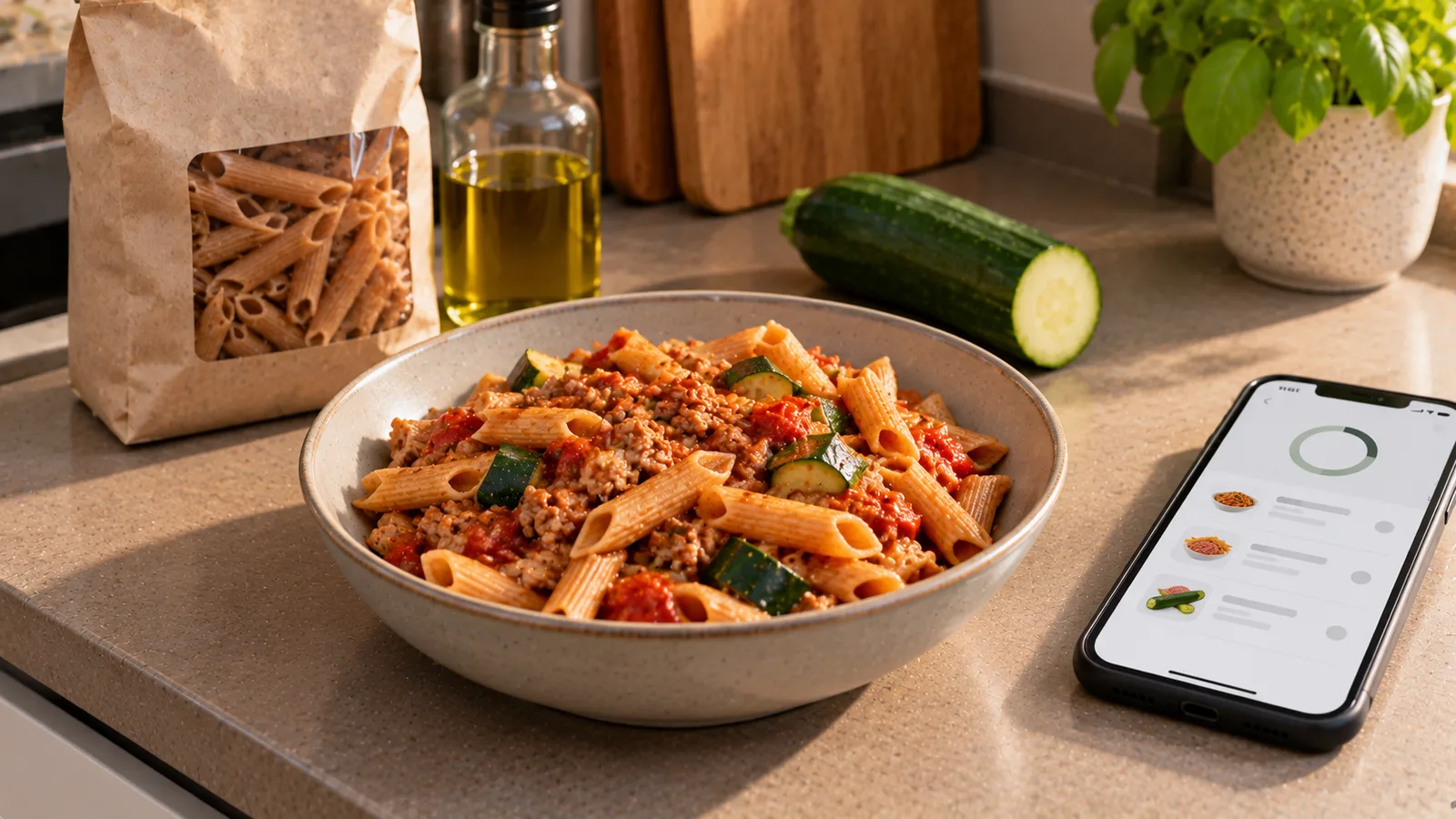
A food tracking app can calculate calories and macros precisely from the information it receives while still producing an imperfect estimate of what you actually ate.
That distinction matters.
The final number depends on several steps:
- identifying the correct food;
- using appropriate nutrition data;
- estimating or measuring the correct amount;
- accounting for preparation and added ingredients;
- recording everything that materially contributes to the meal.
An error at any one of these stages can affect the result.
Accuracy is a chain, not a single feature
It is tempting to ask whether a food tracking app is simply “accurate” or “inaccurate.”
In practice, accuracy depends on the entire logging process.
Consider a bowl of pasta with meat sauce.
The app may need to know:
- which pasta was used;
- whether the entered weight is dry or cooked;
- how much pasta was eaten;
- what meat was used;
- how much sauce was included;
- whether oil was used during cooking;
- whether cheese was added;
- whether the database entries match the actual products.
Even excellent calculation software cannot fully correct incorrect input.
1. The wrong food entry
One of the simplest sources of error is selecting an entry that does not represent the food you ate.
A database may contain several versions of what appears to be the same food.
For example:
- raw chicken breast;
- cooked chicken breast;
- chicken breast with skin;
- roasted chicken;
- branded chicken product;
- restaurant chicken.
Their nutrition values can differ.
The most useful entry is not necessarily the first search result. It is the one that best matches the actual food.
2. Raw and cooked weights are not interchangeable
Cooking changes food weight through water loss or water absorption.
For example, meat often becomes lighter during cooking because it loses water.
Rice and pasta generally become heavier because they absorb water.
This changes calories per 100 g even though cooking has not magically created or removed the corresponding amount of food energy.
If you weigh cooked rice but select an entry for dry rice, the estimate can be substantially distorted.
The basic rule is:
match the state you weighed with the state in the database entry.
If you weigh the food raw, use raw nutrition data.
If you weigh it cooked, use an appropriate cooked entry.
For a detailed explanation, see Raw vs Cooked Weight: Which Should You Use for Calories?.
3. Portion-size errors
The nutrition data may be correct while the amount is wrong.
Suppose an app correctly knows the calories per 100 g of a food.
If the actual portion is 180 g but you record 120 g, the final estimate will still be wrong.
This is especially relevant for foods that are difficult to judge visually, including:
- oils;
- nut butter;
- nuts;
- cheese;
- cereal;
- sauces;
- rice;
- pasta;
- mixed dishes.
You do not necessarily need to weigh everything forever.
But it is useful to understand that portion estimation is a separate source of uncertainty from food identification.
4. Serving size can be mistaken for portion size
A label might describe nutrition “per serving.”
That serving is a reference quantity chosen for the label.
It is not automatically the amount you ate.
If one serving is 30 g and you eat 50 g, logging one serving understates the amount.
Likewise, if you eat half the listed serving, entering a full serving overstates it.
Always distinguish between:
the serving used by the label
and
your actual portion.
5. Package data can be misunderstood
Packaged foods often appear easy to track because the label provides nutrition information.
But mistakes still happen.
Check whether the label gives values:
- per 100 g;
- per serving;
- per package;
- as sold;
- after preparation.
Also check the package weight.
A package that looks like one portion may contain more than one labeled serving.
Conversely, a product may show nutrition for a serving larger than the amount you actually ate.
6. Food labels themselves are not laboratory-perfect numbers
Nutrition labels are useful reference data, but the printed values should not be interpreted as an exact chemical measurement of every individual package.
Foods naturally vary.
Manufacturing also involves normal variation.
Label values may involve permitted rounding and regulatory calculation methods.
For everyday tracking, this means that entering the label perfectly does not make the final result infinitely precise.
The appropriate goal is usually a useful estimate, not false precision.
7. User-generated database entries can contain mistakes
Some tracking databases include entries submitted or edited by users.
Potential problems include:
- incorrect calories;
- incorrect macros;
- wrong serving sizes;
- missing units;
- confusion between kJ and kcal;
- values copied from a different product;
- outdated product information.
When an entry looks unusual, compare it with the package label or another reliable source.
A suspicious entry should not become trustworthy merely because it exists in the database.
8. Similar products can have different nutrition
Two foods with the same general name can differ substantially.
Examples include:
- low-fat vs full-fat yogurt;
- sweetened vs unsweetened yogurt;
- different breads;
- different granolas;
- sauces from different brands;
- plant-based drinks;
- prepared soups;
- protein bars.
Logging a generic version may be acceptable for a rough estimate, but a barcode or label entry can be more appropriate when the exact product matters.
9. Barcode scanning identifies a product, not necessarily the amount eaten
Barcode scanning can reduce the problem of choosing the wrong product.
But it does not automatically solve portion size.
After scanning, you may still need to determine:
- how much of the package you ate;
- whether the app's default serving matches your portion;
- whether the stored product information still matches the current label.
A correct barcode with an incorrect quantity still produces an incorrect total.
10. Photo recognition has several separate tasks
Photo-based food tracking can make logging much faster, but a photograph does not directly contain a calorie number.
The system may need to estimate:
- what foods are visible;
- how much of each food is present;
- how the food was prepared;
- which ingredients may not be visible.
These tasks have different levels of uncertainty.
A photo may make the food identity obvious while leaving the portion uncertain.
Or the portion may look clear while the recipe is unknown.
For the narrower question of recognizing foods from images, see How Accurate Is Food Recognition From Photos?.
11. Camera angle affects portion estimation
A photograph can make a portion appear larger or smaller depending on:
- camera angle;
- distance;
- lens perspective;
- plate size;
- depth of the food;
- overlapping ingredients.
A top-down photo can show surface area well but may hide depth.
A low angle may show height but make other dimensions harder to judge.
This is why image-based portion estimates should be treated as estimates rather than direct measurements.
12. Hidden ingredients are a major challenge
Some of the most calorie-dense ingredients may be difficult or impossible to see clearly.
Examples include:
- cooking oil;
- butter;
- mayonnaise;
- cream;
- dressings;
- sugar;
- cheese mixed into a dish;
- sauces absorbed into food.
A photograph of roasted vegetables may show the vegetables clearly but not reveal exactly how much oil was used.
A bowl of curry may show its volume but not the amount of coconut milk or oil in the recipe.
When hidden ingredients materially affect the meal, additional information can improve the estimate.
13. Mixed dishes contain recipe uncertainty
Foods such as:
- lasagna;
- curry;
- casserole;
- soup;
- stew;
- pasta sauce;
- homemade cake
cannot always be described accurately by appearance alone.
Two visually similar portions can have different nutrition because their recipes differ.
For homemade food, entering the recipe ingredients and dividing the finished dish into portions can often provide a more consistent estimate.
For more detail, see How to Log Homemade and Mixed Dishes More Accurately.
14. Restaurant meals add another layer of uncertainty
Restaurant food is difficult to estimate when exact nutrition information is unavailable.
You may not know:
- ingredient weights;
- amount of cooking oil;
- sauce quantities;
- recipe formulation;
- exact portion weight.
The goal in this situation is usually not perfect precision.
It is to make a reasonable estimate using the information available.
Repeatedly logging a reasonable estimate is often more useful than pretending an uncertain restaurant meal can be known to the gram.
15. Oils, sauces and condiments are easy to miss
Small additions can be forgotten because they do not look like a major part of the meal.
Examples:
- oil used in a frying pan;
- dressing on salad;
- mayonnaise in a sandwich;
- sauce added after cooking;
- butter on bread;
- milk or sugar in coffee.
Whether they materially affect the total depends on the ingredient and amount.
The important point is that the main visible foods are not always the complete meal.
16. Drinks can be omitted
Food logs sometimes capture meals carefully but ignore drinks.
Depending on what you consume, this can exclude:
- milk in coffee;
- sweetened drinks;
- juice;
- smoothies;
- specialty coffee drinks;
- other caloric beverages.
Water and zero-calorie beverages obviously do not create the same issue.
The practical question is whether the drink contributes meaningful energy or macros.
17. Small repeated items can matter more than one imperfect estimate
Imagine that your lunch estimate is off slightly.
That may have little practical importance.
But suppose you repeatedly forget:
- oil used for cooking;
- several coffees with milk;
- snacks while preparing dinner;
- a regular evening condiment.
A systematic omission repeated every day can matter more than a larger one-time estimation error.
When reviewing your tracking, look for recurring patterns rather than obsessing over one uncertain meal.
18. Recipe yield changes the calculation
For homemade recipes, the total calories of the ingredients are only part of the calculation.
You also need a useful way to divide the finished food.
Suppose a recipe contains 2,400 kcal in total.
If the finished dish weighs 1,600 g, then:
2,400 ÷ 1,600 = 1.5 kcal per gram
A 350 g portion would be approximately:
350 × 1.5 = 525 kcal
If you instead divide the recipe into an assumed number of portions without checking how much you actually served, the result may be less consistent.
19. Changes to a saved recipe can create errors
Saved meals and recipes are useful for faster tracking.
But the saved version should still resemble what you actually ate.
If you normally make a dish with:
- 10 g oil
but today use:
- 30 g oil,
reusing the old recipe unchanged misses that difference.
The same applies when changing:
- meat type;
- cheese quantity;
- sauce;
- serving size;
- major ingredients.
You do not need to rebuild a recipe for tiny differences. Update changes that materially affect the result.
20. Copying yesterday's meal can preserve yesterday's mistake
Repeat-meal features save time.
They can also repeat incorrect data.
If the original entry used:
- the wrong serving size;
- the wrong product;
- a missing ingredient,
copying it for five more days reproduces the same error.
Saved meals are most useful after you have checked the original entry.
21. Macro totals can expose suspicious entries
Calories and macronutrients are related.
Protein and carbohydrate provide about 4 kcal per gram, while fat provides about 9 kcal per gram. Alcohol, fiber treatment, rounding and other factors can complicate exact label comparisons, so the numbers do not always match perfectly.
But a very large mismatch can be a clue that an entry deserves another look.
For example, an entry showing very high amounts of protein, carbohydrate and fat but unusually low calories may contain incorrect data.
You can learn the basic calculation in How to Calculate Calories From Protein, Carbs and Fat.
22. More decimal places do not mean more accuracy
An app might display:
527.4 kcal
That does not mean the meal is known to within 0.1 kcal.
If the portion was visually estimated and the recipe was uncertain, the decimal place reflects calculation precision, not real-world certainty.
This distinction is important.
A precise-looking number can still be based on approximate inputs.
23. Accuracy depends on the purpose of tracking
Different goals require different levels of effort.
General awareness
If you mainly want to understand your eating patterns, approximate logging may provide enough information.
Weight management
Consistency and reasonable portion estimates may be more useful than trying to make every meal exact.
Macro-focused planning
Protein, carbohydrate and fat entries become more important, especially for foods that contribute substantially to your targets.
Learning portion sizes
Occasional weighing can help calibrate your visual estimates without requiring permanent weighing of every food.
The best tracking method is not necessarily the one requiring the most work.
It is the one that provides enough useful information for your goal and that you can use consistently.
Which errors deserve the most attention?
Not every uncertainty deserves equal effort.
A useful priority order is:
| Potential error | Usually worth checking? |
|---|---|
| Wrong food or product | High |
| Large portion mismatch | High |
| Missing oil or major sauce | High |
| Raw/cooked mismatch | High |
| Wrong recipe | High |
| Small vegetable difference | Usually low |
| A few grams difference in a low-calorie food | Usually low |
| Minor rounding difference | Usually low |
This is not a universal rule.
It is a way to focus effort where it is more likely to improve the usefulness of the log.
How to make food tracking more reliable
You can improve your logs without making tracking a full-time job.
Match the food
Choose the correct product, preparation state and database entry.
Check the unit
Make sure you are entering grams, milliliters, servings or package fractions correctly.
Check the amount
Correct large portion errors.
Include important additions
Remember oils, sauces, toppings and caloric drinks when they materially contribute.
Use recipes for repeat homemade dishes
A saved recipe can make future logging faster and more consistent.
Correct AI estimates when necessary
If an automated estimate identifies the wrong food or clearly misjudges the amount, edit the result rather than accepting it automatically.
See How to Correct an AI Food Estimate.
Do you need perfect accuracy?
No food log represents reality with laboratory precision.
Even if you weigh every ingredient, uncertainties remain in:
- food composition;
- labels;
- cooking changes;
- database values;
- recipe distribution.
That does not make tracking useless.
A consistently collected estimate can still help you understand patterns, compare days, plan meals and make adjustments.
The goal is not to eliminate every possible error.
It is to reduce the errors that are large, systematic and relevant to the reason you are tracking.
A practical accuracy check
When an entry looks questionable, ask:
- Did I choose the correct food or product?
- Does the entry match raw or cooked state?
- Is the unit correct?
- Is the portion reasonably close?
- Are important oils, sauces or toppings included?
- Is this a mixed dish that would be better represented by a recipe?
- If it came from a photo, is the food identity or portion uncertain?
- Is this error large enough to matter for my purpose?
If the answers look reasonable, continuing with the estimate is often more useful than spending excessive time chasing a theoretically perfect number.
Food tracking accuracy is not determined by one algorithm or one database.
It is the result of food identification, nutrition data, portion estimation, preparation details and consistent logging working together.