
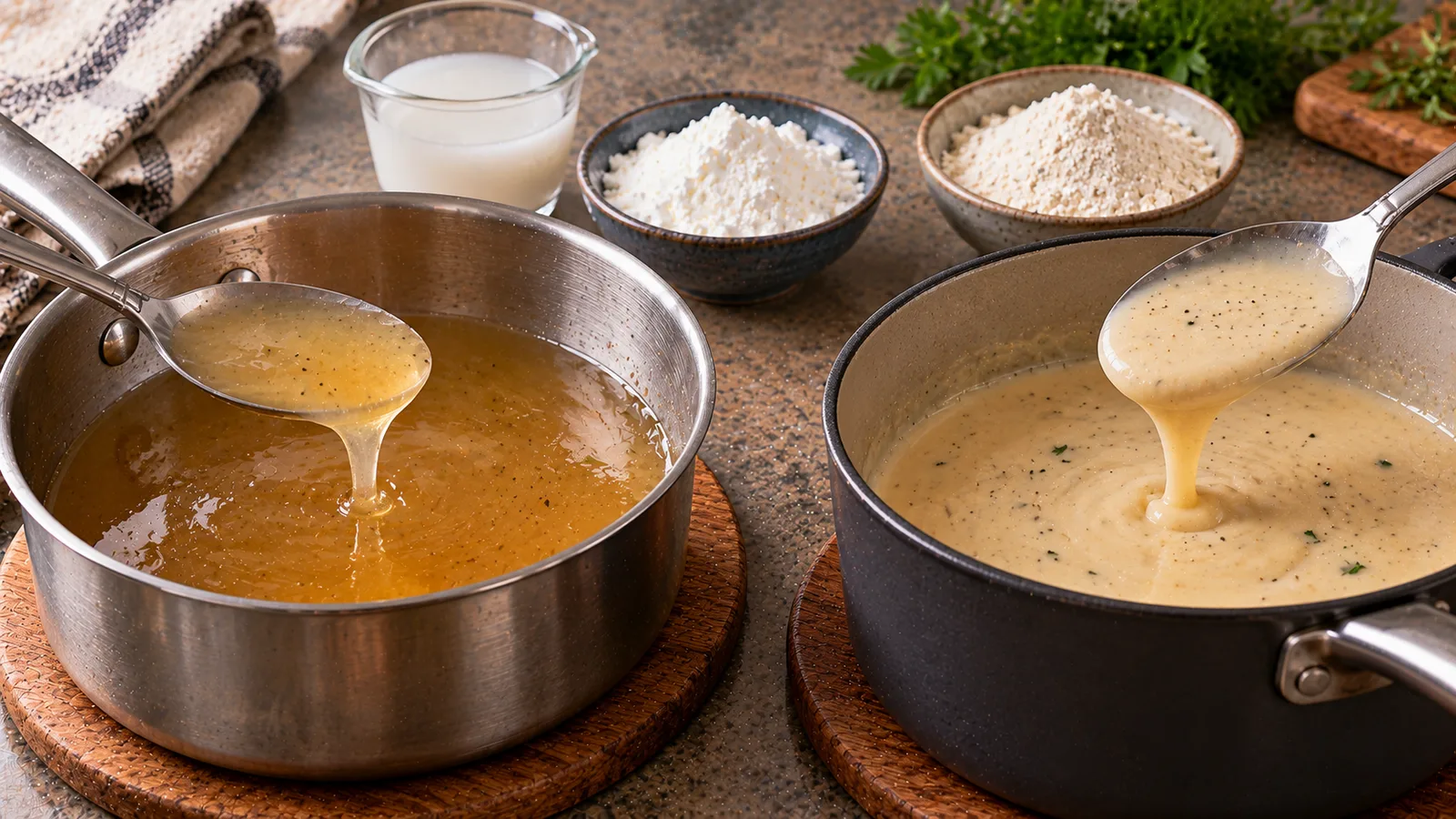
A sauce can look thick with cornstarch or flour, yet the two ingredients behave differently in the pan. Cornstarch tends to give a shinier, more translucent finish. Wheat flour tends to make a sauce opaque and can form the base of a rich roux. The useful comparison is not two equal spoonfuls: it is two sauces thickened to a similar practical consistency, with each dry ingredient weighed before cooking. The simple numbers below help you choose a method without treating a kitchen ratio as laboratory precision.
What changes when you switch thickeners?
| Question | Cornstarch | All-purpose wheat flour |
|---|---|---|
| Starting amount for roughly 240 ml liquid | About 8 g (around 1 tbsp) | About 16 g (around 2 tbsp) |
| Typical finish | Glossy, somewhat translucent | Cloudier, more opaque |
| Easiest incorporation | Cold-water slurry | Flour slurry or cooked roux |
| Heating | Brief simmer after addition | Longer cooking to remove raw-flour flavour |
| Important limitation | Can thin with prolonged boiling | Can taste floury if undercooked |
| Wheat gluten | No wheat ingredient by definition; check the label and cross-contact | Contains wheat gluten |
The 1:2 tablespoon guideline comes from University of Illinois Extension. The listed gram weights are illustrative measured recipe amounts, not a universal conversion for every brand or spoon. Weigh your own tablespoon if nutrition precision matters. Acidic ingredients, starting viscosity and evaporation can change how much is needed.
Why the finished sauce looks different
Both ingredients contain starch granules that absorb water and swell when heated. Pure cornstarch delivers starch with little accompanying protein or fibre, which helps explain its clear-looking finish. Wheat flour also contains protein and other components; the sauce generally appears duller and cloudier. Illinois Extension describes the visual difference in its simple sauces guide. Neither finish is automatically better. A glossy vegetable glaze and an opaque mushroom gravy may need different textures.
Cornstarch can lose thickening power during a long boil or repeated aggressive reheating. Flour-based sauces usually tolerate a longer simmer, although they still need stirring and sufficient liquid. Iowa State University Extension also notes that starch-thickened gravy can behave differently after freezing and thawing; avoid promising identical leftovers from the two methods.
Method A: 8 g cornstarch for a quick sauce
Start with 240 ml stock or water as a simple test base. Dissolve 8 g cornstarch completely in approximately 20–30 ml cold water. Bring the base to a gentle simmer, whisk in the slurry and continue stirring until thickened. Reduce the heat once the texture is right. If it remains thin, make a new small slurry rather than dropping dry powder directly into the hot liquid. If it is too thick, add a little extra liquid.
The cold mixture matters because dry starch added to a hot pan can clump before it disperses. Texas A&M AgriLife's sauce guidance also recommends combining cornstarch with cool water first. A brief simmer is needed; persistent hard boiling is not. Salt, sugar, tomato and other ingredients affect the final feel, so assess the texture only after the sauce is fully hot.
Method B: 16 g flour for a richer, opaque sauce
For a comparable starting test, use 240 ml liquid and 16 g all-purpose flour. For a fat-free version, whisk the flour thoroughly into a little cold liquid before adding it gradually to the warm base; simmer until the raw taste disappears. For a roux, cook the flour briefly in a separately measured amount of butter or oil, then whisk in the liquid in stages. A roux creates a different flavour and mouthfeel, not just a different thickening method.
Do not assume that the flour method requires fat. A flour slurry can thicken without it. Conversely, do not compare a butter-rich roux against a fat-free cornstarch slurry and attribute the entire calorie difference to the choice of starch. The fat is an additional ingredient and must be counted separately.
Calories: measure dry ingredients, not the finished spoonful
For a transparent calculation, take the USDA SR Legacy reference values of 381 kcal per 100 g cornstarch and 364 kcal per 100 g white all-purpose wheat flour. Their respective source entries are cornstarch FDC 169698 and flour FDC 169761. The relevant records can be found in USDA FoodData Central's cornstarch search and wheat flour search.
| Illustrative thickener quantity | Calculation | Energy for whole sauce |
|---|---|---|
| Cornstarch, 8 g | 8 × 381 ÷ 100 | About 30.5 kcal |
| Wheat flour, 16 g | 16 × 364 ÷ 100 | About 58.2 kcal |
| Difference | 58.2 − 30.5 | About 27.8 kcal |
| Difference split into 4 servings | 27.8 ÷ 4 | About 7.0 kcal per serving |
These are thickener-only contributions for an illustrative roughly equally thick sauce, not the calories of the entire finished dish. If you add 10 g oil to a roux, count its energy independently: at an illustrative 884 kcal per 100 g oil, that contributes about 88.4 kcal. Broth, cream, vegetables and meat also count. Boiling off water alters the final weight and calories per 100 g but does not, on its own, remove the ingredient calories from the pot.
For the nutrition of related flours, see the calorie content and serving sizes of flour · how coconut flour differs nutritionally.
How to run your own equal-thickness kitchen comparison
Use two matching pans or two small batches of the same unsalted stock, 240 ml each. Start the first with 8 g cornstarch and the second with 16 g flour. Use a whisk, similar heating and the same final tasting temperature. Record the added water in the slurry and any fat in the roux; for the fairest texture comparison, omit fat in both batches or explicitly make it a separate variable. Compare how each sauce coats the same spoon after a short rest, rather than assuming matching numerical viscosity.
If the flour batch is still runny after its flavour has cooked out, add a little more weighed flour slurry; if the cornstarch batch becomes gummy, add measured stock. Write down the amounts actually used. The next time you cook that same sauce, your observations will be more useful than a fixed two-to-one rule alone.
Where one choice works better
Choose cornstarch for a glossy stir-fry coating, a quick clearish glaze or a sauce added near the end of cooking. Choose flour for a traditional gravy, béchamel-style sauce or a preparation built around a roux and richer toasted flavours. Tomato acidity, dairy, sugar concentration and freezing can change both outcomes. Iowa State's gravy advice cautions against assuming starch gravy freezes like flour gravy.
People avoiding wheat need to check the full sauce, not only the thickener: stock cubes and seasonings can contain wheat. Cornstarch is naturally wheat-free, but packaged products may have cross-contact warnings. If gluten avoidance is medically necessary, use a clearly suitable labelled product and avoid shared utensils. Wheat flour is unsuitable for a gluten-free sauce.
Three mistakes worth avoiding
First, never pour dry cornstarch straight into boiling sauce: mix with cold liquid. Second, do not cook a cornstarch glaze hard for a long time after it reaches the desired body. Third, do not log the same 100 g calorie value for the finished sauce that belongs to the dry powder; the water in the final dish changes its calorie density. Weigh the dry thickener, record oils and dairy separately, and then divide the total recipe calories by the portions actually served.