
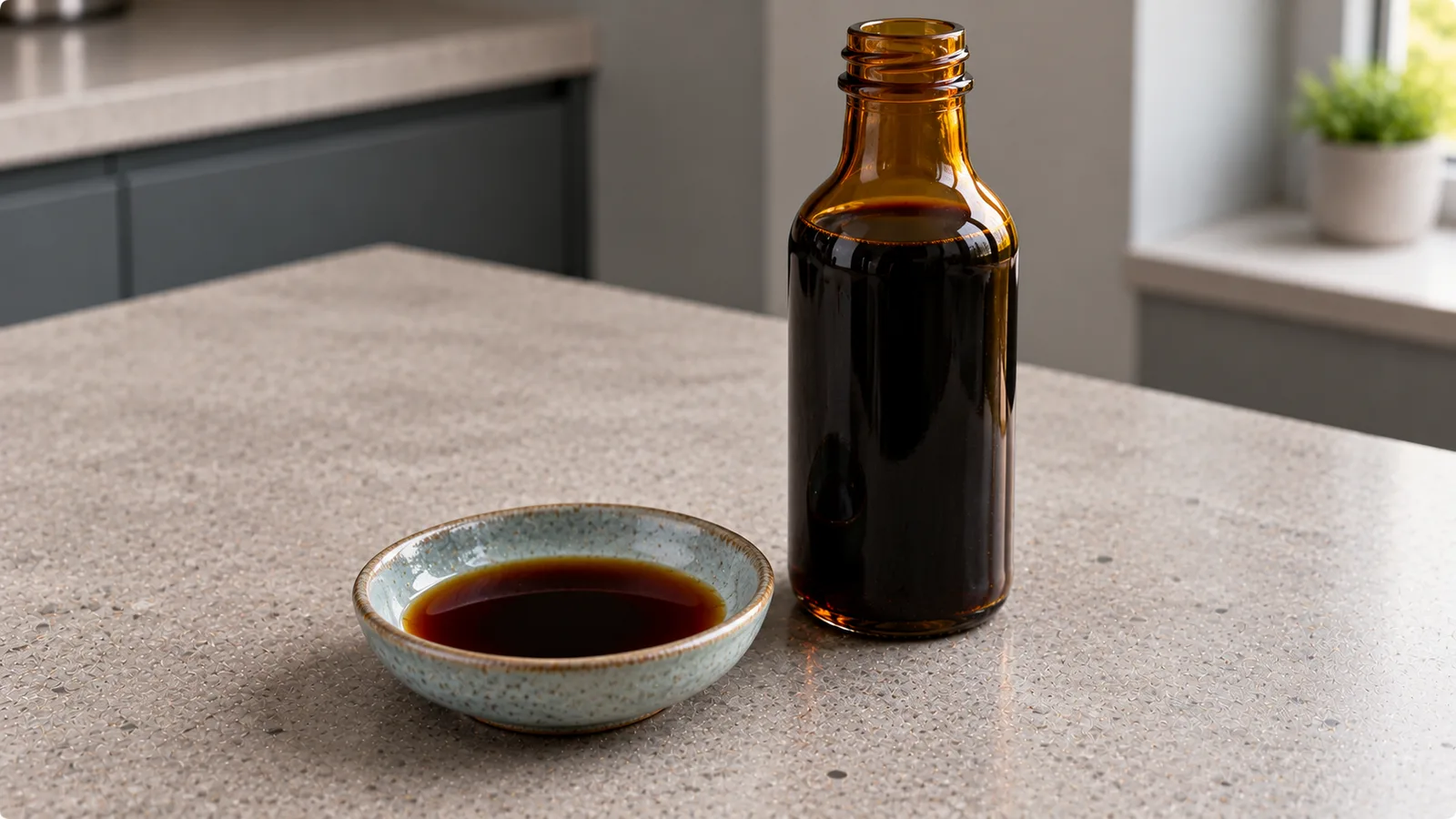
Soy sauce is a fermented or chemically produced seasoning commonly used in Asian cooking, marinades, stir-fries, soups and dipping sauces. It adds a strong savoury flavour, often described as umami, without requiring a large quantity.
Regular soy sauce typically contains around 50–60 calories per 100 g, or approximately 5 calories per teaspoon and 9 calories per tablespoon. Actual values vary by product.
For most people, the sodium content of soy sauce is more nutritionally significant than its calorie content.
How many calories are in soy sauce?
Soy sauce is primarily water, salt and dissolved compounds derived from soybeans and, in many varieties, wheat.
It generally contains little fat and relatively few calories in typical serving sizes.
The following calculations use an illustrative value of 53 kcal per 100 g, close to commonly reported values for conventional soy sauce.
| Serving | Assumed weight | Estimated calories |
|---|---|---|
| 1 teaspoon | 5 g | 3 kcal |
| 2 teaspoons | 10 g | 5 kcal |
| 1 tablespoon | 16 g | 8 kcal |
| 2 tablespoons | 32 g | 17 kcal |
| 3 tablespoons | 48 g | 25 kcal |
| 50 g | 50 g | 27 kcal |
| 100 g | 100 g | 53 kcal |
Values are rounded.
The weight of a spoonful depends on the product and measuring method. A tablespoon of soy sauce is often approximately 15–16 g, but weighing is more accurate.
Calculation: calories = kcal per 100 g × portion weight in grams ÷ 100.
For example, 20 g of soy sauce containing 60 kcal per 100 g provides 12 kcal.
Soy sauce nutrition per 100 g
The following values illustrate the approximate nutritional composition of conventional soy sauce. They are not guaranteed values for a specific brand.
| Nutrient | Approximate amount per 100 g |
|---|---|
| Energy | 53 kcal |
| Protein | 8 g |
| Carbohydrates | 5 g |
| Fat | 0.6 g |
| Sodium | 5,500 mg |
Soy sauce is used in relatively small quantities, so its contribution of protein is modest despite the figure per 100 g.
The sodium content is substantial because salt is a central ingredient.
Values differ between naturally brewed, chemically hydrolysed, sweetened and reduced-sodium products.
For exact nutrition tracking, use the product's label.
How much sodium is in a tablespoon?
Sodium is one of the most important considerations when using soy sauce.
Suppose a product contains 5,500 mg sodium per 100 g.
| Portion | Sodium |
|---|---|
| 5 g | 275 mg |
| 10 g | 550 mg |
| 16 g | 880 mg |
| 32 g | 1,760 mg |
| 50 g | 2,750 mg |
These are calculations for the example product, not universal values.
The World Health Organization recommends that adults consume less than 2,000 mg sodium per day, equivalent to less than 5 g salt.
Under this example, a 16 g tablespoon supplies approximately 44% of that sodium limit.
The amount may be higher or lower depending on the brand.
Sodium vs salt: understanding labels
Some nutrition labels list sodium, while European labels generally list salt.
They are related but not identical measurements.
Salt equivalent in grams ≈ sodium in grams × 2.5.
For example:
- 800 mg sodium = 0.8 g sodium.
- 0.8 × 2.5 = approximately 2 g salt equivalent.
When comparing products from different countries, make sure the labels use the same measurement.
Do not compare 2 g salt directly with 800 mg sodium as though they were the same unit.
Regular vs reduced-sodium soy sauce
Reduced-sodium soy sauce contains less sodium than a reference conventional product, but it is not necessarily low in sodium.
The reduction depends on the brand and formulation.
Consider a hypothetical comparison:
| Product | Sodium per 100 g | Sodium in 16 g |
|---|---|---|
| Regular soy sauce | 5,500 mg | 880 mg |
| Reduced-sodium soy sauce | 3,300 mg | 528 mg |
The reduced-sodium product contains 40% less sodium in this example.
However, 528 mg sodium in one tablespoon is still a meaningful contribution to daily intake.
Reduced-sodium soy sauce is not necessarily lower in calories. Compare calories and sodium separately.
Light soy sauce vs dark soy sauce
In many Chinese cooking traditions, light and dark soy sauces have different culinary roles.
Light soy sauce is generally thinner and used for seasoning and savoury flavour.
Dark soy sauce is often thicker, darker and used to add colour and depth. Some products contain added sugar or caramel colouring.
These names do not guarantee specific nutritional values.
Dark soy sauce may have more carbohydrates or calories if sweeteners are added, but this is not true for every product.
The term light in light soy sauce also does not necessarily mean reduced sodium or reduced calories.
Check the label rather than relying on the name.
Is tamari the same as soy sauce?
Tamari is a Japanese-style seasoning related to soy sauce.
Some tamari products are made without wheat, but others may contain wheat or have cross-contact risks.
Tamari is not automatically gluten-free.
Its calories and sodium content vary by manufacturer.
People who must avoid gluten should choose products explicitly labelled gluten-free and appropriate for their dietary needs.
Soybeans are also a recognized allergen, and many conventional soy sauces contain wheat.
Sweet soy sauce: why calories can be higher
Sweet soy sauce, including products sold as kecap manis, often contains substantial added sugar.
It may therefore be much more calorie-dense than ordinary salty soy sauce.
For illustration:
| Sauce | Assumed kcal per 100 g | Calories in 20 g |
|---|---|---|
| Regular soy sauce | 53 | 11 |
| Sweet soy sauce | 200 | 40 |
These are hypothetical comparison values.
Sweet soy sauce products differ widely, so use the actual label.
Do not substitute the nutritional entry for regular soy sauce when tracking sweet soy sauce.
How many calories does soy sauce add to a stir-fry?
Suppose a stir-fry recipe contains:
- 400 g vegetables.
- 300 g chicken or tofu.
- 20 g cooking oil.
- 30 g regular soy sauce.
At 53 kcal per 100 g, the soy sauce contributes approximately 16 kcal to the entire recipe.
If the recipe makes three equal servings, the soy sauce contributes approximately 5 kcal per serving.
The cooking oil contributes substantially more calories than the soy sauce, but the soy sauce may contribute a significant amount of sodium.
To calculate the whole dish, include every ingredient and divide by the amount eaten.
Soy sauce in marinades: what should you count?
A marinade may contain soy sauce, oil, sugar, garlic and other ingredients.
Not all of the marinade necessarily ends up in the finished food.
For a precise calculation, the amount actually retained would need to be known.
If you record the entire marinade as consumed, the estimate may be higher than actual intake when much of it is discarded.
If you omit it completely, you may underestimate the nutrients and sodium absorbed or retained.
For routine tracking, use a consistent, transparent estimate and avoid claiming exact precision when the retained quantity is unknown.
Is soy sauce good for weight management?
Soy sauce is relatively low in calories when used in small amounts, making it a practical way to add flavour.
However, low calorie content does not mean unrestricted use is advisable.
Sodium intake and the overall nutritional pattern matter.
Reduced-sodium products, smaller portions and other seasonings can help manage sodium intake.
Herbs, citrus juice, vinegar, garlic and spices can also contribute flavour without relying entirely on salty sauces.
How to reduce sodium without losing flavour
Several practical approaches can help:
- Measure soy sauce rather than pouring directly from the bottle.
- Use less soy sauce and add water, vinegar or citrus juice where appropriate.
- Compare sodium per 100 g between brands.
- Consider a reduced-sodium version if suitable.
- Use garlic, ginger, chili and other seasonings for additional flavour.
- Taste the finished dish before adding more salt.
Diluting soy sauce with water reduces sodium concentration per spoonful, but it does not remove sodium from the original amount used.
How to track soy sauce accurately
For the most reliable estimate:
- Weigh the quantity used in grams.
- Identify the exact product and variety.
- Check its calories and sodium per 100 g.
- Calculate the values for the measured weight.
- Divide the amount between servings when used in a shared recipe.
If a sauce contains soy sauce plus oil, honey or sugar, record those ingredients separately.
Avoid counting the same soy sauce both as part of a saved recipe and as an additional condiment.
Frequently asked questions
How many calories are in one tablespoon of soy sauce?
Using 16 g and 53 kcal per 100 g, approximately 8–9 calories.
How many calories are in two tablespoons?
At 32 g and 53 kcal per 100 g, approximately 17 calories.
Is soy sauce high in calories?
Regular soy sauce is relatively low in calories per typical serving. Sodium is generally the more important consideration.
Does reduced-sodium soy sauce have fewer calories?
Not necessarily. Sodium and calorie content are separate nutritional characteristics.
Is dark soy sauce more caloric?
Some dark soy sauces contain added sugar, but the actual difference depends on the product.
Is soy sauce gluten-free?
Many conventional soy sauces contain wheat. Some gluten-free soy sauces and tamari products are available, but labels must be checked.
Sources and references
- USDA FoodData Central — reference nutrition data for soy sauce.
- World Health Organization: Sodium reduction — sodium and salt intake recommendations.
- Regulation (EU) No 1169/2011 — European nutrition and allergen labelling.
The serving calculations use illustrative reference values. For individual tracking, use the nutrition information of the actual product.