
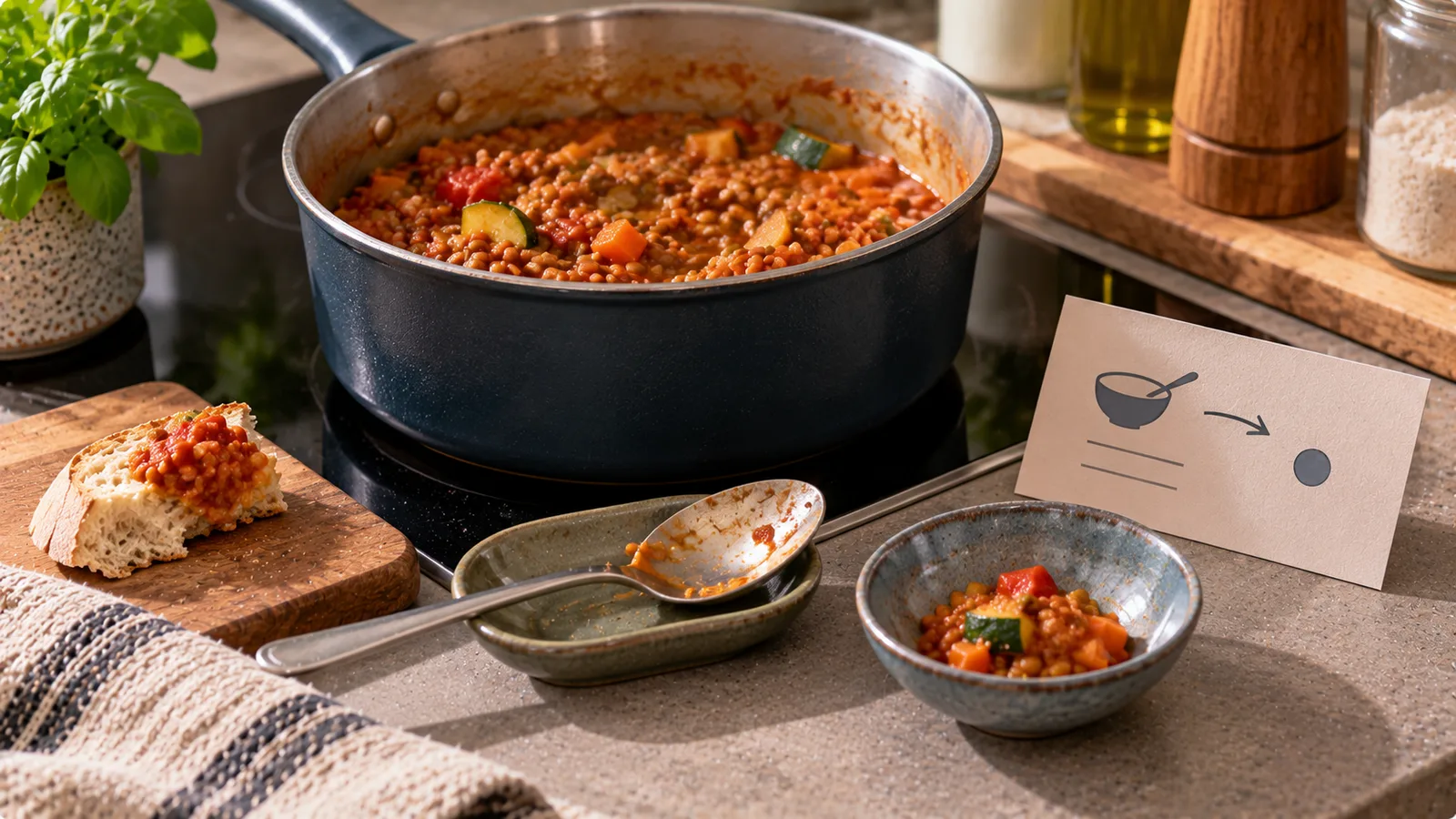
Tasting food while cooking is normal.
A spoonful of sauce, a piece of roasted potato, a bite of cheese or a small sample of a finished dish can contribute some energy, but trying to measure every tiny taste with laboratory precision is rarely realistic.
For food logging, the useful goal is not to reconstruct every gram perfectly. It is to avoid systematically forgetting meaningful amounts while keeping the estimate proportional to what actually happened.
When a taste is probably too small to matter much
A single tiny taste of a low-energy food usually has little effect on a day's total.
Examples might include:
- one small piece of raw vegetable;
- a teaspoon of broth;
- a tiny taste of tomato sauce;
- a few leaves of salad;
- a small sample used only to check seasoning.
If the amount is genuinely negligible and tasting is occasional, recording every individual sample may add more complexity than useful information.
The situation changes when tastes become repeated, larger or calorie-dense.
Repeated bites can become a real portion
One bite may be small.
Ten bites may not be.
Imagine that you taste a pasta dish several times while cooking and serving:
- one forkful while checking texture;
- another after adding sauce;
- a bite while plating;
- two bites from leftovers in the pan.
Individually, each action can feel insignificant.
Together, they may represent a noticeable amount of food.
Instead of trying to create five separate diary entries, it is usually more practical to estimate the combined amount and record it once.
Use one combined entry
A simple rule is:
Combine similar tastes from the same cooking session into one estimated entry.
For example, if you think all your tastes together were roughly equivalent to 40 g of the finished pasta dish, log approximately 40 g once.
If your saved recipe is divided into portions rather than grams, you could estimate the fraction of a serving.
If one normal serving is around 400 g, then 40 g is approximately:
40 ÷ 400 = 0.10 serving
The estimate does not need to imply that exactly 40.0 g was eaten.
It is simply a reasonable representation of the amount.
Use the food itself when possible
If you taste the same dish you are preparing, use that dish or saved recipe as the diary entry.
For example:
- tasting chili → log a small amount of the chili;
- tasting pasta sauce → log the sauce;
- eating a piece of roasted chicken → log chicken;
- tasting a finished casserole → log part of the casserole.
This is generally more useful than creating a generic entry called “cooking tastes,” because the nutritional composition depends on what was actually eaten.
Pay more attention to calorie-dense foods
The size of a taste is not the only factor.
A small amount of oil, nut butter, cheese or frosting can contain considerably more energy than the same weight of cucumber or broth.
Foods worth paying more attention to include:
- cooking oils;
- butter;
- cheese;
- nuts and nut butters;
- chocolate;
- pastry fillings;
- frosting;
- creamy sauces;
- mayonnaise;
- high-fat dips.
You still do not need perfect precision.
The point is that repeatedly tasting these foods is more likely to make a meaningful difference.
Example: tasting cheese while cooking
Suppose you grate cheese for a recipe and eat several pieces while preparing it.
You estimate that the total was around 20 g.
If the cheese contains 360 kcal per 100 g:
360 ÷ 100 × 20 = 72 kcal
Logging approximately 20 g of that cheese is more useful than ignoring it because each individual piece seemed small.
Example: tasting a creamy sauce
Suppose a finished sauce contains 180 kcal per 100 g.
During cooking, you take several spoonfuls that you estimate total around 30 g.
Estimated energy:
180 ÷ 100 × 30 = 54 kcal
You could log 30 g of the sauce once.
There is little benefit in trying to remember whether the individual samples were 6 g, 9 g and 15 g.
Example: vegetables
Now suppose you eat several carrot slices while chopping vegetables.
The total might be around 25 g.
Even if your estimate is somewhat wrong, the difference in daily energy intake is likely to be small.
You can record the amount if you want a complete diary, but this is a situation where extreme precision provides little additional value.
Distinguish tasting from eating a snack while cooking
Sometimes “tasting” gradually becomes eating.
For example:
- several pieces of cheese;
- a handful of nuts;
- multiple spoonfuls of a finished meal;
- repeated bites of bread;
- several pieces of cooked meat.
If the combined amount resembles a snack or a meaningful fraction of a serving, treat it that way.
Calling it a taste does not change the amount consumed.
A practical three-level system
You can use a simple decision system.
Level 1: tiny and occasional
Example:
One small taste of broth to check salt.
Usually no special action is needed unless you prefer comprehensive logging.
Level 2: repeated but still small
Example:
Several spoonfuls of sauce during a 30-minute cooking session.
Estimate the combined amount and create one entry.
Level 3: substantial or calorie-dense
Example:
Cheese, nuts, pastry filling or repeated bites that together resemble a small snack.
Make a more deliberate estimate and log the food.
This keeps attention proportional to the likely nutritional impact.
Estimating without a scale
If you did not weigh the tastes, use the best reasonable information available.
You might estimate using:
- teaspoons;
- tablespoons;
- pieces;
- a fraction of a normal serving;
- comparison with the remaining food;
- an approximate gram amount based on a familiar portion.
The result is an estimate.
It should be recorded as an estimate rather than treated as exact data.
Teaspoons and tablespoons
Volume can be useful for sauces and liquids.
As a rough kitchen reference:
- 1 teaspoon = about 5 ml;
- 1 tablespoon = about 15 ml.
The weight in grams depends on the food.
A tablespoon of oil, yogurt and thick tomato sauce will not necessarily weigh exactly the same.
If the product label provides nutrition per tablespoon or per milliliter, use that information.
Estimating a fraction of a serving
Suppose a saved recipe contains four servings.
During cooking you estimate that your tastes together represented roughly one eighth of a normal serving.
You can log:
0.125 serving
If the app does not make such small fractions convenient, use a reasonable nearby value rather than creating false precision.
For example, 0.1 serving may be sufficiently representative for an uncertain estimate.
Avoid automatically rounding everything upward
Uncertainty does not mean you need to choose the highest plausible number every time.
If you think you ate somewhere between 20 and 30 g, using approximately 25 g is usually a more neutral estimate than automatically recording 30 or 40 g.
Consistently exaggerating uncertain entries can distort the diary just as consistently ignoring them can.
Use a reasonable central estimate unless you have better information.
Avoid automatically rounding everything downward
The opposite pattern also causes problems.
If repeated bites probably amounted to 50–70 g, recording 10 g because “it was only tasting” systematically understates intake.
The goal is a useful approximation, not the smallest defensible number.
What if you cannot remember the amount?
Sometimes you notice after cooking that you tasted the meal several times but have no clear idea how much.
Do not invent detailed measurements.
Use a broad estimate based on what you remember.
For example:
- “probably one or two tablespoons”;
- “roughly a quarter of a small serving”;
- “about three bites”;
- “somewhere around 30–50 g.”
You can then choose a representative value from that range.
If the amount was clearly trivial, it may not justify an entry.
Cooking oil is a different issue
Oil used in the recipe should normally be included as an ingredient in the recipe itself.
That is different from tasting food while cooking.
For example, if you use 15 g of oil to fry vegetables, those 15 g belong in the recipe calculation.
You should not add the oil again simply because you tasted the vegetables.
If a meaningful amount of oil remains in the pan, actual intake may differ from the amount added, but repeatedly trying to estimate microscopic residues can introduce more uncertainty than accuracy.
Use a consistent method.
What about licking a spoon or spatula?
The same principle applies.
A tiny residue from a low-calorie mixture is usually minor.
A spoon covered with peanut butter, frosting, melted chocolate or another calorie-dense food may be more relevant.
If this happens repeatedly, estimate the combined amount rather than entering every spoon separately.
Baking can be easy to underestimate
Baking often involves calorie-dense ingredients and several opportunities to sample:
- cookie dough;
- cake batter;
- chocolate;
- frosting;
- nuts;
- cream fillings.
Several small tastes can add up.
For example, if you eat approximately 30 g of cookie dough and the dough contains around 430 kcal per 100 g:
430 ÷ 100 × 30 = 129 kcal
That is large enough to be relevant in many food diaries.
One combined estimated entry is sufficient.
Restaurant or professional cooking
If your work involves tasting food repeatedly throughout the day, the situation is different from tasting one dinner at home.
Dozens of small samples can become difficult to reconstruct afterward.
A practical approach may be to use a consistent estimation method for a typical workday, based on the types and approximate quantities of foods usually tasted.
If intake varies substantially from day to day, adjust the estimate rather than assuming every day is identical.
The goal remains useful tracking, not pretending uncertain samples were precisely measured.
Do you need to log zero-calorie tastes?
Water, unsweetened tea and other genuinely negligible-energy items generally do not need calorie entries.
However, “zero calorie” on a label can sometimes involve rounding rules and serving definitions.
For ordinary food logging, the practical significance of a tiny labeled-zero serving is usually minimal.
Tasting while following a recipe
If you regularly taste a predictable amount while preparing the same recipe, you can account for it consistently.
For example, suppose a soup recipe makes 2,000 g and you usually consume about 40 g while seasoning and checking texture.
You can:
- treat the 40 g as part of your own intake;
- log approximately 40 g;
- portion the remaining soup normally.
If the full cooked batch contains 1,600 kcal:
1,600 ÷ 2,000 = 0.8 kcal per gram
A 40 g tasting amount would be approximately:
40 × 0.8 = 32 kcal
The exact value matters less than using the same logic consistently.
Be careful when the tasting changes the final yield
If you weigh a recipe only after you have already eaten several tastes, the measured final batch no longer includes the food you consumed.
Suppose the recipe originally produced approximately 2,000 g.
You eat about 50 g while cooking and then weigh 1,950 g remaining.
If you assign all of the recipe's calories only to the 1,950 g remaining and separately log the 50 g without adjusting the calculation, you can accidentally double-count or distort the calorie density.
A simpler approach is to decide on one consistent method.
Either account for the tasting as part of the original finished batch before portioning, or make a reasonable estimate of the tasting and ensure the saved yield reflects the remaining food appropriately.
If exact tracking is important, pre-weighing can help
You do not need to weigh every taste individually.
For a dish you know you will sample repeatedly, you can weigh the serving spoon or a small tasting bowl before cooking and place all samples into it.
Then weigh the total sample once.
This can be useful for recipe testing or situations where accurate recipe data matters.
For everyday home cooking, it is usually unnecessary.
Do not let tiny uncertainties dominate the diary
Food tracking already contains uncertainty from:
- natural variation between foods;
- package rounding;
- restaurant portions;
- cooking water changes;
- household measuring errors;
- database differences.
Trying to eliminate every uncertainty from a tiny taste can create an illusion of precision.
A diary can still be useful when some entries are approximate.
Consistency is usually more useful than perfection
If you frequently taste while cooking, choose a method you can repeat.
For example:
- ignore genuinely tiny seasoning checks;
- combine repeated samples into one entry;
- pay closer attention to calorie-dense foods;
- estimate substantial bites as a fraction of the dish;
- avoid inventing exact numbers when the amount is unknown.
This gives the diary a more realistic representation of intake without turning normal cooking into a measurement exercise.
When tastes repeatedly affect your totals
If you often finish the day wondering why logged intake seems lower than expected, repeated unrecorded eating while cooking may be one factor worth checking.
Other factors can include drinks, cooking fats, condiments, portion estimates and incomplete entries.
Rather than assuming tastes are the problem, observe your normal cooking routine for several days.
If the amounts are meaningful, include them.
If they are consistently tiny, they may not explain much.
A practical default rule
For everyday tracking, a reasonable default is:
- do not worry about one genuinely tiny taste;
- combine several tastes from the same food into one estimate;
- log meaningful portions and calorie-dense samples;
- use the actual recipe or ingredient whenever possible;
- accept that the result is approximate.
Food logging is most useful when it represents eating behavior realistically. A sensible estimate of repeated tastes is usually better than either ignoring everything or trying to assign false precision to every bite.