
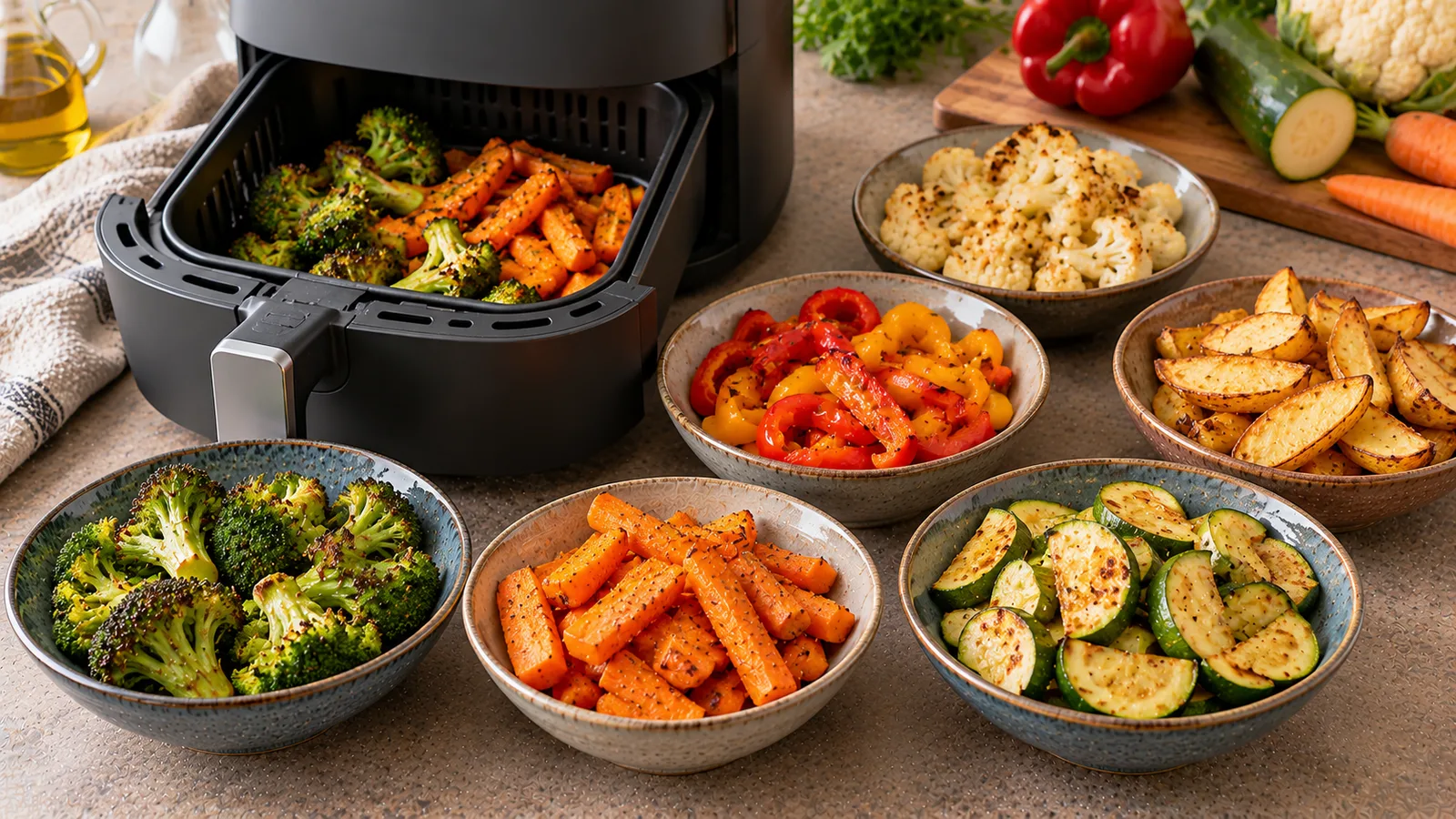
Why the cut matters more than a single timer setting
A basket of air-fried vegetables can be brown at the edges but still firm in the middle. The missing detail in most quick charts is piece thickness. A thin carrot slice and a thick carrot baton are not interchangeable, even at the same temperature. Moisture, the amount of food, the air-fryer model and whether the basket was preheated also change the result. Use the numbers below to decide when to check, not as a promise that every piece will be cooked after exactly that many minutes.
This is a chart of vegetable sides, not a guide to cooking a complete dinner with chicken or fish. Do not use a vegetable's colour to decide whether raw meat in the same basket is safe. For a complete air-fryer meal, plan the protein separately and apply its appropriate food-safety checks.
Six vegetables: model-specific starting times
The following settings reproduce selected fresh-vegetable entries in a Salter Dual Air recipe booklet. They belong to the specified cuts, quantities and 200 °C settings; the table is not the result of independent Mealisa testing. Your appliance's manual takes priority. Haier's published guidance, for example, uses lower temperatures and shorter times for some differently sliced vegetables, illustrating why numbers cannot be copied between shapes or machines.
| Vegetable | Cut and example batch | Setting in source | Starting time |
|---|---|---|---|
| Broccoli | 2.5 cm florets; 400 g | 200 °C | 9 min |
| Cauliflower | 2.5 cm florets; 900 g | 200 °C | 15–20 min |
| Carrots | 1.5 cm pieces; 500 g | 200 °C | 13–16 min |
| Courgette / zucchini | 2.5 cm pieces; 500 g | 200 °C | 15–18 min |
| Green beans | Trimmed, whole; 200 g | 200 °C | 8 min |
| Bell pepper | Whole; 2 peppers | 200 °C | 16 min |
The Salter examples include oil for most vegetables: 1 tablespoon for broccoli, carrots, courgette and green beans, 2 tablespoons for cauliflower and none for whole peppers. Those are the manufacturer's amounts for the example batches, not recommended amounts that every home cook must use. If you cook less food, use your normal measured amount of oil, check earlier and avoid equating a spray with a weighed tablespoon.
Step 1: measure the thickest part, not the longest side
For broccoli and cauliflower, measure across a typical floret including its stem. A 2.5 cm floret differs from one with a dense 4 cm core. For carrots, the 1.5 cm pieces in the source chart are not the same as long sticks with a 1.5 cm width or paper-thin rounds. For courgettes, choose roughly even pieces rather than mixing thin slices and large quarters. Whole peppers have a larger thermal mass than pepper strips; do not apply the 16 min whole-pepper row to chopped peppers.
A useful home method is to sort the prepared pieces into similar thicknesses. Put the largest pieces in a separate batch if possible. This removes one source of uncertainty without pretending you can calculate an exact extra minute for every extra centimetre.
Step 2: prepare a batch the fan can circulate around
Wash the vegetables, drain them and pat their surfaces dry where practical. Moisture left on the surface has to evaporate before browning develops. Toss cut vegetables lightly with oil if using it; seasonings that scorch quickly can go on towards the end. Leave room for hot air around the pieces, especially in a small basket. If the base is completely buried under several layers, a manufacturer's single-batch chart may not apply.
Preheat if your specific model recommends it, then start the cooking time when the vegetables actually enter the basket. Record what you did on the first attempt: ingredient, cut, weight, temperature, oil and time. A repeatable record is more valuable than a generic online chart when cooking with the same appliance every week.
What doneness looks like for each vegetable
Broccoli: florets may colour before thick stems soften. Pierce the largest stem with a fork, then decide whether to continue in short intervals. If the buds become bitter or dark too soon, use a lower setting or smaller florets next time instead of leaving the food untouched.
Cauliflower: the 2.5 cm floret reference is a bigger example batch than the broccoli row. Test the core of a large floret, not only the browned surface. Separate very small pieces that darken early from oversized ones that remain hard.
Carrots: a caramelised edge does not prove a thick carrot piece is tender. Cut a test piece in half or pierce it; a crisp-tender result is different from a soft roasted carrot. Use the preferred texture, not a single mandatory internal temperature, for this plain vegetable side.
Courgette: because courgette carries plenty of water, pieces can soften and release moisture before taking on colour. Dry the surface and leave air gaps. If the middle is already soft, cooking longer merely to darken the skin may make the pieces soggy.
Green beans: the source uses 200 g of trimmed whole beans and an 8 min setting. Start checking for tenderness around the reference point, but do not assume a much larger mound or frozen beans will behave the same way. A bean should be easy to bite while retaining the firmness you prefer.
Peppers: the 16 min row is for two whole peppers. Cut strips expose much more surface area and need their own check. The separate Haier vegetable guide lists roasted peppers at 190 °C for 8–10 min, but it does not define an equivalent strip thickness; treat that as another model's orientation, not as an exact replacement formula.
Halfway check: when and how to adjust
Set a reminder to inspect and turn or shake the food around the midpoint when the basket design allows it. A quick visual check is especially useful for dry, light vegetables that brown rapidly. If pieces are nearly ready, check again soon instead of adding a large arbitrary time block. If they remain hard, continue in small increments. Move a larger piece from the middle of the basket to the edge, or split batches, rather than assuming the air fryer is defective.
When comparing two cuts, change only one variable at a time. Keep the same vegetable variety, weight, temperature and oil, then compare thickness. Otherwise you cannot tell whether the thicker pieces, larger batch or different machine caused the difference. These are practical kitchen controls, not laboratory-validated formulas.
Small pieces, large pieces and frozen vegetables
Thinner pieces typically have more exposed surface relative to their volume and can lose water or brown sooner. Thick pieces may need longer for the middle to soften. Neither outcome has a universal fixed number of extra minutes. If carrots are cut into thin coins rather than the booklet's thicker pieces, use the original time only as an upper reference for an early check, not an instruction to cook the coins for the same duration.
Frozen vegetables can release surface moisture and may be blanched before freezing. Do not pretend a fresh-vegetable chart gives precise frozen times. Follow the package or appliance instructions, keep the loading quantity manageable and evaluate the thickest pieces. Cook frozen vegetables according to their specific preparation guidance; don't thaw or re-freeze automatically just to match a fresh-vegetable table.
Calories, oil and portion size
Air frying is a cooking method, not a fixed calorie value. The energy of the finished portion depends on which vegetables were used and on actual oil, sauces and toppings. For illustration, 5 g of oil contributes about 45 kcal to a batch before accounting for any oil left in the mixing bowl or tray. Dividing a finished batch into two portions does not mean each contains precisely half the oil unless it was distributed evenly. Measure ingredients for a meaningful nutrition estimate, and distinguish raw input weight from the lower or higher cooked weight after water loss.
In a meal planner, keep vegetables and cooking oil as separate ingredients. Do not assign one generic “air-fried vegetables” macro profile to broccoli, carrots and beans. This article deliberately provides timing rather than unsupported nutrient values for six different cooked vegetables.
Troubleshooting without changing everything at once
Brown outside, hard middle? Cut more evenly or lower the heat slightly and check the thickest piece. Soft but pale? Reduce basket crowding and excess surface moisture; a slightly hotter finish may help in models that allow it. Some pieces burnt and others raw? Mixed cut sizes and stacked layers are likely culprits. Food sticking? Check whether the basket coating and oil use follow the appliance manual. Seasoning blackened? Add delicate garlic or herbs later.
For meal prep, roast vegetables in batches of comparable density. Combine them after cooking rather than forcing thin courgette pieces and thick carrot chunks to finish together. Store cooked vegetables promptly according to your normal food-safety practices; this chart is not a validation of long hot holding or reheating temperatures.
For related applications, see planning meals with an air fryer · chickpea texture in air fryer versus oven · complete air-fryer dinners for one.
Sources
- Salter Dual Air recipe booklet and cooking chart — cut sizes, batch amounts, 200 °C starting settings for all six rows.
- Haier Air Fryer Cooking Times: A General Guide — model differences and other example temperatures and times.
- Philips roasted winter vegetables recipe — additional manufacturer example of approximately 2 cm cuts, 200 °C and halfway stirring.