
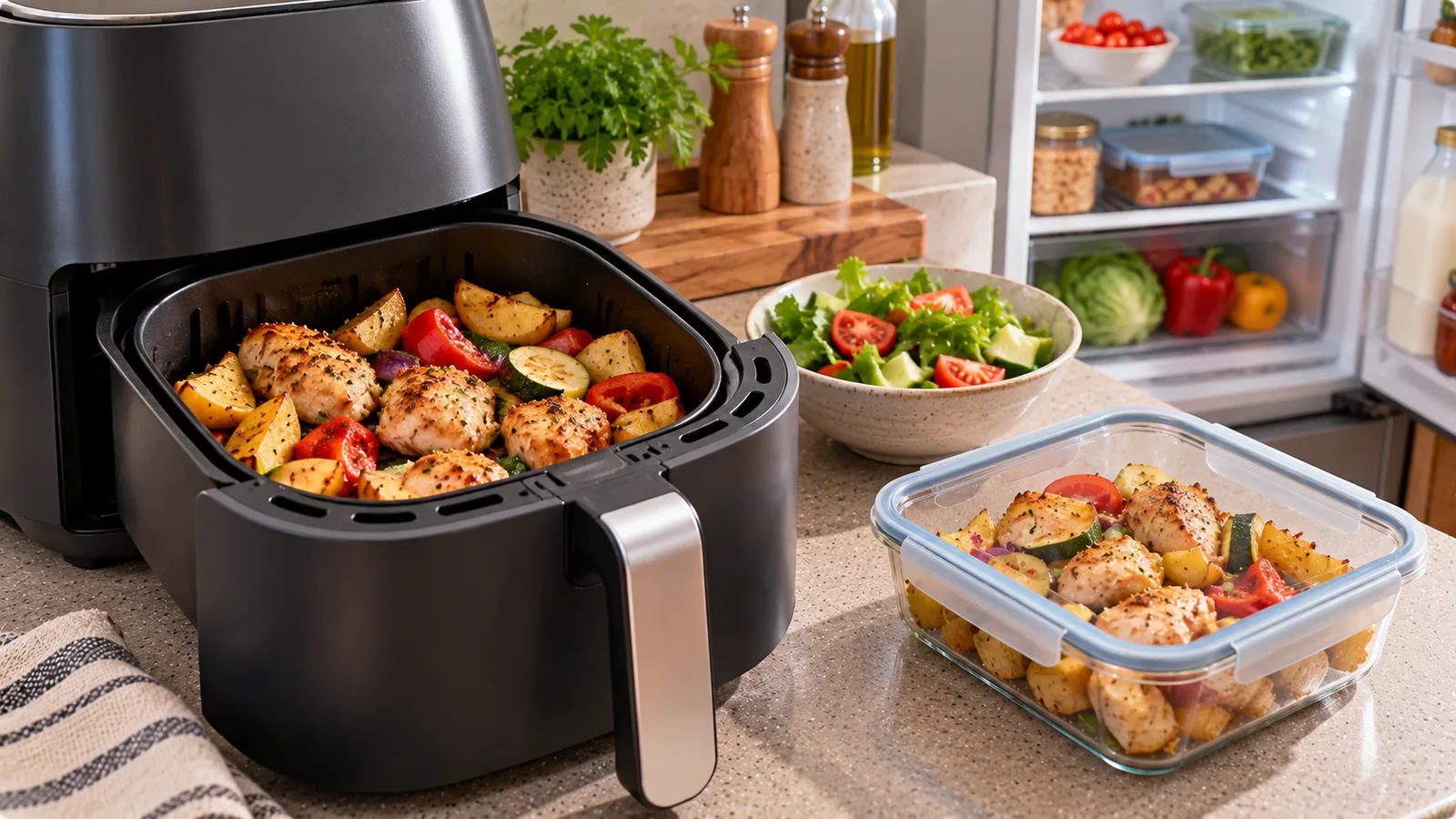
You do not need a full kitchen to plan several days of satisfying meals. An air fryer and a refrigerator can cover many everyday cooking needs, provided you choose ingredients that work with the equipment and organize storage carefully.
The key is to plan around what an air fryer actually does well: roasting small portions of vegetables, cooking proteins, crisping potatoes and reheating suitable leftovers. It is less useful for boiling rice, making soup or preparing large quantities of wet food.
This guide provides a practical five-day meal plan for one adult, a consolidated shopping list and a workflow that avoids relying on a stove, oven or microwave.
Start with the equipment you actually have
The plan assumes:
- One countertop air fryer with a basket or tray.
- A refrigerator that maintains a temperature of 4°C or below.
- A knife, cutting board, mixing bowl and basic utensils.
- Food-safe containers for refrigerated ingredients.
- Access to a sink for washing produce and equipment.
A food thermometer is strongly recommended for checking poultry and other foods that require a verified internal temperature.
An air fryer is a compact convection cooker, not a substitute for every kitchen appliance. Its capacity, temperature settings and cooking performance vary considerably between models.
Check the manufacturer's instructions before using baking dishes, foil, parchment or other accessories. Never obstruct the airflow or place loose paper in an empty running basket.
Build meals from four practical components
Instead of planning five unrelated recipes, choose a small group of ingredients that can be combined in different ways.
| Component | Air-fryer-friendly options | Ready-to-eat alternatives |
|---|---|---|
| Protein | Chicken breast, salmon, tofu, chickpeas | Canned beans, canned fish, hummus, yogurt |
| Vegetables | Broccoli, peppers, courgette, carrots | Tomatoes, cucumber, salad leaves |
| Starchy food | Potatoes, sweet potatoes | Wholegrain bread, wraps, ready-to-eat grains |
| Sauce or topping | Warmed seasonings or roasted garlic | Yogurt sauce, tahini, olive oil, lemon |
The ready-to-eat options matter. They reduce pressure on the air fryer and allow you to assemble some meals without cooking at all.
Choose commercially prepared grains that are explicitly labeled ready to eat without further heating. Products requiring cooking should not be treated as ready-to-eat simply because they are packaged.
A five-day air fryer meal plan
This is an example for one adult, not a personalized calorie prescription. Adjust portions to your appetite, activity, medical needs and other meals or snacks.
| Day | Main meal | Second meal |
|---|---|---|
| Monday | Paprika chicken, air-fried potatoes and broccoli | Hummus wrap with cucumber, tomatoes and salad |
| Tuesday | Salmon with roasted courgette and potatoes | Chickpea and vegetable salad with wholegrain bread |
| Wednesday | Crispy tofu, peppers and ready-to-eat grains | Greek-style yogurt bowl with fruit and nuts |
| Thursday | Chicken and vegetable wrap with yogurt sauce | Roasted sweet potato with canned beans and salad |
| Friday | Spiced chickpea and vegetable tray-style meal | Tuna, tomato and cucumber sandwich |
Breakfast can remain simple: yogurt with oats and fruit, wholegrain toast with nut butter, or another ready-to-eat option. None requires additional cooking equipment.
The plan intentionally alternates cooked and assembled meals. Running the air fryer for every single meal would make the routine slower and less convenient.
Shopping list for one person
These are approximate quantities for the five-day example. Package sizes, appetites and leftover amounts will vary.
Protein and dairy
- Chicken breast: approximately 350–450 g.
- Salmon fillet: approximately 150–200 g.
- Firm tofu: approximately 180–250 g.
- Canned chickpeas: two small cans, drained.
- Canned beans: one can.
- Canned tuna: one can.
- Plain yogurt or Greek-style yogurt: 500 g.
- Hummus: 150–200 g.
Vegetables and fruit
- Potatoes: 600–800 g.
- One medium sweet potato.
- Broccoli: one small head.
- Two peppers.
- One courgette.
- One cucumber.
- Four to six tomatoes.
- One bag of salad leaves.
- Lemons, fruit and optional fresh herbs.
Bread, grains and pantry items
- Wholegrain wraps: one small pack.
- Wholegrain bread: one small loaf.
- Ready-to-eat grain pouch: one or two, depending on portion size.
- Rolled oats.
- Nuts or nut butter.
- Olive oil, paprika, pepper and dried herbs.
Buying everything at once is convenient, but it does not mean every fresh ingredient should sit in the fridge until Friday. Freeze appropriate items immediately if a freezer is available, or make a small second shopping trip for highly perishable foods.
If you have only a refrigerator and no freezer, purchase fish and raw poultry close to the day you intend to cook them, following their use-by dates.
How to organize the cooking
Monday: prepare only what you can store safely
Wash and cut vegetables for the first couple of days. Keep washed salad ingredients dry and refrigerated.
Cook the chicken intended for Monday and any additional portion you will use soon.
Air-fry potato pieces in a lightly oiled single layer, shaking or turning them according to the appliance instructions.
For chicken, check that the thickest part reaches at least 74°C (165°F). Appearance and cooking time alone are not reliable measures of doneness.
Cool leftovers promptly in shallow containers and refrigerate within two hours. Do not leave cooked food on the counter while completing the rest of the week's preparation.
Tuesday: cook fish fresh
Fish is a good candidate for a quick air-fryer meal, but its cooking time depends on thickness and the appliance.
Cook fish to a safe internal temperature of 63°C (145°F), or follow applicable local food-safety guidance.
Pair it with courgette and potatoes, cooking in batches if necessary to avoid overcrowding.
Assemble the chickpea salad separately. Drain and rinse canned chickpeas, then add cucumber, tomatoes, lemon and olive oil.
Wednesday: use tofu and ready-to-eat grains
Pat firm tofu dry, cut it into cubes and season lightly.
Air-fry until the exterior is browned and the center is heated through. Exact cooking time depends on cube size and the appliance.
Cook peppers in a separate batch if your basket is small.
Serve with a ready-to-eat grain product prepared according to its label. If it requires heating, check whether its packaging permits an air-fryer-compatible method or choose bread instead.
Thursday: assemble a wrap and roast a sweet potato
For the chicken wrap, use a portion cooked and refrigerated safely within its recommended storage period, or cook a fresh portion.
Combine chicken, salad leaves, cucumber and a quick sauce made from yogurt, lemon and herbs.
For the second meal, air-fry a sweet potato until tender and serve with drained canned beans and fresh vegetables.
Do not assume a potato will cook evenly merely because the outside looks browned. Test the center with a fork.
Friday: finish with flexible ingredients
Air-fry drained chickpeas with peppers, courgette and seasonings, working in batches to maintain airflow.
For the other meal, assemble a tuna sandwich with tomatoes and cucumber.
This final day uses mostly pantry and refrigerated ingredients rather than depending on raw meat purchased at the start of the week.
Batch cooking without overloading the air fryer
Small air fryers are often more efficient when you cook one component at a time.
A practical sequence is:
- Prepare and season all ingredients before switching on the appliance.
- Cook foods that need the highest food-safety attention, checking internal temperatures.
- Clean utensils and surfaces that contacted raw meat before handling ready-to-eat foods.
- Cook vegetables or potatoes in separate batches.
- Assemble sauces and cold sides while the appliance runs.
- Refrigerate any leftovers promptly.
Do not stack food so densely that air cannot circulate. A crowded basket can create uneven cooking and may require longer times.
Also avoid relying on one universal temperature or cooking time for chicken, fish, tofu and vegetables. Follow the appliance guidance and verify doneness where necessary.
Storage rules that change the plan
A refrigerator-only setup creates a stricter planning horizon than a kitchen with a freezer.
Keep the refrigerator at 4°C or below. Store raw meat and fish in sealed containers on a lower shelf so their juices cannot drip onto ready-to-eat food.
Follow use-by dates and product-specific instructions. A use-by date is a safety limit, not merely a suggestion about quality.
Cooked leftovers are commonly recommended for use within three to four days under US food-safety guidance when promptly refrigerated at 4°C or below. Other national guidance can be more conservative, so follow applicable local recommendations.
For this five-day plan, do not cook all the chicken and fish on Monday and assume they will remain suitable through Friday.
Instead, cook perishables closer to the day they will be eaten and rely on canned foods, wraps and stable pantry ingredients toward the end of the week.
Reheat refrigerated leftovers thoroughly. The US FoodSafety.gov recommendation is 74°C (165°F) for leftovers.
Three limitations worth planning around
Air-fryer capacity
A compact basket may hold only one or two portions comfortably. Cooking for several people can require repeated batches.
Foods that need boiling
Dry rice, dried beans, pasta and most soups are poor choices for a basic basket-style air fryer.
Use ready-to-eat versions when suitable, or choose potatoes, bread and wraps instead.
Refrigerator space
Prepared vegetables, raw ingredients and leftovers compete for the same shelves.
Plan realistic container sizes and avoid buying more perishables than the refrigerator can safely hold.
How to adapt the plan for different goals
For a higher-protein approach, increase portions of chicken, tofu, yogurt or canned fish while considering the full day's intake.
For a lower-cost plan, replace salmon with eggs prepared using a manufacturer-approved method, canned fish, tofu or additional beans. Prices differ by store and region, so compare actual unit prices.
For a vegetarian plan, replace chicken and fish with tofu, beans, chickpeas or other suitable protein sources.
For a dairy-free plan, choose an appropriate dairy-free yogurt or sauce and check product labels for allergens.
For a smaller air fryer, prioritize single-portion cooking and use more cold assembled meals.
The objective is not to make every ingredient pass through the air fryer. It is to use the appliance where it adds convenience.
Sources and food-safety references
- FoodSafety.gov: Safe Minimum Internal Temperatures — temperature guidance for poultry, fish and leftovers.
- FoodSafety.gov: Cold Food Storage Chart — refrigeration and storage reference.
- USDA FSIS — food handling, cooking and storage guidance.
- European Food Safety Authority — European food-safety information.
Make the equipment fit the plan
An air fryer and a fridge are enough for a varied short-term meal routine when you combine small-batch cooking with ready-to-eat ingredients.
The most reliable approach is to plan five days of meals, but prepare perishable ingredients in shorter intervals. That keeps the cooking practical and reduces the temptation to store cooked food longer than recommended.