
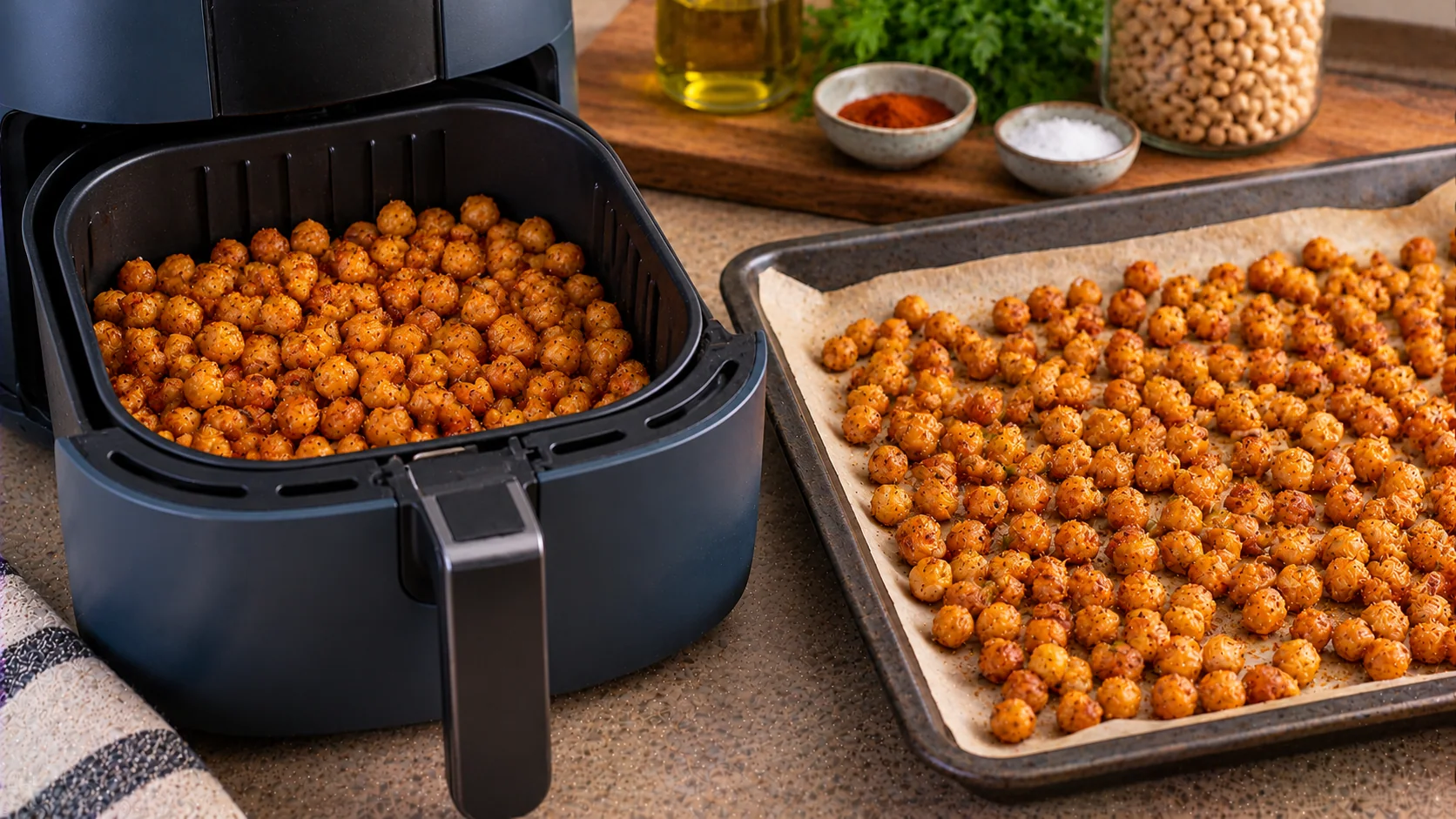
Air-Fryer Chickpeas vs Oven-Roasted Chickpeas: Time and Texture
For crunchy chickpeas, an air fryer can be convenient for one small batch, whereas a conventional oven offers more tray space. Neither appliance guarantees a crisp result: how thoroughly you drain and dry the chickpeas, the space around them, the oil and the cooling time can matter more than a few degrees of temperature. This is a same-ingredient, same-edible-weight test-style method comparison, not a claim that we conducted instrumented kitchen trials.
Quick answer
For a 240 g drained can of chickpeas, start with 190 °C for 12–18 minutes in an air fryer or 200 °C conventional oven for 25–35 minutes, checking and adjusting to your machine. These are practical trial ranges, not scientifically measured averages. The air fryer often makes sense for a small basket; an oven can be more practical when roasting several portions together. A crisp exterior is possible with either method, but both can soften during storage.
Ingredients and measured starting point
For two snack-size servings, use:
| Ingredient | Amount | Measurement note |
|---|---|---|
| Cooked canned chickpeas | 240 g | Drained mass, not a 400 g can's full contents |
| Olive or rapeseed oil | 10 g | Weigh before tossing; about 2 tsp depending on spoon size |
| Smoked paprika | 2 g | Optional seasoning |
| Ground cumin | 1 g | Optional |
| Black pepper | To taste | No extra salt assumed |
Use the same 240 g batch and 10 g oil for each alternative method, not two batches added together. If you want to directly compare side by side, split an identical double batch (480 g drained chickpeas and 20 g oil) into two 240 g portions.
How to make the air-fryer batch
- Drain and rinse the chickpeas; spread on a clean towel, pat dry, and remove visibly loose skins if desired. Allow several minutes for surface moisture to evaporate.
- Preheat the air fryer if its manufacturer's instructions recommend this. Toss 240 g drained chickpeas with 10 g oil, paprika, cumin and pepper.
- Spread in a loose, mostly single layer in the basket. Do not pile them up or block air circulation. If the basket is small, cook in batches rather than overcrowding.
- Cook at 190 °C for 12 minutes; shake the basket, then continue in 2–3 minute increments to a total of roughly 12–18 minutes, watching closely as the beans darken. Check that they are hot and dry; stop before they burn.
- Tip onto a plate and cool uncovered for 5–10 minutes. Taste one when safe to handle: the surface should feel firm, not wet. Cooling changes perceived crunch.
Allow approximately 20–30 minutes including drying and cooling, plus any appliance preheat. Air fryers vary widely in fan strength and basket geometry.
How to make the oven batch
- Drain, rinse and dry 240 g chickpeas in exactly the same way; toss with 10 g oil and the same seasonings.
- Preheat a conventional oven to 200 °C (roughly 180 °C fan, but follow your oven instructions). Line a broad metal tray with baking paper if helpful.
- Spread in one loose layer with space between beans. Do not cover with a lid or add wet sauce.
- Roast for 25 minutes, turn once, and continue checking every 3–5 minutes until the exterior is browned and drier, typically 25–35 minutes total. Larger, wetter batches may take longer.
- Cool uncovered on the tray for 5–10 minutes and assess the texture with the same criteria as the air-fryer batch.
With preheating, drying and cooling, allow about 40–55 minutes. The oven's advantage is useful tray area, not necessarily speed for one can.
Same-batch comparison at a glance
| Factor | Air fryer | Conventional oven |
|---|---|---|
| Drained chickpeas | 240 g | 240 g |
| Oil | 10 g | 10 g |
| Starting temperature | 190 °C | 200 °C (180 °C fan as adjustment) |
| Starting check window | 12–18 min | 25–35 min |
| Space | Small basket; shake | Wide tray; turn once |
| Texture risk | Crowding traps steam | Too much on one tray traps steam |
| Best use | One small snack batch | Several batches or dinner components |
Timing is not a controlled scientific result. Check early and adjust for your device, bean moisture and quantity.
Why some chickpeas stay soft
Water on the outside evaporates before the surface browns. A thick pile holds steam, while a thin single layer allows airflow. Oil can help even browning but too much can leave a greasy rather than crisp finish. Spices burn more easily than chickpeas: for very long roasting, sprinkle delicate dried spices closer to the end. Overcooking can turn the exterior bitter before the center has a satisfying texture. Neither method converts cooked chickpeas into shelf-stable food.
To compare methods fairly, match drained chickpea mass, oil grams, initial moisture, seasoning, endpoint and cooling time. The oven may perform differently if it is already hot from cooking dinner, which is a real practical advantage but changes the energy comparison.
Energy and cost: illustrative, not a meter reading
The simple equation is kWh = average power (kW) × time (hours). Nameplate wattage is usually a maximum rating, not the measured average over the whole cycle. Consider these assumptions only:
| Scenario | Assumed average power | Time including preheat | Energy | At €0.35/kWh |
|---|---|---|---|---|
| Air fryer, one 240 g batch | 1.0 kW | 0.30 h | 0.30 kWh | €0.11 |
| Oven, one 240 g batch | 1.5 kW | 0.65 h | 0.975 kWh | €0.34 |
| Oven, three batches together | 1.5 kW | 0.65 h | 0.975 kWh total | €0.11 per batch |
All figures are arithmetic illustrations, not measured appliance performance or current German tariffs. The air fryer appears cheaper for one small batch under these assumptions; the difference narrows per batch when an oven tray holds more. Real consumption may reverse the comparison. To estimate your own cost, use a plug-in energy meter when compatible, or a reliable appliance energy measurement, and multiply the observed kWh by your tariff.
Nutrition per serving and what cooking changes
Each half batch contains about 120 g drained chickpeas plus 5 g oil before roasting. Heating evaporates water, so the finished portion may weigh less without losing an equivalent proportion of calories. If all oil remains with the food, it contributes about 45 kcal per serving (5 g × 9 kcal/g), before the chickpeas. Exact protein, fibre, salt and calories depend on the can label and oil retained; avoid using the post-roast 100 g value as if it were the same as 100 g drained chickpeas. Check USDA FoodData Central or the product label for your precise ingredient form.
The comparison is primarily about method, time and texture. For whole-meal budgeting and use of pantry staples, see meal planning with an air fryer. For more examples of budget bean meals, see budget-friendly legume combinations.
Storage and safety
Cooked chickpeas are moist foods, even when crisp on the outside. Eat immediately for the best texture. Refrigerate leftovers promptly in shallow containers; USDA FSIS advises using refrigerated cooked leftovers within 3–4 days and reheating to 74 °C (165 °F). See USDA's leftovers guidance. Cover when refrigerating for safety, accepting that the coating will soften. Recrisp briefly in a preheated appliance while ensuring thorough reheating, and never leave cooked beans at room temperature overnight.
Sources
- USDA FoodData Central — database to check the ingredient's nutrient form and label assumptions.
- USDA FSIS: Leftovers and food safety — cooling, storage and reheating.
Appliance times and power inputs are starting scenarios, not laboratory tests; verify the result and energy cost in your own kitchen.