
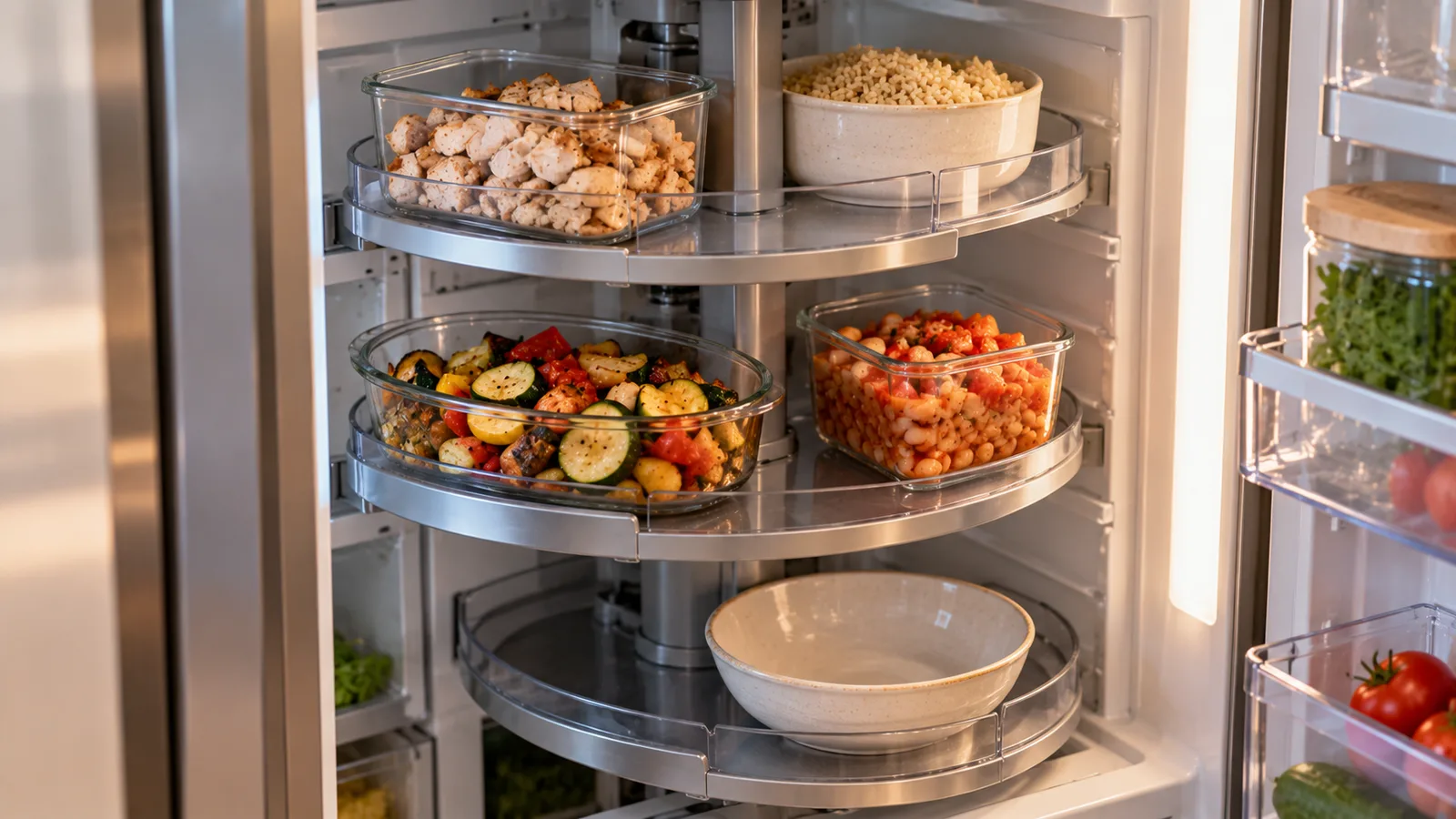
Planning lunches for the week does not mean cooking seven finished meals on Sunday.
The main job is simpler: decide in advance what lunch needs to look like on each day, make sure the ingredients are available and reduce the number of decisions you have to make during the week.
A useful weekly lunch plan can include freshly cooked meals, leftovers, assembled lunches, restaurant days and backup options.
Start with your actual week
Before choosing any food, look at your schedule.
Write down where you expect to eat lunch each day.
For example:
| Day | Situation | What lunch needs to do |
|---|---|---|
| Monday | Office | Portable |
| Tuesday | Home | Can cook quickly |
| Wednesday | Office | Portable |
| Thursday | Meetings | Very fast |
| Friday | Home | Flexible |
| Saturday | Out | No planned home lunch |
| Sunday | Home | Use remaining ingredients |
This immediately gives you more useful information than starting with seven recipes.
A lunch that works at home may be inconvenient at work. A meal that takes 30 minutes to prepare may be unrealistic on a meeting-heavy day.
Plan the situation first and the food second.
Decide how many lunches you actually need
Do not automatically plan seven separate lunches.
Count the lunches that require food from home.
If you know that:
- one day you will eat at a restaurant;
- one day lunch is provided at work;
- one weekend day is unpredictable;
you may only need to plan four lunches.
This prevents unnecessary shopping and reduces the chance of ingredients being wasted.
Choose a weekly lunch structure
Instead of selecting every lunch independently, use a small number of formats.
For example:
- grain or potato bowl;
- sandwich or wrap;
- salad-based lunch;
- leftovers;
- quick backup meal.
These are formats, not fixed recipes.
A bowl could use rice one week and potatoes the next. A wrap could contain chicken, beans, tuna or tofu.
The structure reduces decisions while leaving the actual foods flexible.
Use the 2 + 2 + 1 method
For five weekday lunches, a simple pattern is:
- two portions of Lunch A;
- two portions of Lunch B;
- one flexible lunch.
Example:
| Day | Lunch |
|---|---|
| Monday | Chicken, rice and vegetables |
| Tuesday | Chicken, rice and vegetables |
| Wednesday | Lentil wrap with salad |
| Thursday | Lentil wrap with salad |
| Friday | Leftovers or backup lunch |
You only need to organize two main lunch combinations instead of inventing five different meals.
If you dislike repeated lunches, keep the components similar while changing the final meal.
For example, cooked chicken can become:
- a rice bowl on Monday;
- a wrap on Tuesday.
The ingredient repeats, but the lunch does not have to feel identical.
Build lunches from components
A component-based lunch is easier to plan than a complicated recipe.
A practical framework is:
protein source + carbohydrate or grain + vegetables or fruit + flavor component
Examples:
- chicken + potatoes + vegetables + yogurt sauce;
- lentils + rice + vegetables + dressing;
- tuna + whole-grain bread + salad + fruit;
- tofu + noodles + vegetables + sauce;
- beans + wrap + vegetables + salsa.
This is not a mandatory nutrition formula. It is simply a planning framework that makes grocery quantities easier to calculate.
For broader meal composition, see How to Build a Balanced Lunch.
Check what you already have
Before writing the grocery list, inspect:
- refrigerator;
- freezer;
- pantry;
- foods that need to be used soon.
Suppose you already have:
- 300 g cooked rice;
- half a bag of spinach;
- two carrots;
- frozen peas;
- a can of chickpeas.
Instead of ignoring those foods and starting from zero, build one or two lunches around them.
For example:
Lunch 1: rice + chickpeas + spinach + carrots + dressing.
Lunch 2: rice + peas + another protein source.
Weekly planning becomes cheaper and less wasteful when inventory comes before shopping.
Choose shared ingredients deliberately
Ingredient overlap is useful when it is planned.
Suppose Lunch A needs:
- chicken;
- cucumber;
- tomatoes;
- yogurt.
Lunch B needs:
- wraps;
- beans;
- lettuce;
- salsa.
There is almost no overlap.
That may be fine, but it creates a longer shopping list.
You could instead design lunches around several shared ingredients:
Lunch A
- chicken;
- rice;
- cucumber;
- tomatoes;
- yogurt dressing.
Lunch B
- chicken or chickpeas;
- wrap;
- cucumber;
- tomatoes;
- yogurt sauce.
Now several ingredients serve both lunches.
The goal is not maximum repetition. It is enough overlap to make shopping and food use easier.
Calculate quantities from portions
Once the lunches are chosen, calculate what you actually need.
Suppose you plan three rice bowls.
Each bowl uses:
- 120 g cooked chicken;
- 180 g cooked rice;
- 150 g vegetables.
For three lunches:
Chicken:
120 × 3 = 360 g cooked chicken
Rice:
180 × 3 = 540 g cooked rice
Vegetables:
150 × 3 = 450 g vegetables
This gives the grocery list a reason behind each quantity.
If you cook ingredients from raw, account for changes in food weight during cooking rather than assuming raw and cooked weights are interchangeable.
See Raw vs Cooked Food Weight: How to Track Calories Correctly.
Turn the plan into one grocery list
Group ingredients by shopping section rather than by recipe.
For example:
Produce
- tomatoes;
- cucumber;
- carrots;
- spinach;
- fruit.
Protein foods
- chicken;
- yogurt;
- chickpeas.
Carbohydrate foods
- rice;
- whole-grain wraps.
Flavor and extras
- herbs;
- dressing ingredients;
- salsa.
This makes it easier to see duplicate ingredients and prevents buying the same item twice for different lunches.
Plan around perishability
Not every lunch needs to be prepared at the same time.
Foods with shorter storage life can be scheduled earlier.
For example:
| Day | Lunch strategy |
|---|---|
| Monday | Fresh prepared lunch |
| Tuesday | Fresh prepared lunch |
| Wednesday | Refrigerated components |
| Thursday | Frozen or newly assembled components |
| Friday | Pantry/freezer backup |
Use appropriate food-safety practices and storage times for the ingredients you choose.
When in doubt about how long a prepared food can be stored safely, follow official local food-safety guidance rather than relying on a generic weekly rule.
Separate planning from meal prep
Weekly lunch planning and meal prep are related, but they are not the same task.
Planning answers:
- What am I eating?
- On which days?
- What ingredients do I need?
- Which lunches must be portable?
- Which foods should be used first?
Meal prep answers:
- What should I cook or chop in advance?
- How much should I prepare?
- How should it be stored?
You can plan all five lunches and prepare none of them in advance.
Or you can prepare selected components that make the plan easier.
See Meal Planning vs Meal Prep: What's the Difference?.
Prep the bottleneck, not necessarily the whole lunch
Ask which step is most likely to stop you from following the plan.
It may be:
- cooking rice;
- roasting vegetables;
- cooking a protein source;
- washing salad;
- preparing a sauce;
- portioning ingredients.
If cooking rice takes too long during your workday, prepare the rice.
If assembling the lunch takes only five minutes, there is no need to assemble every meal days in advance.
This keeps preparation proportional to the actual problem.
Use leftovers intentionally
Leftovers can become a planned lunch rather than an accidental one.
Suppose Monday dinner is:
- roasted potatoes;
- chicken;
- vegetables.
Cook an appropriate extra amount and assign it to Tuesday lunch.
Now Tuesday lunch is already solved.
This works particularly well when dinner components transport and reheat well.
For a broader system, see How to Plan Meals Around Leftovers.
Keep one backup lunch
Even a good weekly plan can fail.
Meetings move. Food gets eaten earlier. You forget a container. Plans change.
Keep one lunch that requires very little effort.
Possible backup components include:
- canned tuna or beans;
- whole-grain crackers or bread;
- frozen vegetables;
- soup stored appropriately;
- eggs;
- shelf-stable grain products;
- another simple freezer or pantry combination.
The backup does not need to be exciting.
Its purpose is to prevent a small scheduling problem from forcing you to rebuild the whole day.
Plan work lunches around transport
A work lunch has practical requirements that a home lunch does not.
Ask:
- Does it need refrigeration?
- Can it leak?
- Can it be reheated?
- Is there a microwave?
- Do I need cutlery?
- Can I eat it in a short break?
A soup may be a good lunch at home but inconvenient if you cannot transport it safely.
A cold grain bowl or sandwich may be more practical on a day without reheating facilities.
Do not plan aspirational lunches
A common planning mistake is choosing lunches for the person you hope to be next week rather than for your actual routine.
If you normally have ten minutes for lunch, do not plan five elaborate midday recipes.
If you dislike cold salads, do not make salads the foundation of your office plan simply because they seem convenient.
A useful plan should match:
- available time;
- equipment;
- appetite;
- cooking skill;
- budget;
- food preferences.
Repeatability is more valuable than complexity.
Adjust lunch size to the rest of the day
Not every lunch needs the same size.
A larger lunch may make sense when dinner will be late.
A smaller lunch may be appropriate when you know you will eat an earlier or larger dinner.
Instead of treating lunch as an isolated meal, place it inside the complete day.
Example:
Day A
- early breakfast;
- lunch at 12:00;
- dinner at 20:30.
A more substantial lunch or planned snack may be useful.
Day B
- breakfast at 09:00;
- lunch at 13:30;
- dinner at 18:00.
The same lunch size may not be necessary.
Planning for more than one person
If two people need lunches, do not automatically create two completely separate plans.
Start with shared components.
Example:
Shared:
- rice;
- roasted vegetables;
- chicken;
- chickpeas;
- yogurt sauce.
Person A:
- larger rice portion + chicken.
Person B:
- smaller rice portion + chickpeas and chicken.
The base preparation remains shared while portions and combinations can differ.
A complete five-day example
Suppose your week looks like this:
- Monday: office;
- Tuesday: office;
- Wednesday: home;
- Thursday: office with meetings;
- Friday: home.
You choose:
Shared ingredients
- chicken;
- chickpeas;
- rice;
- wraps;
- tomatoes;
- cucumber;
- spinach;
- yogurt sauce;
- fruit.
The plan:
| Day | Lunch | Reason |
|---|---|---|
| Monday | Chicken rice bowl | Portable and reheatable |
| Tuesday | Chicken wrap + fruit | Uses same chicken and vegetables |
| Wednesday | Chickpea rice bowl | Easy to assemble at home |
| Thursday | Chickpea wrap + yogurt | Fast to eat during meetings |
| Friday | Leftovers or freezer backup | Uses remaining food |
This plan creates variety from a small ingredient set rather than requiring five unrelated recipes.
Build a reusable lunch matrix
Once you know which lunches work, save the formats rather than planning from zero every week.
For example:
| Protein | Base | Produce | Flavor |
|---|---|---|---|
| Chicken | Rice | Cucumber + tomato | Yogurt sauce |
| Tuna | Bread | Lettuce + tomato | Mustard/yogurt |
| Chickpeas | Wrap | Spinach + cucumber | Salsa |
| Tofu | Noodles | Mixed vegetables | Soy-based sauce |
| Eggs | Potatoes | Salad | Herb yogurt |
Each week, choose two or three rows and adapt them to what you already have.
A 10-minute weekly lunch-planning routine
You can reduce the process to ten minutes.
Minute 1–2: Check the calendar
Mark office, home, travel and restaurant days.
Minute 3–4: Check inventory
Identify ingredients that should be used.
Minute 5–6: Choose two main lunch formats
Prefer some ingredient overlap.
Minute 7: Assign lunches to days
Put more perishable options earlier where appropriate.
Minute 8: Choose a backup
Pick one low-effort alternative.
Minute 9–10: Build the grocery list
Buy only what is missing.
The point is not to create a perfect menu.
It is to remove weekday uncertainty.
Review the plan after the week
A weekly plan becomes better when you keep what worked.
Ask:
- Which lunch was easiest to take to work?
- Which one took too long?
- Which ingredients were left over?
- Did portions match your appetite?
- Did you buy food that never got used?
- Which lunch would you willingly repeat?
Use those answers in the next plan.
Over time, you build a personal lunch rotation instead of inventing a new system every Sunday.
The practical weekly system
A useful weekly lunch plan follows this order:
calendar → number of lunches → available food → two or three lunch formats → quantities → grocery list → minimal prep → backup option
This keeps the article's goal where it belongs: planning lunches before the week begins.
It is not necessary to prepare seven containers, follow a rigid menu or cook a different recipe every day.
The best weekly lunch plan is one that makes your actual weekdays easier.