
Healthy meal planning is not about creating seven perfect days of eating.
A useful weekly plan gives you enough structure to make everyday food decisions easier while leaving enough flexibility for appetite, schedule changes, leftovers and real life.
The goal is to build a week that works as a whole.
That usually means combining:
- useful protein sources
- vegetables and fruit
- carbohydrate-rich foods
- dietary fats
- enough fiber
- meals you actually enjoy
- realistic cooking time
- ingredient reuse
- planned flexibility
You do not need every meal to look identical or achieve a perfect nutritional balance on its own.
Instead, look at the overall pattern across the day and week.
What is healthy meal planning?
Healthy meal planning means deciding in advance how at least some of your meals will fit together.
It can include:
- choosing meals
- estimating portions
- checking food already at home
- creating a grocery list
- planning leftovers
- considering nutrition goals
- matching meals to available cooking time
A meal plan can be detailed or simple.
Some people prefer to plan breakfast, lunch, dinner and snacks for every day.
Others only plan dinners and keep the rest flexible.
Both approaches can work.
For a basic planning system, see Meal Planning for Beginners.
Start with the week you actually have
Before choosing recipes, look at your schedule.
Ask:
- Which days are busy?
- Which days have more time for cooking?
- Will you eat outside the home?
- Are there training days?
- Will anyone else eat with you?
- Which evenings are unpredictable?
A meal plan should fit the week.
The week should not have to fit the meal plan.
For example, a complicated recipe may work well on Sunday but poorly on a Wednesday when you arrive home late.
Do not start with seven different dinners
Variety is useful, but seven completely different dinners can create unnecessary work and a long grocery list.
A more practical week might include:
- several freshly cooked meals
- one or two planned leftover meals
- one very quick meal
- one flexible meal
- one freezer or backup option
This reduces pressure without making the week repetitive.
Build meals around a few core components
Instead of thinking only in complete recipes, consider useful meal components.
A balanced meal often contains some combination of:
- protein
- vegetables or fruit
- a carbohydrate source
- dietary fat
Not every meal needs to contain every component in exactly the same proportion.
The point is to create an overall pattern that supports your nutritional needs.
For more detail, see What Is a Balanced Meal?.
Plan protein sources first
Protein can be one useful anchor when planning meals.
Depending on your diet, options may include:
- fish
- chicken
- lean meat
- eggs
- yogurt or skyr
- cottage cheese
- tofu
- tempeh
- beans
- lentils
- chickpeas
You do not need a different protein source at every meal.
Using the same ingredient in different ways can simplify shopping.
For example, cooked chicken could be used in one dinner and later in a lunch.
Lentils might become part of a soup and another mixed dish.
Add vegetables and fruit across the week
Instead of trying to make every meal visually perfect, look for variety over several days.
You might include:
- leafy vegetables
- cruciferous vegetables
- tomatoes
- peppers
- carrots
- onions
- frozen vegetables
- berries
- apples
- bananas
- citrus fruit
Fresh produce is not the only option.
Frozen vegetables and fruit can be convenient and may reduce waste.
Canned options can also be useful when appropriate.
Choose practical carbohydrate sources
Carbohydrate-rich foods can provide energy and make meals more substantial.
Examples include:
- potatoes
- rice
- oats
- pasta
- bread
- whole grains
- beans and lentils
- fruit
You do not need to remove carbohydrates to create a healthy meal plan.
Choose foods that fit your preferences, activity and overall nutrition goals.
Include dietary fats deliberately
Useful fat sources may include:
- olive oil
- nuts
- seeds
- avocado
- eggs
- oily fish
Because fats are energy-dense, amounts can matter when you are following a calorie target.
But a balanced plan does not require eliminating fat.
Think about fiber across the whole day
Fiber-rich foods include:
- vegetables
- fruit
- legumes
- whole grains
- oats
- nuts
- seeds
Instead of trying to add a large amount of fiber to one meal, distribute fiber-rich foods naturally throughout the day.
If your current intake is low, increasing it gradually may be more comfortable.
Reuse ingredients without repeating identical meals
Ingredient reuse is one of the easiest ways to make weekly planning more practical.
For example, one week might use:
- potatoes with fish one evening
- potatoes in a vegetable soup later
- leftover cooked potatoes in another quick meal
Or:
- yogurt at breakfast
- yogurt in a sauce
- yogurt as part of a snack
The ingredient repeats, but the meal does not need to.
This can reduce both cost and waste.
Use perishable foods earlier
When planning the order of meals, consider shelf life.
Foods that spoil more quickly can be used earlier in the week.
Longer-lasting, frozen or pantry foods can support meals later.
For example:
Earlier in the week
- delicate leafy greens
- fresh fish
- ripe berries
- opened dairy products
Later in the week
- cabbage
- carrots
- potatoes
- frozen vegetables
- lentils
- beans
- rice
- pasta
This simple ordering can reduce food waste.
Plan leftovers before cooking
Leftovers are easier to use when they have a purpose.
Before cooking a larger recipe, decide:
- Is the extra portion tomorrow's lunch?
- Will it become another dinner?
- Can it be frozen?
- Can one component be reused separately?
Planned leftovers are different from forgotten leftovers.
Keep one meal intentionally flexible
A rigid seven-day plan can become inconvenient when something changes.
Keeping one meal flexible gives you room for:
- unexpected leftovers
- eating out
- a schedule change
- using food that needs to be finished
- choosing something based on appetite
Flexibility is part of good planning.
It is not a failure to follow the plan.
Match cooking effort to your schedule
Not every day should require the same amount of preparation.
You can deliberately mix:
Higher-effort meals
Useful when you have more time.
Moderate-effort meals
Normal everyday cooking.
Very quick meals
Useful for busy evenings.
A balanced week can contain all three.
Healthy eating does not require cooking everything from scratch every day.
Use convenience foods strategically
Convenience can support a healthy plan.
Examples may include:
- frozen vegetables
- canned beans
- pre-cooked lentils
- plain yogurt
- canned fish
- frozen fruit
- prepared whole grains
- simple frozen meals
Evaluate foods based on the overall diet rather than assuming that more preparation always means better nutrition.
Plan breakfasts according to your routine
Breakfast does not need to change every day.
A few repeatable options can simplify the week.
Examples:
- oats with yogurt and fruit
- eggs with whole-grain bread
- skyr with fruit and nuts
- a simple sandwich with a protein source
If you do not normally eat breakfast, you do not need to add it simply because it appears in a meal plan.
Make lunches realistic
Lunch planning often fails when it assumes you will cook a completely new meal in the middle of every day.
Practical lunches may come from:
- dinner leftovers
- sandwiches
- soups
- grain-based dishes
- salads with a protein source
- prepared components from earlier meals
Plan around where you will actually be at lunchtime.
Use snacks only when they are useful
Snacks are optional.
They can help when there is a long gap between meals or when your schedule makes regular meals difficult.
Possible options include:
- fruit
- yogurt
- eggs
- nuts
- vegetables with a dip
- cottage cheese
But there is no need to add snacks simply because a template includes them.
Consider calories and macros when relevant
If you have a calorie or macro target, meal planning can distribute those targets across the day.
You might allocate more calories to meals when you are usually hungrier.
Protein can be distributed across several meals.
Carbohydrates can be adjusted around activity if that works for you.
Dietary fat can be included in practical amounts.
The plan should support your targets rather than force every meal into an identical formula.
For more detail, see How to Calculate Macros.
Healthy meal planning for weight loss
If your goal is weight loss, the weekly plan still needs to be satisfying enough to follow.
A practical approach can include:
- a reasonable calorie deficit
- protein-rich meals
- fiber-rich foods
- useful food volume
- planned snacks when needed
- foods you enjoy
Do not confuse healthy meal planning with making every meal as small as possible.
If hunger is a recurring problem, see How to Manage Hunger While Losing Weight.
Healthy meal planning on a budget
Nutrition and cost can be planned together.
Useful strategies include:
- checking food at home first
- reusing ingredients
- using beans and lentils
- choosing seasonal produce
- using frozen vegetables
- planning leftovers
- reducing specialized ingredients
You can also set a spending target before building the final grocery list.
See How to Make a Weekly Food Budget.
Turn the plan into a grocery list
Once the week is roughly planned:
- Write down the ingredients required.
- Check the refrigerator, freezer and pantry.
- Remove ingredients you already have.
- Combine duplicate ingredients.
- Adjust quantities for portions.
- Add flexible breakfast and snack basics.
- Review perishable foods.
- Check the estimated cost.
For a detailed process, see How to Make a Grocery List From Your Meal Plan.
A practical seven-day structure
You do not need to assign a completely unique recipe to every day.
A practical structure might look like this:
Day 1
Fresh meal using the most perishable ingredients.
Day 2
Different meal using one or two shared ingredients.
Day 3
Planned leftovers or a transformed leftover meal.
Day 4
Fresh meal using longer-lasting vegetables and pantry staples.
Day 5
Quick meal requiring minimal preparation.
Day 6
Meal with more cooking time if your schedule allows.
Day 7
Flexible meal using remaining ingredients, freezer food or leftovers.
This is a structure, not a rule.
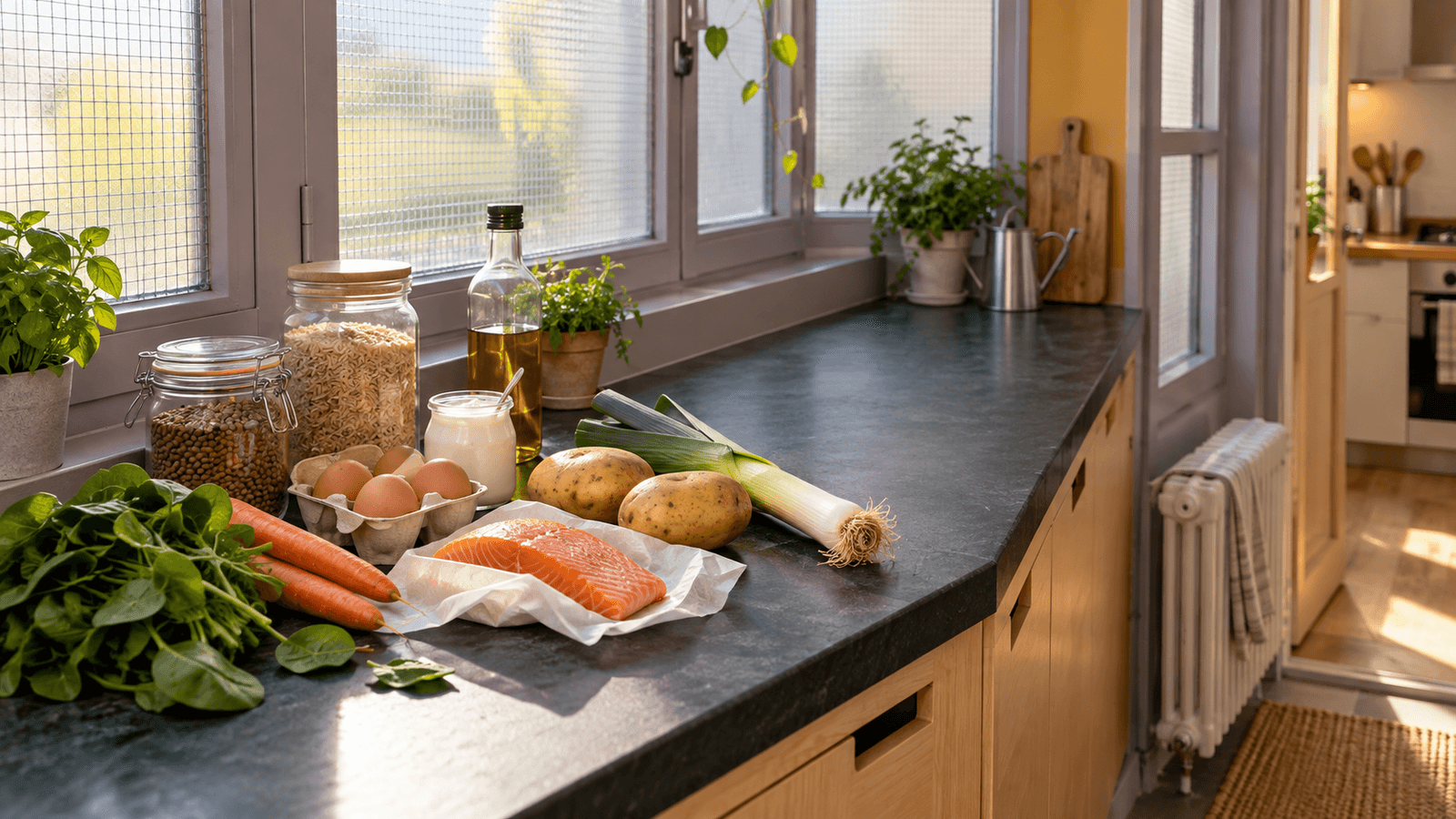
Example of ingredient reuse across a week
Imagine you buy:
- potatoes
- carrots
- spinach
- onions
- yogurt
- eggs
- chicken
- lentils
- rice
These foods could support several different meals.
For example:
- chicken with potatoes and vegetables
- lentil and carrot soup
- rice with vegetables and egg
- leftover chicken in a lunch
- yogurt with breakfast
- yogurt-based sauce
- spinach added to eggs or lentils
The goal is not to force every ingredient into as many meals as possible.
It is to avoid buying many one-purpose ingredients unnecessarily.
How much variety do you need?
Variety is useful, but it does not require constant novelty.
Repeating breakfast several times is fine.
Using the same carbohydrate source in two dinners is fine.
Eating leftovers is fine.
A practical week can combine repetition in some areas with variety in others.
For example:
- repeat breakfast
- rotate lunch
- vary dinners
- change fruit or vegetables
- reuse staple ingredients
What if the plan changes?
It probably will.
You may:
- work late
- eat out unexpectedly
- have more leftovers than expected
- feel like eating something different
- skip a planned meal
Instead of abandoning the entire plan, move meals around.
Use perishable foods first and shift shelf-stable meals later.
A meal plan should be editable.
Avoid planning based on your ideal self
One common mistake is building a plan for the person you wish you were during the week.
For example:
- seven complicated recipes
- extensive meal prep every Sunday
- completely different breakfasts every day
- no convenience foods
- no unplanned meals
If this does not match your real routine, the plan will be difficult to maintain.
Build for your actual schedule.
Keep a backup meal
A backup meal can prevent the entire plan from collapsing on a busy day.
Useful backup meals are:
- quick
- made from foods you normally keep
- reasonably balanced
- something you actually enjoy
Examples might include:
- eggs with bread and vegetables
- pasta with tomato sauce and a protein source
- rice with frozen vegetables and beans
- soup with bread and yogurt
- a simple freezer meal
The exact option is less important than having one.
Review the week before planning the next one
At the end of the week, ask:
- Which meals did I actually cook?
- What was left over?
- Which foods were wasted?
- Which meals were too complicated?
- When was I unusually hungry?
- Did I need extra grocery trips?
- Which ingredients were useful in several meals?
- What should I repeat?
This feedback makes the next plan more realistic.
How Mealisa can help
Mealisa can connect weekly meal planning with:
- calorie targets
- macro targets
- food preferences
- allergies and intolerances
- cooking time
- budget
- ingredients already available
- meal history
Instead of generating seven unrelated meals, a useful plan can consider the week as one connected system.
For example, Mealisa can help reuse ingredients across meals, adjust remaining meals when the day changes and account for food already available at home.
This can make meal planning more practical while reducing unnecessary decisions and waste.
Healthy weekly meal planning checklist
Before finalizing the week, ask:
- Does the plan fit my actual schedule?
- Do I have useful protein sources?
- Is there enough fruit and vegetable variety?
- Are there fiber-rich foods?
- Have I included practical carbohydrate sources?
- Are dietary fats included in sensible amounts?
- Can some ingredients be reused?
- Are perishable foods scheduled early enough?
- Have I planned useful leftovers?
- Is there at least one quick backup meal?
- Is there some flexibility?
- Does the grocery list match the plan?
You do not need a perfect answer to every question.
The checklist is simply a way to catch obvious problems before shopping.
Common mistakes
Planning too many different recipes
This increases complexity and often increases grocery costs.
Ignoring your schedule
A healthy recipe is not practical if you never have time to cook it.
Buying food before checking what you already have
This creates duplicates and waste.
Making every meal completely different
Some repetition can make the week much easier.
Forgetting leftovers
Planned leftovers can save both time and food.
Making the plan too rigid
Real schedules change.
Assuming healthy eating requires cooking everything from scratch
Convenient foods can be part of a balanced diet.
Planning tiny meals for weight loss
A weight-loss plan still needs to be manageable and satisfying.
Buying too many perishable foods at once
Use shelf life when deciding which meals happen first.
Treating one changed meal as failure
Move the plan around instead of abandoning it.
Frequently asked questions
How many meals should I plan each week?
There is no required number. Plan enough meals to reduce uncertainty without creating more structure than you need.
Do I need seven different dinners?
No. Leftovers, repeated ingredients, quick meals and flexible meals can all be part of a practical week.
Is repeating breakfast unhealthy?
No. A repeated breakfast can still fit into a varied overall diet.
Should every meal be perfectly balanced?
No. Look at the overall pattern across the day and week.
Can frozen foods be part of healthy meal planning?
Yes. Frozen vegetables, fruit and other practical foods can reduce preparation time and waste.
How can I make meal planning cheaper?
Reuse ingredients, check existing food first, plan leftovers, use versatile staples and avoid unnecessary one-purpose ingredients.
What should I do when my schedule changes?
Move meals around, prioritize perishable ingredients and use your flexible or backup meal.
Can meal planning help with weight loss?
It can help create structure around calories, portions, protein, fiber and food choices, but the overall energy balance still matters.
The bottom line
Healthy meal planning is not about designing a perfect menu.
It is about creating enough structure to make the week easier.
Start with your real schedule.
Choose a manageable number of meals, use versatile ingredients, plan protein and produce, include practical carbohydrates and fats, reuse ingredients and deliberately plan leftovers.
Keep at least some flexibility.
Then turn the plan into a grocery list based on what you actually need.
A good weekly meal plan should support nutrition while reducing unnecessary decisions, food waste and last-minute stress.
This article provides general nutrition information and is not a substitute for individualized medical or dietetic advice.