
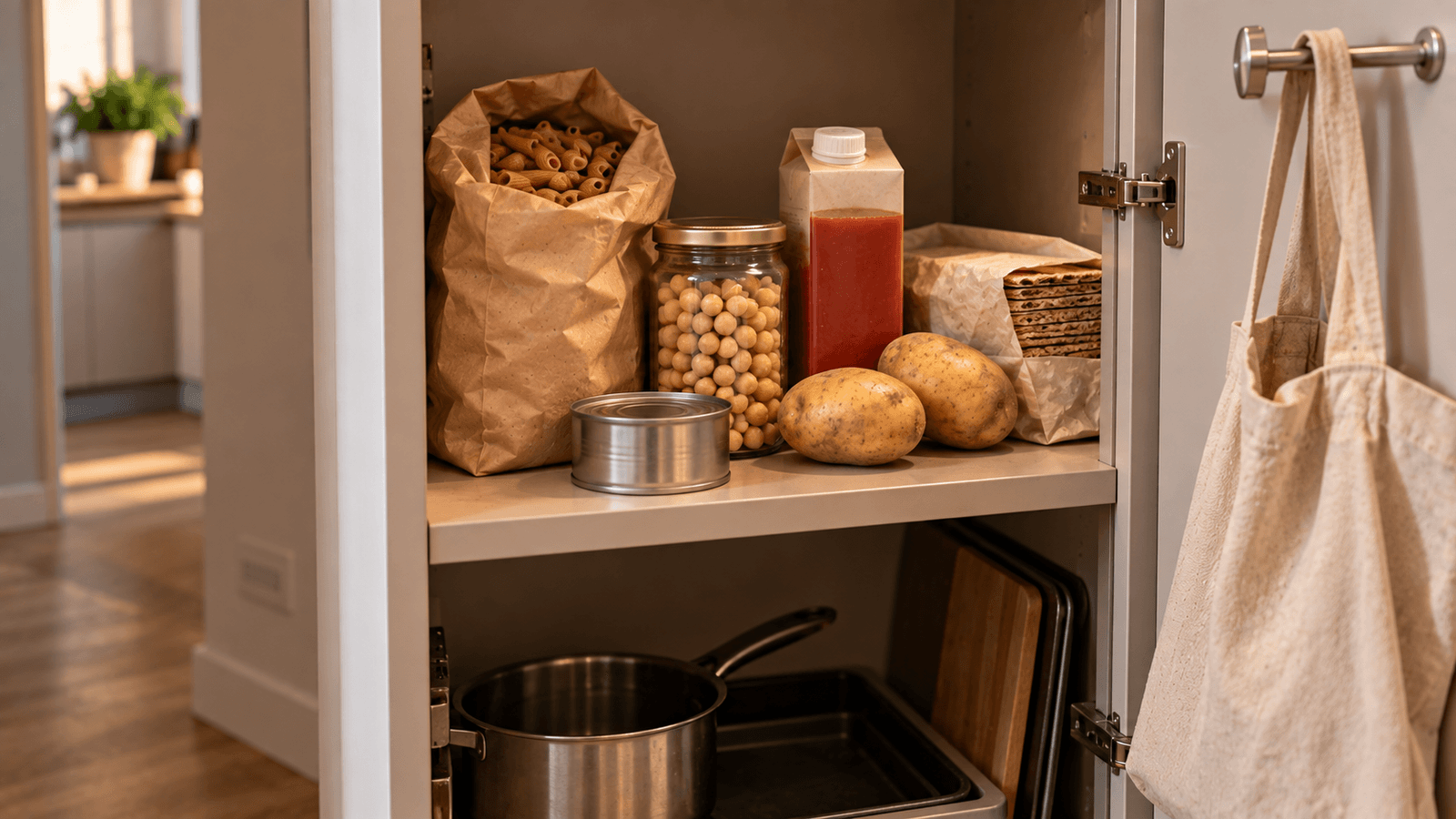
A meal plan is most useful when it still works after the day stops going according to plan.
You may intend to cook dinner and then:
- work finishes late
- an appointment takes longer than expected
- an ingredient is missing
- you arrive home tired
- leftovers are already gone
- someone in the household changes plans
The usual problem is not that you failed to plan.
The problem is that the plan had no fallback.
A backup meal list is a short collection of meals you can make with little time, little decision-making and ingredients you are likely to have available.
It is contingency planning, not a second full meal plan.
Step 1: Identify when your normal plan usually breaks
Do not start by collecting dozens of quick recipes.
Start with your actual difficult situations.
For one week, notice what causes an unplanned meal.
For example:
| Situation | What you need from a backup meal |
|---|---|
| Home 45 minutes late | Ready in 10–15 minutes |
| Too tired to cook | Almost no preparation |
| Fresh ingredients are gone | Pantry or freezer ingredients |
| Planned protein was not defrosted | Alternative protein source |
| Lunch was not prepared | Portable option |
| Household plans changed | Easy to make for one person |
| Grocery trip delayed | Long-life ingredients |
Your backup list should solve these situations.
If your main problem is arriving home late, a complicated 35-minute "quick recipe" is not a useful backup.
Step 2: Set a maximum effort level
Define what qualifies as a backup meal.
A practical rule might be:
- 15 minutes or less
- no complicated recipe
- few ingredients
- minimal chopping
- ingredients commonly kept at home
You can make the rule stricter if necessary.
For extremely busy days, your backup category might mean:
5 minutes, one pan or no cooking.
The purpose is to make the backup easier than ordering food simply because you cannot think of anything else.
Step 3: Build around foods you already buy
A backup system works better when it does not require a separate collection of special ingredients.
Look at foods already appearing on your grocery list.
Useful categories might include:
Pantry
- oats
- pasta
- rice
- couscous
- canned beans
- canned lentils
- canned tuna
- canned tomatoes
- crispbread or wraps
- shelf-stable sauces
Freezer
- frozen vegetables
- frozen berries
- bread
- cooked rice portions
- soup
- frozen fish
- frozen cooked meals
Fridge
- eggs
- yogurt or skyr
- cottage cheese
- cheese
- tofu
- vegetables
- hummus
You do not need all of these.
Choose foods you genuinely use.
Step 4: Create meal formulas instead of recipes
Backup meals should require very little thinking.
A formula is often more useful than a specific recipe.
For example:
quick carbohydrate + protein + vegetable/fruit + optional sauce
That can become:
- couscous + chickpeas + frozen vegetables + dressing
- bread + eggs + tomatoes + fruit
- rice + tuna + frozen peas + sauce
- pasta + beans + tomato sauce
- yogurt + oats + berries + nuts
The formula stays the same while ingredients change.
This lets you adapt to what is actually available.
Step 5: Make a first list of 8–12 meals
You do not need 40 backup meals.
A short list is easier to remember and maintain.
Here is an example:
| Backup meal | Typical ingredients | Approx. active effort |
|---|---|---|
| Eggs on toast + fruit | Eggs, bread, fruit | 5–10 min |
| Yogurt-oat bowl | Yogurt/skyr, oats, fruit | 3 min |
| Tuna couscous bowl | Couscous, tuna, frozen vegetables | 10 min |
| Bean pasta | Pasta, canned beans, tomato sauce | 15 min |
| Egg fried rice | Cooked rice, eggs, frozen vegetables | 10 min |
| Chickpea wrap | Wrap, chickpeas, vegetables, sauce | 5–10 min |
| Cottage cheese potato bowl | Microwave potato, cottage cheese, vegetables | 10 min |
| Lentil tomato soup | Canned lentils, tomatoes, frozen vegetables | 10–15 min |
| Hummus sandwich + yogurt | Bread, hummus, vegetables, yogurt | 5 min |
| Freezer meal + vegetables | Prepared portion, frozen vegetables | 5–10 min |
These are examples, not a required menu.
Your list should reflect what you already eat.
Step 6: Include different levels of emergency
Not every busy day is equally difficult.
It can help to divide your list into three levels.
Level 1: I still have 15 minutes
Examples:
- pasta with beans and tomato sauce
- omelet with bread and vegetables
- couscous with chickpeas
- quick lentil soup
Level 2: I have 5 minutes
Examples:
- yogurt, oats and fruit
- sandwich with protein filling
- microwave potato with cottage cheese
- leftovers with frozen vegetables
Level 3: I am not realistically cooking
Examples:
- prepared freezer portion
- supermarket meal you already know
- soup + bread + ready protein source
- simple assembled cold meal
This prevents the backup system itself from being too demanding.
Step 7: Give every planned meal a fallback category
You do not need to assign a specific backup to every day.
Instead, connect planned meals to simple fallback categories.
For example:
| Planned meal | If it fails |
|---|---|
| Chicken, potatoes, vegetables | Eggs + bread + vegetables |
| Homemade curry | Lentil tomato bowl |
| Fish with rice | Tuna rice bowl |
| Pasta recipe | Fast bean pasta |
| Cooked lunch for work | Sandwich + yogurt + fruit |
Now a failed dinner plan does not send you back to zero.
You already know what type of replacement to use.
Step 8: Keep at least one protein backup
One common failure point is discovering that the planned protein source is unavailable or still frozen.
Keep one or two alternatives that require little preparation.
Depending on your diet, examples include:
- eggs
- canned tuna
- canned beans
- lentils
- cottage cheese
- skyr
- tofu
- frozen cooked protein portions
The goal is not to create a high-protein rule for every emergency meal.
It is simply useful to have a meal-building component available when the original ingredient cannot be used.
Step 9: Use the freezer as part of the plan
The freezer is not only for storing ingredients.
It can store completed decisions.
When you make a meal that freezes well, an extra portion can become a future backup.
Useful examples include:
- soup
- chili
- curry
- cooked beans or lentils
- pasta sauce
- cooked grains
- individual complete meals
Labeling portions clearly makes them easier to use.
A freezer containing food you cannot identify is much less useful as a backup system.
Step 10: Make leftovers intentional
Leftovers can also function as backup meals.
Instead of treating every leftover as accidental, decide when cooking whether part of the meal has a future job.
For example:
Monday dinner: make four portions.
- two eaten Monday
- one becomes Tuesday lunch
- one goes into the freezer as a backup
This is different from simply hoping something remains.
The extra portion already has a purpose.
See How to Plan Meals With Leftovers.
Step 11: Create a small "always available" grocery layer
Your normal grocery list changes from week to week.
The backup layer should change less often.
For example:
Always try to have:
- eggs
- one canned protein or legume
- pasta or couscous
- frozen vegetables
- bread in the freezer
- one quick sauce
- one simple dairy or plant-based protein
When one of these is used, add it back to the next grocery list.
This turns the backup list into a maintained system rather than a document you create once and forget.
Step 12: Avoid backup meals that depend on one fragile ingredient
Suppose your backup meal is:
avocado toast with eggs
If you frequently do not have ripe avocado, it is not a reliable backup.
A stronger backup can tolerate substitutions:
toast + protein + available vegetable or fruit
Possible versions:
- eggs + tomato
- cottage cheese + cucumber
- hummus + peppers
- tuna + salad leaves
The meal survives even when one ingredient is missing.
Step 13: Keep the list visible
A backup meal is not useful if you forget it exists.
Store the list somewhere you naturally look when deciding what to eat.
That might be:
- your meal-planning note
- the refrigerator
- your grocery-list app
- a saved note on your phone
- your weekly planning page
The list should be short enough to scan in seconds.
Do not turn it into a recipe archive.
Step 14: Remove meals you never choose
After a few weeks, review what actually happened.
Suppose your list contains ten meals.
You used:
- eggs on toast three times
- tuna couscous twice
- freezer soup twice
- yogurt bowl once
But you never chose the other six.
That is useful information.
Maybe those six meals are not genuinely convenient for you.
Replace them with options that better match your behavior.
The backup list should be based on what you actually use, not what sounds organized.
Example: building a backup system from scratch
Imagine your normal weekday problem is dinner.
You usually arrive home at 18:30, but one or two days per week you arrive much later.
Your normal planned dinners take 25–40 minutes.
Problem
On late days, you no longer want to cook the planned meal.
Constraint
The replacement should take no more than 10 minutes.
Foods usually available
- eggs
- bread
- canned beans
- couscous
- frozen vegetables
- tuna
- yogurt
- frozen soup portions
Backup list
- eggs + toast + vegetables
- tuna couscous + frozen vegetables
- beans + tomato sauce + bread
- freezer soup + toast
- yogurt + oats + fruit when a cold meal is acceptable
Now the question at 20:15 is no longer:
"What should I eat?"
It is:
"Which of these five backups works tonight?"
That is a much smaller decision.
Example: a backup system for work lunches
Suppose the recurring problem is forgetting to prepare lunch.
Instead of relying on a single solution, create layers.
At home
Keep ingredients for:
- fast sandwich
- yogurt + oats + fruit
- leftovers
- wrap with beans or tuna
At work
If practical, keep non-perishable items such as:
- oats
- crispbread
- canned or packaged foods appropriate to your storage setup
Near work
Identify one or two supermarket or restaurant options you can use when neither home nor workplace food is available.
The external option is still part of the contingency plan.
A backup meal does not have to be homemade.
Backup meals and nutrition goals
A backup meal does not need to reproduce your planned meal exactly.
If your original dinner was:
- salmon
- potatoes
- roasted vegetables
your backup does not need identical calories and macros.
It only needs to be reasonably compatible with your overall goals.
A practical check is:
- Does it contain a useful protein source?
- Is there some fruit or vegetable when practical?
- Is the portion appropriate?
- Will it actually satisfy me?
- Can I prepare it with the time and energy I have?
The purpose is to keep the day functional, not nutritionally perfect.
Backup meals and calorie tracking
If you track calories or macros, familiar backup meals can make tracking easier because you use them repeatedly.
After weighing or calculating a meal once, you may already know the approximate portions you normally use.
For example:
Backup meal:
- 2 eggs
- 2 slices of bread
- tomatoes
- measured spread
The next time you make the same meal, tracking requires much less work.
This is one reason simple repeat meals can be valuable on busy days.
See How to Track Repeat Meals Faster.
Backup meals are not the same as a meal rotation
A backup list answers:
"What can I eat when today's plan stops working?"
A meal rotation answers a different question:
"Which meals do I intentionally repeat as part of my normal routine?"
Some meals may appear in both systems, but the purpose is different.
Keep the backup list focused on contingency situations rather than turning it into your complete weekly menu.
A simple template
You can build your own list using this structure:
| Situation | Backup meal | Ingredients to keep | Time |
|---|---|---|---|
| Late home | |||
| No defrosted protein | |||
| No lunch prepared | |||
| Very tired | |||
| Grocery trip delayed | |||
| Cooking for one unexpectedly |
Fill in one realistic meal for each recurring problem.
If the same meal solves several situations, that is useful rather than repetitive.
A good backup meal list is deliberately small.
Its job is to remove friction when the original plan fails.