
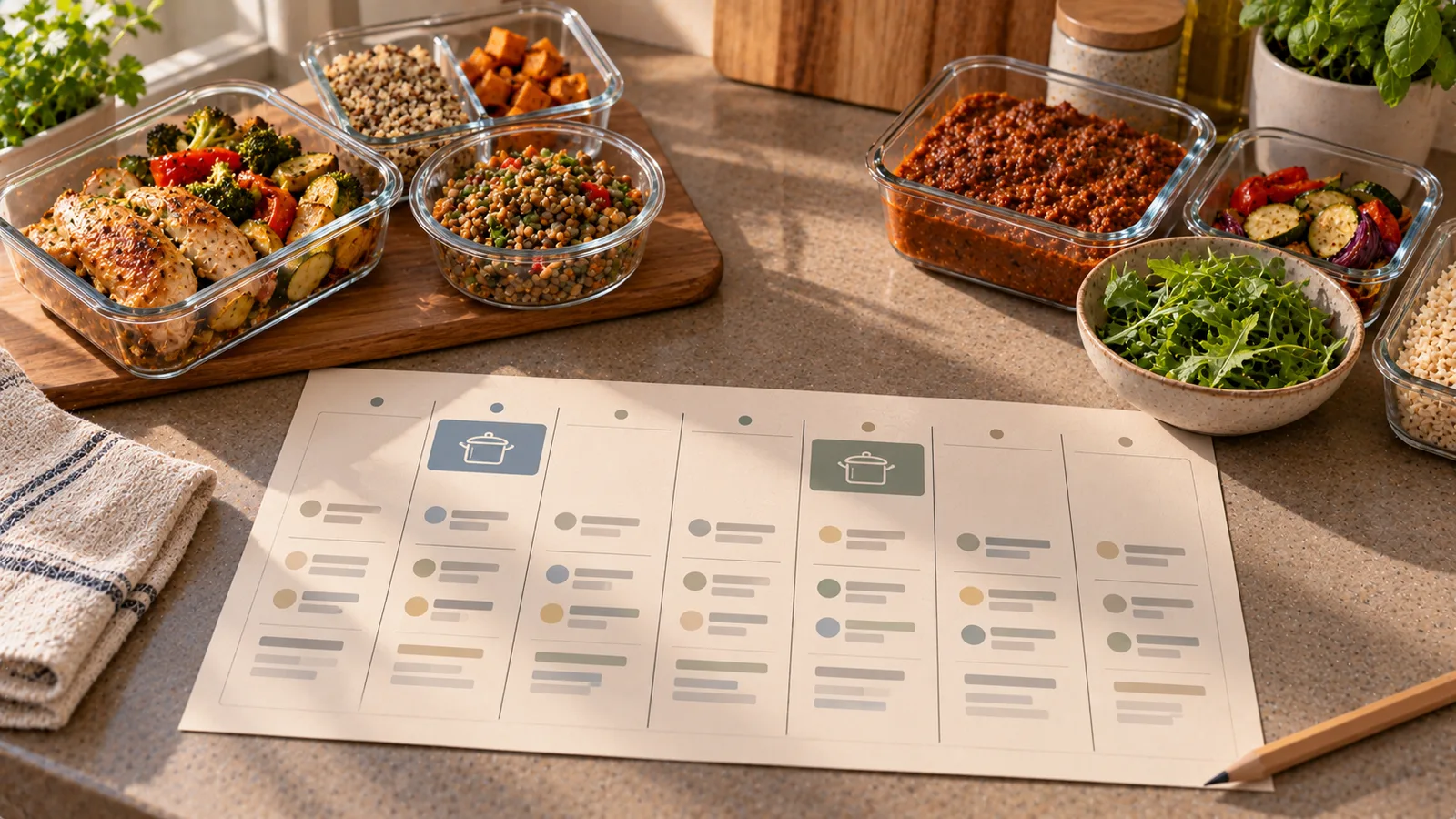
Cooking every day is not necessary for a useful weekly meal plan.
If you can reliably cook only twice per week, the goal is not to prepare seven identical containers at once. A more flexible system is to use two cooking sessions to create several components that can be recombined into different meals.
The result can reduce weekday cooking without forcing you to eat exactly the same meal every day.
The two-day cooking model
Choose two days that fit your schedule.
For example:
- Sunday;
- Wednesday.
Sunday covers roughly the first half of the week.
Wednesday refreshes the plan for the second half.
A simple rhythm could look like this:
| Day | Main task |
|---|---|
| Sunday | Cook batch 1 |
| Monday | Assemble or reheat |
| Tuesday | Assemble or reheat |
| Wednesday | Cook batch 2 |
| Thursday | Assemble or reheat |
| Friday | Assemble or use frozen portions |
| Saturday | Flexible meal, leftovers or freezer |
The exact days do not matter.
What matters is creating a repeatable gap of roughly three to four days between cooking sessions.
Start with your real week
Before choosing recipes, look at your schedule.
Mark:
- long workdays;
- evenings away from home;
- exercise or activities;
- days when lunch must travel with you;
- days when you can eat at home;
- your two realistic cooking windows.
This prevents you from building a meal plan around an imaginary week in which you always have time to cook.
Plan meals before choosing recipes
Start with the number of meals you actually need.
Suppose you need:
- 7 breakfasts;
- 5 packed lunches;
- 2 lunches at home;
- 6 dinners;
- 1 flexible dinner.
You do not necessarily need 21 different recipes.
Some meals may be simple assemblies rather than cooked dishes.
Examples include:
- yogurt with fruit and oats;
- bread with eggs and vegetables;
- cottage cheese with fruit;
- a sandwich with a side salad;
- leftovers from dinner;
- a grain bowl assembled from prepared components.
The two cooking sessions should focus on foods that genuinely benefit from advance preparation.
Build around components, not only complete meals
A component-based system gives you more flexibility than cooking several identical meals.
A cooking session might produce:
Protein
- roasted chicken;
- baked tofu;
- cooked lentils;
- beans;
- hard-boiled eggs.
Carbohydrate base
- rice;
- potatoes;
- pasta;
- quinoa;
- another grain.
Vegetables
- roasted vegetables;
- cooked vegetables;
- washed raw vegetables.
Sauce or finishing component
- yogurt-herb sauce;
- tomato sauce;
- hummus;
- vinaigrette.
You can then combine the components differently throughout the next few days.
Example: one batch, several meals
Suppose Sunday produces:
- roasted chicken;
- cooked rice;
- roasted peppers and zucchini;
- washed salad vegetables;
- yogurt-herb sauce.
These ingredients could become:
Monday lunch
Chicken rice bowl with roasted vegetables.
Monday dinner
Chicken with vegetables and a different side.
Tuesday lunch
Cold rice and chicken salad.
Tuesday dinner
Wraps filled with chicken, vegetables and yogurt sauce.
The ingredients overlap, but the meals do not have to feel identical.
Use the second cooking day as a reset
The second cooking session should not simply reproduce the first.
It can introduce:
- another protein;
- another carbohydrate source;
- different vegetables;
- a new sauce;
- a soup, stew or pasta dish.
For example, Wednesday might produce:
- lentil tomato stew;
- boiled potatoes;
- roasted broccoli;
- a tray of baked fish;
- chopped vegetables for quick side dishes.
This creates variety while keeping the number of actual cooking sessions low.
A complete example week
Here is one possible structure.
Sunday cooking
Prepare:
- roasted chicken;
- rice;
- roasted zucchini and peppers;
- boiled eggs;
- yogurt-herb sauce.
Monday
Lunch: chicken rice bowl with vegetables.
Dinner: chicken, roasted vegetables and bread.
Tuesday
Lunch: chicken and rice salad.
Dinner: egg and vegetable wraps with yogurt sauce.
Wednesday cooking
Prepare:
- lentil tomato stew;
- baked fish;
- potatoes;
- broccoli.
Thursday
Lunch: lentil stew with bread.
Dinner: fish, potatoes and broccoli.
Friday
Lunch: lentil stew.
Dinner: potato and vegetable bowl with eggs or another available protein.
Saturday
Use a frozen portion, remaining ingredients or a flexible meal.
Sunday
Start the next cycle.
This is only a framework. Portions and food choices should reflect your own needs.
Do not cook everything in advance
A two-day cooking system works better when some foods remain quick and fresh.
You may prepare major components ahead but leave tasks such as these for the day of eating:
- cutting an avocado;
- adding fresh herbs;
- toasting bread;
- assembling a sandwich;
- adding dressing;
- reheating a prepared dish;
- cooking a very quick egg.
This keeps the system practical without turning every meal into long cooking.
Decide what must be eaten first
Not every prepared food has the same useful storage window.
When planning the first cooking session, identify which meals should be eaten earlier and which portions can be frozen.
A useful approach is:
- eat more perishable prepared foods first;
- refrigerate portions intended for the next few days;
- freeze portions intended for later use when appropriate;
- thaw safely before they are needed.
Do not assume that every cooked food should simply remain in the refrigerator for the entire week.
Food safety matters more than the schedule
A meal plan should adapt to safe storage rather than forcing food to remain refrigerated because the calendar says so.
General food-safety principles include:
- cool cooked food promptly;
- refrigerate perishable foods without unnecessary delay;
- use clean containers;
- keep the refrigerator appropriately cold;
- avoid leaving cooked foods at room temperature for extended periods;
- reheat foods appropriately where needed;
- freeze portions when they will not be eaten within an appropriate refrigerated storage period.
Exact safe storage times vary by food and local guidance.
If you are unsure about a specific food, follow current food-safety guidance from the relevant authority in your country.
Use the freezer deliberately
The freezer can turn two cooking sessions into a much more flexible system.
Instead of planning:
Sunday → Monday → Tuesday → Wednesday
only with refrigerated leftovers, you can freeze some portions immediately.
For example:
Sunday:
- cook six portions of a stew;
- refrigerate two;
- freeze four.
Several days later, frozen portions can replace an unplanned takeaway or a cooking session that did not happen.
Freeze individual portions
Freezing food in one large container can create unnecessary friction.
Individual or meal-sized portions make it easier to:
- thaw only what you need;
- use meals on different days;
- avoid repeatedly reheating the same batch;
- maintain flexibility when plans change.
Labeling containers with the food and date can also make the freezer easier to use.
Avoid seven-day dependency on one batch
One enormous Sunday batch may look efficient, but it creates several problems:
- limited variety;
- greater dependence on refrigerated storage;
- higher risk of becoming tired of the food;
- less flexibility if your schedule changes.
Two smaller cooking sessions reduce these problems.
They also let you adjust the second half of the week based on what remains from the first half.
Check leftovers before the second cooking session
Before cooking on the second day, inspect what you still have.
You may discover:
- two portions of rice remain;
- vegetables were eaten faster than expected;
- one dinner was skipped;
- a protein portion is still frozen;
- lunch plans changed.
Adjust the second cooking session accordingly.
Do not automatically prepare everything originally planned.
Use a flexible quantity system
Instead of deciding that every recipe must make exactly four servings, assign quantities according to expected use.
For example:
Chicken:
- two lunches;
- two dinners.
Rice:
- three meals.
Roasted vegetables:
- four meals.
Lentil stew:
- three meals plus one freezer portion.
This makes your shopping list easier to connect to your actual meal plan.
Plan for one disruption
A realistic weekly plan should assume that something may change.
You might:
- eat out;
- work late;
- skip a planned meal;
- have unexpected leftovers;
- decide you do not want the scheduled dinner.
Leave at least one meal flexible.
That meal can use:
- leftovers;
- freezer food;
- eggs;
- canned beans;
- pasta;
- a simple sandwich;
- another quick pantry option.
The flexible slot prevents one change from disrupting the entire week.
Keep emergency foods available
Two cooking days work much better when your kitchen contains a few low-effort backups.
Useful examples can include:
- eggs;
- canned beans;
- canned tuna or another shelf-stable protein;
- frozen vegetables;
- frozen portions of previous meals;
- pasta;
- rice;
- bread;
- yogurt;
- simple sauces.
The purpose is not to build another complicated meal plan.
It is to make the system resilient when one prepared component runs out.
Breakfast does not always need batch cooking
If breakfast is already quick, do not spend valuable cooking-session time preparing it.
Examples of low-preparation breakfasts include:
- yogurt, oats and fruit;
- eggs and bread;
- cottage cheese and fruit;
- overnight oats;
- simple sandwiches.
Batch-cook breakfast only when it genuinely saves time for you.
Lunches are often the best batch-cooking target
Packed lunches usually benefit most from advance planning because you may not have access to your kitchen during the day.
When planning two cooking sessions, decide first:
- how many lunches must leave the house;
- whether they need reheating;
- whether refrigeration is available;
- how portable the meal must be.
This can determine which recipes belong in your cooking sessions.
Dinners can use prepared components
Dinner does not always need to be fully cooked in advance.
If you already have:
- cooked potatoes;
- prepared protein;
- washed vegetables;
- a sauce;
assembling dinner may take only a few minutes.
This can feel fresher than reheating a fully assembled meal while still keeping weekday work low.
Use ingredient overlap strategically
Ingredient overlap saves time and reduces waste.
For example, one week might use:
- peppers in rice bowls and wraps;
- yogurt in breakfast and sauce;
- potatoes with fish and in a vegetable bowl;
- lentils in stew and a lunch bowl.
But avoid making every meal from exactly the same ingredients.
Useful overlap means reusing ingredients with different roles.
Create a shopping list from the plan
Once the week is mapped, convert each planned meal into quantities.
Then combine repeated ingredients.
For example:
Meal 1 needs 150 g chicken.
Meal 2 needs 150 g chicken.
Meal 3 needs 120 g chicken.
Total:
150 + 150 + 120 = 420 g chicken
Add an appropriate margin only if you realistically need one.
This is more reliable than buying a large package simply because it looks convenient.
Consider package sizes before finalizing the plan
If chicken is sold in 500 g packages but your plan needs 420 g, decide what happens to the remaining 80 g.
Options include:
- increase one portion;
- use it in another meal;
- freeze it;
- choose another package size.
Doing this before shopping helps reduce forgotten leftovers.
A simple two-session template
Cooking session 1
Prepare:
- 1 main protein;
- 1 carbohydrate base;
- 1–2 vegetable components;
- 1 sauce or flavor component;
- optional eggs or another quick protein.
Cooking session 2
Prepare:
- 1 different protein or legume dish;
- 1 different carbohydrate base;
- 1–2 vegetables;
- 1 dish that freezes well.
This is enough to create many combinations without preparing a huge number of recipes.
Example quantities for one person
Suppose the first session is intended to support six main meals.
You might prepare approximately:
- 700–900 g of a protein-rich main ingredient, depending on the food and your portions;
- 3–4 portions of a grain or potato base;
- several portions of vegetables;
- enough sauce for 3–4 meals.
These are not nutritional targets.
They are planning examples. Your actual quantities should match your appetite, energy needs and household size.
For two people
Do not automatically double every ingredient.
Some items scale cleanly, while others may not.
Start with the number of portions required.
If two people need six shared meals, you need approximately 12 portions.
Then calculate each component according to the portion sizes each person actually eats.
This is especially useful when household members have different energy needs.
If you track calories or macros
Build the plan around meals you can adjust.
For example, keep the main components separate:
- protein;
- carbohydrate base;
- vegetables;
- sauce.
Then a portion can be changed without cooking a different recipe.
One person may take:
- 120 g cooked rice.
Another may take:
- 200 g cooked rice.
Both can use the same prepared meal components.
Do not force exact macros into every meal
If you use macro targets, your daily or multi-day pattern may matter more than making every meal mathematically identical.
A flexible component system makes adjustment easier.
For example, you can increase:
- protein with an additional protein portion;
- carbohydrates with more rice, bread or potatoes;
- fats with oil, nuts, cheese or another appropriate food.
The specific choice depends on the rest of your diet.
What if the first batch runs out early?
Do not automatically move the second cooking day forward.
First check whether you can bridge the gap with:
- a freezer portion;
- eggs;
- canned beans;
- tuna;
- a simple pasta dish;
- a sandwich;
- another quick meal.
If the problem happens repeatedly, increase the quantities in the next week's first cooking session.
What if there are too many leftovers?
Reduce the next batch.
A useful meal-planning system learns from actual consumption.
After each week, ask:
- Which food ran out first?
- Which food remained?
- Which meals were skipped?
- Which portions were too large?
- Which prepared food was not appealing after several days?
Use those answers to change quantities rather than adding more recipes.
When your cooking day gets cancelled
A two-day plan should survive the loss of one cooking session.
If Wednesday cooking becomes impossible:
- use remaining refrigerated food first;
- use frozen portions;
- use simple pantry meals;
- move the cooking session if your schedule allows;
- simplify the rest of the week instead of trying to catch up with an enormous cooking session.
The goal is continuity, not perfect adherence to the original calendar.
Two cooking days vs meal prep
Traditional meal prep often means preparing complete meals in advance.
A two-cooking-day system can be broader.
You can prepare:
- complete dishes;
- individual components;
- ingredients that only need assembly;
- freezer portions;
- quick backup foods.
This makes it useful for people who want less cooking without eating identical pre-portioned meals all week.
A 60–90 minute cooking-session structure
A cooking session can be organized efficiently.
First 10 minutes
- preheat oven;
- start water for grains or potatoes;
- wash produce;
- begin the longest-cooking component.
Next 20–30 minutes
- prepare protein;
- chop vegetables;
- start oven dishes;
- cook grain or carbohydrate base.
Next 20 minutes
- prepare sauce;
- boil eggs if needed;
- finish vegetables;
- portion cooled components.
Final stage
- cool food appropriately;
- refrigerate near-term portions;
- freeze later portions;
- clean the workspace.
Actual timing depends on the recipes and your kitchen.
Reduce active cooking time with parallel tasks
Choose foods that can cook simultaneously.
For example:
- vegetables roast in the oven;
- rice cooks on the stove;
- eggs boil in another pot;
- sauce is mixed without cooking.
This is often more efficient than preparing three recipes that each require constant attention.
Avoid choosing too many complex recipes
If your plan contains two cooking days but each session includes four complicated recipes, the system may still feel like too much work.
A better combination may be:
- one main cooked dish;
- one simple protein;
- one carbohydrate base;
- one tray of vegetables;
- one no-cook sauce.
Complexity matters as much as frequency.
A practical grocery-list structure
Organize your list around the two sessions.
Proteins
Buy enough for both cooking blocks, freezing raw ingredients when appropriate.
Vegetables and fruit
Choose which items should be used early and which keep longer.
Carbohydrate staples
Rice, pasta, potatoes, bread and grains can support multiple meals.
Flexible foods
Eggs, canned foods, frozen vegetables and freezer portions cover disruptions.
Flavor components
Sauces, herbs, spices and condiments help repeated ingredients feel different.
Freshness can guide the order of meals
Plan more delicate foods earlier.
For example, depending on the product and storage conditions:
Earlier in the cycle:
- delicate fresh produce;
- meals containing ingredients that should be used promptly.
Later in the cycle:
- frozen portions;
- shelf-stable ingredients;
- freshly cooked second-batch meals.
Do not rely on a generic weekly sequence when the actual food requires different handling.
Repeating ingredients is not the same as repeating meals
A weekly plan does not need seven unrelated ingredient lists.
If chicken appears in three meals, those meals can still differ through:
- side dishes;
- sauces;
- preparation;
- temperature;
- vegetables;
- format.
For example:
- warm chicken rice bowl;
- chicken wrap;
- chicken salad.
Strategic repetition makes two-day cooking practical.
Track what actually gets eaten
At the end of the week, compare your plan with reality.
Suppose you planned:
- six portions of chicken;
- four portions of rice;
- four portions of lentil stew.
Actual consumption:
- five chicken portions;
- four rice portions;
- three stew portions.
Next week, you may reduce chicken and stew slightly.
This feedback loop gradually makes the plan more accurate.
A simple rule for building the week
Think in this order:
schedule → meals needed → cooking sessions → components → quantities → grocery list
Starting with recipes often creates too much food.
Starting with your actual schedule tells you how much food you really need.
What to remember
Meal planning with only two cooking days works best when you:
- choose two realistic cooking windows;
- plan around your actual weekly schedule;
- prepare flexible components rather than only identical complete meals;
- use the second cooking day as a midweek reset;
- refrigerate and freeze food appropriately;
- leave one meal flexible;
- keep simple backup foods available;
- adjust the second batch based on leftovers;
- use actual consumption to improve next week's quantities.
Two cooking days can be enough for a full week when the plan is designed around reuse, safe storage and flexibility rather than seven days of identical meal-prep containers.