
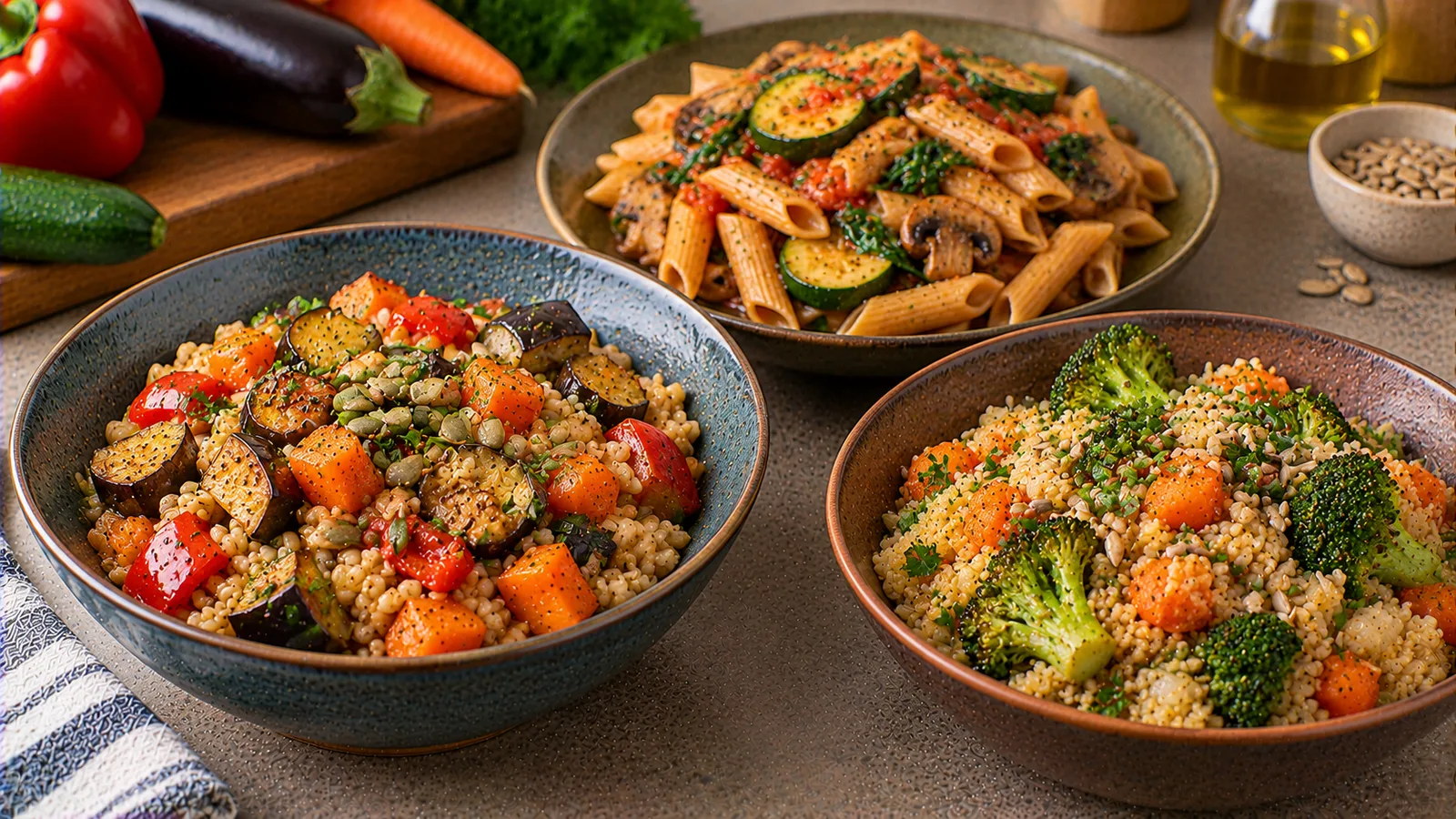
Three high-fiber dinners without beans: the plan
Yes, you can build high-fiber dinners without beans, chickpeas, lentils or peas. For one adult, this plan makes three different single-serving dinners: whole-wheat pasta with broccoli and sunflower seeds; bulgur with spinach, mushrooms and ground flaxseed; and roasted potatoes with Brussels sprouts, two eggs and sunflower seeds. The estimated fiber contributions are 17.5 g, 21.2 g and 19.2 g per dinner, respectively. They are calculated from 90 g dry pasta, 90 g dry bulgur, or 350 g raw unpeeled potatoes, plus weighed vegetables and seeds—not from an imagined 100 g of a cooked meal.
The figures describe the ingredients put into the pan, using a specified reference food or a commercial pack's fiber declaration. They are estimates, not laboratory analyses of a finished dinner. Edible trimming, a different product label and cooking-related loss can change the value. A dinner is not a full-day diet, and these figures must not be presented as daily fiber intake. a related Mealisa article covers full-day meal planning with fiber calculations.
How much fiber is enough, and where does it come from?
The European Food Safety Authority (EFSA) considers 25 g/day adequate for normal bowel function in adults. Germany's DGE recommends at least 30 g/day for adults. These are daily reference values, not amounts a single dinner must deliver. Increasing fiber is best done progressively, with adequate fluids and attention to individual tolerance; seek personal advice if you have a condition requiring a medically modified fiber diet.
This plan uses grains, vegetables, potatoes with edible skin, sunflower kernels and ground flaxseed instead of legumes. It is bean-free, not gluten-free: whole-wheat pasta and bulgur contain wheat. Quark adds a convenient dairy protein component and dinner three includes eggs. If you have a milk or egg allergy, replace these with an appropriate food and recalculate; do not assume an alternative has identical protein or fiber.
Three dinners at a glance
| Evening meal for one adult | Key dry/raw basis | Estimated fiber |
|---|---|---|
| Whole-wheat pasta, broccoli, carrots, sunflower | 90 g pasta dry; vegetables raw | 17.5 g |
| Bulgur, spinach, mushrooms, ground flaxseed | 90 g bulgur dry; vegetables raw | 21.2 g |
| Skin-on potatoes, Brussels sprouts, eggs, sunflower | 350 g potatoes raw with skin; sprouts raw | 19.2 g |
The target is a substantial mixed dinner, not a plate of isolated vegetables. Each meal includes a starch source, several vegetables, a modest amount of oil and a protein-containing component. Vegetables alone do not reliably provide the energy or protein many adults need from a main meal; total needs depend on the person and the rest of their day. In all three dinners, 120 g plain low-fat quark is an optional savory topping or sauce; its fiber is not counted, and its own nutritional values depend on the brand. Herbs, lemon, garlic and pepper are optional seasonings. Salt can be adjusted to taste and health circumstances.
Grocery quantities: what the three dinners actually use
The amounts below are the edible ingredients used for one adult over three evenings, not necessarily the shopping receipt or the pack sizes available at your store. An unopened pack can contain more than the amount used. Frozen vegetables can be practical, but compare their labels and weigh the portion used after removing ice glaze or other non-food packaging. Don't treat 500 g bought as automatically 500 g eaten.
| Ingredient | Used across three dinners | Measure before preparation |
|---|---|---|
| Whole-wheat pasta | 90 g | Dry |
| Bulgur, specified high-fiber product | 90 g | Dry |
| Potatoes | 350 g | Raw edible, skin kept |
| Broccoli | 200 g | Raw edible florets and tender stalk |
| Carrots | 120 g | Raw edible |
| Spinach | 200 g | Raw edible leaves |
| Mushrooms | 150 g | Raw edible |
| Brussels sprouts | 250 g | Raw trimmed edible |
| Sunflower seed kernels | 35 g | 20 g on day one, 15 g on day three |
| Ground flaxseed | 15 g | Day two only |
| Plain low-fat quark | 360 g | 120 g on each day |
| Eggs | 2 | Day three |
| Olive oil | 30 ml | 10 ml on each day |
Use the remaining grain, seeds or quark in other meals within their storage instructions; a three-day menu does not justify wasting a whole purchased package. The plain sauce is a suggestion, not an extra fiber source, and there are no beans or other pulses hidden in the shopping list. our guide to balancing a budget meal explains the difference between a balanced budget plate and a list of single nutrients.
Dinner 1 — Broccoli–carrot whole-wheat pasta with sunflower crunch
Makes: one large adult dinner. Hands-on time: about 15 minutes; total: approximately 25 minutes, depending on pasta and vegetable size. Measure 90 g dry whole-wheat pasta, 200 g raw broccoli, 120 g raw carrots, 20 g shelled sunflower kernels, 120 g quark and 10 ml olive oil. Optional: garlic, black pepper, lemon and parsley. No legumes or bean sauces are required.
- Wash the broccoli and carrots. Chop the broccoli into small florets and slice the carrots thinly; count only the edible 200 g and 120 g. Boil water for the pasta.
- Cook 90 g dry pasta according to its pack, usually roughly 8–10 minutes. The cooked pasta weighs more because it absorbs water; do not multiply fiber by that increase.
- Steam broccoli and carrots until tender-crisp, about 6–9 minutes depending on cut size. Heat the 10 ml oil in a pan with herbs or garlic, then combine with the drained pasta and vegetables. A little reserved pasta water makes a light sauce.
- Sprinkle 20 g sunflower kernels over the hot bowl. Mix quark with a little water and lemon for a cool sauce, and add just before serving.
Fiber calculation, using ingredient reference values: pasta 90 × 8.0/100 = 7.20 g (the Barilla wholegrain dry-pasta label); broccoli 200 × 2.6/100 = 5.20 g; carrots 120 × 2.8/100 = 3.36 g; sunflower kernels 20 × 8.6/100 = 1.72 g. Total = 17.48 g ≈ 17.5 g fiber per dinner. The plant reference numbers are from the USDA SR Legacy records listed under Sources. Quark, oil and seasonings are not claimed as fiber contributors. If your pasta label shows a different figure, replace the 8.0 g/100 g dry input with that figure.
Wholegrain pasta contains wheat gluten. Sunflower kernels add texture and calories as well as fiber; do not substitute 20 g with 200 g. To keep dinner varied, use broccoli as the main vegetable and carrots as a secondary one rather than treating a tiny garnish as an adequate vegetable serving.
Dinner 2 — Bulgur–spinach mushroom skillet with ground flaxseed
Makes: one adult dinner. Total time: around 25–30 minutes. Measure 90 g dry bulgur, 200 g raw spinach, 150 g raw mushrooms, 15 g ground flaxseed, 120 g plain quark and 10 ml olive oil. Optional: lemon, cumin, nutmeg and black pepper. Bulgur is wheat, so this dinner is not appropriate for someone who needs gluten-free food.
- Prepare 90 g dry bulgur using the package instructions. For the example Heimatsmühle bulgur label, use roughly 150–200 ml water for this portion, simmer for about 7 minutes and let stand covered until tender. Follow your actual product's method; grain size varies.
- Clean and slice the 150 g mushrooms; cook in a pan with 10 ml oil until their moisture has largely evaporated. Add 200 g spinach in batches, letting it wilt and cook thoroughly. Raw leaf volume falls substantially when heated, but the recipe still began with 200 g raw edible spinach.
- Combine the drained or fluffed bulgur with the vegetables. Stir 15 g ground flaxseed into the hot mixture during the last few minutes of cooking, adding a splash of water if it thickens. Serve with 120 g quark stirred with lemon and pepper.
- Eat promptly, or cool any leftovers in a shallow covered container and refrigerate. Don't leave cooked grains on the counter overnight.
Fiber calculation: bulgur 90 × 12.5/100 = 11.25 g using the specific Heimatsmühle dry-bulgur pack declaration; spinach 200 × 2.2/100 = 4.40 g; mushrooms 150 × 1.0/100 = 1.50 g; ground flaxseed 15 × 27.3/100 = 4.095 g. Total = 21.245 g ≈ 21.2 g fiber. Bulgur products genuinely vary: the REWE Bio bulgur listing shows 7 g/100 g, not 12.5. If that were your product, this dinner's estimate would drop by 4.95 g, from 21.2 g to about 16.3 g. Never present the first result as a universal bulgur number.
The 15 g flaxseed portion is intended for one adult, not a child. The German BfR's June 2026 guidance advises limiting raw ground flaxseed to 15–20 g per day for adults, and notes special caution for young children; heating reduces the risk from cyanogenic compounds. Do not add a second large flaxseed portion later the same day without considering that limit. Increase fiber gradually if your usual diet is much lower in fiber.
Dinner 3 — Roasted skin-on potatoes and Brussels sprouts with eggs
Makes: one adult dinner. Total: around 35–45 minutes depending on the size of the potatoes. Prepare 350 g raw potatoes with intact edible skin, 250 g trimmed raw Brussels sprouts, 15 g sunflower kernels, 2 eggs, 120 g plain quark and 10 ml olive oil. Optional: paprika, garlic, mustard-free herbs, lemon and pepper. Choose sound potatoes without green patches and remove any sprouts or damaged sections.
- Heat the oven to 200°C conventional (180°C fan). Wash potatoes thoroughly and cut into small wedges; keep the edible skin. Trim sprouts, remove damaged outer leaves and halve large ones.
- Toss potatoes with approximately 7 ml oil and roast on a baking tray for about 15 minutes. Add the sprouts with the remaining 3 ml oil, spread in one layer and roast for another 18–25 minutes, until vegetables are tender and nicely browned. Avoid relying on a fixed clock if your pieces are larger.
- While they roast, hard-boil two eggs until fully set, or cook them through using your preferred method. Make a cool sauce from 120 g quark, herbs and a little water. Spoon eggs and sauce over the vegetables.
- Add 15 g sunflower kernels just before serving. Split the plate into potatoes, sprouts, egg and sauce so this is an actual meal rather than a side dish.
Fiber calculation uses raw edible weights: skin-on white potatoes 350 × 2.4/100 = 8.40 g; Brussels sprouts 250 × 3.8/100 = 9.50 g; sunflower kernels 15 × 8.6/100 = 1.29 g. Total = 19.19 g ≈ 19.2 g fiber. The USDA reference for the potatoes is white potatoes, flesh and skin, raw, not skin alone or baked potato by 100 g. Water loss in the oven makes the finished weight smaller; multiplying a raw-food value by the finished weight would distort the estimate. Eggs, quark and oil contribute essentially no dietary fiber.
Day three deliberately combines potatoes and seeds with vegetables, rather than trying to reproduce the two grain dinners. If your portion appetite differs, scale all ingredients and redo the fiber calculation. The two eggs and quark contribute protein, but this article does not claim a fixed total protein or calorie amount without verifying your egg size and actual dairy label.
Read the calculations correctly
The same general method works for every dinner: fiber contributed (g) = edible ingredient weight (g) × fiber listed per 100 g ÷ 100. Add contributions only when the state matches—dry pasta and dry bulgur go with dry label values; raw vegetables and raw potatoes go with raw database figures. This is a reproducible starting calculation, not a promise that cooking and trimming preserve exactly the same laboratory-measured grams. Ingredients described as cooked or drained on a different label must be recalculated separately.
| Dinner | Reference basis | Estimated fiber |
|---|---|---|
| 1 — Pasta, broccoli, carrot, sunflower | 90 g pasta dry; vegetables raw; kernels dry | 17.5 g |
| 2 — Bulgur, spinach, mushrooms, flax | 90 g bulgur dry; vegetables raw; flax ground | 21.2 g |
| 3 — Potatoes, sprouts, eggs, sunflower | 350 g potatoes raw skin-on; sprouts raw; kernels dry | 19.2 g |
All three dinners together contribute approximately 57.9 g fiber, spread over three evenings—not 57.9 g on one day. Breakfasts, lunches and snacks still determine each day's total. A food label can legitimately differ from a database entry because of cultivar, brand, methodology and processing. Use actual packaging for packaged grains; do not substitute a dry bulgur figure for cooked bulgur per 100 g. the seven-day fiber meal plan demonstrates another measured three-day approach, but with a different scope.
Planning, storage and important limits
These are three separate one-person dinner recipes. They do not call for cooking a single huge pot on day one and keeping every prepared component on the counter. Wash and trim the vegetables close to use; store them according to package or produce-specific instructions, and refrigerate quark and eggs. If you choose to batch-cook grains or potatoes, divide cooked food into shallow containers and refrigerate within two hours, or one hour above 32°C; keep the refrigerator at or below 4°C, use most cooked leftovers within 3–4 days, and reheat them thoroughly to 74°C. See FoodSafety.gov. These precautions are particularly useful for grain-based lunches and dinners.
Dietary fiber is not a competition. A sudden jump from a low-fiber diet to a very large dinner can cause bloating or discomfort. Smaller portions, more chewing, sufficient drinking and a gradual increase may be more appropriate for some people. People with active gastrointestinal conditions, swallowing problems or a prescribed low-residue/low-fiber diet should follow their clinician's advice. The plan is not gluten-free, dairy-free or egg-free, and is meant for adults. It is also not a calculated calorie-restriction or weight-loss prescription.
Sources and numerical boundaries
- Barilla whole-wheat pasta, dry: 8 g fiber/100 g — product-specific label.
- Heimatsmühle bulgur, dry: 12.5 g fiber/100 g — product-specific label; other brands differ.
- USDA FoodData Central, SR Legacy food search — broccoli raw 2.6, carrots raw 2.8, spinach raw 2.2, mushrooms raw 1.0, potatoes white flesh and skin raw 2.4, Brussels sprouts raw 3.8, sunflower kernels dried 8.6, ground flaxseed 27.3 g fiber/100 g. Search by food name and confirm state.
- BfR, hydrocyanic acid and cadmium in linseeds, 16 June 2026 — ground-flaxseed precautions.
- EFSA, dietary fiber reference and DGE adult fiber guide.
- FoodSafety.gov, the four steps to food safety.
No live supermarket prices or precise finished-dish calorie totals are asserted. Numbers are calculated per one adult serving from stated raw or dry ingredients. Actual packaged-food labels and personal tolerances take precedence over this illustrative meal plan.